Species · Mammals
Brown Spider Monkey Ateles hybridus
The scientific name of the Brown Spider Monkey is Ateles hybridus. It is a species of mammal in the family Atelidae (atelids), order Primates. The name dates from 1829.
- Scientific name
- Ateles hybridus I. Geoffroy Saint-Hilaire, 1829
- Common name
- Brown Spider Monkey
- Genus
- Ateles
- Family
- Atelidae (Atelids)
- Order
- Primates
- Class
- Mammalia
- Red List category
- CR Critically Endangered
- Recorded in
- 2 countries
- Name status
- accepted in the Catalogue of Life

Overview
Ateles hybridus occurs in northern Colombia and northwestern Venezuela. It has a flexible, prehensile tail with a hairless tip and four curved fingers, and lacks thumbs.
Written 26 November 2026 from the sources listed below. Each statement was checked against the passage it cites; statements that could not be supported were removed.
Appearance
The upper body ranges in color from light brown to dark brown. The inner surfaces of the legs, arms, and tail are lighter and buff-colored.[1][2]
Some individuals have a distinctive whitish triangular forehead patch. Some have pale blue eyes, although light brown eyes are more usual.[3][4]
The species has four curved fingers and no thumbs. Its flexible, thin, prehensile tail has a hairless tip and grooved skin that improves grip.[5][6]
The prehensile tail is approximately 75 cm long. Average adult body length is approximately 50 cm.[7][8]
Adult males weigh between 7.9 and 9.1 kg, while adult females weigh between 7.5 and 9 kg.[9][10]
Habitat
The species inhabits subtropical and tropical moist lowland forests in Colombia and Venezuela. It primarily occupies evergreen primary rainforests at elevations between 20 and 700 m.[11][12]
It prefers undisturbed old-growth forests and rarely inhabits secondary forests. It uses the high canopy most frequently but also occupies middle and lower forest strata.[13][14]
Diet
The Brown Spider Monkey is primarily herbivorous and frugivorous. Ripe fruit is a major component of its diet, and lipid-rich fruits account for more than three quarters of its diet.[15][16][17]
The species occasionally eats soil and clay.[18]
Behaviour
Brown Spider Monkeys are arboreal and spend most of their time traveling and foraging in the forest canopy. They rarely descend to the forest floor, mainly doing so to drink water or eat soil.[19][20]
Males usually travel in all-male groups, while females generally travel with their dependent offspring. The species generally sleeps in emergent trees near fruit sources.[21][22]
Group sizes increase when fruit is abundant and decrease when fruit becomes scarce. The species can shake branches to deter potential predators.[23][24]
Reproduction and life cycle
Mating is not seasonal. Brown Spider Monkeys typically reach sexual maturity between four and five years of age.[25][26]
Females generally give birth to their first offspring between seven and eight years of age. They usually give birth to one offspring every three to four years.[27][28]
The gestation period lasts approximately 226 to 232 days. Newborn offspring cling to their mother's belly during their first months.[29][30]
Young Brown Spider Monkeys lactate for at least one year. Females provide most parental care to their offspring.[31][32]
Conservation
The Brown Spider Monkey has been classified as critically endangered. Its population is estimated to have declined by at least 80%, and approximately 98% of its habitat has already disappeared.[33][34][35]
The species faces threats from habitat fragmentation, hunting, and capture for the pet trade. Habitat loss is driven by logging and land clearance for agriculture and cattle ranching.[36][37]
Wildlife corridors are being used to reconnect fragmented habitats for the species.[38]
Classification of the Brown Spider Monkey
| Kingdom | Animalia |
|---|---|
| Phylum | Chordata |
| Subphylum | Vertebrata |
| Infraphylum | Gnathostomata |
| Parvphylum | Osteichthyes |
| Megaclass | Tetrapoda |
| Class | Mammalia (Mammal) |
| Subclass | Theria |
| Infraclass | Eutheria |
| Order | Primates (Primate) |
| Suborder | Haplorrhini |
| Infraorder | Simiiformes |
| Family | Atelidae (Atelids) |
| Subfamily | Atelinae |
| Genus | Ateles (Spider Monkey) |
| Species | Ateles hybridus I. Geoffroy Saint-Hilaire, 1829 |
Where the Brown Spider Monkey is found
Checklists and occurrence records place Ateles hybridus in 2 countries across South America. GBIF holds 264 georeferenced records of it.
Countries
Regions and cities with the most records
- Santander Department, Colombia 70
- Antioquia, Colombia 49
- Zulia, Venezuela 17
- Bolívar, Colombia 13
- Cesar Department, Colombia 9
- Boyacá, Colombia 8
- La Guajira Department, Colombia 8
- Barrancas, Colombia 7
- Hatonuevo, Colombia 7
- Zaragoza, Colombia 5
- Caldas Department, Colombia 4
- Curumaní, Colombia 4
- El Bagre, Colombia 4
- Tiquisio, Colombia 4
- Barinas, Venezuela 3
- Caucasia, Colombia 3
- Córdoba, Colombia 3
- Nechí, Colombia 3
- Norte de Santander Department, Colombia 3
4 more countries have a few records outside this range
These countries hold a few records of Ateles hybridus but lie outside the range the checklists give for it. Such records are often zoo or garden specimens, museum material or vagrants, so the species is not counted as occurring there.
Range as the checklists state it
South America
A number beside a place is its count of GBIF occurrence records. A place without a number comes from a checklist alone. Records show where a species has been observed or collected, which can include escapes and vagrants.
Common names
English
- Brown Spider Monkey
- Hybrid Spider Monkey
- Long-haired Spider Monkey
- Variegated Spider Monkey
Names in 13 other languages
- Arabic
- سعدان عنكبوتي بني
- Chinese
- 棕蜘蛛猴
- Czech
- chápan skvrnočelý
- Danish
- Brun edderkoppeabe
- Dutch
- Bruine Slingeraap
- French
- Atèle varié, Singe-araignée varié
- German
- Braune Klammeraffe
- Italian
- Atele bruno
- Japanese
- ブラウンケナガクモザル
- Polish
- czepiak brązowy
- Portuguese
- Macaco-aranha-marrom
- Spanish
- Choiba, Marimonda del Magdalena, Mono Araña Café, Mono Araña Marrón, Mono Frontino
- Turkish
- Kahverengi yünlü örümcek maymunu
Synonyms
5 other scientific names have been used for this species and are now treated as synonyms of Ateles hybridus.
- Ameranthropoides loysi Montandon, 1929
- Ateles albifrons Gray, 1870
- Ateles belzebuth brunneus Gray, 1872
- Ateles hybridus brunneus Gray, 1872
- Ateles hybridus hybridus I. Geoffroy Saint-Hilaire, 1829
Related species
-
 Geoffroy's Spider MonkeyAteles geoffroyi
-
 Black-headed Spider MonkeyAteles fusciceps
-
 Red-faced Spider MonkeyAteles paniscus
-
 Peruvian Spider MonkeyAteles chamek
-
 White-cheeked Spider MonkeyAteles marginatus
-
 White-bellied Spider MonkeyAteles belzebuth
-
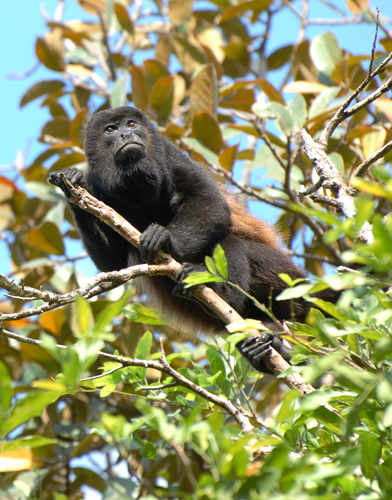 Mantled HowlerAlouatta palliata
-
 Black HowlerAlouatta caraya
Compare
Questions and answers
What is the scientific name of the Brown Spider Monkey?
The scientific name of the Brown Spider Monkey is Ateles hybridus. Written with its author, the full name is Ateles hybridus I. Geoffroy Saint-Hilaire, 1829.
Which family does the Brown Spider Monkey belong to?
Ateles hybridus belongs to the family Atelidae, in the order Primates and the class Mammalia.
Where is the Brown Spider Monkey found?
Checklists and occurrence records place Ateles hybridus in 2 countries: Colombia and Venezuela.
What is the conservation status of the Brown Spider Monkey?
The IUCN Red List category recorded for Ateles hybridus is Critically Endangered (CR).
What other names does the Brown Spider Monkey have?
Ateles hybridus is also known in English as Hybrid Spider Monkey, Long-haired Spider Monkey and Variegated Spider Monkey.
What is the diet of a spider monkey?
The Brown Spider Monkey is primarily herbivorous and frugivorous. Ripe fruit, particularly lipid-rich fruits, is a major component of its diet. It also eats figs, leaves, seeds, flowers, bark, honey, decaying wood, termites, and caterpillars.[15][16][17][39][40]
Sources
Passages the profile rests on
- Its upper body coloration ranges from light brown to dark brown. Source passage: “Its coloration ranges from light brown to dark on upper parts including the head.” — English Wikipedia
- The inner surfaces of the legs, arms, and tail are lighter and buff-colored. Source passage: “The inner side of the legs, arms and tail are a lighter, more buff color.” — animaldiversity.org
- Some individuals have a distinctive whitish triangular patch on the forehead. Source passage: “Another distinguishing characteristic of this species is the white triangular forehead patch but not all individuals possess this conspicuous feature.” — animaldiversity.org
- Some individuals have pale blue eyes, although light brown eyes are more usual. Source passage: “Some individuals also have pale blue eyes, but usually they are light brown.” — animaldiversity.org
- The species has a flexible, thin, prehensile tail with a hairless tip and grooved skin that improves grip. Source passage: “The tail has a highly flexible, hairless tip with skin grooves which improves grip.” — English Wikipedia
- The brown spider monkey has four curved fingers and lacks thumbs. Source passage: “Brown spider monkeys have four curved fingers and lack thumbs to help them swing from one tree to another.” — English Wikipedia
- The brown spider monkey has a prehensile tail approximately 75 cm long. Source passage: “The length of the tail is around 75 cm” — animaldiversity.org
- The average adult body length is approximately 50 cm. Source passage: “The average body length for adult individuals is around 50 cm.” — animaldiversity.org
- Adult males weigh between 7.9 and 9.1 kg. Source passage: “Adult males weigh between 7.9 and 9.1 kg (17 and 20 lb)” — English Wikipedia
- Adult females weigh between 7.5 and 9 kg. Source passage: “adult females weigh between 7.5 and 9 kg (17 and 20 lb).” — English Wikipedia
- The species inhabits subtropical and tropical moist lowland forests in Colombia and Venezuela. Source passage: “Brown spider monkeys, Ateles hybridus , are restricted to subtropical and tropical moist lowlands in Venezuela and Colombia.” — animaldiversity.org
- Brown spider monkeys primarily inhabit evergreen primary rainforests at elevations between 20 and 700 m. Source passage: “Brown spider monkeys are arboreal and mainly found in high and lowland primary evergreen rainforest from 20 to 700 m elevation.” — animaldiversity.org
- The species prefers undisturbed old-growth forests and rarely inhabits secondary forests. Source passage: “Brown spider monkeys are habitat specialists and prefer undisturbed old forests (primary forests) and rarely inhabit disturbed forests with less complete canopy (secondary forests).” — animaldiversity.org
- The species uses the high canopy most frequently but also occupies middle and lower forest strata. Source passage: “They spend most of their time traveling and foraging in the high canopy, but they also use the middle and lower strata to a lesser extent.” — animaldiversity.org
- The brown spider monkey is primarily herbivorous and frugivorous. Source passage: “It is mainly herbivorous and frugivorous.” — English Wikipedia
- Ripe fruit is a major component of the species' diet. Source passage: “A main component of the brown spider monkey's diet is ripe fruit.” — English Wikipedia
- Lipid-rich fruits account for more than three quarters of its diet. Source passage: “Over three quarters of its diet is lipid-rich fruits.” — English Wikipedia
- The species occasionally eats soil and clay. Source passage: “Scientists have observed it eating soil and clay” — English Wikipedia
- Brown spider monkeys are arboreal and spend most of their time traveling and foraging in the forest canopy. Source passage: “They spend most of their time traveling and foraging in the high canopy” — animaldiversity.org
- The species rarely descends to the forest floor, mainly doing so to drink water or eat soil. Source passage: “They rarely descend to the forest floor except for drinking water or eating soil.” — animaldiversity.org
- Males usually travel in all-male groups, while females generally travel with their dependent offspring. Source passage: “Males usually travel in all-male groups and females with their dependent offspring” — animaldiversity.org
- Brown spider monkeys generally sleep in emergent trees near fruit sources. Source passage: “At night brown spider monkeys use sleeping trees that are usually emergent trees in close proximity to a food source (fruit trees)” — animaldiversity.org
- Group sizes increase when fruit is abundant and decrease when fruit becomes scarce. Source passage: “During periods when fruit is abundant, females tend to associate with each other more, thus increasing the size of the group. In periods when fruits are scarcer, groups are smaller.” — animaldiversity.org
- The species can shake branches to deter potential predators. Source passage: “The brown spider monkey is known to shake branches in order to ward off potential predators.” — English Wikipedia
- The species' mating is not seasonal. Source passage: “Mating is not seasonal” — animaldiversity.org
- Brown spider monkeys typically reach sexual maturity between four and five years of age. Source passage: “The species typically reaches sexual maturity at 4 to 5 years of age” — animaldiversity.org
- Female brown spider monkeys usually give birth to one offspring every three to four years. Source passage: “females usually giving birth to a single offspring every 3 to 4 years.” — animaldiversity.org
- Females generally give birth to their first offspring between seven and eight years of age. Source passage: “females give birth to their first infant at an age of 7 to 8 years.” — animaldiversity.org
- The gestation period lasts approximately 226 to 232 days. Source passage: “The gestation period is approximately 226 to 232 days.” — animaldiversity.org
- Newborn offspring cling to their mother's belly during their first months. Source passage: “When offspring are born they cling to their mother’s belly the first couple of months” — animaldiversity.org
- Young brown spider monkeys lactate for at least one year. Source passage: “Young lactate at least one year.” — animaldiversity.org
- Females provide most parental care to their offspring. Source passage: “Females provide the major part of the parental care” — animaldiversity.org
- The brown spider monkey has been classified as critically endangered. Source passage: “The brown spider monkey or variegated spider monkey (Ateles hybridus) is a critically endangered species of spider monkey” — English Wikipedia
- The brown spider monkey population is estimated to have declined by at least 80%. Source passage: “The population is estimated to have decreased by at least 80%” — English Wikipedia
- Approximately 98% of the species' habitat has already disappeared. Source passage: “Habitat loss is ongoing within its wild range, and an estimated 98% of its habitat is already gone.” — English Wikipedia
- The species faces threats from habitat fragmentation, hunting, and capture for the pet trade. Source passage: “This is due to habitat fragmentation, threats of hunting, and threats of capture for pet trade.” — English Wikipedia
- Habitat loss is driven by logging and land clearance for agriculture and cattle ranching. Source passage: “Habitat loss is driven both by logging, and land clearance for agriculture and cattle ranches.” — English Wikipedia
- Wildlife corridors are being used to reconnect fragmented habitats for the species. Source passage: “Corridors are being utilized to direct the brown spider monkeys back to their natural habitat that has been severely fragmented.” — English Wikipedia
- During dry seasons, the species also consumes leaves, seeds, flowers, bark, honey, decaying wood, termites, and caterpillars. Source passage: “it feeds on leaves, seeds, flowers, bark, honey, decaying wood, and occasionally insects such as termites and caterpillars.” — English Wikipedia
- The brown spider monkey eats different species of figs throughout the year. Source passage: “The brown spider monkey feeds on different species of figs year around.” — English Wikipedia
Data
- Catalogue of Life, 2026-10-16 XR cc by
- Global Biodiversity Information Facility CC BY 4.0
- Wikidata CC0
- GeoNames CC BY 4.0
- Wikimedia Commons per image; credit shown with each image
- Within the Catalogue of Life, this name comes from The Integrated Taxonomic Information System cc0
References
- Wilson, Don E., and DeeAnn M. Reeder, eds. (2005). Mammal Species of the World: A Taxonomic and Geographic Reference, 3rd Ed., Vol. 1.
- Mittermeier, Rusell A., Anthony B. Rylands, and Don E. Wilson, eds. (2013). Handbook of the Mammals of the World. Volume 3. Primates.
- Link, Andrés, Lina María Valencia, Laura Natalia Céspodes, Liz Diana Duque, et al. (2015). Phylogeography of the Critically Endangered Brown Spider Monkey (Ateles hybridus): Testing the Riverine Barrier Hypothesis. International Journal of Primatology, Vol. 36, No. 3.
This species in other databases
Page built on 28 November 2026. See how the catalog is made and all sources and licences.
Cite this page
ScientificNames.org. (2026). Ateles hybridus (Brown Spider Monkey). Retrieved November 28, 2026, from https://scientificnames.org/species/ateles-hybridus
“Ateles hybridus (Brown Spider Monkey).” ScientificNames.org, 2026, scientificnames.org/species/ateles-hybridus. Accessed 28 Nov. 2026.
ScientificNames.org. “Ateles hybridus (Brown Spider Monkey).” Accessed November 28, 2026. https://scientificnames.org/species/ateles-hybridus.
@misc{scientificnames_ateles_hybridus_brown_spider_monkey,
  author = {{ScientificNames.org}},
  title = {Ateles hybridus (Brown Spider Monkey)},
  year = {2026},
  url = {https://scientificnames.org/species/ateles-hybridus},
  note = {Accessed 2026-11-28}
}