Species · Mammals
Peruvian Spider Monkey Ateles chamek
The scientific name of the Peruvian Spider Monkey is Ateles chamek. It is a species of mammal in the family Atelidae (atelids), order Primates. The name dates from 1812.
- Scientific name
- Ateles chamek (Humboldt, 1812)
- Common name
- Peruvian Spider Monkey
- Genus
- Ateles
- Family
- Atelidae (Atelids)
- Order
- Primates
- Class
- Mammalia
- Red List category
- EN Endangered
- Recorded in
- 3 countries
- Name status
- accepted in the Catalogue of Life

Overview
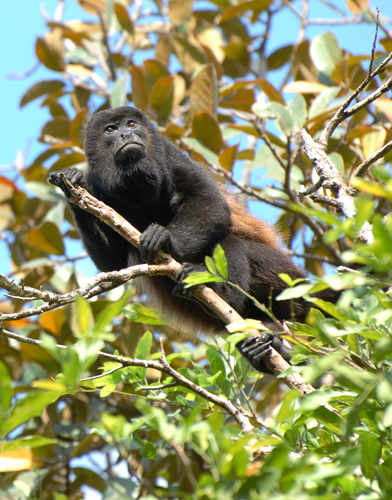
Ateles chamek occurs in Peru, Brazil and Bolivia, inhabiting lowland forests and other forest types. It typically has entirely black fur, a black face, four elongated fingers and a very short, almost absent thumb.
Written 26 November 2026 from the sources listed below. Each statement was checked against the passage it cites; statements that could not be supported were removed.
Appearance
It has four elongated fingers and a very short, almost absent thumb.[1]
Adults typically weigh between 7 and 9 kilograms, and their bodies can reach 70 centimetres in length. Their tails can reach approximately one metre in length.[2][3][4]
Habitat
The species inhabits semi-deciduous lowland forests and occupies the canopy and sub-canopy layers. Its habitat also includes piedmont and cerrado forests with dry and hilly landscapes.[5][6][7]
It has also been observed in seasonally flooded Amazonian forests. Individuals have been reported accessing food resources such as rotten wood and salt licks on the ground.[8][9]
Diet
The Peruvian Spider Monkey primarily eats fleshy fruits. Its diet also includes leaves, berries, small animals, flowers, termites, honey, grubs and fruits.[10][11]
It increases its consumption of leaves when fruits are scarce. Its diet can also include baby birds, bird eggs and frogs.[12][13]
Its foraging contributes to seed dispersal for numerous Amazonian tree species.[14]
Behaviour
The species is diurnal and moves between forest areas according to food availability. Individuals use their prehensile tails to assist with brachiation.[15][16][17]
Male offspring generally remain with their natal groups, while females disperse when mature.[18]
An adult female has been observed walking on four legs and standing upright on her hind legs on a sandy riverbank. A solitary adult female was observed on a sandy bank of the Pinquén River in Manu, Peru.[19][20]
Reproduction and life cycle
Females can give birth throughout the year, although most births occur between September and December. They generally give birth to a single offspring.[21][22]
Gestation lasts approximately 226 to 232 days. Females reach sexual maturity at approximately four to five years of age.[23][24]
The average interval between births in captivity is approximately 17.5 months, while the interval between births in the wild is estimated at 28 to 30 months.[25][26]
Mothers carry their young during much of the first 15 months of life. Young individuals can travel independently by approximately 15 months of age and may remain close to their mothers until approximately 23 months of age.[27][28][29]
Similar species
The red-faced spider monkey, Ateles paniscus, is a closely related species from which Ateles chamek can be distinguished by external characteristics. Ateles chamek has 34 chromosomes, whereas Ateles paniscus has 32.[30][31]
The white-bellied spider monkey is identified as the closest relative of the Peruvian Spider Monkey.[32]
Conservation
The Peruvian Spider Monkey is classified as Endangered on the IUCN Red List and is listed in Appendix II of CITES.[33][34]
Its population has declined by at least 50% over the preceding 45 years, according to IUCN experts. Human exploitation and habitat loss threaten the species.[35][36]
Researchers estimate that 31–40% of its habitat will be lost by 2050. Hunting for sale and consumption in the Amazonian bushmeat trade contributes to population decline.[37][38]
Illegal mining has contributed to habitat pollution and destruction in Madre de Dios, southwestern Peru. Researchers have initiated reintroduction efforts at Reserva Ecologica Taricaya along the lower Madre de Dios River.[39][40]
Classification of the Peruvian Spider Monkey
| Kingdom | Animalia |
|---|---|
| Phylum | Chordata |
| Subphylum | Vertebrata |
| Infraphylum | Gnathostomata |
| Parvphylum | Osteichthyes |
| Megaclass | Tetrapoda |
| Class | Mammalia (Mammal) |
| Subclass | Theria |
| Infraclass | Eutheria |
| Order | Primates (Primate) |
| Suborder | Haplorrhini |
| Infraorder | Simiiformes |
| Family | Atelidae (Atelids) |
| Subfamily | Atelinae |
| Genus | Ateles (Spider Monkey) |
| Species | Ateles chamek (Humboldt, 1812) |
Where the Peruvian Spider Monkey is found
Checklists and occurrence records place Ateles chamek in 3 countries across South America. GBIF holds 678 georeferenced records of it.
Countries
Regions and cities with the most records
- Madre de Dios, Peru 283
- Rondônia, Brazil 97
- Mato Grosso, Brazil 77
- Amazonas, Brazil 38
- Loreto, Peru 35
- Puno, Peru 22
- Santa Cruz Department, Bolivia 20
- La Paz Department, Bolivia 15
- Puerto Maldonado, Peru 14
- Acre, Brazil 8
- São Paulo, Brazil 8
- Beni Department, Bolivia 7
- Alumínio, Brazil 5
- Araçoiaba da Serra, Brazil 5
- Huánuco Department, Peru 5
- Sorocaba, Brazil 5
- Votorantim, Brazil 5
- Cuzco Department, Peru 4
- Pará, Brazil 4
- Pasco, Peru 4
- Sinop, Brazil 4
- Tabatinga, Brazil 4
- Aripuanã, Brazil 3
- Atalaia do Norte, Brazil 3
- Ayacucho, Peru 3
- Benjamin Constant, Brazil 3
- Cacoal, Brazil 3
- Cochabamba, Bolivia 3
- Leticia, Colombia 3
- Mauá, Brazil 3
- San Martín Department, Peru 3
- Tingo María, Peru 3
1 more country has a few records outside this range
These countries hold a few records of Ateles chamek but lie outside the range the checklists give for it. Such records are often zoo or garden specimens, museum material or vagrants, so the species is not counted as occurring there.
Range as the checklists state it
South America
A number beside a place is its count of GBIF occurrence records. A place without a number comes from a checklist alone. Records show where a species has been observed or collected, which can include escapes and vagrants.
Common names
English
- Peruvian Spider Monkey
- Black Spider Monkey
- Black-faced Black Spider Monkey
- Chamek Spider Monkey
- Peruvian Black Spider Monkey
Names in 18 other languages
- Arabic
- سعدان عنكبوتي بيروفي
- Chinese
- 秘魯蜘蛛猴
- Czech
- chápan chamek
- Danish
- Peruviansk edderkoppeabe
- Dutch
- Zwartgezichtslingeraap
- Finnish
- acrenhämähäkkiapina
- French
- Atèle à face noire, Atèle à tête noire, Singe-araignée à tête noire
- German
- Schwarzgesicht-Klammeraffe, Schwarzgesichtklammeraffe
- Greek
- Μαύρος Αραχνοπίθηκος
- Hungarian
- fekete pókmajom
- Italian
- Atele peruviano
- Japanese
- ペルークロクモザル
- Polish
- czepiak czarnolicy
- Portuguese
- Coatá-preto, Macaco-aranha-de-cara-preta, Macaco-aranha-peruano
- Russian
- Чамек
- Spanish
- Maquisapa, Marimono, Mono Araña Peruano, Mono Araña negro
- Turkish
- Kara yüzlü yünlü örümcek maymunu
- que
- Makisapa
Synonyms
4 other scientific names have been used for this species and are now treated as synonyms of Ateles chamek.
- Ateles ater peruvianus Lönnberg, 1940
- Ateles longimembris J. A. Allen, 1914
- Ateles peruvianus Lönnberg, 1940
- Simia chamek Humboldt, 1812
Related species
-
 Geoffroy's Spider MonkeyAteles geoffroyi
-
 Brown Spider MonkeyAteles hybridus
-
 Black-headed Spider MonkeyAteles fusciceps
-
 Red-faced Spider MonkeyAteles paniscus
-
 White-cheeked Spider MonkeyAteles marginatus
-
 White-bellied Spider MonkeyAteles belzebuth
-
 Mantled HowlerAlouatta palliata
-
 Black HowlerAlouatta caraya
Compare
Questions and answers
What is the scientific name of the Peruvian Spider Monkey?
The scientific name of the Peruvian Spider Monkey is Ateles chamek. Written with its author, the full name is Ateles chamek (Humboldt, 1812).
Which family does the Peruvian Spider Monkey belong to?
Ateles chamek belongs to the family Atelidae, in the order Primates and the class Mammalia.
Where is the Peruvian Spider Monkey found?
Checklists and occurrence records place Ateles chamek in 3 countries: Peru, Brazil and Bolivia.
What is the conservation status of the Peruvian Spider Monkey?
The IUCN Red List category recorded for Ateles chamek is Endangered (EN).
What other names does the Peruvian Spider Monkey have?
Ateles chamek is also known in English as Black Spider Monkey, Black-faced Black Spider Monkey, Chamek Spider Monkey and Peruvian Black Spider Monkey.
Sources
Passages the profile rests on
- The species has four elongated fingers and a very short, almost absent thumb. Source passage: “They also have four long fingers and a thumb which is short (almost absent).” — animaldiversity.org
- Adults typically weigh between 7 and 9 kilograms. Source passage: “The weight of an adult black-faced black spider monkeys typically ranges from 15 to 20 lbs (7 to 9 kgs)” — animaldiversity.org
- Its body can reach 70 centimetres in length. Source passage: “Its body can be 70 cm (28 in) long” — English Wikipedia
- Its tail can reach approximately one metre in length. Source passage: “the tail can be 1 m (40 in) long.” — English Wikipedia
- The species inhabits semi-deciduous lowland forests. Source passage: “Black-faced black spider monkeys can be found in a variety of semi-deciduous lowland forests” — animaldiversity.org
- It occupies the canopy and sub-canopy layers of forests. Source passage: “They are typically found in high forest strata, occupying the canopy and sub canopy layers.” — animaldiversity.org
- Its habitat includes piedmont and cerrado forests with dry and hilly landscapes. Source passage: “including piedmont and cerrado forests which can be dry and have hilly landscapes” — animaldiversity.org
- The species has also been observed in seasonally flooded Amazonian forests. Source passage: “They were also observed living in Amazonian seasonally flooded forests.” — English Wikipedia
- Individuals have been reported accessing food resources such as rotten wood and salt licks on the ground. Source passage: “Individuals of Ateles chamek have been reported to access some kind of food resources (rotten wood or salt licks) on the ground.” — primate.socgen.ucla.edu
- The species primarily eats fleshy fruits. Source passage: “They prefer to eat fleshy fruit” — English Wikipedia
- It consumes leaves, berries, small animals, flowers, termites, honey, grubs and fruits. Source passage: “The Peruvian spider monkey feeds on leaves, berries, small animals such as birds and frogs, flowers, termites, honey, grubs, and fruits.” — English Wikipedia
- It increases its consumption of leaves when fruits are scarce. Source passage: “It is primarily frugivorous with a tendency to exhibit folivory in times of fruit scarcity.” — English Wikipedia
- Its diet can include baby birds, bird eggs and frogs. Source passage: “It will also eat insects, baby birds, bird eggs, and frogs.” — English Wikipedia
- Its foraging contributes to seed dispersal for numerous Amazonian tree species. Source passage: “The foraging habits of this species causes the monkeys to be a vital component of seed dispersal patterns for many tree species in Amazonia.” — English Wikipedia
- The species moves between forest areas according to food availability. Source passage: “They typically shift their home ranges based on food availability” — animaldiversity.org
- Individuals use their prehensile tails to assist with brachiation. Source passage: “Black-faced black spider monkeys have a prehensile tail like the other Ateles species that can be used to assist with brachiation.” — animaldiversity.org
- The species is diurnal. Source passage: “Black-faced black spider monkeys are diurnal” — animaldiversity.org
- Male offspring generally remain with their natal groups, while females disperse when mature. Source passage: “the females disperse to find mates in neighboring communities, and the males remain with their natal group and compete for mates.” — animaldiversity.org
- An adult female has been observed walking on four legs and standing upright on her hind legs on a sandy riverbank. Source passage: “This behavior lasted several minutes, with sequences of walking on four legs, pausing, and standing upright on the hind legs.” — primate.socgen.ucla.edu
- A solitary adult female was observed on a sandy bank of the Pinquén River in Manu, Peru. Source passage: “We describe the terrestrial behavior of an adult female Ateles chamek (Peruvian spider monkey) on a sandy bank of the Pinquén River, Manu, Peru.” — primate.socgen.ucla.edu
- Females can give birth throughout the year, although most births occur between September and December. Source passage: “Black-faced black spider monkeys give birth throughout the year, however the majority of the births have been seen to occur in the fall months of September through December.” — animaldiversity.org
- Females generally give birth to a single offspring. Source passage: “They give birth to a single offspring” — animaldiversity.org
- Gestation lasts approximately 226 to 232 days. Source passage: “after a long gestation period of 226 to 232 days.” — animaldiversity.org
- Females reach sexual maturity at approximately four to five years of age. Source passage: “black-faced black spider monkeys reach sexual maturity at the age of 4 to 5 years.” — animaldiversity.org
- The average interval between births in captivity is approximately 17.5 months. Source passage: “In captivity, the interbirth time is on average 17.5 months” — animaldiversity.org
- The interval between births in the wild is estimated at 28 to 30 months. Source passage: “whereas in the wild it is likely longer, ranging between 28 and 30 months.” — animaldiversity.org
- Mothers carry their young during much of the first 15 months of life. Source passage: “Young black-faced black spider monkeys spend the majority of the first 15 months of their lives living closely with and being carried by their mother” — animaldiversity.org
- Young individuals can travel independently by approximately 15 months of age. Source passage: “By 15 months, the young can travel independently” — animaldiversity.org
- Young individuals may remain close to their mothers until approximately 23 months of age. Source passage: “but many remain in very close proximity of their mother until 23 months of age.” — animaldiversity.org
- The red-faced spider monkey, Ateles paniscus, is a closely related species from which Ateles chamek can be distinguished by external characteristics. Source passage: “Ateles chamek can be distinguished from the closely related Ateles paniscus by several external characteristics.” — animaldiversity.org
- Ateles chamek has 34 chromosomes, whereas Ateles paniscus has 32. Source passage: “Ateles chamek and Ateles paniscus can also be distinguished by their different number of chromosomes (2n=34 and 2n=32 respectively).” — animaldiversity.org
- The white-bellied spider monkey is identified as the closest relative of the Peruvian spider monkey. Source passage: “and the species' closest relative the white-bellied spider monkey (A. belzebuth).” — English Wikipedia
- The species is classified as Endangered on the IUCN Red List. Source passage: “It is currently listed on the IUCN Red List of Threatened Species as Endangered” — English Wikipedia
- The species is listed in Appendix II of CITES. Source passage: “and is listed in Appendix II of CITES” — English Wikipedia
- Its population has declined by at least 50% over the preceding 45 years, according to IUCN experts. Source passage: “The IUCN experts claim that the number of individuals has declined by at least 50% over the past 45 years.” — English Wikipedia
- The species is threatened by human exploitation and habitat loss. Source passage: “This species of spider monkey, in addition to other species within the genus Ateles, is threatened due to exploitation by humans and habitat loss.” — English Wikipedia
- Researchers estimate that 31–40% of its habitat will be lost by 2050. Source passage: “They also suggests that 31–40% of the species' habitat will be lost by 2050.” — English Wikipedia
- Hunting for sale and consumption in the Amazonian bushmeat trade contributes to population decline. Source passage: “these monkeys are targeted by hunters for sale and consumption in the Amazonian bushmeat trade.” — English Wikipedia
- Illegal mining has contributed to habitat pollution and destruction in Madre de Dios, southwestern Peru. Source passage: “habitat in the southwestern Peruvian region of Madre de Dios is being polluted and destroyed by illegal mining activity.” — English Wikipedia
- Researchers have initiated reintroduction efforts at Reserva Ecologica Taricaya along the lower Madre de Dios River. Source passage: “Reintroduction efforts by researchers at Reserva Ecologica Taricaya have begun along the lower Madre de Dios river” — English Wikipedia
Data
- Catalogue of Life, 2026-10-16 XR cc by
- Global Biodiversity Information Facility CC BY 4.0
- Wikidata CC0
- GeoNames CC BY 4.0
- Wikimedia Commons per image; credit shown with each image
- Within the Catalogue of Life, this name comes from The Integrated Taxonomic Information System cc0
References
- Rec. Observ. Zool. vol.1 p.353 where the name was published
- Wilson, Don E., and DeeAnn M. Reeder, eds. (1993). Mammal Species of the World: A Taxonomic and Geographic Reference, 2nd Ed., 3rd Printing.
- Wilson, Don E., and F. Russell Cole. (2000). Common Names of Mammals of the World.
- Wilson, Don E., and DeeAnn M. Reeder, eds. (2005). Mammal Species of the World: A Taxonomic and Geographic Reference, 3rd Ed., Vol. 1.
- Mittermeier, Rusell A., Anthony B. Rylands, and Don E. Wilson, eds. (2013). Handbook of the Mammals of the World. Volume 3. Primates.
This species in other databases
Page built on 26 November 2026. See how the catalog is made and all sources and licences.
Cite this page
ScientificNames.org. (2026). Ateles chamek (Peruvian Spider Monkey). Retrieved November 26, 2026, from https://scientificnames.org/species/ateles-chamek
“Ateles chamek (Peruvian Spider Monkey).” ScientificNames.org, 2026, scientificnames.org/species/ateles-chamek. Accessed 26 Nov. 2026.
ScientificNames.org. “Ateles chamek (Peruvian Spider Monkey).” Accessed November 26, 2026. https://scientificnames.org/species/ateles-chamek.
@misc{scientificnames_ateles_chamek_peruvian_spider_monkey,
  author = {{ScientificNames.org}},
  title = {Ateles chamek (Peruvian Spider Monkey)},
  year = {2026},
  url = {https://scientificnames.org/species/ateles-chamek},
  note = {Accessed 2026-11-26}
}