Species · Mammals
Geoffroy's Spider Monkey Ateles geoffroyi
The scientific name of the Geoffroy's Spider Monkey is Ateles geoffroyi. It is a species of mammal in the family Atelidae (atelids), order Primates. The name dates from 1820.
- Scientific name
- Ateles geoffroyi Kuhl, 1820
- Common name
- Geoffroy's Spider Monkey
- Genus
- Ateles
- Family
- Atelidae (Atelids)
- Order
- Primates
- Class
- Mammalia
- Red List category
- EN Endangered
- Recorded in
- 12 countries
- Name status
- accepted in the Catalogue of Life

Overview
Ateles geoffroyi occurs in Panama, Costa Rica, Nicaragua, Guatemala, Honduras, El Salvador, Belize, and southern and eastern Mexico. It has long, slender limbs, a vestigial thumb, and a prehensile tail with a palm-like gripping pad.
Written 26 November 2026 from the sources listed below. Each statement was checked against the passage it cites; statements that could not be supported were removed.
Appearance
Its hands have a vestigial thumb and long, strong fingers that form a hook-like shape. Its prehensile tail has a palm-like pad at its tip that assists with gripping.[1][2]
Females have an enlarged, externally protruding clitoris that can resemble a male penis.[3]
Adult body length ranges from 30 to 63 cm, and adult body weight ranges from 6 to 9 kg. The tail measures between 63 and 85 cm long, and males and females are approximately the same size.[4][5][6][7]
Habitat
The species inhabits rainforest, semideciduous forest, and mangrove forest, as well as mature rainforest and montane forest. It uses the upper canopy of primary and secondary rainforests.[8][9][10]
Higher population densities generally occur in areas containing evergreen forest.[11]
Diet
Ripe fruit is the principal component of the species' diet and accounts for approximately 70–80% of its feeding time. Leaves constitute most of the remainder.[12][13][14]
Other recorded foods include flowers, bark, insects, honey, seeds, and buds. Its diet can also include nuts, arachnids, and eggs.[15][16]
Behaviour
The species is arboreal and active during daylight hours. It primarily moves through the canopy by swinging from its arms, with assistance from its prehensile tail.[17][18]
It lives in fission-fusion societies containing typically 20 to 42 individuals. Foraging subgroups typically contain two to six individuals.[19][20]
Group home ranges can exceed 900 hectares, and individuals can travel approximately 2,000 metres in a day. Individuals can hang using one limb or their tail.[21][22][23]
The species sometimes rubs saliva mixed with ground lime tree leaves onto its fur, a behaviour believed to repel insects.[24]
Its vocalizations include barks, whinnies, squeals, squeaks, and screams. When threatened, individuals may bark, throw branches, jump up and down, and shake tree limbs.[25][26]
Reproduction and life cycle
Gestation lasts approximately 7.5 months, or between 226 and 232 days. Females typically give birth to one offspring, although twins occasionally occur.[27][28][29]
Females typically give birth every two to four years. The female estrous cycle lasts 24 to 27 days, with mating restricted to two or three days.[30][31]
Females reach sexual maturity at approximately four years of age, while males reach sexual maturity at approximately five years. Females leave their natal group upon reaching sexual maturity, whereas males remain.[32][33][34]
Conservation
The species is classified as endangered by the IUCN. It is listed in CITES Appendix I and as endangered under the US Endangered Species Act.[35][36]
Habitat loss and capture for the pet trade are major threats to the species. It has disappeared from some areas where it was formerly common because of human-related pressures.[37][38]
Hunting eliminated the native population on Barro Colorado Island by 1912.[39]
Uses
The species is used as a source of food by some Central and South American peoples.[40]
Classification of the Geoffroy's Spider Monkey
| Kingdom | Animalia |
|---|---|
| Phylum | Chordata |
| Subphylum | Vertebrata |
| Infraphylum | Gnathostomata |
| Parvphylum | Osteichthyes |
| Megaclass | Tetrapoda |
| Class | Mammalia (Mammal) |
| Subclass | Theria |
| Infraclass | Eutheria |
| Order | Primates (Primate) |
| Suborder | Haplorrhini |
| Infraorder | Simiiformes |
| Family | Atelidae (Atelids) |
| Subfamily | Atelinae |
| Genus | Ateles (Spider Monkey) |
| Species | Ateles geoffroyi Kuhl, 1820 |
Where the Geoffroy's Spider Monkey is found
Checklists and occurrence records place Ateles geoffroyi in 12 countries across North America and South America. GBIF holds 11,385 georeferenced records of it.
Countries
- Belize 271
- Brazil 3
- Canada 3
- Colombia 14
- Costa Rica 4,050
- El Salvador 40
- Guatemala 789
- Honduras 48
- Mexico 5,613
- Nicaragua 244
- Panama 218
- United States 92
Regions and cities with the most records
- Oaxaca, Mexico 1,935
- Quintana Roo, Mexico 1,557
- Puntarenas Province, Costa Rica 867
- Petén, Guatemala 833
- Alajuela Province, Costa Rica 681
- Chiapas, Mexico 645
- Limón Province, Costa Rica 594
- Campeche, Mexico 480
- Guanacaste Province, Costa Rica 453
- Playa del Carmen, Mexico 427
- Veracruz, Mexico 286
- Heredia Province, Costa Rica 278
- Tuxtla, Mexico 144
- Yucatán, Mexico 121
- Orange Walk District, Belize 110
- Cozumel, Mexico 109
- Liberia, Costa Rica 109
- Chiapa de Corzo, Mexico 88
- Catemaco, Mexico 72
- Cancún, Mexico 71
- Berriozábal, Mexico 70
- Cayo District, Belize 68
- Granada, Nicaragua 68
- Tulum, Mexico 68
- San Ignacio, Belize 64
- San José, Costa Rica 50
- San Andrés Tuxtla, Mexico 49
- Suchiapa, Mexico 42
- Panamá Oeste Province, Panama 37
- Palenque, Mexico 36
- Cartago Province, Costa Rica 30
- Flores, Guatemala 27
- Río San Juan Department, Nicaragua 26
- San Benito, Guatemala 26
- Puntarenas, Costa Rica 25
- Chiriquí Province, Panama 23
4 more countries have a few records outside this range
These countries hold a few records of Ateles geoffroyi but lie outside the range the checklists give for it. Such records are often zoo or garden specimens, museum material or vagrants, so the species is not counted as occurring there.
Range as the checklists state it
Middle America
South America
A number beside a place is its count of GBIF occurrence records. A place without a number comes from a checklist alone. Records show where a species has been observed or collected, which can include escapes and vagrants.
Common names
English
- Geoffroy's Spider Monkey
- Black-handed Spider Monkey
- Central American Spider Monkey
- Geoffroy S Spider Monkey
- Geoffroy’s Spider Monkey
- Hooded Spider Monkey
- Mono Colorado
Names in 20 other languages
- Arabic
- سعدان عنكبوتي أسود اليد
- Chinese
- 黑掌蜘蛛猴
- Czech
- chápan středoamerický
- Danish
- Gylden edderkoppeabe, gylden edderkopabe
- Dutch
- Zwarthandslingeraap
- Finnish
- hämähäkkiapina
- French
- Atèle de Geoffroy, Singe-araignée de Geoffroy
- German
- Geoffroy-Klammeraffe
- Greek
- Αραχνοπίθηκος της Κεντρικής Αμερικής
- Hungarian
- Geoffroy-pókmajom
- Italian
- Atele centroamericana, Atele di Geoffroy, Scimmia ragno dalle mani nere, Scimmia ragno di Geoffroy
- Japanese
- ジェフロイクモザル, ジョフロイクモザル
- Norwegian Bokmål
- Svarthåndklamreape
- Polish
- czepiak czarnoręki
- Portuguese
- Macaco-aranha-de-Geoffroy, Macaco-aranha-de-capuz
- Russian
- Коата Жоффруа
- Spanish
- Mico, Mono Araña, Mono Araña Centroamericano, Mono Araña de Geoffroy, Mono-araña centroamericano
- Swedish
- Röd spindelapa
- Turkish
- Geoffroy yünlü örümcek maymunu
- cpa
- cuø¹²
Subspecies and varieties
- Ateles geoffroyi azuerensis (Azuero Spider Monkey) subspecies
- Ateles geoffroyi frontatus (Black-browed Spider Monkey) subspecies
- Ateles geoffroyi geoffroyi (Geoffroy's Spider Monkey) subspecies
- Ateles geoffroyi grisescens (Hooded Spider Monkey) subspecies
- Ateles geoffroyi ornatus (Ornate Spider Monkey) subspecies
- Ateles geoffroyi vellerosus (Mexican Spider Monkey) subspecies
Related species
-
 Brown Spider MonkeyAteles hybridus
-
 Black-headed Spider MonkeyAteles fusciceps
-
 Red-faced Spider MonkeyAteles paniscus
-
 Peruvian Spider MonkeyAteles chamek
-
 White-cheeked Spider MonkeyAteles marginatus
-
 White-bellied Spider MonkeyAteles belzebuth
-
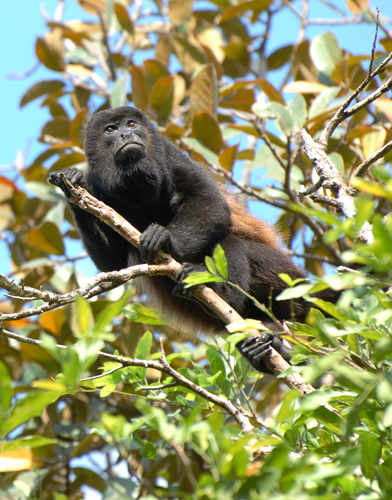 Mantled HowlerAlouatta palliata
-
 Black HowlerAlouatta caraya
Compare
Questions and answers
What is the scientific name of the Geoffroy's Spider Monkey?
The scientific name of the Geoffroy's Spider Monkey is Ateles geoffroyi. Written with its author, the full name is Ateles geoffroyi Kuhl, 1820.
Which family does the Geoffroy's Spider Monkey belong to?
Ateles geoffroyi belongs to the family Atelidae, in the order Primates and the class Mammalia.
Where is the Geoffroy's Spider Monkey found?
Checklists and occurrence records place Ateles geoffroyi in 12 countries, including Mexico, Costa Rica, Guatemala, Belize, Nicaragua and Panama.
What is the conservation status of the Geoffroy's Spider Monkey?
The IUCN Red List category recorded for Ateles geoffroyi is Endangered (EN).
What other names does the Geoffroy's Spider Monkey have?
Ateles geoffroyi is also known in English as Black-handed Spider Monkey, Central American Spider Monkey, Geoffroy S Spider Monkey, Geoffroy’s Spider Monkey, Hooded Spider Monkey and Mono Colorado.
What is the diet of a spider monkey?
Ripe fruit is the principal component of Geoffroy's Spider Monkey's diet, accounting for approximately 70–80% of its feeding time. Leaves constitute most of the remainder, while other foods include flowers, bark, insects, honey, seeds, buds, nuts, arachnids, and eggs.[12][13][14][15][16]
What kind of habitat do spider monkeys live in?
Geoffroy's Spider Monkey inhabits rainforest, semideciduous forest, mangrove forest, and montane forest. It uses the upper canopy of primary and secondary rainforests.[8][9][10]
Where do Geoffroy's spider monkeys live?
They occur in Panama, Costa Rica, Nicaragua, Guatemala, Honduras, El Salvador, Belize, and southern and eastern Mexico. They are also reported along both Mexican coasts, from Tamaulipas in the northeast and Jalisco in the west, south toward northwestern Colombia.[41][42]
What is the main diet of a monkey?
Ripe fruit is the principal component of Geoffroy's Spider Monkey's diet.[12]
Sources
Passages the profile rests on
- Its hands have a vestigial thumb and long, strong fingers that form a hook-like shape. Source passage: “The thumb is only vestigial, but the fingers are long and strong, making the hands hook-like.” — English Wikipedia
- Its prehensile tail has a palm-like pad at its tip that assists with gripping. Source passage: “The prehensile tail is very strong and has a palm-like pad at the end.” — English Wikipedia
- Females have an enlarged, externally protruding clitoris that can resemble a male penis. Source passage: “The clitoris of female Geoffroy's spider monkeys is large and protrudes, looking like a penis.” — English Wikipedia
- Adult body length ranges from 30 to 63 cm. Source passage: “Its length measures between 30 and 63 cm (12 and 25 in) and it weighs between 6 and 9 kg (13 and 20 lb).” — English Wikipedia
- Adult body weight ranges from 6 to 9 kg. Source passage: “Its length measures between 30 and 63 cm (12 and 25 in) and it weighs between 6 and 9 kg (13 and 20 lb).” — English Wikipedia
- The tail measures between 63 and 85 cm long. Source passage: “The tail is longer than the body at between 63 and 85 cm (25 and 33+1⁄2 in).” — English Wikipedia
- Males and females are approximately the same size. Source passage: “Males and females are approximately the same size.” — English Wikipedia
- The species inhabits rainforest, semideciduous forest, and mangrove forest. Source passage: “Geoffroy's spider monkey lives in various types of forest, including rainforest, semideciduous and mangrove forests.” — English Wikipedia
- The species inhabits mature rainforest and montane forest. Source passage: “Ateles geoffroyi inhabits mature rainforest and montane forest.” — animaldiversity.org
- The species uses the upper canopy of primary and secondary rainforests. Source passage: “Habitat: Upper canopy of primary and secondary rainforests” — lafayette.in.gov
- Higher population densities generally occur in areas containing evergreen forest. Source passage: “Higher densities of Geoffroy's spider monkeys are generally found in areas containing evergreen forest.” — English Wikipedia
- Ripe fruit is the principal component of the species' diet. Source passage: “Geoffroy's spider monkey eats mostly fruit – preferably ripe and fleshy – and spends 70–80% of its feeding time eating fruit.” — English Wikipedia
- Fruit accounts for approximately 70–80% of the species' feeding time. Source passage: “Geoffroy's spider monkey eats mostly fruit – preferably ripe and fleshy – and spends 70–80% of its feeding time eating fruit.” — English Wikipedia
- Leaves constitute most of the remainder of its diet after fruit. Source passage: “Leaves make up most of the rest of its diet.” — English Wikipedia
- Other recorded foods include flowers, bark, insects, honey, seeds, and buds. Source passage: “Other elements of its diet include flowers, bark, insects, honey, seeds and buds.” — English Wikipedia
- Its diet can include nuts, seeds, insects, arachnids, and eggs. Source passage: “They may also eat some nuts, seeds, insects, arachnids, and eggs.” — animaldiversity.org
- The species is arboreal and active during daylight hours. Source passage: “Geoffroy's spider monkey is arboreal and diurnal, and mostly inhabits the upper portion of the forest.” — English Wikipedia
- The species primarily moves through the canopy by swinging from its arms, with assistance from its prehensile tail. Source passage: “Brachiation, or swinging from the arms with assistance from the prehensile tail, is the most common form of suspensory locomotion.” — English Wikipedia
- It lives in fission-fusion societies containing typically 20 to 42 individuals. Source passage: “It lives in fission–fusion societies, large groups with a typical 20 to 42 members, which split into smaller subgroups to forage during the day.” — English Wikipedia
- Its foraging subgroups typically contain two to six individuals. Source passage: “Subgroups typically number two to six members, and sometimes the subgroups remain separate from the main group even through the night.” — English Wikipedia
- Group home ranges can exceed 900 hectares. Source passage: “Home ranges for groups can exceed 900 hectares (2,200 acres).” — English Wikipedia
- Individuals can travel approximately 2,000 metres in a day. Source passage: “Monkeys can range about 2,000 metres (6,600 ft) each day.” — English Wikipedia
- The species is among the most agile primates and can hang using one limb or its tail. Source passage: “These monkeys are among the most agile of the primates and are often seen hanging by one limb or by the tail, which essentially functions as a fifth limb.” — animaldiversity.org
- The species sometimes rubs saliva mixed with ground lime tree leaves onto its fur, a behaviour believed to repel insects. Source passage: “Geoffroy's spider monkey sometimes rubs a mixture of saliva and ground lime tree Citrus aurantifolia leaves on its fur. This is believed to act as an insect repellent.” — English Wikipedia
- Its vocalizations include barks, whinnies, squeals, squeaks, and screams. Source passage: “Sounds produced by Geoffroy's spider monkey include barks, whinnies, squeals, squeaks and screams.” — English Wikipedia
- When threatened, individuals may bark, throw branches, jump up and down, and shake tree limbs. Source passage: “Black-handed spider monkeys "bark" when threatened and often throw branches, jump up and down, and shake tree limbs when approached by humans.” — animaldiversity.org
- Gestation lasts approximately 7.5 months. Source passage: “The gestational period is about 7.5 months, after which a single young is typically born, although twins sometimes occur.” — English Wikipedia
- Females typically give birth to one offspring, although twins occasionally occur. Source passage: “The gestational period is about 7.5 months, after which a single young is typically born, although twins sometimes occur.” — English Wikipedia
- Gestation lasts between 226 and 232 days. Source passage: “Gestation lasts 226 to 232 days and one young is born.” — animaldiversity.org
- Females typically give birth every two to four years. Source passage: “Females bear young every two to four years.” — English Wikipedia
- The female estrous cycle lasts 24 to 27 days, with mating restricted to two or three days. Source passage: “Female black-handed spider monkeys have an estrous cycle of 24 to 27 days; mating is restricted to a period of two to three days.” — animaldiversity.org
- Females reach sexual maturity at approximately four years of age. Source passage: “Females become sexually mature at about four years, and males at about five years.” — English Wikipedia
- Males reach sexual maturity at approximately five years of age. Source passage: “Females become sexually mature at about four years, and males at about five years.” — English Wikipedia
- Female individuals leave their natal group upon reaching sexual maturity, whereas males remain. Source passage: “Upon reaching sexual maturity, females leave their natal group, but males do not.” — English Wikipedia
- The species is classified as endangered by the IUCN. Source passage: “Geoffroy's spider monkey is listed as endangered by the IUCN, mostly due to habitat loss and capture for the pet trade.” — English Wikipedia
- The species is listed in CITES Appendix I and as endangered under the US Endangered Species Act. Source passage: “This monkey is listed as CITES Appendix I, US-ESA endangered.” — animaldiversity.org
- Habitat loss and capture for the pet trade are major threats to the species. Source passage: “Geoffroy's spider monkey is listed as endangered by the IUCN, mostly due to habitat loss and capture for the pet trade.” — English Wikipedia
- The species has disappeared from some areas where it was formerly common because of human-related pressures. Source passage: “As a result, Geoffroy's spider monkey has disappeared from some areas where it was once common.” — English Wikipedia
- Hunting eliminated the native population on Barro Colorado Island by 1912. Source passage: “Hunting had eliminated the native population there by 1912.” — English Wikipedia
- The species is used as a source of food by some Central and South American peoples. Source passage: “Spider monkeys are a source of food for many Central and South American peoples.” — animaldiversity.org
- The species occurs in Panama, Costa Rica, Nicaragua, Guatemala, Honduras, El Salvador, Belize, and southern and eastern Mexico. Source passage: “The range of this species extends over much of Central America, encompassing Panama, Costa Rica, Nicaragua, Guatemala, Honduras, El Salvador, Belize and the south and much of the eastern portion of Mexico.” — English Wikipedia
- The species is reported along both Mexican coasts, from Tamaulipas in the northeast and Jalisco in the west, south toward northwestern Colombia. Source passage: “The black-handed spider monkey is found along both coasts of Mexico from Tamaulipas in the northeast and Jalisco in the west south to northwestern Colombia.” — animaldiversity.org
Data
- Catalogue of Life, 2026-10-16 XR cc by
- Global Biodiversity Information Facility CC BY 4.0
- Wikidata CC0
- GeoNames CC BY 4.0
- Wikimedia Commons per image; credit shown with each image
- Within the Catalogue of Life, this name comes from The Integrated Taxonomic Information System cc0
References
- Beitr. Zool. Vergl. Anat. vol.1 p.26 where the name was published
- Wilson, Don E., and DeeAnn M. Reeder, eds. (1993). Mammal Species of the World: A Taxonomic and Geographic Reference, 2nd Ed., 3rd Printing.
- Wilson, Don E., and F. Russell Cole. (2000). Common Names of Mammals of the World.
- Wilson, Don E., and DeeAnn M. Reeder, eds. (2005). Mammal Species of the World: A Taxonomic and Geographic Reference, 3rd Ed., Vol. 1.
- Mittermeier, Rusell A., Anthony B. Rylands, and Don E. Wilson, eds. (2013). Handbook of the Mammals of the World. Volume 3. Primates.
This species in other databases
Page built on 27 November 2026. See how the catalog is made and all sources and licences.
Cite this page
ScientificNames.org. (2026). Ateles geoffroyi (Geoffroy's Spider Monkey). Retrieved November 27, 2026, from https://scientificnames.org/species/ateles-geoffroyi
“Ateles geoffroyi (Geoffroy's Spider Monkey).” ScientificNames.org, 2026, scientificnames.org/species/ateles-geoffroyi. Accessed 27 Nov. 2026.
ScientificNames.org. “Ateles geoffroyi (Geoffroy's Spider Monkey).” Accessed November 27, 2026. https://scientificnames.org/species/ateles-geoffroyi.
@misc{scientificnames_ateles_geoffroyi_geoffroys_spider_monkey,
  author = {{ScientificNames.org}},
  title = {Ateles geoffroyi (Geoffroy's Spider Monkey)},
  year = {2026},
  url = {https://scientificnames.org/species/ateles-geoffroyi},
  note = {Accessed 2026-11-27}
}