Species · Flowering plants
Deadly Nightshade Atropa belladonna
The scientific name of the Deadly Nightshade is Atropa belladonna. It is a species of flowering plant in the family Solanaceae (nightshades), order Solanales.
- Scientific name
- Atropa belladonna L.
- Common name
- Deadly Nightshade
- Genus
- Atropa
- Family
- Solanaceae (Nightshades)
- Order
- Solanales
- Class
- Magnoliopsida
- Recorded in
- 51 countries
- Name status
- accepted in the Catalogue of Life
Overview
Deadly nightshade is a branching, herbaceous perennial plant with a fleshy rootstock. It is native to temperate southern, central and eastern Europe, northwestern Africa, and southwestern Asia. All parts of the plant contain toxic tropane alkaloids, including atropine, scopolamine and hyoscyamine.
Written 27 November 2026 from the sources listed below. Each statement was checked against the passage it cites; statements that could not be supported were removed.
Appearance
The plant has dark green, simple leaves arranged alternately along the stems. Its leaves can grow up to 18 centimetres long.[1][2][3]
Its flowers are dull purple, bell-shaped and faintly scented, with yellow-green coloration near their bases.[1][4]
The berries develop from green fruits into shiny, purplish-black berries. They are approximately 1.5 centimetres in diameter and have a sweet taste.[5][6][7]
The plant can reach 2 metres in height, although it more commonly grows to 1.5 metres.[8]
Diet
Birds are the main animals reported to consume the berries. Cattle and rabbits consume the plant without apparently suffering harmful effects.[9][10]
Behaviour
Animals that eat the berries disperse the plant's seeds through their droppings.[11]
Reproduction and life cycle
Deadly nightshade reproduces through small seeds with hard coats that can cause dormancy and make germination difficult. Germination takes several weeks under alternating temperature conditions.[12][13]
Germination can be accelerated using gibberellic acid. Seedlings require sterile soil to avoid damping off.[14][15]
Conservation
Deadly nightshade is considered a weed in some regions because it colonises disturbed soils.[16]
Uses
The plant has historically been used for medicinal, cosmetic and poisonous purposes. Atropine extracted from the plant is used by ophthalmologists to dilate patients' pupils for eye examinations and surgery.[17][18]
Belladonna preparations have been used in lotions, plasters and salves to relieve pain associated with sciatica, gout and cardiac palpitations. Belladonna plasters were commonly used during the nineteenth and early twentieth centuries for neuralgia, chronic rheumatism, muscle pain, back pain and pulmonary tuberculosis.[19][20]
The plant has occasionally been used recreationally because its alkaloids produce hallucinations and delirium. Atropine obtained from the plant has also been used to treat bradycardia and heart block following myocardial infarction.[21][22]
Similar species
Deadly nightshade can be distinguished from black nightshade by its larger, glossier berries, which grow singly rather than in clusters. Black nightshade has white, star-shaped flowers rather than the tubular flowers of deadly nightshade.[23][24]
Classification of the Deadly Nightshade
| Kingdom | Plantae |
|---|---|
| Subkingdom | Pteridobiotina |
| Phylum | Tracheophyta |
| Class | Magnoliopsida |
| Order | Solanales |
| Family | Solanaceae (Nightshades) |
| Subfamily | Solanoideae |
| Tribe | Hyoscyameae |
| Subtribe | Hyoscyaminae |
| Genus | Atropa (Belladonna) |
| Species | Atropa belladonna L. |
Where the Deadly Nightshade is found
Checklists and occurrence records place Atropa belladonna in 51 countries across Africa, Asia, Europe, North America and Oceania. GBIF holds 61,362 georeferenced records of it.
Countries where it is native or its origin is not stated
- Albania 27
- Algeria 25
- Armenia 8
- Austria 9,848
- Azerbaijan 8
- Belgium 493
- Bosnia and Herzegovina 28
- Bulgaria 18
- China 38
- Croatia 174
- Czechia 1,017
- France 9,661
- Georgia 50
- Greece 46
- Hungary 202
- India 41
- Iran 13
- Italy 614
- Jersey 6
- Kosovo 6
- Lebanon 7
- Liechtenstein 31
- Luxembourg 370
- Montenegro 23
- Morocco 13
- Myanmar 1
- North Macedonia 5
- Norway 26
- Pakistan 5
- Poland 396
- Portugal 45
- Romania 83
- Russia 162
- Serbia 59
- Slovakia 307
- Slovenia 262
- Spain 1,476
- Sweden 252
- Switzerland 6,336
- Syria 5
- The Netherlands 1,050
- Turkey 61
- Ukraine 447
Countries where it has been introduced
- Denmark 92
- Estonia 6
- Germany 19,041
- Ireland 6
- New Zealand 17
- Seychelles
- United Kingdom 8,358
- United States 97
Regions and cities with the most records
- Bavaria, Germany 11,465
- England, United Kingdom 7,453
- Upper Austria, Austria 6,059
- Gilching, Germany 2,408
- Gauting, Germany 2,231
- Starnberg, Germany 2,200
- Fürstenfeldbruck, Germany 2,070
- Grand Est, France 2,065
- Puchheim, Germany 2,040
- Baden-Wurttemberg, Germany 2,015
- Germering, Germany 1,994
- Olching, Germany 1,746
- Gröbenzell, Germany 1,650
- Auvergne-Rhône-Alpes, France 1,561
- Bourgogne-Franche-Comté, France 1,443
- Salzburg, Austria 1,268
- North Rhine-Westphalia, Germany 1,263
- Wolfratshausen, Germany 1,154
- Bern, Switzerland 1,152
- Hesse, Germany 1,137
- Weilheim, Germany 1,132
- Hauts-de-France, France 969
- Landsberg am Lech, Germany 932
- Zurich, Switzerland 911
- Lower Saxony, Germany 903
- Vaud, Switzerland 892
- Rheinland-Pfalz, Germany 849
- Dübendorf, Switzerland 816
- Salzburg, Austria 794
- Stamford, United Kingdom 777
- Zürich, Switzerland 762
- Provence-Alpes-Côte d'Azur, France 760
- Dietikon, Switzerland 758
- Kloten, Switzerland 748
- Occitanie, France 745
- Opfikon, Switzerland 744
3 more countries have a few records outside this range
These countries hold a few records of Atropa belladonna but lie outside the range the checklists give for it. Such records are often zoo or garden specimens, museum material or vagrants, so the species is not counted as occurring there.
A number beside a place is its count of GBIF occurrence records. A place without a number comes from a checklist alone. Records show where a species has been observed or collected, which can include escapes and vagrants.
Common names
English
- Deadly Nightshade
- Dwale
- Naughty-man's Cherries
- Belladonna
- Deadly-nightshade
Names in 44 other languages
- Arabic
- ست الحسن
- Armenian
- Բելադոննա, Սովորական մահամորմ
- Azerbaijani
- Adi xanımotu
- Basque
- Belaiki
- Breton
- Benede
- Catalan
- tabac bord
- Chinese
- 顛茄, 颠茄
- Croatian
- Crni bun, Velebilje, Veliki bun
- Czech
- rulík zlomocný
- Danish
- Galnebær
- Dutch
- Wolfskers
- Estonian
- Must belladonna
- French
- belladone, morelle furieuse
- Galician
- Beladona
- German
- Echte Tollkirsche, Schwarze Tollkirsche, Tollkirsche
- Greek
- Μπελαντόνα
- Hungarian
- Nadragulya, maszlagos nadragulya
- Japanese
- ベラドンナ
- Kazakh
- Итжидек
- Korean
- 벨라돈나풀
- Latvian
- Beladonna
- Lithuanian
- Vaistinė šunvyšnė
- Malayalam
- ബല്ലഡോണ
- Norwegian Bokmål
- belladonnaurt
- Persian
- شابیزک
- Polish
- Pokrzyk wilcza jagoda
- Portuguese
- beladama
- Romanian
- Mătrăguna, Mătrăgună
- Russian
- Белладонна, Красавка кавказская, красавка белладонна
- Serbian
- Велебиље, Велебиље - Velebilje
- Slovak
- ľuľkovec zlomocný
- Slovenian
- volčja češnja
- Spanish
- belladona
- Turkish
- güzelavrat otu
- Ukrainian
- Беладона, Беладонна звичайна
- Welsh
- Ceirios y Gŵr Drwg, Codwarth, Gedor-Wrach Wenwynllyd
- csb
- Wilczô jagòda
- hat
- Bèl dam
- hsb
- Čorny rulik
- ido
- Beladono
- oss
- Æррабал / Æррагага
- pcd
- Putréle
- san
- काकमाची
- wln
- Bele-dame
Synonyms
One other scientific name has been used for this species and is now treated as a synonym of Atropa belladonna.
- Belladonna baccifera (L.) Lam.
Subspecies and varieties
- Atropa belladonna subsp. belladonna subspecies
- Atropa belladonna subsp. caucasica subspecies
Related species
-
 Andalusian BelladonnaAtropa baetica
- Indian BelladonnaAtropa acuminata
- Hyrcanian BelladonnaAtropa pallidiflora
- Turkmenistan BelladonnaAtropa komarovii
- Atropa × martiana
-
 PotatoSolanum tuberosum
-
 Indian GinsengWithania somnifera
-
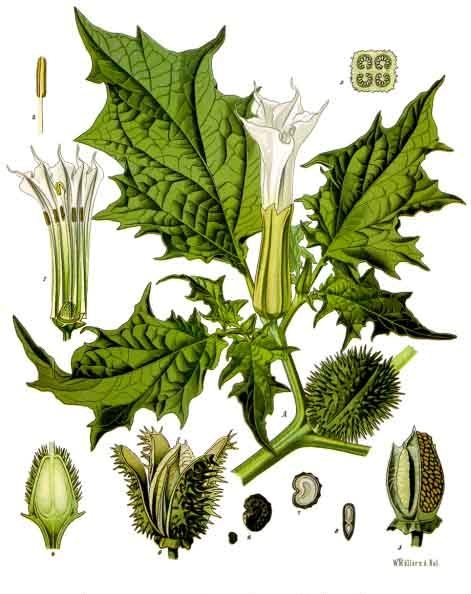 JimsonweedDatura stramonium
Compare
Questions and answers
What is the scientific name of the Deadly Nightshade?
The scientific name of the Deadly Nightshade is Atropa belladonna. Written with its author, the full name is Atropa belladonna L..
Which family does the Deadly Nightshade belong to?
Atropa belladonna belongs to the family Solanaceae, in the order Solanales and the class Magnoliopsida.
Where is the Deadly Nightshade found?
Checklists and occurrence records place Atropa belladonna in 51 countries, including Austria, France, Switzerland, Spain, The Netherlands and Czechia.
What other names does the Deadly Nightshade have?
Atropa belladonna is also known in English as Dwale, Naughty-man's Cherries, Belladonna and Deadly-nightshade.
What are the uses of belladonna?
Belladonna has historically been used for medicinal, cosmetic and poisonous purposes. Atropine extracted from the plant is used to dilate pupils for eye examinations and surgery, and has been used to treat bradycardia and heart block following myocardial infarction. Preparations have also been used for pain relief and cosmetic pupil dilation.[17][18][19][25][22]
What does belladonna do to a human?
Its alkaloids can produce hallucinations and delirium. All parts of the plant contain toxic tropane alkaloids, and handling it can expose people to toxins through the skin or cause severe dermatitis.[21][26][27][28]
What if you eat belladonna?
The plant contains toxic tropane alkaloids, including atropine, scopolamine and hyoscyamine. Its alkaloids can produce hallucinations and delirium, and its berries pose a particular poisoning risk to children because of their attractive appearance and somewhat sweet taste.[21][26][27][29]
What does Atropa belladonna taste like?
Its berries are sweet-tasting and purplish-black.[7]
Sources
Passages the profile rests on
- The plant has dark green leaves and distinct purple, bell-shaped flowers. Source passage: “Atropa belladonna is a medium sized shrub with dark green leaves and distinct purple bell-shaped flowers.” — fs.usda.gov
- Its leaves are simple and arranged alternately along the stems. Source passage: “Belladonna has simple, alternate leaves and flowers placed singly within the axils of leaves.” — fs.usda.gov
- Its leaves can grow up to 18 centimetres long. Source passage: “have ovate leaves up to 18 cm (7 in) long.” — English Wikipedia
- Its flowers are dull purple with yellow-green coloration near their bases and have a faint scent. Source passage: “The bell-shaped flowers are dull purple tinged yellow-green toward the base and are faintly scented.” — English Wikipedia
- Its berries develop from green fruits into shiny black berries. Source passage: “The fruits are berries, which are green, ripening to a shiny black” — English Wikipedia
- Its berries are approximately 1.5 centimetres in diameter. Source passage: “approximately 1.5 cm (0.6 in) in diameter.” — English Wikipedia
- The berries are sweet-tasting and purplish-black. Source passage: “The sweet-tasting belladonna fruit is a purple-black berry attractive to children” — fs.usda.gov
- The plant can reach 2 metres in height, although it more commonly grows to 1.5 metres. Source passage: “Plants can reach a height of 2 m (7 ft) (more commonly 1.5 m (5 ft))” — English Wikipedia
- Birds are the main animals reported to consume the plant's berries. Source passage: “The berries are sweet and are consumed by animals (mainly birds)” — English Wikipedia
- Cattle and rabbits consume the plant without apparently suffering harmful effects. Source passage: “However, cattle and rabbits eat the plant seemingly without suffering harmful effects.” — English Wikipedia
- Animals that eat the berries disperse the plant's seeds through their droppings. Source passage: “that disperse the seeds in their droppings” — English Wikipedia
- The plant reproduces through small seeds whose hard coats can cause dormancy and make germination difficult. Source passage: “Germination of the small seeds is often difficult, due to hard seed coats that cause seed dormancy.” — English Wikipedia
- Seed germination takes several weeks under alternating temperature conditions. Source passage: “Germination takes several weeks under alternating temperature conditions” — English Wikipedia
- Germination can be accelerated using gibberellic acid. Source passage: “but can be sped up with the use of gibberellic acid.” — English Wikipedia
- Seedlings require sterile soil to avoid damping off. Source passage: “Seedlings require sterile soil to prevent damping off” — English Wikipedia
- The species is considered a weed in some regions because it colonises disturbed soils. Source passage: “It is considered a weed species in parts of the world, where it colonises areas with disturbed soils.” — English Wikipedia
- The plant has historically been used for medicinal, cosmetic and poisonous purposes. Source passage: “Atropa bella-donna has a long history of use as a medicine, cosmetic, and poison.” — English Wikipedia
- Atropine extracted from the plant is used by ophthalmologists to dilate patients' pupils for eye examinations and surgery. Source passage: “Ophthalmologists use atropine to dilate their patient’s pupils for eye-exams and surgery.” — fs.usda.gov
- Belladonna preparations have been used in lotions, plasters and salves to relieve pain associated with sciatica, gout and cardiac palpitations. Source passage: “Various preparations of belladonna are used as lotions, plasters and salves to relieve pain from sciatica, gout, and cardiac palpitations.” — fs.usda.gov
- Belladonna plasters were commonly used during the nineteenth and early twentieth centuries for neuralgia, chronic rheumatism, muscle pain, back pain and pulmonary tuberculosis. Source passage: “Preparations of belladonna plasters came into common usage during the 19th and early 20th centuries for a wide variety of conditions including neuralgia, chronic rheumatism, muscle and back pain, and pulmonary tuberculosis.” — fs.usda.gov
- The plant has occasionally been used recreationally because its alkaloids produce hallucinations and delirium. Source passage: “Atropa bella-donna and related plants, such as Datura stramonium (commonly known as thornapple or jimson weed), have occasionally been used as recreational drugs because of the vivid hallucinations and delirium they produce.” — English Wikipedia
- Atropine obtained from the plant has been used to treat bradycardia and heart block following myocardial infarction. Source passage: “its use for the treatment of bradycardia and heart block after myocardial infarction.” — pmc.ncbi.nlm.nih.gov
- Deadly nightshade can be distinguished from black nightshade by its larger, glossier berries, which grow singly rather than in clusters. Source passage: “whereas the berries of deadly nightshade are much glossier, twice as large, somewhat flattened and are borne singly.” — English Wikipedia
- Black nightshade has white, star-shaped flowers rather than the tubular flowers of deadly nightshade. Source passage: “black nightshade flowers are not tubular but white and star-shaped” — English Wikipedia
- The plant's atropine-rich extracts were historically used as eye drops to dilate women's pupils for cosmetic purposes. Source passage: “who dilated their pupils with a tincture of belladonna eye-drops.” — fs.usda.gov
- All parts of the plant contain toxic tropane alkaloids. Source passage: “All parts of the plant contain tropane alkaloids;” — English Wikipedia
- The plant contains atropine, scopolamine and hyoscyamine. Source passage: “These toxins include atropine, scopolamine, and hyoscyamine” — English Wikipedia
- Handling the plant can expose people to toxins through the skin or cause severe dermatitis. Source passage: “Handling the plant can expose a person to absorbing toxins through the skin or cause severe dermatitis.” — fs.usda.gov
- The berries pose a particular poisoning risk to children because of their attractive appearance and somewhat sweet taste. Source passage: “The berries pose the greatest danger to children because they look attractive and have a somewhat sweet taste.” — English Wikipedia
Data
- Catalogue of Life, 2026-10-16 XR cc by
- Global Biodiversity Information Facility CC BY 4.0
- GeoNames CC BY 4.0
- Within the Catalogue of Life, this name comes from Synonymic Checklists of the Vascular Plants of the World cc by
References
- L. where the name was published
This species in other databases
Page built on 27 November 2026. See how the catalog is made and all sources and licences.
Cite this page
ScientificNames.org. (2026). Atropa belladonna (Deadly Nightshade). Retrieved November 27, 2026, from https://scientificnames.org/species/atropa-belladonna
“Atropa belladonna (Deadly Nightshade).” ScientificNames.org, 2026, scientificnames.org/species/atropa-belladonna. Accessed 27 Nov. 2026.
ScientificNames.org. “Atropa belladonna (Deadly Nightshade).” Accessed November 27, 2026. https://scientificnames.org/species/atropa-belladonna.
@misc{scientificnames_atropa_belladonna_deadly_nightshade,
  author = {{ScientificNames.org}},
  title = {Atropa belladonna (Deadly Nightshade)},
  year = {2026},
  url = {https://scientificnames.org/species/atropa-belladonna},
  note = {Accessed 2026-11-27}
}