Species · Flowering plants
Bactris aubletiana
Bactris aubletiana has no English name on record in the checklists used here. It is a species of flowering plant in the family Arecaceae (palm), order Arecales.
- Scientific name
- Bactris aubletiana Trail
- Genus
- Bactris
- Family
- Arecaceae (Palm)
- Order
- Arecales
- Class
- Liliopsida
- Recorded in
- 3 countries
- Name status
- accepted in the Catalogue of Life
Overview
Bactris aubletiana grows in lowland forests in French Guiana and Suriname. It is a shrub with ten or eleven leaves, round orange fruits and stems measuring 0.6–2 metres in height.
Written 27 November 2026 from the sources listed below. Each statement was checked against the passage it cites; statements that could not be supported were removed.
Appearance
Bactris aubletiana is a shrub with ten or eleven leaves. Its stems measure 0.6–2 metres in height and 3–5 millimetres in width.[1][2]
The leaves measure 17–30 centimetres long and 4–10 centimetres wide, with leaf stems measuring 5–16 centimetres long. They rarely bear black spines and sometimes have soft spines along their edges.[3][4][5]
The flower stems are curved, spiny and 3–3.5 centimetres long. The male flowers are deciduous and measure up to 3 millimetres long, with six stamens and petals measuring 2.5–3.5 millimetres long.[6][7][8]
The female flowers measure up to 2.5 millimetres long and have a cup-shaped calyx measuring 0.5–1 millimetre long. Their tube-shaped corolla measures 1.5–2 millimetres long and sometimes bears spines.[9][10]
The fruits are round and measure 5–8 millimetres in width. Mature fruits are orange, with a starchy mesocarp and a turbinate endocarp.[11][12][13]
Habitat
The species grows in lowland forests at elevations of 10–460 metres.[14][15]
It is native to French Guiana and Suriname and occurs in the wet tropical biome of both places.[16][17]
Reproduction and life cycle
The species flowers from December through April. It produces fruits from April through November.[18][19]
Classification of Bactris aubletiana
| Kingdom | Plantae |
|---|---|
| Subkingdom | Pteridobiotina |
| Phylum | Tracheophyta |
| Class | Liliopsida |
| Order | Arecales |
| Family | Arecaceae (Palm) |
| Genus | Bactris (Bactris Palm) |
| Species | Bactris aubletiana Trail |
Where Bactris aubletiana is found
Checklists and occurrence records place Bactris aubletiana in 3 countries across South America. GBIF holds 163 georeferenced records of it.
Countries
Regions and cities with the most records
- Matoury, French Guiana 7
- Amazonas, Brazil 5
- Kourou, French Guiana 4
- Sipaliwini District, Suriname 4
- Cayenne, French Guiana 3
A number beside a place is its count of GBIF occurrence records. A place without a number comes from a checklist alone. Records show where a species has been observed or collected, which can include escapes and vagrants.
Related species
-
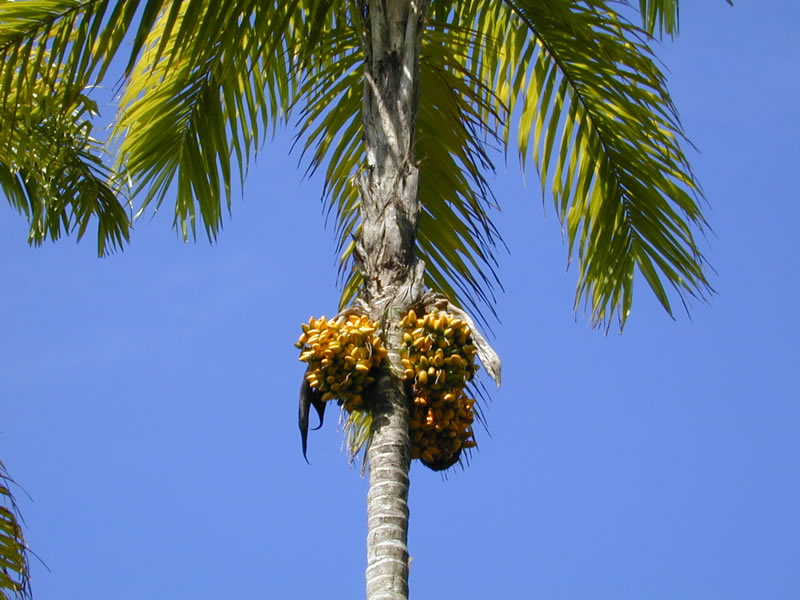 Peach PalmBactris gasipaes
-
 Lata PalmBactris major
-
 Bactris maraja
-
 Tobago CaneBactris guineensis
-
 Bactris setosa
-
 Bactris mexicana
- Prickly PalmBactris plumeriana
- Prickly PoleBactris jamaicana
Compare
Questions and answers
When does Bactris aubletiana flower?
It flowers from December through April.[18]
When does Bactris aubletiana produce fruits?
It produces fruits from April through November.[19]
Where is Bactris aubletiana native?
It is native to French Guiana and Suriname.[16]
At what elevations does Bactris aubletiana grow?
It occurs at elevations of 10–460 metres.[15]
Who described Bactris aubletiana and when?
James W. H. Trail described the species in 1876.[20]
Sources
Passages the profile rests on
- Bactris aubletiana is a shrub with ten or eleven leaves and round orange fruits. Source passage: “It is a shrub with ten or eleven leaves, and round orange fruits.” — English Wikipedia
- The stems measure 0.6–2 metres in height and 3–5 millimetres in width. Source passage: “The stems are 0.6–2 metres (2.0–6.6 ft) tall, and 3–5 millimetres (0.12–0.20 in) wide.” — English Wikipedia
- The leaves are 17–30 centimetres long and 4–10 centimetres wide. Source passage: “The leaves are 17–30 centimetres (6.7–11.8 in) long, 4–10 centimetres (1.6–3.9 in) wide” — English Wikipedia
- The leaves rarely bear black spines and sometimes have soft spines along their edges. Source passage: “The plant has ten or eleven leaves, which rarely have black spines. The leaves are 17–30 centimetres (6.7–11.8 in) long, 4–10 centimetres (1.6–3.9 in) wide, and sometimes have soft spines on the edges.” — English Wikipedia
- The leaf stems are 5–16 centimetres long. Source passage: “The leaf stems are 5–16 centimetres (2.0–6.3 in) long.” — English Wikipedia
- The flower stems are curved, spiny, and 3–3.5 centimetres long. Source passage: “The flower stems are 3–3.5 centimetres (1.2–1.4 in) long, curved, and spiny.” — English Wikipedia
- The male flowers are deciduous and measure up to 3 millimetres in length. Source passage: “The male flowers are deciduous, up to 3 millimetres (0.12 in) long.” — English Wikipedia
- Male flowers have six stamens and petals measuring 2.5–3.5 millimetres long. Source passage: “The male flowers have 2.5–3.5 millimetres (0.098–0.138 in) long petals, sepal lobes that are around 1 millimetre (0.039 in) long, and six stamens.” — English Wikipedia
- The female flowers measure up to 2.5 millimetres long and have a cup-shaped calyx measuring 0.5–1 millimetre long. Source passage: “The female flowers are up to 2.5 millimetres (0.098 in) long, and have a cup-shaped, 0.5–1 millimetre (0.020–0.039 in) long calyx.” — English Wikipedia
- The female flowers have a tube-shaped corolla measuring 1.5–2 millimetres long, which sometimes bears spines. Source passage: “The corolla of female flowers is 1.5–2 millimetres (0.059–0.079 in) long, tube-shaped, and sometimes spiny.” — English Wikipedia
- The fruits are round and measure 5–8 millimetres in width. Source passage: “The fruits are round, 5–8 millimetres (0.20–0.31 in) wide, and orange when mature.” — English Wikipedia
- The mature fruits are orange. Source passage: “The fruits are round, 5–8 millimetres (0.20–0.31 in) wide, and orange when mature.” — English Wikipedia
- The fruit mesocarp is starchy and its endocarp is turbinate. Source passage: “The mesocarp is starchy, and the endocarp is turbinate.” — English Wikipedia
- The species grows in lowland forests. Source passage: “It grows in lowland forests, at elevations of 10–460 metres (33–1,509 ft).” — English Wikipedia
- The species occurs at elevations of 10–460 metres. Source passage: “It grows in lowland forests, at elevations of 10–460 metres (33–1,509 ft).” — English Wikipedia
- The species is native to French Guiana and Suriname. Source passage: “The species is native to French Guiana and Suriname.” — English Wikipedia
- The species occurs in the wet tropical biome of French Guiana and Suriname. Source passage: “Bactris aubletiana is native to the wet tropical biome of French Guiana and Suriname.” — English Wikipedia
- The species flowers from December through April. Source passage: “The plant flowers from December to April.” — English Wikipedia
- The species produces fruits from April through November. Source passage: “The plant fruits from April to November.” — English Wikipedia
- The species was described by James W. H. Trail in 1876. Source passage: “The species was described by James W. H. Trail in 1876.” — English Wikipedia
Data
- Catalogue of Life, 2026-10-16 XR cc by
- Global Biodiversity Information Facility CC BY 4.0
- Wikidata CC0
- GeoNames CC BY 4.0
- Within the Catalogue of Life, this name comes from The World Checklist of Vascular Plants (WCVP) cc by
References
- J. Bot. 14: 372 (1876) where the name was published
This species in other databases
Page built on 28 November 2026. See how the catalog is made and all sources and licences.
Cite this page
ScientificNames.org. (2026). Bactris aubletiana. Retrieved November 28, 2026, from https://scientificnames.org/species/bactris-aubletiana
“Bactris aubletiana.” ScientificNames.org, 2026, scientificnames.org/species/bactris-aubletiana. Accessed 28 Nov. 2026.
ScientificNames.org. “Bactris aubletiana.” Accessed November 28, 2026. https://scientificnames.org/species/bactris-aubletiana.
@misc{scientificnames_bactris_aubletiana,
  author = {{ScientificNames.org}},
  title = {Bactris aubletiana},
  year = {2026},
  url = {https://scientificnames.org/species/bactris-aubletiana},
  note = {Accessed 2026-11-28}
}