Species · Flowering plants
Bactris balanophora
Bactris balanophora has no English name on record in the checklists used here. It is a species of flowering plant in the family Arecaceae (palm), order Arecales.
- Scientific name
- Bactris balanophora Spruce
- Genus
- Bactris
- Family
- Arecaceae (Palm)
- Order
- Arecales
- Class
- Liliopsida
- Recorded in
- 4 countries
- Name status
- accepted in the Catalogue of Life
Overview
Bactris balanophora Spruce is a shrub or tree. It is native to northern Brazil, specifically Amazonas, and the Colombian departments of Amazonas and Vaupés. It is characterized by black prickles, compound leaves, and orange fruits.
Written 28 November 2026 from the sources listed below. Each statement was checked against the passage it cites; statements that could not be supported were removed.
Appearance
Its stems grow in clusters of two to six. The plant reaches a height of 1.5–7 metres and a width of 2–3 centimetres, and its black prickles can reach 15 centimetres in length.[1][2][3]
The plant bears five to eight leaves, each with fifteen to twenty-one pinnae on either side. The pinnae are linear-lanceolate and irregularly arranged in groups of two to five, while the leaf stems measure 40–60 centimetres in length.[4][5][6][7]
Its inflorescence stems are curved and spiny and measure 9–11 centimetres in length. The male flowers measure 2.5–4 millimetres in length and have six stamens.[8][9][10][11]
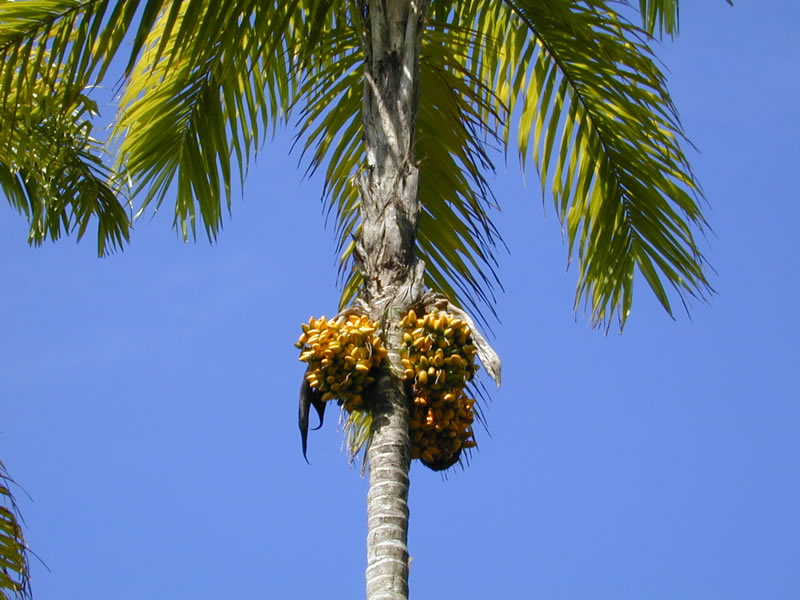
The female flowers reach a maximum length of 3 millimetres and possess a cup-shaped calyx and a tube-shaped corolla. Mature fruits are orange, ovoid or obovoid, and measure 1.3–1.7 centimetres long and 7–8 millimetres wide; their epicarp is smooth and their mesocarp is starchy.[12][13][14][15][16][17]
Habitat
The species occurs in the wet tropical biome. It grows at elevations of up to 700 metres above sea level.[18][19]
Its native distribution includes northern Brazil, specifically Amazonas, and the Colombian departments of Amazonas and Vaupés.[20][21]
Diet
The red acouchi and the red-rumped agouti consume Bactris balanophora.[22][23]
Conservation
The IUCN assessed the species as Least Concern in 2022.[24]
Uses
The species is used as a food source, has medicinal uses, and is used as a poison.[25][26][27]
Classification of Bactris balanophora
| Kingdom | Plantae |
|---|---|
| Subkingdom | Pteridobiotina |
| Phylum | Tracheophyta |
| Class | Liliopsida |
| Order | Arecales |
| Family | Arecaceae (Palm) |
| Genus | Bactris (Bactris Palm) |
| Species | Bactris balanophora Spruce |
Where Bactris balanophora is found
Checklists and occurrence records place Bactris balanophora in 4 countries across South America. GBIF holds 178 georeferenced records of it.
Countries
Regions and cities with the most records
- Caquetá, Colombia 52
- Amazonas, Brazil 23
- Amazonas Department, Colombia 14
- Vaupés, Colombia 10
- Potaro-Siparuni, Guyana 6
- Amazonas, Venezuela 5
- Guainía Department, Colombia 4
- Cuyuni-Mazaruni, Guyana 3
A number beside a place is its count of GBIF occurrence records. A place without a number comes from a checklist alone. Records show where a species has been observed or collected, which can include escapes and vagrants.
Common names
Names in 1 other language
- Spanish
- Chontaduro Falso, Chontilla
Synonyms
3 other scientific names have been used for this species and are now treated as synonyms of Bactris balanophora.
- Cocos chloroleuca Barb.Rodr.
- Syagrus chloroleuca (Barb.Rodr.) Burret
- Astrocaryum aculeatum Wallace ambiguous synonym
Related species
-
 Peach PalmBactris gasipaes
-
 Lata PalmBactris major
-
 Bactris maraja
-
 Tobago CaneBactris guineensis
-
 Bactris setosa
-
 Bactris mexicana
- Prickly PalmBactris plumeriana
- Prickly PoleBactris jamaicana
Compare
Sources
Passages the profile rests on
- The plant reaches a height of 1.5–7 metres and a width of 2–3 centimetres. Source passage: “grows 1.5–7 metres (4.9–23.0 ft) high, and 2–3 centimetres (0.79–1.18 in) wide.” — English Wikipedia
- Its stems grow in clusters containing two to six stems. Source passage: “The stems are in clumps of two to six.” — English Wikipedia
- Its black prickles can reach 15 centimetres in length. Source passage: “It has black prickles that are up to 15 centimetres (5.9 in) long.” — English Wikipedia
- The plant bears five to eight leaves. Source passage: “The plant has five to eight leaves” — English Wikipedia
- Its leaves have fifteen to twenty-one pinnae on each side. Source passage: “have fifteen to twenty-one pinnae on each side.” — English Wikipedia
- The leaf pinnae are linear-lanceolate and irregularly arranged in groups of two to five. Source passage: “The pinnae are linear-lanceolate, and irregularly clustered in groups of two to five.” — English Wikipedia
- The leaf stems measure 40–60 centimetres in length. Source passage: “which grow on 40–60 centimetres (1.3–2.0 ft) stems.” — English Wikipedia
- Its inflorescence stems are curved and spiny. Source passage: “The inflorescence stems are 9–11 centimetres (3.5–4.3 in) long, curved, and spiny.” — English Wikipedia
- Its inflorescence stems measure 9–11 centimetres in length. Source passage: “The inflorescence stems are 9–11 centimetres (3.5–4.3 in) long” — English Wikipedia
- The male flowers have six stamens. Source passage: “The petals of the male flowers have six stamens.” — English Wikipedia
- The male flowers measure 2.5–4 millimetres in length. Source passage: “The male flowers are 2.5–4 millimetres (0.098–0.157 in) long” — English Wikipedia
- The female flowers reach a maximum length of 3 millimetres. Source passage: “The female flowers are up to 3 millimetres (0.12 in) long” — English Wikipedia
- The female flowers possess a cup-shaped calyx. Source passage: “and have a cup-shaped calyx” — English Wikipedia
- The female flowers have a tube-shaped corolla. Source passage: “The corolla is tube-shaped” — English Wikipedia
- Its mature fruits are orange and have an ovoid or obovoid shape. Source passage: “ovoid or obovoid, and orange when mature.” — English Wikipedia
- Its fruits measure 1.3–1.7 centimetres long and 7–8 millimetres wide. Source passage: “The fruits are 1.3–1.7 centimetres (0.51–0.67 in) long, 7–8 millimetres (0.28–0.31 in) wide” — English Wikipedia
- The fruit epicarp is smooth and its mesocarp is starchy. Source passage: “The epicarp is smooth, the mesocarp is starchy” — English Wikipedia
- The species occurs in the wet tropical biome. Source passage: “is native to the wet tropical biome” — English Wikipedia
- The species grows at elevations of up to 700 metres above sea level. Source passage: “The species grows at elevations of up to 700 metres (2,300 ft).” — English Wikipedia
- The species is native to northern Brazil, specifically Amazonas. Source passage: “northern Brazil (Amazonas)” — English Wikipedia
- The species is native to the Colombian departments of Amazonas and Vaupés. Source passage: “Colombia (Amazonas and Vaupés)” — English Wikipedia
- The red acouchi consumes Bactris balanophora. Source passage: “Bactris balanophora is eaten by the red acouchi” — English Wikipedia
- The red-rumped agouti consumes Bactris balanophora. Source passage: “and red-rumped agouti.” — English Wikipedia
- The IUCN assessed the species as Least Concern in 2022. Source passage: “In 2022, the IUCN assessed Bactris balanophora as of Least Concern.” — English Wikipedia
- The species is used as a food source. Source passage: “Bactris balanophora is used for food, medicine, and poison.” — English Wikipedia
- The species has medicinal uses. Source passage: “Bactris balanophora is used for food, medicine, and poison.” — English Wikipedia
- The species is used as a poison. Source passage: “Bactris balanophora is used for food, medicine, and poison.” — English Wikipedia
Data
- Catalogue of Life, 2026-10-16 XR cc by
- Global Biodiversity Information Facility CC BY 4.0
- Wikidata CC0
- GeoNames CC BY 4.0
- Within the Catalogue of Life, this name comes from The World Checklist of Vascular Plants (WCVP) cc by
References
- J. Linn. Soc., Bot. 11: 146 (1869) where the name was published
This species in other databases
Page built on 28 November 2026. See how the catalog is made and all sources and licences.
Cite this page
ScientificNames.org. (2026). Bactris balanophora. Retrieved November 28, 2026, from https://scientificnames.org/species/bactris-balanophora
“Bactris balanophora.” ScientificNames.org, 2026, scientificnames.org/species/bactris-balanophora. Accessed 28 Nov. 2026.
ScientificNames.org. “Bactris balanophora.” Accessed November 28, 2026. https://scientificnames.org/species/bactris-balanophora.
@misc{scientificnames_bactris_balanophora,
  author = {{ScientificNames.org}},
  title = {Bactris balanophora},
  year = {2026},
  url = {https://scientificnames.org/species/bactris-balanophora},
  note = {Accessed 2026-11-28}
}