Species · Flowering plants
Caryota-leaf Peach Palm Bactris caryotifolia
The scientific name of the Caryota-leaf Peach Palm is Bactris caryotifolia. It is a species of flowering plant in the family Arecaceae (palm), order Arecales.
- Scientific name
- Bactris caryotifolia Mart.
- Common name
- Caryota-leaf Peach Palm
- Genus
- Bactris
- Family
- Arecaceae (Palm)
- Order
- Arecales
- Class
- Liliopsida
- Recorded in
- 1 country
- Name status
- accepted in the Catalogue of Life

Overview
Bactris caryotifolia Mart. is a shrub in the family Arecaceae, order Arecales and class Liliopsida. The caryota-leaf peach palm is native to the wet tropical biome of north-east and south-east Brazil, including Bahia, Espírito Santo, and Rio de Janeiro. It has pinnate leaves with wedge-shaped pinnae, scattered yellowish-brown spines, and globose to obovoid fruits that are purple to black.
Written 27 November 2026 from the sources listed below. Each statement was checked against the passage it cites; statements that could not be supported were removed.
Appearance
The caryota-leaf peach palm has stems that grow in small clumps. The stems measure 1–1.5 metres in height and 1–2 centimetres in width.[1][2]
The plant bears ten to twelve leaves with scattered yellowish-brown spines. Each leaf has eleven to thirteen wedge-shaped pinnae on either side, and its leaf stem measures 20–37 centimetres in length.[3][4][5]
The fruits are globose to obovoid and purple to black, measuring 1–1.8 centimetres in length. The fruit mesocarp is juicy and the endocarp is turbinate.[6][7][8]
Reproduction and life cycle
The inflorescence stem is curved and may or may not bear spines. It measures 6–15 centimetres in length.[9][10]
Male flowers measure up to 3.5 millimetres in length and have six stamens. Their sepal lobes measure up to 1 millimetre in length.[11][12][13]
Female flowers measure up to 4 millimetres in length. The calyx and corolla are cup-shaped and measure up to 3.5 millimetres in length.[14][15]
Habitat
The caryota-leaf peach palm grows in lowland rainforests at elevations of up to 550 metres.[16][17]
The species is native to Brazil, occurring in the wet tropical biome of north-east and south-east Brazil, including Bahia, Espírito Santo, and Rio de Janeiro.[18][19]
Classification of the Caryota-leaf Peach Palm
| Kingdom | Plantae |
|---|---|
| Subkingdom | Pteridobiotina |
| Phylum | Tracheophyta |
| Class | Liliopsida |
| Order | Arecales |
| Family | Arecaceae (Palm) |
| Genus | Bactris (Bactris Palm) |
| Species | Bactris caryotifolia Mart. |
Where the Caryota-leaf Peach Palm is found
Checklists and occurrence records place Bactris caryotifolia in 1 country across South America. GBIF holds 134 georeferenced records of it.
Countries
Regions and cities with the most records
- Espírito Santo, Brazil 29
- Rio de Janeiro, Brazil 17
- Bahia, Brazil 11
- Santa Teresa, Brazil 8
- Fundão, Brazil 7
- Cachoeiras de Macacu, Brazil 5
- Sooretama, Brazil 5
- Guapimirim, Brazil 4
- Queimados, Brazil 4
- São Pedro, Brazil 4
- Teresópolis, Brazil 4
- Mucuri, Brazil 3
- Porto Seguro, Brazil 3
- Santa Cruz Cabrália, Brazil 3
- Serra, Brazil 3
- Universidade Rural, Brazil 3
A number beside a place is its count of GBIF occurrence records. A place without a number comes from a checklist alone. Records show where a species has been observed or collected, which can include escapes and vagrants.
Common names
English
- Caryota-leaf Peach Palm
Related species
-
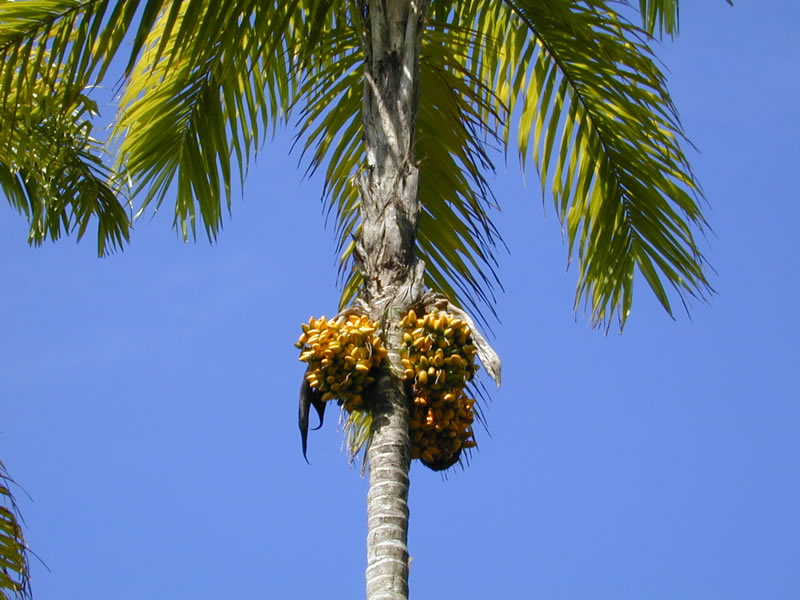 Peach PalmBactris gasipaes
-
 Lata PalmBactris major
-
 Bactris maraja
-
 Tobago CaneBactris guineensis
-
 Bactris setosa
-
 Bactris mexicana
- Prickly PalmBactris plumeriana
- Prickly PoleBactris jamaicana
Compare
Questions and answers
What is the scientific name of the Caryota-leaf Peach Palm?
The scientific name of the Caryota-leaf Peach Palm is Bactris caryotifolia. Written with its author, the full name is Bactris caryotifolia Mart..
Which family does the Caryota-leaf Peach Palm belong to?
Bactris caryotifolia belongs to the family Arecaceae, in the order Arecales and the class Liliopsida.
Where is the Caryota-leaf Peach Palm found?
Checklists and occurrence records place Bactris caryotifolia in 1 country: Brazil.
Sources
Passages the profile rests on
- The stems measure 1–1.5 metres in height and 1–2 centimetres in width. Source passage: “The stems are 1–1.5 metres (3.3–4.9 ft) tall, 1–2 centimetres (0.39–0.79 in) wide” — English Wikipedia
- The stems grow in small clumps. Source passage: “grow in small clumps.” — English Wikipedia
- The plant bears ten to twelve leaves with scattered yellowish-brown spines. Source passage: “The plant has ten to twelve leaves, with scattered yellowish-brown spines.” — English Wikipedia
- Each leaf has eleven to thirteen wedge-shaped pinnae on either side. Source passage: “The leaves have eleven to thirteen wedge-shaped pinnae on each side.” — English Wikipedia
- The leaf stem measures 20–37 centimetres in length. Source passage: “The leaf stem is 20–37 centimetres (7.9–14.6 in) long.” — English Wikipedia
- The fruits measure 1–1.8 centimetres in length. Source passage: “The fruits are 1–1.8 centimetres (0.39–0.71 in) long” — English Wikipedia
- The fruits are globose to obovoid and purple to black. Source passage: “globose to obovoid, and purple to black in colour.” — English Wikipedia
- The fruit mesocarp is juicy and the endocarp is turbinate. Source passage: “The mesocarp is juicy, and the endocarp is turbinate.” — English Wikipedia
- The inflorescence stem is curved and may or may not bear spines. Source passage: “The inflorescence stem is curved, 6–15 centimetres (2.4–5.9 in) long, and may or may not have spines.” — English Wikipedia
- The inflorescence stem measures 6–15 centimetres in length. Source passage: “The inflorescence stem is curved, 6–15 centimetres (2.4–5.9 in) long” — English Wikipedia
- Male flowers measure up to 3.5 millimetres in length. Source passage: “The male flowers are up to 3.5 millimetres (0.14 in) long” — English Wikipedia
- Male flowers have six stamens. Source passage: “The male flowers have six stamens.” — English Wikipedia
- The sepal lobes of male flowers measure up to 1 millimetre in length. Source passage: “have sepal lobes that are up to 1 millimetre (0.039 in) long.” — English Wikipedia
- Female flowers measure up to 4 millimetres in length. Source passage: “The female flowers are up to 4 millimetres (0.16 in) long.” — English Wikipedia
- The calyx and corolla are cup-shaped and measure up to 3.5 millimetres in length. Source passage: “The calyx and corolla are cup-shaped, and up to 3.5 millimetres (0.14 in) long.” — English Wikipedia
- The species grows in lowland rainforests. Source passage: “The species grows in lowland rainforests” — English Wikipedia
- The species occurs at elevations of up to 550 metres. Source passage: “at elevations of up to 550 metres (1,800 ft).” — English Wikipedia
- Bactris caryotifolia is native to Brazil. Source passage: “The species is native to Brazil” — English Wikipedia
- The species is native to the wet tropical biome of north-east and south-east Brazil, including Bahia, Espírito Santo, and Rio de Janeiro. Source passage: “Bactris caryotifolia is native to the wet tropical biome of north-east and south-east Brazil (Bahia, Espírito Santo, and Rio de Janeiro).” — English Wikipedia
Data
- Catalogue of Life, 2026-10-16 XR cc by
- Global Biodiversity Information Facility CC BY 4.0
- Wikidata CC0
- GeoNames CC BY 4.0
- Wikimedia Commons per image; credit shown with each image
- Within the Catalogue of Life, this name comes from The World Checklist of Vascular Plants (WCVP) cc by
References
- Hist. Nat. Palm. 2: 106 (1826) where the name was published
This species in other databases
- Catalogue of Life 67ZX9
- Wikidata Q15458014
- iNaturalist 364374
- World Flora Online wfo-0000306523
- GRIN 6252
Page built on 28 November 2026. See how the catalog is made and all sources and licences.
Cite this page
ScientificNames.org. (2026). Bactris caryotifolia (Caryota-leaf Peach Palm). Retrieved November 28, 2026, from https://scientificnames.org/species/bactris-caryotifolia
“Bactris caryotifolia (Caryota-leaf Peach Palm).” ScientificNames.org, 2026, scientificnames.org/species/bactris-caryotifolia. Accessed 28 Nov. 2026.
ScientificNames.org. “Bactris caryotifolia (Caryota-leaf Peach Palm).” Accessed November 28, 2026. https://scientificnames.org/species/bactris-caryotifolia.
@misc{scientificnames_bactris_caryotifolia_caryota_leaf_peach_palm,
  author = {{ScientificNames.org}},
  title = {Bactris caryotifolia (Caryota-leaf Peach Palm)},
  year = {2026},
  url = {https://scientificnames.org/species/bactris-caryotifolia},
  note = {Accessed 2026-11-28}
}