Species · Flowering plants
Bactris faucium
Bactris faucium has no English name on record in the checklists used here. It is a species of flowering plant in the family Arecaceae (palm), order Arecales.
- Scientific name
- Bactris faucium Mart.
- Genus
- Bactris
- Family
- Arecaceae (Palm)
- Order
- Arecales
- Class
- Liliopsida
- Recorded in
- 1 country
- Name status
- accepted in the Catalogue of Life
Overview
Bactris faucium Mart. is a shrub with spiny leaves and purple or black fruits. The species occurs in the wet tropical biome of Bolivia, in Cochabamba, La Paz, and Santa Cruz, at elevations between 250 and 630 metres. It is distinguished by its scattered dark brown leaf spines and globose to obovoid fruits with juicy mesocarps.
Written 27 November 2026 from the sources listed below. Each statement was checked against the passage it cites; statements that could not be supported were removed.
Appearance
The stems measure 2–3 metres in height and 0.8–1.5 centimetres in width. Each plant bears five to ten leaves, which are either simple or divided into two to fifteen pinnae on each side.[1][2][3]
The leaves bear scattered dark brown spines reaching up to 6 centimetres in length. The leaf stems measure 17–25 centimetres in length.[4][5]
The straight inflorescence stem measures 2–4.5 centimetres in length. Male flowers reach up to 6.5 millimetres in length and possess six stamens.[6][7][8]
The female flowers measure 3.5–4 millimetres in length. They have a spiny, tube-shaped calyx measuring up to 3.5 millimetres in length and a spiny, tube-shaped corolla reaching up to 4 millimetres in length.[9][10][11][12]
The fruits are globose to obovoid, purple or black, and reach up to 2 centimetres in width. Their mesocarp is juicy.[13][14][15]
Habitat
The species occurs in the wet tropical biome and is adapted to shaded areas.[16][17]
Bactris faucium is native to Bolivia and is recorded in the departments of Cochabamba, La Paz, and Santa Cruz. It occurs at elevations between 250 and 630 metres and has an extent of occurrence of approximately 86,214 square kilometres.[18][19][20][21]
Conservation
The IUCN assessed Bactris faucium as Endangered in 2023. Habitat fragmentation threatens the species, and road construction is a documented threat.[22][23][24]
Classification of Bactris faucium
| Kingdom | Plantae |
|---|---|
| Subkingdom | Pteridobiotina |
| Phylum | Tracheophyta |
| Class | Liliopsida |
| Order | Arecales |
| Family | Arecaceae (Palm) |
| Genus | Bactris (Bactris Palm) |
| Species | Bactris faucium Mart. |
Where Bactris faucium is found
Checklists and occurrence records place Bactris faucium in 1 country across South America. GBIF holds 29 georeferenced records of it.
Countries
Regions and cities with the most records
A number beside a place is its count of GBIF occurrence records. A place without a number comes from a checklist alone. Records show where a species has been observed or collected, which can include escapes and vagrants.
Related species
-
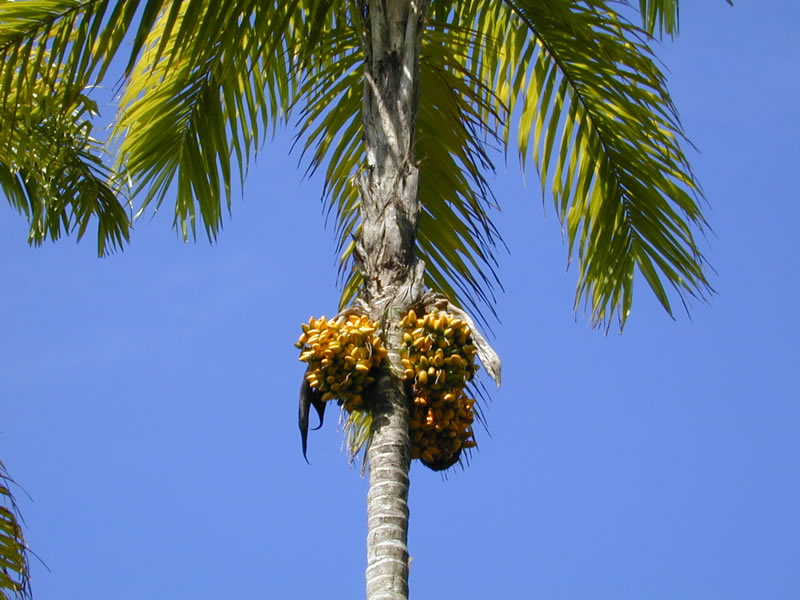 Peach PalmBactris gasipaes
-
 Lata PalmBactris major
-
 Bactris maraja
-
 Tobago CaneBactris guineensis
-
 Bactris setosa
-
 Bactris mexicana
- Prickly PalmBactris plumeriana
- Prickly PoleBactris jamaicana
Compare
Sources
Passages the profile rests on
- The stems measure 2–3 metres in height and 0.8–1.5 centimetres in width. Source passage: “The stems are 2–3 metres (6.6–9.8 ft) tall, and 0.8–1.5 centimetres (0.31–0.59 in) wide.” — English Wikipedia
- Each plant bears five to ten leaves. Source passage: “The plant has five to ten leaves.” — English Wikipedia
- The leaves are either simple or divided into two to fifteen pinnae on each side. Source passage: “The leaves are simple, or have two to fifteen pinnae on each side.” — English Wikipedia
- The leaves bear scattered dark brown spines reaching up to 6 centimetres in length. Source passage: “The leaves have scattered dark brown spines that are up to 6 centimetres (2.4 in) long.” — English Wikipedia
- The leaf stems measure 17–25 centimetres in length. Source passage: “The leaf stems are 17–25 centimetres (6.7–9.8 in) long.” — English Wikipedia
- The straight inflorescence stem measures 2–4.5 centimetres in length. Source passage: “The inflorescence stem is straight 2–4.5 centimetres (0.79–1.77 in) long.” — English Wikipedia
- The male flowers reach up to 6.5 millimetres in length. Source passage: “The male flowers are up to 6.5 millimetres (0.26 in) long” — English Wikipedia
- Male flowers possess six stamens. Source passage: “The male flowers have six stamens.” — English Wikipedia
- The female flowers measure 3.5–4 millimetres in length. Source passage: “The female flowers are 3.5–4 millimetres (0.14–0.16 in) long” — English Wikipedia
- The female flowers have a spiny, tube-shaped calyx measuring up to 3.5 millimetres in length. Source passage: “have a spiny, tube-shaped calyx that is up to 3.5 millimetres (0.14 in) long.” — English Wikipedia
- The corolla of female flowers is spiny and tube-shaped. Source passage: “The corolla of female flowers is spiny, tube-shaped” — English Wikipedia
- The female flower corolla reaches up to 4 millimetres in length. Source passage: “and up to 4 millimetres (0.16 in) long.” — English Wikipedia
- The fruits are globose to obovoid in shape and purple or black in colour. Source passage: “The fruits are globose to obovoid, up to 2 centimetres (0.79 in) wide, and purple or black.” — English Wikipedia
- The fruits reach up to 2 centimetres in width. Source passage: “The fruits are globose to obovoid, up to 2 centimetres (0.79 in) wide” — English Wikipedia
- The fruit mesocarp is juicy. Source passage: “The mesocarp is juicy.” — English Wikipedia
- The species occurs in the wet tropical biome. Source passage: “Bactris faucium is native to the wet tropical biome of Bolivia” — English Wikipedia
- The species is adapted to shaded areas. Source passage: “Bactris faucium is adapted to shaded areas.” — English Wikipedia
- Bactris faucium is native to Bolivia. Source passage: “The species is native to Bolivia.” — English Wikipedia
- The species is recorded in the Bolivian departments of Cochabamba, La Paz, and Santa Cruz. Source passage: “Bolivia (Cochabamba, La Paz, and Santa Cruz).” — English Wikipedia
- The species occurs at elevations between 250 and 630 metres. Source passage: “The species grows at elevations of 250–630 metres (820–2,070 ft).” — English Wikipedia
- The species has an extent of occurrence of approximately 86,214 square kilometres. Source passage: “Its extent of occurrence is around 86,214 square kilometres (33,287 sq mi).” — English Wikipedia
- The IUCN assessed Bactris faucium as Endangered in 2023. Source passage: “In 2023, the IUCN assessed Bactris faucium as Endangered.” — English Wikipedia
- Habitat fragmentation threatens the species. Source passage: “It is threatened by habitat fragmentation and road construction.” — English Wikipedia
- Road construction is a documented threat to the species. Source passage: “It is threatened by habitat fragmentation and road construction.” — English Wikipedia
Data
- Catalogue of Life, 2026-10-16 XR cc by
- Global Biodiversity Information Facility CC BY 4.0
- Wikidata CC0
- GeoNames CC BY 4.0
- Within the Catalogue of Life, this name comes from The World Checklist of Vascular Plants (WCVP) cc by
References
- A.D.d'Orbigny, Voy. Amér. Mér. 7(3): 60 (1844) where the name was published
This species in other databases
Page built on 28 November 2026. See how the catalog is made and all sources and licences.
Cite this page
ScientificNames.org. (2026). Bactris faucium. Retrieved November 28, 2026, from https://scientificnames.org/species/bactris-faucium
“Bactris faucium.” ScientificNames.org, 2026, scientificnames.org/species/bactris-faucium. Accessed 28 Nov. 2026.
ScientificNames.org. “Bactris faucium.” Accessed November 28, 2026. https://scientificnames.org/species/bactris-faucium.
@misc{scientificnames_bactris_faucium,
  author = {{ScientificNames.org}},
  title = {Bactris faucium},
  year = {2026},
  url = {https://scientificnames.org/species/bactris-faucium},
  note = {Accessed 2026-11-28}
}