Species · Flowering plants
Beetle Lily Baeometra uniflora
The scientific name of the Beetle Lily is Baeometra uniflora. It is a species of flowering plant in the family Colchicaceae (meadow saffron family), order Liliales.
- Scientific name
- Baeometra uniflora (Jacq.) G.J.Lewis
- Common name
- Beetle Lily
- Genus
- Baeometra
- Family
- Colchicaceae (Meadow Saffron Family)
- Order
- Liliales
- Class
- Liliopsida
- Recorded in
- 2 countries
- Name status
- accepted in the Catalogue of Life

Overview
Beetle Lily is a geophyte. It is native to the southwestern Cape of South Africa, occurring between Malmesbury and Riversdale. It produces bright orange or yellow flowers with distinctive dark central markings that attract money beetles.
Written 27 November 2026 from the sources listed below. Each statement was checked against the passage it cites; statements that could not be supported were removed.
Appearance
Beetle Lily has lance-shaped leaves arranged in a spiral around the stem. It has five to eight leaves that clasp the base of its stem, and its largest leaf measures between 10 and 30 cm in length.[1][2][3]
Its corm is flattened and ovoid, with dark brown leathery outer layers. The plant grows to a maximum height of approximately 30 cm.[4][5]
The plant produces bright orange or yellow flowers without scent, each with a distinctive dark central marking. The flowers have maroon stamen filaments, yellow anthers and a firm texture, and they do not contain nectar.[6][7][8][9]
The seeds are reddish brown, approximately subglobose in shape, and measure between 1 and 1.5 mm in diameter.[10][11]
Habitat
Beetle Lily grows in seasonally wet areas of southwestern South Africa. It occurs in lightly disturbed habitats, including roadside verges, and on rocky sandstone and granite slopes.[12][13][14]
Behaviour
The flowers open only in warm conditions and individual flowers remain open for only a few days. The flowers attract money beetles through dark central markings that resemble a potential mate.[15][16][17]
Reproduction and life cycle
Beetle Lily is pollinated by insects and appears capable of self-fertilisation. All flowers produce a complete set of fertile seeds.[18][19][20]
The species usually produces at least two yellowish flowers on each stem despite its single-flowered scientific epithet. Each plant can bear between one and five flowers, and the flowers are produced between August and October.[21][22][23][24]
The fruits develop after the tepals fall away from the flowers. They mature slowly and generally release their seeds in late summer.[25][26]
The fruits split open in the upper quarter where their lobes meet. Seeds are released gradually when wind shakes the fruit-bearing stalks.[27][28]
Conservation
Beetle Lily has been introduced to Australia, where it is regarded as an invasive and unwanted plant.[29][30]
Uses
Beetle Lily contains the alkaloid colchicine and is described as poisonous.[31]
Similar species
Beetle Lily is related to species in the genus Wurmbea.[32]
Classification of the Beetle Lily
| Kingdom | Plantae |
|---|---|
| Subkingdom | Pteridobiotina |
| Phylum | Tracheophyta |
| Class | Liliopsida |
| Order | Liliales |
| Family | Colchicaceae (Meadow Saffron Family) |
| Genus | Baeometra (Beetle Lilies) |
| Species | Baeometra uniflora (Jacq.) G.J.Lewis |
Where the Beetle Lily is found
Checklists and occurrence records place Baeometra uniflora in 2 countries across Africa and Oceania. GBIF holds 2,001 georeferenced records of it.
Countries where it is native or its origin is not stated
Countries where it has been introduced
Regions and cities with the most records
- Western Cape, South Africa 1,873
- Rondebosch, South Africa 801
- Cape Town, South Africa 730
- Retreat, South Africa 659
- Muizenberg, South Africa 653
- Kuils River, South Africa 452
- Stellenbosch, South Africa 409
- Kraaifontein, South Africa 392
- Somerset West, South Africa 358
- Durbanville, South Africa 314
- Grabouw, South Africa 301
- Hermanus, South Africa 117
- Le Roux, South Africa 86
- Paarl, South Africa 85
- Franschhoek, South Africa 69
- Wellington, South Africa 52
- Gansbaai, South Africa 35
- Western Australia, Australia 31
- Caledon, South Africa 30
- Ceres, South Africa 19
- Atlantis, South Africa 18
- Malmesbury, South Africa 12
- Bredasdorp, South Africa 9
- Swellendam, South Africa 7
- Victoria, Australia 3
A number beside a place is its count of GBIF occurrence records. A place without a number comes from a checklist alone. Records show where a species has been observed or collected, which can include escapes and vagrants.
Common names
English
- Beetle Lily
Synonyms
9 other scientific names have been used for this species and are now treated as synonyms of Baeometra uniflora.
- Baeometra columellaris Salisb.
- Epionix flava Raf.
- Epionix rubra Raf.
- Kolbea uniflora (Jacq.) Harv.
- Melanthium aethiopicum Desr.
- Melanthium flavum Sm.
- Melanthium uniflorum Jacq.
- Baeometra breyniana Baill. ambiguous synonym
- Kolbea breyniana (L.) Kunth ambiguous synonym
Related species
-
 Autumn CrocusColchicum autumnale
-
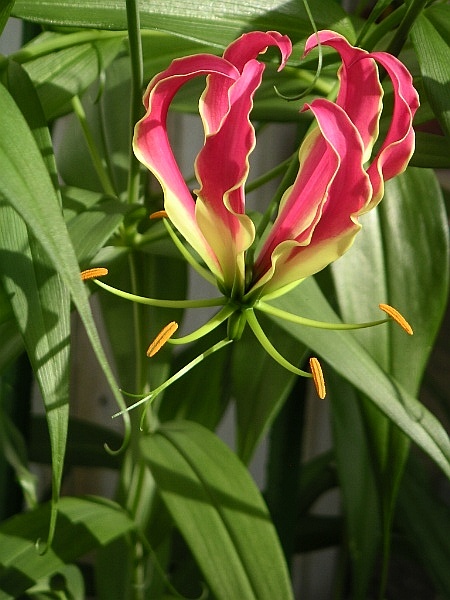 Flame LilyGloriosa superba
-
 ChristmasbellsSandersonia aurantiaca
-
 Giant Meadow SaffronColchicum speciosum
-
 MilkmaidsBurchardia umbellata
-
 Large-flowered BellwortUvularia grandiflora
-
 Early NancyWurmbea dioica
-
 Spring Meadow SaffronColchicum bulbocodium
Compare
Questions and answers
What is the scientific name of the Beetle Lily?
The scientific name of the Beetle Lily is Baeometra uniflora. Written with its author, the full name is Baeometra uniflora (Jacq.) G.J.Lewis.
Which family does the Beetle Lily belong to?
Baeometra uniflora belongs to the family Colchicaceae, in the order Liliales and the class Liliopsida.
Where is the Beetle Lily found?
Checklists and occurrence records place Baeometra uniflora in 2 countries, including South Africa.
What attracts flower beetles?
Beetle Lily attracts money beetles through its dark flower centers, which resemble a potential mate.[17]
Sources
Passages the profile rests on
- The beetle lily has lance-shaped leaves arranged in a spiral around the stem. Source passage: “The lance-shaped leaves grow in a spiral shape.” — English Wikipedia
- The plant has five to eight leaves that clasp the base of its stem. Source passage: “There are between five and eight of them, clasping the base of the stem.” — English Wikipedia
- Its largest leaf measures between 10 and 30 cm in length. Source passage: “The largest is 10–30 cm (3.9–11.8 in) long” — English Wikipedia
- Its corm is flattened and ovoid, with dark brown leathery outer layers. Source passage: “The corm is a flattened, ovoid shape and is covered in dark brown, leathery layers.” — English Wikipedia
- The beetle lily grows to a maximum height of approximately 30 cm. Source passage: “The beetle lily is a geophyte that grows up to 30 cm (12 in) tall.” — English Wikipedia
- The plant produces bright orange or yellow flowers without scent. Source passage: “Bright orange or yellow unscented flowers are present between August and October.” — English Wikipedia
- Each flower has a distinctive dark central marking. Source passage: “Each flower has a distinctive dark eye at the center.” — English Wikipedia
- The flowers have maroon stamen filaments and yellow anthers. Source passage: “The stamens have maroon filaments and yellow anthers.” — English Wikipedia
- The flowers have a firm texture and do not contain nectar. Source passage: “They have a firm texture and lack nectar.” — English Wikipedia
- The seeds are reddish brown and approximately subglobose in shape. Source passage: “The reddish brown seeds (1–1.5 mm (0.039–0.059 in) in diameter) have a subglobose shape” — English Wikipedia
- Its reddish brown seeds measure between 1 and 1.5 mm in diameter. Source passage: “The reddish brown seeds (1–1.5 mm (0.039–0.059 in) in diameter)” — English Wikipedia
- The beetle lily grows in seasonally wet areas of southwestern South Africa. Source passage: “where it is common in seasonally wet areas” — English Wikipedia
- The species occurs in lightly disturbed habitats, including roadside verges. Source passage: “as well as lightly disturbed regions, such as road verges.” — English Wikipedia
- The species also grows on rocky sandstone and granite slopes. Source passage: “It is also found on rocky sandstone and granite slopes.” — English Wikipedia
- The flowers open only in warm conditions. Source passage: “the flowers only open when it is warm.” — English Wikipedia
- Individual flowers remain open for only a few days. Source passage: “Each flower lasts only a few days” — English Wikipedia
- The species attracts money beetles through dark flower centers that resemble a potential mate. Source passage: “the dark center attracts money beetles, such as Peritrichia abdominalis, as it resembles a mate.” — English Wikipedia
- The beetle lily is pollinated by insects. Source passage: “This species is insect pollinated.” — English Wikipedia
- The species appears capable of self-fertilisation. Source passage: “The plant does, however, also seem to be able to self-fertilise” — English Wikipedia
- All flowers produce a complete set of fertile seeds. Source passage: “as all flowers produce a full set of fertile seeds.” — English Wikipedia
- The species usually produces at least two yellowish flowers on each stem despite its single-flowered scientific epithet. Source passage: “The epithet means "single-flowered", which is contradicted by the fact that the stem usually bears at least two yellowish flowers.” — English Wikipedia
- Each plant can bear between one and five flowers. Source passage: “Each plant has between one and five flowers growing in a funnel of successively smaller flowers.” — English Wikipedia
- The flowers are produced between August and October. Source passage: “Bright orange or yellow unscented flowers are present between August and October.” — English Wikipedia
- The specific epithet uniflora refers to the plant being single-flowered. Source passage: “The epithet means "single-flowered"” — English Wikipedia
- The fruits develop after the tepals fall away from the flowers. Source passage: “the tepals falling off to make space for the enlarging cylindrical, 3-lobed ovary as the fruits start to develop.” — English Wikipedia
- The fruits mature slowly and generally release their seeds in late summer. Source passage: “The woody fruits (3–5 cm (1.2–2.0 in) long) mature slowly, usually only shedding seeds in late summer.” — English Wikipedia
- The fruits split open in the upper quarter where their lobes meet. Source passage: “They split where the lobes join on the top quarter of the fruit.” — English Wikipedia
- The seeds are released gradually when wind shakes the fruit-bearing stalks. Source passage: “They are slowly released as the stalks the fruits are borne on are shaken by the wind.” — English Wikipedia
- The species has been introduced to Australia. Source passage: “This species has also been introduced to Australia” — English Wikipedia
- The beetle lily is regarded as an invasive and unwanted plant in Australia. Source passage: “where it is considered to be an invasive and unwanted addition to the local flora.” — English Wikipedia
- The beetle lily contains the alkaloid colchicine and is described as poisonous. Source passage: “is known to be a poisonous plant containing the alkaloid colchicine.” — English Wikipedia
- The beetle lily is related to species in the genus Wurmbea. Source passage: “The species is related to the genus Wurmbea” — English Wikipedia
Data
- Catalogue of Life, 2026-10-16 XR cc by
- Global Biodiversity Information Facility CC BY 4.0
- Wikidata CC0
- GeoNames CC BY 4.0
- Wikimedia Commons per image; credit shown with each image
- Within the Catalogue of Life, this name comes from The World Checklist of Vascular Plants (WCVP) cc by
References
- J. S. African Bot. 7: 59 (1941) where the name was published
This species in other databases
- Catalogue of Life KCMC
- Wikidata Q4841288
- iNaturalist 361679
- World Flora Online wfo-0000761104
- GRIN 508417
Page built on 28 November 2026. See how the catalog is made and all sources and licences.
Cite this page
ScientificNames.org. (2026). Baeometra uniflora (Beetle Lily). Retrieved November 28, 2026, from https://scientificnames.org/species/baeometra-uniflora
“Baeometra uniflora (Beetle Lily).” ScientificNames.org, 2026, scientificnames.org/species/baeometra-uniflora. Accessed 28 Nov. 2026.
ScientificNames.org. “Baeometra uniflora (Beetle Lily).” Accessed November 28, 2026. https://scientificnames.org/species/baeometra-uniflora.
@misc{scientificnames_baeometra_uniflora_beetle_lily,
  author = {{ScientificNames.org}},
  title = {Baeometra uniflora (Beetle Lily)},
  year = {2026},
  url = {https://scientificnames.org/species/baeometra-uniflora},
  note = {Accessed 2026-11-28}
}