Species · Reptiles
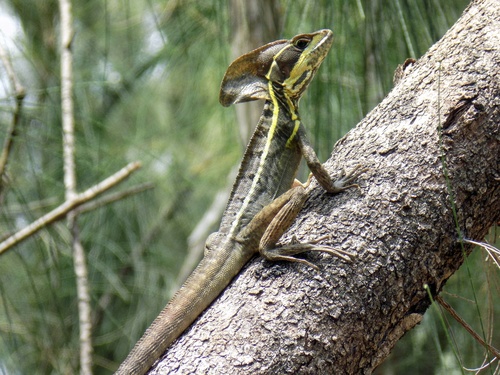
Common Basilisk Basiliscus basiliscus
The scientific name of the Common Basilisk is Basiliscus basiliscus. It is a species of reptile in the family Corytophanidae (helmet lizards), order Squamata. The name dates from 1758.
- Scientific name
- Basiliscus basiliscus (Linnaeus, 1758)
- Common name
- Common Basilisk
- Genus
- Basiliscus
- Family
- Corytophanidae (Helmet Lizards)
- Order
- Squamata
- Class
- Reptilia
- Red List category
- LC Least Concern
- Recorded in
- 8 countries
- Name status
- accepted in the Catalogue of Life

Overview
The common basilisk (Basiliscus basiliscus) is a species of lizard in the family Corytophanidae. The species is endemic to Central America and South America, where it is found near rivers and streams in rainforests. It is also known as the Jesus Christ lizard, Jesus lizard, South American Jesus lizard, or lagarto de Jesus Cristo for its ability to run on the surface of water.
Classification of the Common Basilisk
| Kingdom | Animalia |
|---|---|
| Phylum | Chordata |
| Subphylum | Vertebrata |
| Infraphylum | Gnathostomata |
| Parvphylum | Osteichthyes |
| Megaclass | Tetrapoda |
| Class | Reptilia (Reptile) |
| Order | Squamata (Snakes) |
| Suborder | Iguania (Iguanas) |
| Family | Corytophanidae (Helmet Lizards) |
| Genus | Basiliscus (Basilisks) |
| Species | Basiliscus basiliscus (Linnaeus, 1758) |
Where the Common Basilisk is found
Checklists and occurrence records place Basiliscus basiliscus in 8 countries across North America. GBIF holds 13,225 georeferenced records of it.
Countries
Regions and cities with the most records
- Puntarenas Province, Costa Rica 4,228
- Antioquia, Colombia 2,695
- Santander Department, Colombia 632
- Panamá, Panama 579
- Panama City, Panama 537
- Colón, Panama 501
- San Miguelito, Panama 499
- Juan Díaz, Panama 441
- Arraiján, Panama 426
- Magdalena Department, Colombia 395
- Guanacaste Province, Costa Rica 361
- Cesar Department, Colombia 305
- Bolívar, Colombia 256
- Coclé, Panama 246
- San José, Costa Rica 241
- Chiriquí Province, Panama 200
- Tocumen, Panama 194
- Panamá Oeste Province, Panama 186
- Ciénaga, Colombia 143
- Córdoba, Colombia 138
- Chocó, Colombia 137
- Alajuela, Costa Rica 132
- Veraguas Province, Panama 127
- Sucre Department, Colombia 112
- San José, Costa Rica 105
- Turbaco, Colombia 94
- Arjona, Colombia 92
- Darién, Panama 89
- Santa Marta, Colombia 89
- Alajuela Province, Costa Rica 87
- Cartagena, Colombia 87
- La Guajira Department, Colombia 75
- Apartadó, Colombia 71
- Liberia, Costa Rica 64
- Bello, Colombia 59
- David, Panama 59
2 more countries have a few records outside this range
These countries hold a few records of Basiliscus basiliscus but lie outside the range the checklists give for it. Such records are often zoo or garden specimens, museum material or vagrants, so the species is not counted as occurring there.
Range as the checklists state it
Costa Rica, Panama,
A number beside a place is its count of GBIF occurrence records. A place without a number comes from a checklist alone. Records show where a species has been observed or collected, which can include escapes and vagrants.
Common names
English
- Common Basilisk
- Jesus Christ Lizard
Names in 16 other languages
- Belarusian
- Шаломаносны васіліск
- Catalan
- Basilisc comú
- Croatian
- Bazilisk
- Czech
- bazilišek hřebenatý
- Danish
- Brun Basilisk
- Finnish
- Basiliskit
- French
- Basilic commun
- German
- Helmbasilisk
- Hebrew
- בסיליסק מצוי
- Hungarian
- sisakos baziliszkusz
- Italian
- Basilisco comune
- Japanese
- チャイロバシリスク
- Russian
- Шлемоносный василиск
- Spanish
- Basilisco, Basilisco común, Lagarto jesucristo común, Meracho, Toloque centroamericano
- Tamil
- இயேசுப் பல்லி
- Ukrainian
- Василіск звичайний
Synonyms
7 other scientific names have been used for this species and are now treated as synonyms of Basiliscus basiliscus.
- Basiliscus americanus Laurenti, 1768
- Basiliscus barbouri Ruthven, 1914
- Basiliscus guttulatus Cope, 1876
- Basiliscus mitratus Daudin, 1802
- Lacerta basiliscus Linnaeus, 1758
- Lophosaura goodridgii Gray, 1852
- Ophryessa bilineata Gray, 1839
Subspecies and varieties
- Basiliscus basiliscus barbouri subspecies
- Basiliscus basiliscus basiliscus subspecies
Related species
-
 Plumed BasiliskBasiliscus plumifrons
-
 Brown BasiliskBasiliscus vittatus
-
 Western BasiliskBasiliscus galeritus
-
 Smooth Helmeted IguanaCorytophanes cristatus
-
 Eastern Casquehead IguanaLaemanctus longipes
- Julio’s Casquehead IguanaLaemanctus julioi
-
 Hernandez’s Helmeted BasiliskCorytophanes hernandesii
-
 Serrated Casquehead IguanaLaemanctus serratus
Compare
Questions and answers
What is the scientific name of the Common Basilisk?
The scientific name of the Common Basilisk is Basiliscus basiliscus. Written with its author, the full name is Basiliscus basiliscus (Linnaeus, 1758).
Which family does the Common Basilisk belong to?
Basiliscus basiliscus belongs to the family Corytophanidae, in the order Squamata and the class Reptilia.
Where is the Common Basilisk found?
Checklists and occurrence records place Basiliscus basiliscus in 8 countries, including Costa Rica, Colombia, Panama, Nicaragua, Mexico and Belize.
What is the conservation status of the Common Basilisk?
The IUCN Red List category recorded for Basiliscus basiliscus is Least Concern (LC).
What other names does the Common Basilisk have?
Basiliscus basiliscus is also known in English as Jesus Christ Lizard.
Sources
Data
- Catalogue of Life, 2026-10-16 XR cc by
- Global Biodiversity Information Facility CC BY 4.0
- Wikidata CC0
- English Wikipedia CC BY-SA 4.0
- GeoNames CC BY 4.0
- Wikimedia Commons per image; credit shown with each image
- Within the Catalogue of Life, this name comes from The Reptile Database cc by
References
- Linné, C. [= Linnaeus, C.]. (1758). Systema naturæ per regna tria naturæ, secundum classes, ordines, genera, species, cum characteribus, differentiis, synonymis, locis. Tomus I. Editio decima, reformata. Laurentii Salvii, Holmiæ. 10th Edition: 824 Pp.
- Laurenti, J. N. (1768). Specimen medicum, exhibens synopsin reptilium emendatam cum experimentis circa venena et antidota reptilium austracorum, quod authoritate et consensu. Vienna, Joan. Thomae, 217 Pp.
- Shaw, G., & Nodder, F. P. (1793). The Naturalist’s Miscellany [...], Vol. IV. London, Nodder & Co., Plates 111-146, 158 Unnumbered Pages [Published in Monthly Issues between August 1, 1792, and July 1, 1793].
- Meyer, F. A. A. (1795). Synopsis Reptilium, novam ipsorum sistens generum methodum, nec non Gottingensium huius ordinis animalium enumerationem. Vandenhoeck Und Ruprecht, Göttingen, 32 Pp [for Current Names See Rösler & Böhme 2021].
- Daudin, F. M. (1802). Histoire Naturelle, génerale et particulièredes reptiles, ouvrage faisant suite, a l’histoiure naturelle, générale et particulière composée par LECLERC DE BUFFON, et redigée par C. S. SONNINI, vol. 3. F. Dufart, Paris, 452 Pp.
- Latreille, P. A. (1802). In: C.N.S. Sonnini de Manoncourt and P.A. Latreille. Histoire Naturelle des Reptiles, avec Figures Déssinnées d’après Nature. Vol. 3. Détérville, Paris [1802].
- Gray, J. E. (1839). Reptiles. In: J. Richardson et al., The Zoology of Captain Beechey`s Voyage... H.G. Bohn, London, 180 Pp. (+ Plates).
- Gray, J. E. (1845). Catalogue of the specimens of lizards in the collection of the British Museum. Trustees of Die British Museum/Edward Newman, London: Xxvii + 289 Pp.
- Gray, J. E. (1852). Description of several new genera of reptiles, principally from the collection of H.M.S. Herald. Ann. Mag. Nat. Hist. (2) 10: 437-440.
- Cope, E. D. (1875). On the Batrachia and Reptilia collected by Dr. John M. Bransford during the Nicaraguan Canal Survey of 1874. Jour. Acad. Nat. Sci. Philad. 8 (2): 155-157 + 6 Plates [Presumably Published in 1875, Not 1876].
- Boulenger, G. A. (1885). Catalogue of the lizards in the British Museum (Natural History). Vol. 2, Second edition. London, Xiii+497 Pp.
- Barbour, T. in: Bangs, Outram; Brown, Wilmont W.; Thayer, John E.; Barbour, Thomas. (1905). The Vertebrata of Gorgona Island, Colombia. 1 Introduction. Mammalia. 2. Physical aspect and climate; Fauna. 3 Aves. 4 Reptilia; Amphibia. Bull. Mus. Comp. Zool. Harvard 46 (5): 87-102.
- Ruthven, A. (1914). Description of a new species of Basiliscus from the region of the Sierra Nevada de Santa Marta, Colombia. Proc. Biol. Soc. Washington 27: 9-12.
- Taylor, E. H. (1956). A review of the lizards of Costa Rica. Univ. Kansas Sci. Bull. 38 (Part 1): 3-322.
- Maturana, H. R. (1962). A study of the species of the genus Basiliscus. Bull. Mus. Comp. Zool. Harvard 128: 1-34.
- Ortleb, E., & Heatwole, H. (1965). Comments on some Panamanian lizards with a key to the species from Barro Colorado Island, C.Z. and vicinity. Carib. J. Sci. 5 (3-4):141-147.
- Nemuras, K. (1967). Notes on the Herpetology of Panama: Part 3. Bull. Maryland Herp. Soc. 3 (2): 31-40.
- Peters, James A.; Donoso-Barros, Roberto & Orejas-Miranda, Braulio. (1970). Catalogue of the Neotropical Squamata: Part I Snakes. Bull. US Natl. Mus. 297: 347 Pp.
- Wever, E. G. (1971). The Ear of Basiliscus basiliscus (Sauria: Iguanidae); Its Structure and Function. Copeia 1971 (1): 139-144.
- Böhme, W. (1975). Indizien für natürliche Parthenogenese beim Helmbasilisken, Basiliscus basiliscus (Linnaeus 1758). Salamandra 11: 77-83.
- Kluge, Arnold G. (1984). Type-specimens of reptiles in the University of Michigan Museum of Zoology. [type catalogue]. Miscellaneous Publications, Museum of Zoology, University of Michigan (167): 1-85.
- Gotch, A. F. (1986). Reptiles - Their Latin Names Explained. Blandford Press, 176 Pp.
- Lang, M. (1989). Phylogenetic and Biogeographic Patterns of Basiliscine Iguanians (Reptilia: Squamata: “Iguanidae”). Bonner Zool. Monogr. 28: 1-172.
- Köhler, G. (1993). Basiliscus basiliscus (LINNAEUS, 1758). Sauria 15 Suppl.: 283–288.
- La Marca, E., & Milano, J. J. G. (1994). Basiliscus basiliscus barbouri (NCN). Venezuela: Estado Merida. Herpetological Review 25 (4): 164.
This species in other databases
Page built on 25 November 2026. See how the catalog is made and all sources and licences.
Cite this page
ScientificNames.org. (2026). Basiliscus basiliscus (Common Basilisk). Retrieved November 25, 2026, from https://scientificnames.org/species/basiliscus-basiliscus
“Basiliscus basiliscus (Common Basilisk).” ScientificNames.org, 2026, scientificnames.org/species/basiliscus-basiliscus. Accessed 25 Nov. 2026.
ScientificNames.org. “Basiliscus basiliscus (Common Basilisk).” Accessed November 25, 2026. https://scientificnames.org/species/basiliscus-basiliscus.
@misc{scientificnames_basiliscus_basiliscus_common_basilisk,
  author = {{ScientificNames.org}},
  title = {Basiliscus basiliscus (Common Basilisk)},
  year = {2026},
  url = {https://scientificnames.org/species/basiliscus-basiliscus},
  note = {Accessed 2026-11-25}
}