Species · Reptiles
Serrated Casquehead Iguana Laemanctus serratus
The scientific name of the Serrated Casquehead Iguana is Laemanctus serratus. It is a species of reptile in the family Corytophanidae (helmet lizards), order Squamata. The name dates from 1864.
- Scientific name
- Laemanctus serratus Cope, 1864
- Common name
- Serrated Casquehead Iguana
- Genus
- Laemanctus
- Family
- Corytophanidae (Helmet Lizards)
- Order
- Squamata
- Class
- Reptilia
- Red List category
- LC Least Concern
- Recorded in
- 4 countries
- Name status
- accepted in the Catalogue of Life

Overview
Laemanctus serratus occurs in southeastern Mexico and Central America. It has enlarged triangular scales along the rear margin of its head casque and a serrated crest running along the middle of its back.
Written 27 November 2026 from the sources listed below. Each statement was checked against the passage it cites; statements that could not be supported were removed.
Appearance
The species has enlarged triangular scales along the rear margin of its head casque. It also has a serrated crest running along the middle of its back.[1][2]
Habitat
The species' preferred natural habitat is forest.[3]
Behaviour
The species is active during the day.[4]
Reproduction and life cycle
The species reproduces by laying eggs.[5]
Classification of the Serrated Casquehead Iguana
| Kingdom | Animalia |
|---|---|
| Phylum | Chordata |
| Subphylum | Vertebrata |
| Infraphylum | Gnathostomata |
| Parvphylum | Osteichthyes |
| Megaclass | Tetrapoda |
| Class | Reptilia (Reptile) |
| Order | Squamata (Snakes) |
| Suborder | Iguania (Iguanas) |
| Family | Corytophanidae (Helmet Lizards) |
| Genus | Laemanctus (Conehead Lizards) |
| Species | Laemanctus serratus Cope, 1864 |
Where the Serrated Casquehead Iguana is found
Checklists and occurrence records place Laemanctus serratus in 4 countries across North America. GBIF holds 773 georeferenced records of it.
Countries
Regions and cities with the most records
- Yucatán, Mexico 228
- Quintana Roo, Mexico 137
- Tamaulipas, Mexico 78
- Veracruz, Mexico 78
- Campeche, Mexico 72
- Mérida, Mexico 52
- Chichén-Itzá, Mexico 47
- Kanasín, Mexico 47
- Playa del Carmen, Mexico 26
- Chiapas, Mexico 22
- San Luis Potosí, Mexico 22
- Umán, Mexico 22
- Puebla, Mexico 21
- Progreso, Mexico 20
- Lerdo de Tejada, Mexico 19
- Comitán, Mexico 16
- Tulum, Mexico 16
- Chetumal, Mexico 15
- Champotón, Mexico 14
- Tizimín, Mexico 14
- Valladolid, Mexico 12
- Motul, Mexico 11
- Cancún, Mexico 10
- Hunucmá, Mexico 10
- Catemaco, Mexico 9
- Tampico, Mexico 9
- Altamira, Mexico 8
- Ciudad Madero, Mexico 8
- Las Margaritas, Mexico 8
- Miramar, Mexico 8
- San Andrés Tuxtla, Mexico 8
- Ticul, Mexico 6
- Berriozábal, Mexico 5
- Ciudad Valles, Mexico 5
- Corozal District, Belize 5
- Veracruz, Mexico 5
1 more country has a few records outside this range
These countries hold a few records of Laemanctus serratus but lie outside the range the checklists give for it. Such records are often zoo or garden specimens, museum material or vagrants, so the species is not counted as occurring there.
Range as the checklists state it
Mexico (Yucatan, Chiapas, Oaxaca, Veracruz, Hidalgo, Campeche, Quintana Roo, San Luis Potosí, Tamaulipas, Puebla, Quéretaro [HR 27: 210]), Belize, Honduras, Guatemala
A number beside a place is its count of GBIF occurrence records. A place without a number comes from a checklist alone. Records show where a species has been observed or collected, which can include escapes and vagrants.
Common names
English
- Serrated Casquehead Iguana
Names in 5 other languages
- Czech
- bazilišek štíhlý
- German
- Gezackter Kronenbasilisk, Helmkopfbasilisk
- Japanese
- ノコヘリカンムリトカゲ
- Polish
- Hełmogwan koroniasty
- Spanish
- Lemacto coronado, Lemancto Coronado, Toloque coronado
Synonyms
2 other scientific names have been used for this species and are now treated as synonyms of Laemanctus serratus.
- Laemanctus alticoronatus Cope, 1866
- Laemanctus serratus mccoyi Perez-Higareda & Vogt, 1985
Subspecies and varieties
- Laemanctus serratus alticoronatus subspecies
- Laemanctus serratus serratus subspecies
Related species
-
 Eastern Casquehead IguanaLaemanctus longipes
- Julio’s Casquehead IguanaLaemanctus julioi
-
 Honduran Casquehead IguanaLaemanctus waltersi
-
 Common BasiliskBasiliscus basiliscus
-
 Plumed BasiliskBasiliscus plumifrons
-
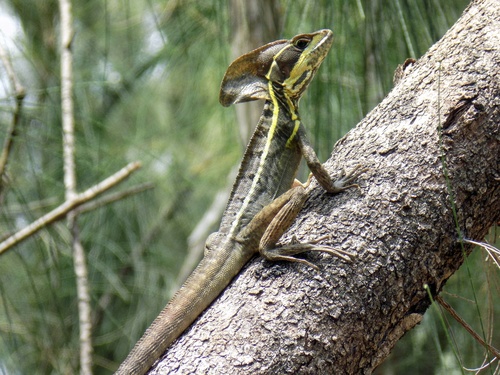 Brown BasiliskBasiliscus vittatus
-
 Smooth Helmeted IguanaCorytophanes cristatus
-
 Western BasiliskBasiliscus galeritus
Compare
Questions and answers
What is the scientific name of the Serrated Casquehead Iguana?
The scientific name of the Serrated Casquehead Iguana is Laemanctus serratus. Written with its author, the full name is Laemanctus serratus Cope, 1864.
Which family does the Serrated Casquehead Iguana belong to?
Laemanctus serratus belongs to the family Corytophanidae, in the order Squamata and the class Reptilia.
Where is the Serrated Casquehead Iguana found?
Checklists and occurrence records place Laemanctus serratus in 4 countries: Mexico, Belize, Honduras and Guatemala.
What is the conservation status of the Serrated Casquehead Iguana?
The IUCN Red List category recorded for Laemanctus serratus is Least Concern (LC).
Sources
Passages the profile rests on
- The species has enlarged triangular scales along the rear margin of its head casque. Source passage: “Laemanctus serratus has enlarged triangular scales along the posterior margin of the head casque” — English Wikipedia
- The species has a serrated crest running along the middle of its back. Source passage: “and a serrated middorsal crest.” — English Wikipedia
- The species' preferred natural habitat is forest. Source passage: “The preferred natural habitat of Laemanctus serratus is forest” — English Wikipedia
- The species is active during the day. Source passage: “Laemanctus serratus is diurnal” — English Wikipedia
- The species reproduces by laying eggs. Source passage: “Laemanctus serratus is oviparous.” — English Wikipedia
Data
- Catalogue of Life, 2026-10-16 XR cc by
- Global Biodiversity Information Facility CC BY 4.0
- Wikidata CC0
- GeoNames CC BY 4.0
- Wikimedia Commons per image; credit shown with each image
- Within the Catalogue of Life, this name comes from The Reptile Database cc by
References
- Cope, E. D. (1864). Contributions to the herpetology of tropical America. Proc. Acad. Nat. Sci. Philadelphia 16: 166-181.
- Cope, E. D. (1866). Third contribution to the herpetology of tropical America. Proc. Acad. Nat. Sci. Philadelphia 17: 185-198 [1865].
- Cope, E. D. (1866). Fourth contribution lo the herpetology of tropical America. Proc. Acad. Nat. Sci. Philadelphia, 18: 123-132.
- Boulenger, George A. (1878). Étude monographique du genre Læmanctus et description d’une espèce nouvelle. Bulletin de La Société Zoologique de France 2: 460-466 [1877].
- Boulenger, G. A. (1885). Catalogue of the lizards in the British Museum (Natural History). Vol. 2, Second edition. London, Xiii+497 Pp.
- Barbour, T., and L. J. Cole. (1906). Vertebrata from Yucatan. Reptilia, Amphibia and Pisces. Bull. Mus. Comp. Zool. Harvard 50: 146-159.
- Gaige, H. (1936). Some reptiles and amphibians from Yucatan and Campeche, Mexico. Carnegie Inst. Wash. Publ., (457): 289-304.
- Taylor, E. H. (1949). A preliminary account of the herpetology of the state of San Luis Potosi, Mexico. Univ. Kansas Sci. Bull. 33 (2): 169-215.
- Smith, H. M., & Taylor, E. H. (1950). An annotated checklist and key to the reptiles of Mexico exclusive of the snakes. Bull. US Natl. Mus. 199: 1-253.
- Álvarez DEL TORO, M., & SMITH, H. M. (1956). Notulae herpetologicae Chiapasiae. I. Herpetologica 12: 3-17.
- Martin, Plul S. (1958). A biogeography of reptiles and amphibians in the Gomez Farias Region, Tamaulipas, Mexico. Miscellaneous Publications, Museum of Zoology, University of Michigan (101): 1-102 + 7 Plates.
- McCOY, C. J. (1968). A review of the genus Laemanctus (Reptilia: Iguanidae). Copeia 1968 (4): 665-78.
- Perez-Higareda G. & Vogt, R.C. (1985). A new subspecies of arboreal lizard, genus Laemanctus, from the mountainous region of Los Tuxtlas, Veracruz, Mexico (Lacertilia, Iguanidae). Bull. Maryland Herp. Soc. 21: 139-144.
- Johnson, J. D. (1989). A biogeographic analysis of the herpetofauna of northwestern Nuclear Central America. Milwaukee Public Mus. Contrib. In Biol. And Geol. No. 76, 66 Pp.
- García, U. P., Ballardo, W. S., & Mendoza-Quijano, F. (1996). Geographic Distribution. Laemanctus serratus serratus. Herpetological Review 27 (4): 211.
- Lee, J. C. (1996). The amphibians and reptiles of the Yucatán Peninsula. Comstock, Cornell University Press, Ithaca, 500 Pp.
- Campbell, J. A. (1998). Amphibians and reptiles of northern Guatemala, the Yucatán, and Belize. Norman: University of Oklahoma Press, Xiii + 380 Pp.
- Canseco-Marquez, L., & Gutierrez-Mayen, Q. (1998). Geographic Distribution. Laemanctus serratus serratus. Herpetological Review 29 (1): 51.
- Lee, J. C. (2000). A field guide to the amphibians and reptiles of the Maya world. Cornell University Press, Ithaca,.
- Köhler, G. (2000). Reptilien und Amphibien Mittelamerikas, Bd 1: Krokodile, Schildkröten, Echsen. Herpeton Verlag, Offenbach, 158 Pp.
- Hribal, J., & Holanova, V. (2004). Laemanctus serratus, The Casquehead Iguana. Reptilia (GB) (32): 48-52.
- McCranie, J. R., & Köhler, G. (2004). Laemanctus serratus. Catalogue of American Amphibians and Reptiles 796: 1-5.
- McCranie, J. R., & Köhler, G. (2004). Laemanctus Wiegmann, Casqueheaded Basilisks, Cutetes. Catalogue of American Amphibians and Reptiles 794: 1-2.
- Vieira, G. H. C., Colli, G. R., & Báo, S. N. (2005). Phylogenetic relationships of corytophanid lizards (Iguania, Squamata, Reptilia) based on partitioned and total evidence analyses of sperm morphology, gross morphology, and DNA data. Zoologica Scripta 34 (6): 605-625.
- Dixon, James R. and Julio A. Lemos-Espinal. (2010). Amphibians and reptiles of the state of Queretaro, Mexico. Tlalnepantla UNAM, 428 Pp.
This species in other databases
Page built on 27 November 2026. See how the catalog is made and all sources and licences.
Cite this page
ScientificNames.org. (2026). Laemanctus serratus (Serrated Casquehead Iguana). Retrieved November 27, 2026, from https://scientificnames.org/species/laemanctus-serratus
“Laemanctus serratus (Serrated Casquehead Iguana).” ScientificNames.org, 2026, scientificnames.org/species/laemanctus-serratus. Accessed 27 Nov. 2026.
ScientificNames.org. “Laemanctus serratus (Serrated Casquehead Iguana).” Accessed November 27, 2026. https://scientificnames.org/species/laemanctus-serratus.
@misc{scientificnames_laemanctus_serratus_serrated_casquehead_iguana,
  author = {{ScientificNames.org}},
  title = {Laemanctus serratus (Serrated Casquehead Iguana)},
  year = {2026},
  url = {https://scientificnames.org/species/laemanctus-serratus},
  note = {Accessed 2026-11-27}
}