Species · Amphibians
Pedra Da Tartaruga Flea Toad Brachycephalus auroguttatus
The scientific name of the Pedra Da Tartaruga Flea Toad is Brachycephalus auroguttatus. It is a species of amphibian in the family Brachycephalidae (shield toads), order Anura. The name dates from 2015.
- Scientific name
- Brachycephalus auroguttatus Ribeiro, Firkowski, Bornschein & Pie, 2015
- Common name
- Pedra Da Tartaruga Flea Toad
- Genus
- Brachycephalus
- Family
- Brachycephalidae (Shield Toads)
- Order
- Anura
- Class
- Amphibia
- Name status
- accepted in the Catalogue of Life

Overview
The Pedra da Tartaruga Flea Toad is an amphibian in the Brachycephalus pernix species group. It has a bright yellow head, a brown coloration toward the rear of its body, yellow spots on its limbs and a yellow stripe along its back.
Written 27 November 2026 from the sources listed below. Each statement was checked against the passage it cites; statements that could not be supported were removed.
Appearance
The Pedra da Tartaruga Flea Toad has a robust, toad-like body shape. Its head is bright yellow, with coloration becoming increasingly brown toward the rear of the body.[1][2]
Its legs and arms have yellow spots along their backs, and dark spots occur along the sides of its body. A yellow stripe runs along its back and is less orange than the stripe of Brachycephalus pombali.[3][4][5]
Its dorsal skin lacks dermal co-ossification. Adults have an average length ranging from 9.0 to 13.6 millimetres.[6][7]
Habitat
The species is recorded from cloud forest habitat. It occurs at elevations between 1,070 and 1,100 metres above sea level.[8][9]
It is known only from its type locality at Pedra da Tartaruga in Santa Catarina, Brazil. The type locality is the rocky formation of Pedra da Tartaruga.[10][11]
Conservation
The species may be experiencing population decline because of habitat loss.[12]
Similar species
The dorsal appearance of the Pedra da Tartaruga Flea Toad resembles that of Brachycephalus olivaceus and Brachycephalus mariaeterezae. It differs from the dorsal appearance of Brachycephalus izecksohni and Brachycephalus brunneus.[13][14]
Its back stripe is less orange than that of Brachycephalus pombali. The species belongs to the Brachycephalus pernix species group, whose members share a toad-like body shape and lack osteoderms.[15][16][17]
Classification of the Pedra Da Tartaruga Flea Toad
| Kingdom | Animalia |
|---|---|
| Phylum | Chordata |
| Subphylum | Vertebrata |
| Infraphylum | Gnathostomata |
| Parvphylum | Osteichthyes |
| Megaclass | Tetrapoda |
| Class | Amphibia (Amphibians) |
| Order | Anura (Frogs) |
| Superfamily | Brachycephaloidea |
| Family | Brachycephalidae (Shield Toads) |
| Genus | Brachycephalus (Saddleback Toad) |
| Species | Brachycephalus auroguttatus Ribeiro, Firkowski, Bornschein & Pie, 2015 |
Common names
English
- Pedra Da Tartaruga Flea Toad
Related species
-
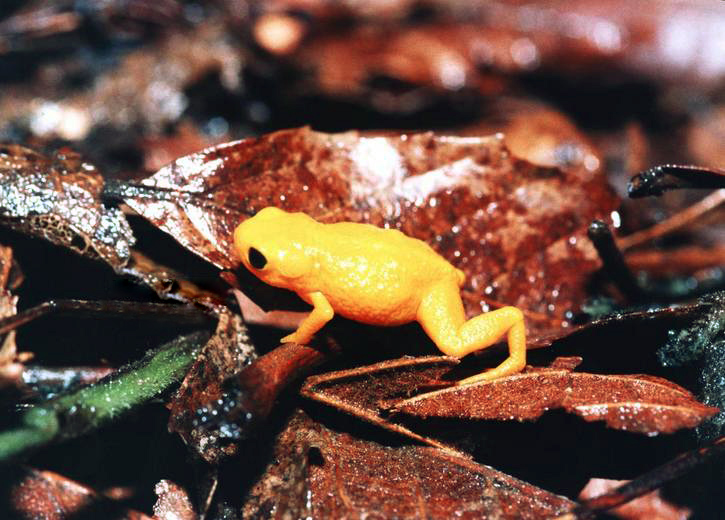 Pumpkin ToadletBrachycephalus ephippium
-
 Brazilian Flea ToadBrachycephalus pulex
-
 Brachycephalus dacnis
-
 Brazilian Gold FrogBrachycephalus didactylus
-
 Pumpkin ToadletBrachycephalus pitanga
- Morro Anhangava Flea ToadBrachycephalus pernix
-
 Pico Caratuva Flea ToadBrachycephalus brunneus
-
 Vargem Alta Flea ToadBrachycephalus alipioi
Compare
Questions and answers
What is the scientific name of the Pedra Da Tartaruga Flea Toad?
The scientific name of the Pedra Da Tartaruga Flea Toad is Brachycephalus auroguttatus. Written with its author, the full name is Brachycephalus auroguttatus Ribeiro, Firkowski, Bornschein & Pie, 2015.
Which family does the Pedra Da Tartaruga Flea Toad belong to?
Brachycephalus auroguttatus belongs to the family Brachycephalidae, in the order Anura and the class Amphibia.
What is the Brazilian Flea Toad?
The Pedra da Tartaruga Flea Toad (Brachycephalus auroguttatus) is an amphibian belonging to the family Brachycephalidae and the order Anura. It belongs to the Brachycephalus pernix species group.[16]
Sources
Passages the profile rests on
- The species has a robust, toad-like body shape. Source passage: “its robust, bufoniform body” — English Wikipedia
- Its head is bright yellow, with coloration becoming increasingly brown toward the rear of the body. Source passage: “its dorsal coloration that shifts from a bright yellow colour on its head with increasingly brownish towards its posterior section” — English Wikipedia
- Its legs and arms have yellow spots along their backs. Source passage: “its legs and arms carry yellow spots along the back” — English Wikipedia
- The species has a yellow stripe along its back that is less orange than the stripe of Brachycephalus pombali. Source passage: “The species also possesses a yellow stripe on its back, which is less orange than B. pombali's.” — English Wikipedia
- Dark spots occur along the sides of its body. Source passage: “This species also shows dark spots along the sides of its body” — English Wikipedia
- Its dorsal skin lacks dermal co-ossification. Source passage: “the skin on its dorsum shows no dermal co-ossification” — English Wikipedia
- Adults have an average length ranging from 9.0 to 13.6 millimetres. Source passage: “adult average length between 9.0 to 13.6 millimetres (0.35 to 0.54 in)” — English Wikipedia
- The species is recorded from cloud forest habitat. Source passage: “which is a cloud forest in the Pedra da Tartaruga” — English Wikipedia
- The species occurs at elevations between 1,070 and 1,100 metres above sea level. Source passage: “at a height of between 1,070 to 1,100 metres (3,510 to 3,610 ft) above sea level.” — English Wikipedia
- The species is known only from its type locality at Pedra da Tartaruga in Santa Catarina, Brazil. Source passage: “Brachycephalus auroguttatus is known only from its type locality” — English Wikipedia
- Its type locality is the rocky formation of Pedra da Tartaruga in the Brazilian state of Santa Catarina. Source passage: “the Pedra da Tartaruga, a rocky formation in the State of Santa Catarina” — English Wikipedia
- The species may be experiencing population decline because of habitat loss. Source passage: “It might be in population decline due to habitat loss.” — English Wikipedia
- Its dorsal appearance resembles that of Brachycephalus olivaceus and Brachycephalus mariaeterezae. Source passage: “its dorsum is similar to that of B. olivaceus and B. mariaeterezae” — English Wikipedia
- Its dorsal appearance differs from that of Brachycephalus izecksohni and Brachycephalus brunneus. Source passage: “which is different to B. izecksohni or B. brunneusto, for example.” — English Wikipedia
- Its back stripe is less orange than the stripe of Brachycephalus pombali. Source passage: “which is less orange than B. pombali's.” — English Wikipedia
- The species belongs to the Brachycephalus pernix species group. Source passage: “Being a representative of the pernix group” — English Wikipedia
- The Brachycephalus pernix group shares a toad-like body shape and lacks osteoderms. Source passage: “share a bufoniform body shape and lack osteoderms” — pmc.ncbi.nlm.nih.gov
Data
- Catalogue of Life, 2026-10-16 XR cc by
- Wikidata CC0
- Wikimedia Commons per image; credit shown with each image
- Within the Catalogue of Life, this name comes from The Integrated Taxonomic Information System cc0
References
- Ribeiro, Luiz F., Marcos R. Bornschein, Ricardo Belmonte-Lopes, Carina R. Firkowski, Sergio A. A. Morato & Marcio R. Pie. 2015. Seven new microendemic species of Brachycephalus (Anura: Brachycephalidae) from southern Brazil. PeerJ 3: e1011. where the name was published
This species in other databases
Page built on 29 November 2026. See how the catalog is made and all sources and licences.
Cite this page
ScientificNames.org. (2026). Brachycephalus auroguttatus (Pedra Da Tartaruga Flea Toad). Retrieved November 29, 2026, from https://scientificnames.org/species/brachycephalus-auroguttatus
“Brachycephalus auroguttatus (Pedra Da Tartaruga Flea Toad).” ScientificNames.org, 2026, scientificnames.org/species/brachycephalus-auroguttatus. Accessed 29 Nov. 2026.
ScientificNames.org. “Brachycephalus auroguttatus (Pedra Da Tartaruga Flea Toad).” Accessed November 29, 2026. https://scientificnames.org/species/brachycephalus-auroguttatus.
@misc{scientificnames_brachycephalus_auroguttatus_pedra_da_tartaruga_flea_toad,
  author = {{ScientificNames.org}},
  title = {Brachycephalus auroguttatus (Pedra Da Tartaruga Flea Toad)},
  year = {2026},
  url = {https://scientificnames.org/species/brachycephalus-auroguttatus},
  note = {Accessed 2026-11-29}
}