Species · Amphibians
Morro Anhangava Flea Toad Brachycephalus pernix
The scientific name of the Morro Anhangava Flea Toad is Brachycephalus pernix. It is a species of amphibian in the family Brachycephalidae (shield toads), order Anura. The name dates from 1998.
- Scientific name
- Brachycephalus pernix Pombal, Wistuba & Bornschein, 1998
- Common name
- Morro Anhangava Flea Toad
- Genus
- Brachycephalus
- Family
- Brachycephalidae (Shield Toads)
- Order
- Anura
- Class
- Amphibia
- Red List category
- CR Critically Endangered
- Recorded in
- 1 country
- Name status
- accepted in the Catalogue of Life
Overview
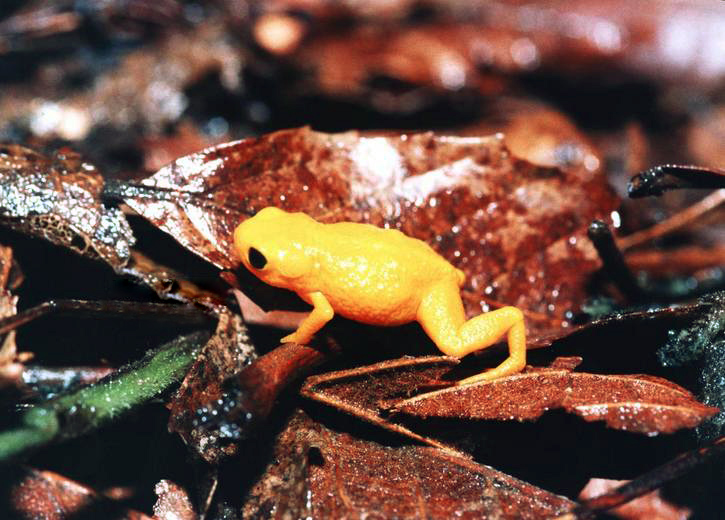
Adults have bright orange coloration with variable black mottling or spotting, and their skin and organs contain tetrodotoxin and similar toxins.
Written 26 November 2026 from the sources listed below. Each statement was checked against the passage it cites; statements that could not be supported were removed.
Appearance
Adults have an overall bright orange coloration with variable amounts of black mottling or spotting on their upper surfaces. The bright coloration is considered warning coloration.[1][2]
Adult males measure 12–13.3 mm in snout-to-vent length, while adult females measure 14.1–15.8 mm.[3][4]
The species' skin and organs contain tetrodotoxin and similar toxins.[5]
Habitat
The known locality is situated at an elevation of 1,135–1,405 m.[6]
Behaviour
The species is diurnal.[7]
Conservation
The IUCN last reviewed the species in 2004 and classified it as data deficient.[8]
An independent assessment in 2019 recommended classifying the species as vulnerable under IUCN criteria.[9]
Classification of the Morro Anhangava Flea Toad
| Kingdom | Animalia |
|---|---|
| Phylum | Chordata |
| Subphylum | Vertebrata |
| Infraphylum | Gnathostomata |
| Parvphylum | Osteichthyes |
| Megaclass | Tetrapoda |
| Class | Amphibia (Amphibians) |
| Order | Anura (Frogs) |
| Superfamily | Brachycephaloidea |
| Family | Brachycephalidae (Shield Toads) |
| Genus | Brachycephalus (Saddleback Toad) |
| Species | Brachycephalus pernix Pombal, Wistuba & Bornschein, 1998 |
Where the Morro Anhangava Flea Toad is found
Checklists and occurrence records place Brachycephalus pernix in 1 country. GBIF holds 16 georeferenced records of it.
Countries
Regions and cities with the most records
- Campina Grande do Sul, Brazil 7
- Paraná, Brazil 7
- Piraquara, Brazil 7
- Quatro Barras, Brazil 7
- Pinhais, Brazil 6
- Colombo, Brazil 5
- Garuva, Brazil 4
- Itapoá, Brazil 4
- Santa Catarina, Brazil 4
- São Francisco do Sul, Brazil 4
A number beside a place is its count of GBIF occurrence records. A place without a number comes from a checklist alone. Records show where a species has been observed or collected, which can include escapes and vagrants.
Common names
English
- Morro Anhangava Flea Toad
- Shield Toad
Names in 1 other language
- Czech
- ropušenka paranská
Related species
-
 Pumpkin ToadletBrachycephalus ephippium
-
 Brazilian Flea ToadBrachycephalus pulex
-
 Brachycephalus dacnis
-
 Brazilian Gold FrogBrachycephalus didactylus
-
 Pumpkin ToadletBrachycephalus pitanga
-
 Pico Caratuva Flea ToadBrachycephalus brunneus
-
 Vargem Alta Flea ToadBrachycephalus alipioi
-
 Pedra Da Tartaruga Flea ToadBrachycephalus auroguttatus
Compare
Questions and answers
What is the scientific name of the Morro Anhangava Flea Toad?
The scientific name of the Morro Anhangava Flea Toad is Brachycephalus pernix. Written with its author, the full name is Brachycephalus pernix Pombal, Wistuba & Bornschein, 1998.
Which family does the Morro Anhangava Flea Toad belong to?
Brachycephalus pernix belongs to the family Brachycephalidae, in the order Anura and the class Amphibia.
Where is the Morro Anhangava Flea Toad found?
Checklists and occurrence records place Brachycephalus pernix in 1 country: Brazil.
What is the conservation status of the Morro Anhangava Flea Toad?
The IUCN Red List category recorded for Brachycephalus pernix is Critically Endangered (CR).
What other names does the Morro Anhangava Flea Toad have?
Brachycephalus pernix is also known in English as Shield Toad.
Sources
Passages the profile rests on
- Adults have an overall bright orange coloration with variable amounts of black mottling or spotting on their upper surfaces. Source passage: “It is overall bright orange with a variable amount of black mottling or spotting above” — English Wikipedia
- The species' bright coloration is considered warning coloration. Source passage: “The bright pattern is considered aposematic (warning colours)” — English Wikipedia
- Adult males measure 12–13.3 mm in snout-to-vent length. Source passage: “12–13.3 mm (0.47–0.52 in) in adult males” — English Wikipedia
- Adult females measure 14.1–15.8 mm in snout-to-vent length. Source passage: “14.1–15.8 mm (0.56–0.62 in) in adult females” — English Wikipedia
- The species' skin and organs contain tetrodotoxin and similar toxins. Source passage: “its skin and organs contain tetrodotoxin and similar toxins.” — English Wikipedia
- The known locality is situated at an elevation of 1,135–1,405 m. Source passage: “at an altitude of 1,135–1,405 m (3,724–4,610 ft) on Serra da Baitaca” — English Wikipedia
- The species is diurnal. Source passage: “This diurnal species lives among leaf litter” — English Wikipedia
- The IUCN last reviewed the species in 2004 and classified it as data deficient. Source passage: “Its conservation status was last reviewed by the IUCN in 2004 where regarded as data deficient” — English Wikipedia
- An independent assessment in 2019 recommended classifying the species as vulnerable under IUCN criteria. Source passage: “an independent review in 2019 that used IUCN's criteria recommended that B. pernix should be recognised as vulnerable.” — English Wikipedia
Data
- Catalogue of Life, 2026-10-16 XR cc by
- Global Biodiversity Information Facility CC BY 4.0
- Wikidata CC0
- GeoNames CC BY 4.0
- Within the Catalogue of Life, this name comes from The Integrated Taxonomic Information System cc0
References
- A new species of brachycephalid (Anura) from the Atlantic Rain Forest of Brazil. (1998). Journal of Herpetology, 32(1), 70–74. https://doi.org/10.2307/1565481 Link where the name was published
This species in other databases
Page built on 27 November 2026. See how the catalog is made and all sources and licences.
Cite this page
ScientificNames.org. (2026). Brachycephalus pernix (Morro Anhangava Flea Toad). Retrieved November 27, 2026, from https://scientificnames.org/species/brachycephalus-pernix
“Brachycephalus pernix (Morro Anhangava Flea Toad).” ScientificNames.org, 2026, scientificnames.org/species/brachycephalus-pernix. Accessed 27 Nov. 2026.
ScientificNames.org. “Brachycephalus pernix (Morro Anhangava Flea Toad).” Accessed November 27, 2026. https://scientificnames.org/species/brachycephalus-pernix.
@misc{scientificnames_brachycephalus_pernix_morro_anhangava_flea_toad,
  author = {{ScientificNames.org}},
  title = {Brachycephalus pernix (Morro Anhangava Flea Toad)},
  year = {2026},
  url = {https://scientificnames.org/species/brachycephalus-pernix},
  note = {Accessed 2026-11-27}
}