Species · Amphibians
Morro Dos Padres Flea Toad Brachycephalus pombali
The scientific name of the Morro Dos Padres Flea Toad is Brachycephalus pombali. It is a species of amphibian in the family Brachycephalidae (shield toads), order Anura. The name dates from 2006.
- Scientific name
- Brachycephalus pombali Alves, Ribeiro, Haddad & Reis, 2006
- Common name
- Morro Dos Padres Flea Toad
- Genus
- Brachycephalus
- Family
- Brachycephalidae (Shield Toads)
- Order
- Anura
- Class
- Amphibia
- Red List category
- VU Vulnerable
- Recorded in
- 1 country
- Name status
- accepted in the Catalogue of Life
Overview
Brachycephalus pombali is known only from its type locality at Morro dos Padres, Pico da Igreja, in the Serra do Mar, Guaratuba, Paraná state, Brazil. It has a robust, orange, toad-like body, lacks a tympanum and has reduced phalanges in its hands and feet.
Written 27 November 2026 from the sources listed below. Each statement was checked against the passage it cites; statements that could not be supported were removed.
Habitat
The Morro dos Padres Flea Toad inhabits leaf litter in the Atlantic Rainforest. Its type locality is approximately 1,300 metres above sea level.[1][2]
Appearance
The species has a robust, toad-like body with general orange coloration. Its lateral body surfaces bear small dark brown spots, while the belly has brownish coalescent spots and small dots.[3][4][5][6]
The skin on the top of the head and central dorsal body is smooth and lacks dermal co-ossification. The dorso-lateral body surfaces, flanks and dorsal surfaces of the thighs have granular skin.[7][8]
The species lacks a tympanum and has reduced phalanges in its hands and feet associated with miniaturization.[9][10]
Adult males measure 12.6–13.9 mm in snout–vent length. Adult females measure 14.6–15.3 mm in snout–vent length.[11][12]
Behaviour
The species is active during the day. Adult males are exposed on the leaf litter while calling.[13][14]
Conservation
The species is known from only a single location. No threats to the species are currently known.[15][16]
Classification of the Morro Dos Padres Flea Toad
| Kingdom | Animalia |
|---|---|
| Phylum | Chordata |
| Subphylum | Vertebrata |
| Infraphylum | Gnathostomata |
| Parvphylum | Osteichthyes |
| Megaclass | Tetrapoda |
| Class | Amphibia (Amphibians) |
| Order | Anura (Frogs) |
| Superfamily | Brachycephaloidea |
| Family | Brachycephalidae (Shield Toads) |
| Genus | Brachycephalus (Saddleback Toad) |
| Species | Brachycephalus pombali Alves, Ribeiro, Haddad & Reis, 2006 |
Where the Morro Dos Padres Flea Toad is found
Checklists and occurrence records place Brachycephalus pombali in 1 country. GBIF holds 3 georeferenced records of it.
Countries
A number beside a place is its count of GBIF occurrence records. A place without a number comes from a checklist alone. Records show where a species has been observed or collected, which can include escapes and vagrants.
Common names
English
- Morro Dos Padres Flea Toad
Related species
-
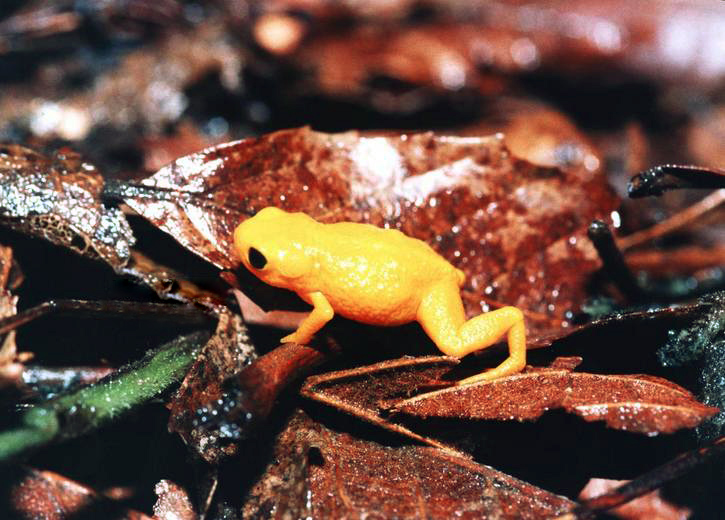 Pumpkin ToadletBrachycephalus ephippium
-
 Brazilian Flea ToadBrachycephalus pulex
-
 Brachycephalus dacnis
-
 Brazilian Gold FrogBrachycephalus didactylus
-
 Pumpkin ToadletBrachycephalus pitanga
- Morro Anhangava Flea ToadBrachycephalus pernix
-
 Pico Caratuva Flea ToadBrachycephalus brunneus
-
 Vargem Alta Flea ToadBrachycephalus alipioi
Compare
Questions and answers
What is the scientific name of the Morro Dos Padres Flea Toad?
The scientific name of the Morro Dos Padres Flea Toad is Brachycephalus pombali. Written with its author, the full name is Brachycephalus pombali Alves, Ribeiro, Haddad & Reis, 2006.
Which family does the Morro Dos Padres Flea Toad belong to?
Brachycephalus pombali belongs to the family Brachycephalidae, in the order Anura and the class Amphibia.
Where is the Morro Dos Padres Flea Toad found?
Checklists and occurrence records place Brachycephalus pombali in 1 country: Brazil.
What is the conservation status of the Morro Dos Padres Flea Toad?
The IUCN Red List category recorded for Brachycephalus pombali is Vulnerable (VU).
Sources
Passages the profile rests on
- The type locality of the species is approximately 1,300 metres above sea level. Source passage: “The type locality is at about 1,300 m (4,300 ft) above sea level.” — English Wikipedia
- The species inhabits leaf litter in the Atlantic Rainforest. Source passage: “Brachycephalus pombali inhabit the leaf litter in the Atlantic Rainforest.” — English Wikipedia
- The species has a robust, toad-like body. Source passage: “The body is robust and toad-like.” — English Wikipedia
- The general body coloration is orange. Source passage: “The general color is orange” — English Wikipedia
- The lateral body surfaces bear small dark brown spots. Source passage: “lateral surfaces have small dark brown spots” — English Wikipedia
- The belly has brownish coalescent spots and small dots. Source passage: “belly has brownish coalescent spots and small dots.” — English Wikipedia
- The skin on the top of the head and central dorsal body is smooth and lacks dermal co-ossification. Source passage: “The skin on top of the head and central part of the back body is smooth and without dermal co-ossification” — English Wikipedia
- The dorso-lateral body surfaces, flanks and dorsal surfaces of the thighs have granular skin. Source passage: “the skin on dorso-lateral surfaces of body, flanks, and dorsal surface of thighs is granular.” — English Wikipedia
- The species lacks a tympanum. Source passage: “There is no tympanum.” — English Wikipedia
- The species has reduced phalanges in its hands and feet associated with miniaturization. Source passage: “this miniaturization is associated with loss of phalanges in hands and feet.” — English Wikipedia
- Adult males measure 12.6–13.9 mm in snout–vent length. Source passage: “adult males measure 12.6–13.9 mm (0.50–0.55 in)” — English Wikipedia
- Adult females measure 14.6–15.3 mm in snout–vent length. Source passage: “females 14.6–15.3 mm (0.57–0.60 in) in snout–vent length” — English Wikipedia
- The species is active during the day. Source passage: “They are active by day.” — English Wikipedia
- Adult males are exposed on the leaf litter while calling. Source passage: “Adult males are exposed on the litter when calling.” — English Wikipedia
- No threats to the species are currently known. Source passage: “There are no known threats to this species” — English Wikipedia
- The species is known from only a single location. Source passage: “it is only known from a single location.” — English Wikipedia
- The species is known only from its type locality at Morro dos Padres, Pico da Igreja, in the Serra do Mar, Guaratuba, Paraná state, Brazil. Source passage: “only known from its type locality, "Morro dos Padres, Pico da Igreja", in the Serra do Mar in Guaratuba, Paraná state.” — English Wikipedia
Data
- Catalogue of Life, 2026-10-16 XR cc by
- Global Biodiversity Information Facility CC BY 4.0
- Wikidata CC0
- GeoNames CC BY 4.0
- Within the Catalogue of Life, this name comes from The Integrated Taxonomic Information System cc0
References
- Two new species of Brachycephalus (Anura: Brachycephalidae) from the Atlantic Forest in Parana State, southern Brazil. (2006). Herpetologica, 62(2), 221–233. https://doi.org/10.1655/05-41.1 Link where the name was published
This species in other databases
Page built on 28 November 2026. See how the catalog is made and all sources and licences.
Cite this page
ScientificNames.org. (2026). Brachycephalus pombali (Morro Dos Padres Flea Toad). Retrieved November 28, 2026, from https://scientificnames.org/species/brachycephalus-pombali
“Brachycephalus pombali (Morro Dos Padres Flea Toad).” ScientificNames.org, 2026, scientificnames.org/species/brachycephalus-pombali. Accessed 28 Nov. 2026.
ScientificNames.org. “Brachycephalus pombali (Morro Dos Padres Flea Toad).” Accessed November 28, 2026. https://scientificnames.org/species/brachycephalus-pombali.
@misc{scientificnames_brachycephalus_pombali_morro_dos_padres_flea_toad,
  author = {{ScientificNames.org}},
  title = {Brachycephalus pombali (Morro Dos Padres Flea Toad)},
  year = {2026},
  url = {https://scientificnames.org/species/brachycephalus-pombali},
  note = {Accessed 2026-11-28}
}