Species · Fishes
Scaly Whipray Brevitrygon imbricata
The scientific name of the Scaly Whipray is Brevitrygon imbricata. It is a species of fish in the family Dasyatidae (whiptail stingray), order Myliobatiformes. The name dates from 1801.
- Scientific name
- Brevitrygon imbricata (Bloch & Schneider, 1801)
- Common name
- Scaly Whipray
- Genus
- Brevitrygon
- Family
- Dasyatidae (Whiptail Stingray)
- Order
- Myliobatiformes
- Class
- Elasmobranchii
- Red List category
- VU Vulnerable
- Environment
- brackish, freshwater, marine
- Recorded in
- 11 countries
- Name status
- accepted in the Catalogue of Life

Overview
Brevitrygon imbricata inhabits inshore coastal waters, particularly estuarine environments, and occurs in tropical Indo-West Pacific waters extending from the Red Sea and Mauritius to Indonesia. It has a disc as wide as it is long, a tail shorter than its body and an entirely white ventral surface.
Written 27 November 2026 from the sources listed below. Each statement was checked against the passage it cites; statements that could not be supported were removed.
Appearance
The Scaly Whipray has a disc width equal to its disc length and a tail shorter than its body. Its ventral disc surface is entirely white.[1][2][3]
It reaches a maximum disc width of approximately 22 cm and can reach approximately 65 cm in total length.[4][5]
Habitat
The Scaly Whipray inhabits inshore coastal waters, particularly estuarine environments. Juveniles may occur in mangrove habitats.[6][7]
Diet
Young and adult Scaly Whiprays feed on benthic invertebrates. They are thought to feed largely on benthic flatworms.[8][9]
Behaviour
The Scaly Whipray migrates between saltwater and freshwater environments. This migration is not associated with breeding and does not exceed 100 km.[10][11][12]
Reproduction and life cycle
The Scaly Whipray is ovoviviparous.[13]
Conservation
The Bengal whipray is listed as Vulnerable on the IUCN Red List.[14]
Uses
The Scaly Whipray is harvested by Sri Lankan fisheries.[15]
Classification of the Scaly Whipray
| Kingdom | Animalia |
|---|---|
| Phylum | Chordata |
| Subphylum | Vertebrata |
| Infraphylum | Gnathostomata |
| Parvphylum | Chondrichthyes |
| Class | Elasmobranchii |
| Subclass | Neoselachii |
| Infraclass | Batoidea |
| Order | Myliobatiformes |
| Family | Dasyatidae (Whiptail Stingray) |
| Genus | Brevitrygon (Dwarf Whiprays) |
| Species | Brevitrygon imbricata (Bloch & Schneider, 1801) |
Where the Scaly Whipray is found
Checklists and occurrence records place Brevitrygon imbricata in 11 countries. GBIF holds 174 georeferenced records of it.
Countries
- India 68
- Indonesia 8
- Kuwait 8
- Malaysia 7
- Maldives 3
- Pakistan 8
- Singapore 5
- Sri Lanka 14
- Thailand 40
- United Arab Emirates 4
- Vietnam 9
Regions and cities with the most records
- Tamil Nadu, India 14
- Injambakkam, India 10
- Jalladiampet, India 10
- Kullattūr, India 10
- Neelankarai, India 10
- Pallikaranai, India 10
- Meddappakkam, India 9
- Rajakilpakkam, India 9
- Sholinganallur, India 9
- Madipakkam, India 8
- Tiruvottiyūr, India 8
- Manali, India 7
- Mathur, India 7
- Tambaram, India 6
- Ambattur, India 5
- Ariyānkuppam, India 5
- Chennai, India 5
- Gundupālaiyam, India 5
- Kaikalapettai, India 5
- Kottaikuppam, India 5
- Kurumbapet, India 5
- Madhavaram, India 5
- Maduraivayal, India 5
- Maduravoyal, India 5
- Manaveli, India 5
- Meenambakkam, India 5
- Mugalivakkam, India 5
- Nalambūr, India 5
- Nerkunram, India 5
- Pallāvaram, India 5
- Polichalur, India 5
- Poonamalle, India 5
- Porur, India 5
- Puducherry, India 5
- Ramapuram, India 5
- Saint Thomas Mount, India 5
1 more country has a few records outside this range
These countries hold a few records of Brevitrygon imbricata but lie outside the range the checklists give for it. Such records are often zoo or garden specimens, museum material or vagrants, so the species is not counted as occurring there.
A number beside a place is its count of GBIF occurrence records. A place without a number comes from a checklist alone. Records show where a species has been observed or collected, which can include escapes and vagrants.
Common names
English
- Scaly Whipray
- Bengal Whipray
- Coromandel Whipray
- Dwarf Whipray
- Laccadive Whipray
Names in 8 other languages
- Arabic
- شفنين السوط الحرشفي
- Czech
- trnucha coromandelská
- Finnish
- suistosiimarausku
- German
- Bengal-Peitschenrochen
- Italian
- Pastinaca del Bengala
- Malay
- Pari Blentung, Pari Lalat, Pari Pasir, Pari Tanjung
- Portuguese
- Raia-de-Bengala
- Thai
- Kabang, ปลากระบางกลม
Synonyms
12 other scientific names have been used for this species and are now treated as synonyms of Brevitrygon imbricata.
- Amphotistius imbricatus (Bloch & Schneider, 1801)
- Dasyatis imbricata (Bloch & Schneider, 1801)
- Dasyatis imbricatus (Bloch & Schneider, 1801)
- Dasybatus imbricatus (Bloch & Schneider, 1801)
- Himantura dadong (Bleeker, 1877)
- Himantura imbricata (Bloch & Schneider, 1801)
- Himantura imbricatus (Bloch & Schneider, 1801)
- Himuntura imbricata (Bloch & Schneider, 1801)
- Leiobatis polylepis (Bleeker, 1852)
- Raja imbricata Bloch & Schneider, 1801
- Trygon imbricata (Bloch & Schneider, 1801)
- Raja obtusa Ehrenberg, 1871 ambiguous synonym
Related species
-
 Bengal WhiprayBrevitrygon walga
-
 Dwarf WhiprayBrevitrygon heterura
- Javan WhiprayBrevitrygon javaensis
- Sandwich-tail WhiprayBrevitrygon manjajiae
-
 Bluespotted Ribbontail RayTaeniura lymma
-
 Common StingrayDasyatis pastinaca
-
 Pelagic StingrayPteroplatytrygon violacea
-
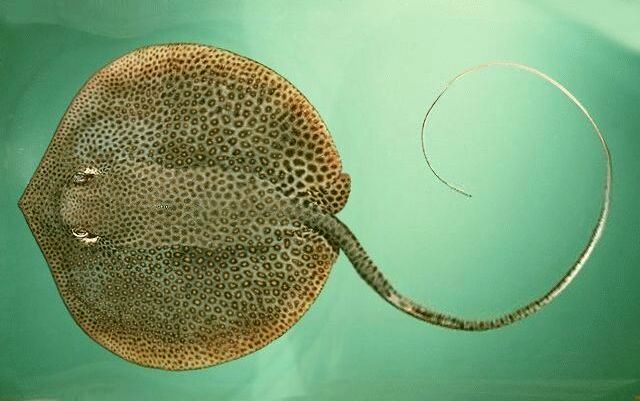 Reticulate WhiprayHimantura uarnak
Compare
Questions and answers
What is the scientific name of the Scaly Whipray?
The scientific name of the Scaly Whipray is Brevitrygon imbricata. Written with its author, the full name is Brevitrygon imbricata (Bloch & Schneider, 1801).
Which family does the Scaly Whipray belong to?
Brevitrygon imbricata belongs to the family Dasyatidae, in the order Myliobatiformes and the class Elasmobranchii.
Where is the Scaly Whipray found?
Checklists and occurrence records place Brevitrygon imbricata in 11 countries, including India, Thailand, Sri Lanka, Vietnam, Indonesia and Kuwait.
What is the conservation status of the Scaly Whipray?
The IUCN Red List category recorded for Brevitrygon imbricata is Vulnerable (VU).
What other names does the Scaly Whipray have?
Brevitrygon imbricata is also known in English as Bengal Whipray, Coromandel Whipray, Dwarf Whipray and Laccadive Whipray.
Sources
Passages the profile rests on
- The species has a disc width equal to its disc length. Source passage: “The disc width of the scaly whipray is equal to its disc length” — English Wikipedia
- The species has a tail shorter than its body. Source passage: “the tail is shorter than the body.” — English Wikipedia
- The ventral surface of the disc is entirely white. Source passage: “The ventral surface of the disc is entirely white.” — English Wikipedia
- The species reaches a maximum disc width of approximately 22 cm. Source passage: “Its width is up to 22 cm (8.7 in)” — English Wikipedia
- The species can reach approximately 65 cm in total length. Source passage: “it may reach 65 cm (2 ft 2 in) in total length.” — English Wikipedia
- The species inhabits inshore coastal waters, particularly estuarine environments. Source passage: “The scaly whipray is found in inshore coastal waters, typically in estuarine habitats.” — English Wikipedia
- Juveniles of the species may occur in mangrove habitats. Source passage: “juveniles may be present in mangroves.” — English Wikipedia
- Young and adult individuals feed on benthic invertebrates. Source passage: “Young and adults feed on benthic invertebrates” — English Wikipedia
- The species is thought to feed largely on benthic flatworms. Source passage: “Bengal whiprays are often misidentified at the species level and are thought to largely feed on benthic flatworms.” — pmc.ncbi.nlm.nih.gov
- The species migrates between saltwater and freshwater environments. Source passage: “They migrate between saltwater and freshwater” — English Wikipedia
- Its migration between saltwater and freshwater is not associated with breeding. Source passage: “though not for the purpose of breeding.” — English Wikipedia
- The species does not migrate distances exceeding 100 km. Source passage: “They do not migrate more than 100 km (62 mi).” — English Wikipedia
- The species is ovoviviparous. Source passage: “Reproduction is ovoviviparous.” — English Wikipedia
- The Bengal whipray is listed as Vulnerable on the IUCN Red List. Source passage: “these two species, which are listed as Near Threatened and Vulnerable, respectively, on the International Union for Conservation of Nature Red List.” — pmc.ncbi.nlm.nih.gov
- The species is harvested by Sri Lankan fisheries. Source passage: “Trophic Ecology of the Tiger Shark (Galeocerdo cuvier) and Bengal Whipray (Brevitrygon imbricata) Harvested by Sri Lankan Fisheries” — pmc.ncbi.nlm.nih.gov
Data
- Catalogue of Life, 2026-10-16 XR cc by
- Global Biodiversity Information Facility CC BY 4.0
- Wikidata CC0
- GeoNames CC BY 4.0
- Wikimedia Commons per image; credit shown with each image
- Within the Catalogue of Life, this name comes from World Register of Marine Species cc by
This species in other databases
- Catalogue of Life 5WQZM
- Wikidata Q28926196
- iNaturalist 623825
- WoRMS urn:lsid:marinespecies.org:taxname:1042823
Page built on 29 November 2026. See how the catalog is made and all sources and licences.
Cite this page
ScientificNames.org. (2026). Brevitrygon imbricata (Scaly Whipray). Retrieved November 29, 2026, from https://scientificnames.org/species/brevitrygon-imbricata
“Brevitrygon imbricata (Scaly Whipray).” ScientificNames.org, 2026, scientificnames.org/species/brevitrygon-imbricata. Accessed 29 Nov. 2026.
ScientificNames.org. “Brevitrygon imbricata (Scaly Whipray).” Accessed November 29, 2026. https://scientificnames.org/species/brevitrygon-imbricata.
@misc{scientificnames_brevitrygon_imbricata_scaly_whipray,
  author = {{ScientificNames.org}},
  title = {Brevitrygon imbricata (Scaly Whipray)},
  year = {2026},
  url = {https://scientificnames.org/species/brevitrygon-imbricata},
  note = {Accessed 2026-11-29}
}