Species · Fishes
Sandwich-tail Whipray Brevitrygon manjajiae
The scientific name of the Sandwich-tail Whipray is Brevitrygon manjajiae. It is a species of fish in the family Dasyatidae (whiptail stingray), order Myliobatiformes. The name dates from 2023.
- Scientific name
- Brevitrygon manjajiae Last, Weigmann & Naylor, 2023
- Common name
- Sandwich-tail Whipray
- Genus
- Brevitrygon
- Family
- Dasyatidae (Whiptail Stingray)
- Order
- Myliobatiformes
- Class
- Elasmobranchii
- Environment
- marine
- Recorded in
- 1 country
- Name status
- accepted in the Catalogue of Life
Overview
The Sandwich-tail Whipray occurs in the Persian Gulf and Arabian Sea in the north-western Indian Ocean. It has an oval disc, small orbits, relatively small pelvic fins and a relatively short tail with a ridge-like ventral fold.
Written 27 November 2026 from the sources listed below. Each statement was checked against the passage it cites; statements that could not be supported were removed.
Appearance
The Sandwich-tail Whipray has an oval disc, small orbits and a relatively short tail with a ridge-like ventral fold. Its pelvic fins are relatively small, and its dorsal surface is predominantly brownish.[1][2][3]
The species reaches a disc width of at least 25 cm and may reach 35 cm.[4][5]
Habitat
The Sandwich-tail Whipray inhabits continental shelf environments throughout its distribution range. It generally occurs at depths of up to 40 metres.[6][7]
In the Gulf of Oman, it occurs at depths reaching 94 metres.[8]
Behaviour
The Sandwich-tail Whipray is deliberately targeted by local trawlers.[9]
Conservation
The species faces direct threats from fishing in coastal regions of Pakistan and western India.[10]
Uses
In the Persian Gulf, the species is generally discarded as a low-value catch. It is consumed as a delicacy and sold in Indian seafood markets.[11][12]
In Maharashtra and Gujarat, India, the species is retained for consumption and widely sold in traditional markets.[13]
In Pakistan, the species is retained and usually exported to Southeast Asia for human consumption.[14]
Classification of the Sandwich-tail Whipray
| Kingdom | Animalia |
|---|---|
| Phylum | Chordata |
| Subphylum | Vertebrata |
| Infraphylum | Gnathostomata |
| Parvphylum | Chondrichthyes |
| Class | Elasmobranchii |
| Subclass | Neoselachii |
| Infraclass | Batoidea |
| Order | Myliobatiformes |
| Family | Dasyatidae (Whiptail Stingray) |
| Genus | Brevitrygon (Dwarf Whiprays) |
| Species | Brevitrygon manjajiae Last, Weigmann & Naylor, 2023 |
Where the Sandwich-tail Whipray is found
Checklists and occurrence records place Brevitrygon manjajiae in 1 country. GBIF holds 46 georeferenced records of it.
Countries
Regions and cities with the most records
- Mumbai, India 19
- Maharashtra, India 14
- Borivli, India 12
- Airoli, India 11
- Gorai, India 11
- Powai, India 11
- Thāne, India 11
- Chanaje, India 9
- Uran, India 9
- Bhayandar, India 8
- Kalher, India 4
- Cuncolim, India 3
- Karnataka, India 3
A number beside a place is its count of GBIF occurrence records. A place without a number comes from a checklist alone. Records show where a species has been observed or collected, which can include escapes and vagrants.
Common names
English
- Sandwich-tail Whipray
- Arabian Whipray
- Scaly Whipray
Names in 2 other languages
- German
- Sandwich-Peitschenrochen
- Italian
- Pastinaca muso lungo araba
Related species
-
 Bengal WhiprayBrevitrygon walga
-
 Scaly WhiprayBrevitrygon imbricata
-
 Dwarf WhiprayBrevitrygon heterura
- Javan WhiprayBrevitrygon javaensis
-
 Bluespotted Ribbontail RayTaeniura lymma
-
 Common StingrayDasyatis pastinaca
-
 Pelagic StingrayPteroplatytrygon violacea
-
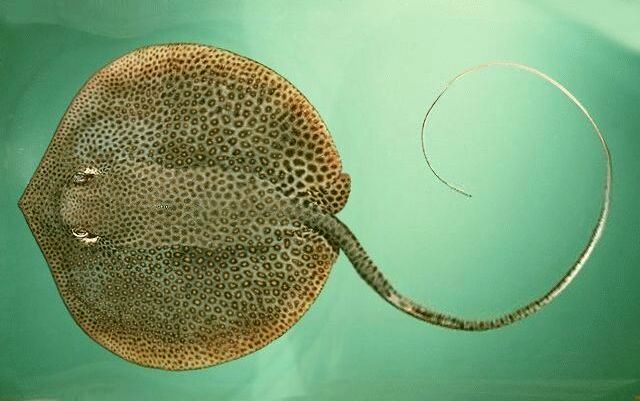 Reticulate WhiprayHimantura uarnak
Compare
Questions and answers
What is the scientific name of the Sandwich-tail Whipray?
The scientific name of the Sandwich-tail Whipray is Brevitrygon manjajiae. Written with its author, the full name is Brevitrygon manjajiae Last, Weigmann & Naylor, 2023.
Which family does the Sandwich-tail Whipray belong to?
Brevitrygon manjajiae belongs to the family Dasyatidae, in the order Myliobatiformes and the class Elasmobranchii.
Where is the Sandwich-tail Whipray found?
Checklists and occurrence records place Brevitrygon manjajiae in 1 country: India.
What other names does the Sandwich-tail Whipray have?
Brevitrygon manjajiae is also known in English as Arabian Whipray and Scaly Whipray.
Sources
Passages the profile rests on
- The species has an oval disc, small orbits, and a relatively short tail with a ridge-like ventral fold. Source passage: “oval disc, small orbits, relatively short tail with ridge-like ventral fold” — English Wikipedia
- The species has relatively small pelvic fins. Source passage: “relatively small pelvic fins” — English Wikipedia
- The species has a predominantly brownish dorsal surface. Source passage: “predominantly brownish dorsal surface” — English Wikipedia
- The species reaches a disc width of at least 25 cm. Source passage: “This species is at least 25 cm (9.8 in) disc width” — English Wikipedia
- The species may reach a disc width of 35 cm. Source passage: “might reach 35 cm (14 in) disc width.” — English Wikipedia
- The species inhabits continental shelf environments throughout its distribution range. Source passage: “inhabits the continental shelf across its distribution range” — English Wikipedia
- The species generally occurs at depths of up to 40 metres. Source passage: “lives in the maximum depth of 40 metres (130 ft) in general.” — English Wikipedia
- The species occurs at depths reaching 94 metres in the Gulf of Oman. Source passage: “to 94 m (310 ft) in Gulf of Oman.” — English Wikipedia
- The species is deliberately targeted by local trawlers. Source passage: “This species is often deliberately targeted by local trawlers.” — English Wikipedia
- The species faces direct threats from fishing in coastal regions of Pakistan and western India. Source passage: “This demersal ray faces direct threats because it is regularly captured in the coastal regions of Pakistan and western India.” — English Wikipedia
- The species is generally discarded as a low-value catch in the Persian Gulf. Source passage: “In Persian Gulf area, it is considered a low-value catch and usually discarded.” — English Wikipedia
- The species is consumed as a delicacy and sold in Indian seafood markets. Source passage: “it is a delicacy and sold locally in Indian seafood markets.” — English Wikipedia
- The species is retained for consumption and widely sold in traditional markets in Maharashtra and Gujarat, India. Source passage: “In India, it is retained as consumption and widely sold in traditional markets, mostly on Maharashtra and Gujarat.” — English Wikipedia
- The species is retained in Pakistan and usually exported to Southeast Asia for human consumption. Source passage: “In Pakistan, the species is retained and usually exported to Southeast Asia for human consumption.” — English Wikipedia
Data
- Catalogue of Life, 2026-10-16 XR cc by
- Global Biodiversity Information Facility CC BY 4.0
- Wikidata CC0
- GeoNames CC BY 4.0
- Within the Catalogue of Life, this name comes from World Register of Marine Species cc by
References
- Last, P. R., Weigmann, S., & Naylor, G. J. P. (2023). The Indo-Pacific Stingray Genus Brevitrygon (Myliobatiformes: Dasyatidae): Clarification of Historical Names and Description of a New Species, B. manjajiae sp. nov., from the Western Indian Ocean. Diversity, 15. https://doi.org/10.3390/d15121213 Link where the name was published
This species in other databases
- Catalogue of Life KV2YG
- Wikidata Q132731600
- iNaturalist 1520489
- WoRMS urn:lsid:marinespecies.org:taxname:1806821
Page built on 28 November 2026. See how the catalog is made and all sources and licences.
Cite this page
ScientificNames.org. (2026). Brevitrygon manjajiae (Sandwich-tail Whipray). Retrieved November 28, 2026, from https://scientificnames.org/species/brevitrygon-manjajiae
“Brevitrygon manjajiae (Sandwich-tail Whipray).” ScientificNames.org, 2026, scientificnames.org/species/brevitrygon-manjajiae. Accessed 28 Nov. 2026.
ScientificNames.org. “Brevitrygon manjajiae (Sandwich-tail Whipray).” Accessed November 28, 2026. https://scientificnames.org/species/brevitrygon-manjajiae.
@misc{scientificnames_brevitrygon_manjajiae_sandwich_tail_whipray,
  author = {{ScientificNames.org}},
  title = {Brevitrygon manjajiae (Sandwich-tail Whipray)},
  year = {2026},
  url = {https://scientificnames.org/species/brevitrygon-manjajiae},
  note = {Accessed 2026-11-28}
}