Species · Birds
Great Black Hawk Buteogallus urubitinga
The scientific name of the Great Black Hawk is Buteogallus urubitinga. It is a species of bird in the family Accipitridae (hawks), order Accipitriformes. The name dates from 1788.
- Scientific name
- Buteogallus urubitinga (J. F. Gmelin, 1788)
- Common name
- Great Black Hawk
- Genus
- Buteogallus
- Family
- Accipitridae (Hawks)
- Order
- Accipitriformes
- Class
- Aves
- Red List category
- LC Least Concern
- Environment
- terrestrial
- Recorded in
- 22 countries
- Name status
- accepted in the Catalogue of Life

Overview
The Great Black Hawk is a bird in the genus Buteogallus. It inhabits coastal areas, forests, open woodland near water, and coastal lowlands. Adults are predominantly black, with very broad wings and a short white tail ending in a broad black tip.
Written 26 November 2026 from the sources listed below. Each statement was checked against the passage it cites; statements that could not be supported were removed.
Appearance
Adult birds are predominantly black with very broad wings and a short white tail ending in a broad black tip. They have a black bill and yellow legs and cere.[1][2]
Immature birds have dark brown upperparts with spots and streaks, buff underparts with dark spots, and tails bearing black and dusky bars.[3]
The Great Black Hawk has longer legs and a longer tail than the Common Black Hawk. Adults measure 56–64 cm in length and weigh approximately 1.1 kg.[4][5][6]
Habitat
The Great Black Hawk inhabits coastal areas, forests, and open woodland near water. It also inhabits coastal lowlands.[7][8]
Diet
The Great Black Hawk feeds mainly on reptiles and other small vertebrates, including amphibians, fish, birds, and small mammals.[9]
Its diet also includes crabs, large insects, carrion, eggs, and fruits. It often hunts its food on foot.[10][11]
Along Amazon rivers, the Great Black Hawk raids hoatzin nesting colonies to obtain eggs and chicks.[12]
Behaviour
The Great Black Hawk is frequently observed soaring above woodlands. It produces a distinctive piping call described as ooo-wheeeeee.[13][14]
Adults have calls in flight that differ substantially from those of the Common Black Hawk.[15]
Reproduction and life cycle
The Great Black Hawk builds large stick nests in trees. It usually lays one whitish egg marked with dark blotches.[16][17]
Similar species
The Great Black Hawk resembles the Common Black Hawk but is larger and differs in its call and tail pattern.[18]
Classification of the Great Black Hawk
| Kingdom | Animalia |
|---|---|
| Phylum | Chordata |
| Subphylum | Vertebrata |
| Infraphylum | Gnathostomata |
| Parvphylum | Osteichthyes |
| Megaclass | Tetrapoda |
| Class | Aves (Bird) |
| Order | Accipitriformes (Hawks) |
| Family | Accipitridae (Hawks) |
| Genus | Buteogallus (Black-Hawks) |
| Species | Buteogallus urubitinga (J. F. Gmelin, 1788) |
Where the Great Black Hawk is found
Checklists and occurrence records place Buteogallus urubitinga in 22 countries across North America and South America. GBIF holds 69,238 georeferenced records of it.
Countries
- Argentina 5,681
- Belize 5,760
- Bolivia 2,025
- Brazil 16,715
- Colombia 5,067
- Costa Rica 4,771
- Ecuador 1,332
- El Salvador 173
- French Guiana 648
- Guatemala 628
- Guyana 1,757
- Honduras 475
- Mexico 6,518
- Nicaragua 195
- Panama 2,987
- Paraguay 1,704
- Peru 7,067
- Suriname 866
- Trinidad and Tobago 1,134
- United States 893
- Uruguay 98
- Venezuela 2,744
Regions and cities with the most records
- Mato Grosso, Brazil 8,710
- Loreto, Peru 3,810
- Madre de Dios, Peru 2,754
- Cayo District, Belize 2,504
- Mato Grosso do Sul, Brazil 2,336
- Veracruz, Mexico 1,744
- Puntarenas Province, Costa Rica 1,632
- Belize District, Belize 1,408
- Alajuela Province, Costa Rica 1,391
- San Ignacio, Belize 1,324
- Amazonas, Brazil 1,312
- Orange Walk District, Belize 1,253
- Santa Fe, Argentina 1,187
- Tobago, Trinidad and Tobago 1,075
- Beni Department, Bolivia 1,072
- Poconé, Brazil 987
- Alcalde Díaz, Panama 974
- Minatitlán, Mexico 928
- Nanchital de Lázaro Cárdenas del Río, Mexico 926
- Nayarit, Mexico 921
- Cosoleacaque, Mexico 919
- Formosa, Argentina 885
- Scarborough, Trinidad and Tobago 875
- Panamá, Panama 865
- Chilibre, Panama 864
- West Scarborough, United States 814
- Maine, United States 812
- Guanacaste Province, Costa Rica 811
- Yucatán, Mexico 801
- Chaco, Argentina 797
- Upper Takutu-Upper Essequibo, Guyana 797
- São Paulo, Brazil 758
- Portland, United States 750
- South Portland, United States 750
- South Portland Gardens, United States 750
- Westbrook, United States 750
Range as the checklists state it
Middle America
South America
A number beside a place is its count of GBIF occurrence records. A place without a number comes from a checklist alone. Records show where a species has been observed or collected, which can include escapes and vagrants.
Common names
English
- Great Black Hawk
- Great Black-Hawk
Names in 28 other languages
- Arabic
- باز أسود كبير
- Catalan
- aligot negre gros
- Chinese
- 大黑雞鵟, 大黑鸡鵟
- Croatian
- crni škanjac
- Czech
- káně velká
- Danish
- Stor Sortvåge
- Dutch
- zwarte arendbuizerd
- Esperanto
- granda buteo
- Estonian
- sooviu
- Finnish
- isomustahaukka
- French
- Buse urubu
- Galician
- Gabián negro
- German
- Schwarzbussard
- Hungarian
- fekete rákászölyv
- Italian
- Poiana nera maggiore
- Japanese
- オオクロノスリ
- Lithuanian
- meksikinis krabinis suopis
- Norwegian
- svartvåk
- Polish
- Urubitinga, urubitinga czarna
- Portuguese
- bútio-preto-grande, gavião-preto
- Russian
- Большой крабоед, Мексиканский крабовый канюк
- Serbian
- Veliki crni mišar
- Slovak
- myšiak vodný
- Spanish
- Aguililla Negra Mayor, Aguililla-negra mayor, Busardo urubitinga, Cangrejero mayor, Gavilán Negro Mayor, Águila negra
- Swedish
- större svartvråk
- Turkish
- Büyük Kara Şahin
- Ukrainian
- канюк-крабоїд великий
- Welsh
- gwalch du mawr
Synonyms
5 other scientific names have been used for this species and are now treated as synonyms of Buteogallus urubitinga.
- Aquila brasiliensis Brisson, 1759
- Falco longipes Lichtenstein, MHC, 1816
- Falco urubitinga J. F. Gmelin, 1788
- Hypomorphnus urubitinga Gmelin, JF, 1788
- Urubitinga urubitinga Gmelin, JF, 1788
Subspecies and varieties
- Buteogallus urubitinga ridgwayi (Ridgway's Black Hawk) subspecies
- Buteogallus urubitinga urubitinga (Great Black Hawk) subspecies
Related species
-
 Common Black HawkButeogallus anthracinus
-
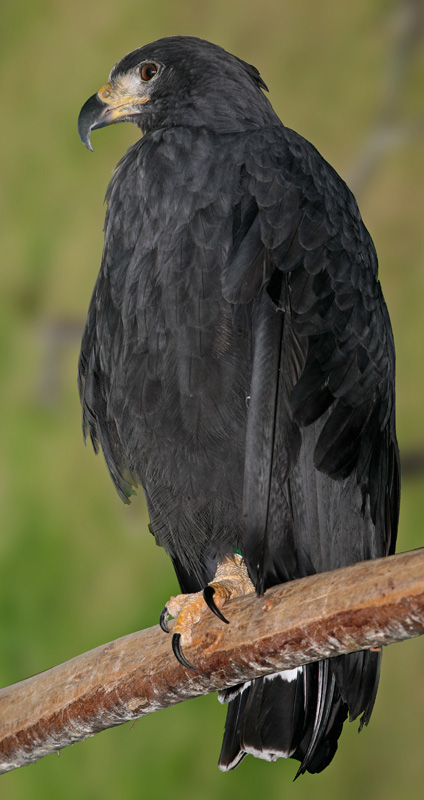 Solitary EagleButeogallus solitarius
-
 Chaco EagleButeogallus coronatus
-
 Savanna HawkButeogallus meridionalis
-
 Buteogallus borrasi
-
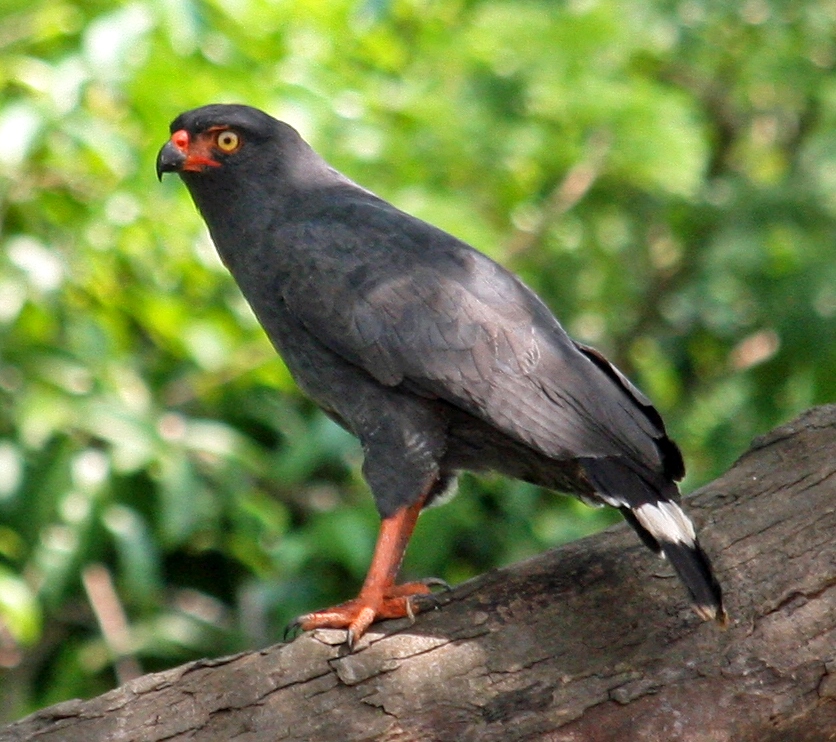 Slate-colored HawkButeogallus schistaceus
-
 Rufous Crab HawkButeogallus aequinoctialis
-
 Cuban Black HawkButeogallus gundlachii
Compare
Questions and answers
What is the scientific name of the Great Black Hawk?
The scientific name of the Great Black Hawk is Buteogallus urubitinga. Written with its author, the full name is Buteogallus urubitinga (J. F. Gmelin, 1788).
Which family does the Great Black Hawk belong to?
Buteogallus urubitinga belongs to the family Accipitridae, in the order Accipitriformes and the class Aves.
Where is the Great Black Hawk found?
Checklists and occurrence records place Buteogallus urubitinga in 22 countries, including Brazil, Peru, Mexico, Belize, Argentina and Colombia.
What is the conservation status of the Great Black Hawk?
The IUCN Red List category recorded for Buteogallus urubitinga is Least Concern (LC).
What other names does the Great Black Hawk have?
Buteogallus urubitinga is also known in English as Great Black-Hawk.
Sources
Passages the profile rests on
- Adult birds are predominantly black with very broad wings and a short white tail ending in a broad black tip. Source passage: “It has very broad wings, and is mainly black. The short tail is white with a broad black tip.” — English Wikipedia
- Adults have a black bill and yellow legs and cere. Source passage: “The bill is black and the legs and cere are yellow.” — English Wikipedia
- Immature birds have dark brown upperparts with spots and streaks, buff underparts with dark spots, and tails bearing black and dusky bars. Source passage: “immature birds are dark brown above with spotting and streaks. Their underparts are buff with dark spots, and the tail has a number of black and dusky bars.” — English Wikipedia
- The species has longer legs and a longer tail than the Common Black Hawk. Source passage: “Slightly larger and lankier than Common Black Hawk, with longer legs and tail” — ebird.org
- Adult Great Black Hawks measure 56–64 cm in length. Source passage: “The adult great black hawk is 56 to 64 centimetres (22 to 25 in) long” — English Wikipedia
- Adult Great Black Hawks weigh approximately 1.1 kg. Source passage: “weighs 1.1 kilograms (2 lb 7 oz).” — English Wikipedia
- The species inhabits coastal areas, forests, and open woodland near water. Source passage: “It is a mainly coastal bird, but also lives in forests and open woodland near water.” — English Wikipedia
- The species inhabits coastal lowlands. Source passage: “inhabiting coastal lowlands and.” — digitalcommons.usf.edu
- The species feeds mainly on reptiles and other small vertebrates, including amphibians, fish, birds, and small mammals. Source passage: “feeds mainly on reptiles, other small vertebrates (such as amphibians, fish, birds, and small mammals [including bats])” — English Wikipedia
- The species also consumes crabs, large insects, carrion, eggs, and fruits. Source passage: “crabs, large insects, carrion, eggs, and fruits” — English Wikipedia
- The species often hunts its food on foot. Source passage: “often hunted on foot.” — English Wikipedia
- Along Amazon rivers, the species raids hoatzin nesting colonies to obtain eggs and chicks. Source passage: “Along Amazon rivers it has been observed raiding hoatzin nesting colonies looking for eggs and chicks.” — English Wikipedia
- The species is frequently observed soaring above woodlands. Source passage: “This species is often seen soaring above woodlands.” — English Wikipedia
- The species produces a distinctive piping call described as ooo-wheeeeee. Source passage: “The call of the great black hawk is a distinctive piping ooo-wheeeeee.” — English Wikipedia
- Adults of this species have calls in flight that differ substantially from those of the Common Black Hawk. Source passage: “adults of the two species have very different calls in flight.” — ebird.org
- The species builds large stick nests in trees. Source passage: “It builds a large stick nest in a tree” — English Wikipedia
- The species usually lays one whitish egg marked with dark blotches. Source passage: “usually lays one dark-blotched whitish egg.” — English Wikipedia
- The Great Black Hawk resembles the Common Black Hawk but is larger and differs in its call and tail pattern. Source passage: “It resembles the common black hawk, but is larger with a different call and tail pattern.” — English Wikipedia
Data
- Catalogue of Life, 2026-10-16 XR cc by
- Global Biodiversity Information Facility CC BY 4.0
- Wikidata CC0
- GeoNames CC BY 4.0
- Wikimedia Commons per image; credit shown with each image
- Within the Catalogue of Life, this name comes from The Integrated Taxonomic Information System cc0
References
- Syst. Nat., 1(1): 265. 1788 where the name was published
- Gill, Frank, & and Minturn Wright. (2006). Birds of the World: Recommended English Names.
This species in other databases
- Catalogue of Life NYW3
- Wikidata Q1261514
- iNaturalist 5238
- WoRMS urn:lsid:marinespecies.org:taxname:422589
- Avibase grbhaw1
Page built on 27 November 2026. See how the catalog is made and all sources and licences.
Cite this page
ScientificNames.org. (2026). Buteogallus urubitinga (Great Black Hawk). Retrieved November 27, 2026, from https://scientificnames.org/species/buteogallus-urubitinga
“Buteogallus urubitinga (Great Black Hawk).” ScientificNames.org, 2026, scientificnames.org/species/buteogallus-urubitinga. Accessed 27 Nov. 2026.
ScientificNames.org. “Buteogallus urubitinga (Great Black Hawk).” Accessed November 27, 2026. https://scientificnames.org/species/buteogallus-urubitinga.
@misc{scientificnames_buteogallus_urubitinga_great_black_hawk,
  author = {{ScientificNames.org}},
  title = {Buteogallus urubitinga (Great Black Hawk)},
  year = {2026},
  url = {https://scientificnames.org/species/buteogallus-urubitinga},
  note = {Accessed 2026-11-27}
}