Species · Reptiles
Golden-crowned Snake Cacophis squamulosus
The scientific name of the Golden-crowned Snake is Cacophis squamulosus. It is a species of reptile in the family Elapidae (cobras), order Squamata. The name dates from 1854.

Overview
Cacophis squamulosus is endemic to Australia, ranging from Canberra in the Australian Capital Territory to Cairns in Queensland, and inhabits forested areas, particularly rainforest. It is distinguished by a pale yellow-brown crown stripe, a grayish-brown to dark brown dorsal surface, and an orange to pink underside marked with black spots.
Written 26 November 2026 from the sources listed below. Each statement was checked against the passage it cites; statements that could not be supported were removed.
Appearance
The dorsal surface ranges from grayish-brown to dark brown, while the ventral surface is orange to pink with a mid-line of black spots. A pale yellow-brown crown stripe begins at the snout, runs along both sides of the head without joining behind it, and continues down the neck.[1][2]
The species has 15 rows of dorsal scales at mid-body.[3]
Its average total length, including the tail, is approximately 50 cm. It can reach a total length of 98 cm.[4][5]
Habitat
The Golden-crowned Snake is a forest specialist with a particular preference for rainforest. It prefers deeper forested areas, especially rainforest on mountain slopes.[6][7]
It can also occur in suburbs near waterways and moist environments that provide ground cover and shelter. The species is endemic to Australia, with a geographic range in eastern Australia extending from Canberra in the Australian Capital Territory to Cairns in Queensland.[8][9][10]
Diet
Its diet consists mainly of skinks and other small lizards. It may also consume frogs and tadpoles.[11][12]
Behaviour
The Golden-crowned Snake hunts its prey at night. When threatened, it may bluff or deliver mock bites while raising its body into an S-shape.[13][14]
During its defensive display, it exposes its bright orange ventral pigmentation. The species is only mildly venomous, although bites from larger individuals may pose a health risk.[15][16][17]
Reproduction and life cycle
The Golden-crowned Snake is oviparous.[18]
Classification of the Golden-crowned Snake
| Kingdom | Animalia |
|---|---|
| Phylum | Chordata |
| Subphylum | Vertebrata |
| Infraphylum | Gnathostomata |
| Parvphylum | Osteichthyes |
| Megaclass | Tetrapoda |
| Class | Reptilia (Reptile) |
| Order | Squamata (Snakes) |
| Suborder | Serpentes (Snakes) |
| Infraorder | Alethinophidia |
| Family | Elapidae (Cobras) |
| Subfamily | Hydrophiinae |
| Genus | Cacophis (Crowned Snakes) |
| Species | Cacophis squamulosus (Duméril, Bibron & Duméril, 1854) |
Where the Golden-crowned Snake is found
Checklists and occurrence records place Cacophis squamulosus in 1 country across Oceania. GBIF holds 4,334 georeferenced records of it.
Countries
Regions and cities with the most records
- New South Wales, Australia 3,630
- Hornsby, Australia 1,158
- Sydney, Australia 921
- Parramatta, Australia 718
- Queensland, Australia 599
- Wollongong, Australia 569
- Central Coast, Australia 290
- Newcastle, Australia 148
- Brisbane, Australia 134
- Liverpool, Australia 101
- Coffs Harbour, Australia 67
- Toowoomba, Australia 46
- Logan City, Australia 43
- Capalaba, Australia 41
- Maitland, Australia 24
- Port Macquarie, Australia 20
- Cessnock, Australia 16
- Sunshine Coast, Australia 12
- Grafton, Australia 11
- Gold Coast, Australia 10
- Narangba, Australia 10
- Taree, Australia 7
- Caloundra, Australia 6
- Batemans Bay, Australia 5
- Mackay, Australia 5
- Gympie, Australia 4
Range as the checklists state it
Australia (New South Wales, Queensland)
A number beside a place is its count of GBIF occurrence records. A place without a number comes from a checklist alone. Records show where a species has been observed or collected, which can include escapes and vagrants.
Common names
English
- Golden-crowned Snake
- Golden Crowned Snake
Names in 4 other languages
- Chinese
- 黃金皇冠蛇
- Italian
- Serpente corona d'oro, Serpente dalla corona d'oro
- Portuguese
- Cobra-de-coroa-dourada
- Russian
- Мелкочешуйчатая венценосная змея
Synonyms
6 other scientific names have been used for this species and are now treated as synonyms of Cacophis squamulosus.
- Aspidomorphus squamulosus
- Diemansia cucullata Günther, 1862
- Pseudelaps fordii Boulenger, 1896
- Pseudelaps squamulosus Duméril & Bibron, 1853
- Pseudelaps squamulosus Duméril, Bibron & Duméril, 1854
- Pseudoelaps atropolios Jan & Sordelli, 1873
Related species
- White-crowned SnakeCacophis harriettae
- Dwarf Crowned SnakeCacophis krefftii
- Northern Dward-crowned SnakeCacophis churchilli
-
 King CobraOphiophagus hannah
-
 Inland TaipanOxyuranus microlepidotus
-
 Black MambaDendroaspis polylepis
-
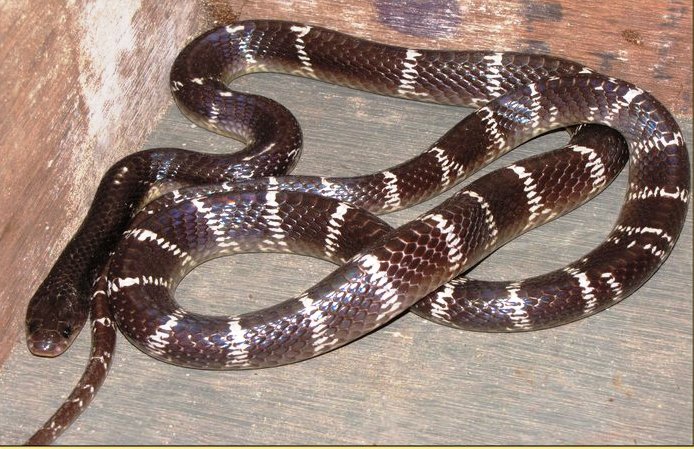 Common KraitBungarus caeruleus
-
 Eastern Brown SnakePseudonaja textilis
Compare
Questions and answers
What is the scientific name of the Golden-crowned Snake?
The scientific name of the Golden-crowned Snake is Cacophis squamulosus. Written with its author, the full name is Cacophis squamulosus (Duméril, Bibron & Duméril, 1854).
Which family does the Golden-crowned Snake belong to?
Cacophis squamulosus belongs to the family Elapidae, in the order Squamata and the class Reptilia.
Where is the Golden-crowned Snake found?
Checklists and occurrence records place Cacophis squamulosus in 1 country: Australia.
What is the conservation status of the Golden-crowned Snake?
The IUCN Red List category recorded for Cacophis squamulosus is Least Concern (LC).
What other names does the Golden-crowned Snake have?
Cacophis squamulosus is also known in English as Golden Crowned Snake.
Sources
Passages the profile rests on
- The species has a dorsal surface ranging from grayish-brown to dark brown and an orange to pink ventral surface marked by a mid-line of black spots. Source passage: “The golden-crowned snake has a dorsal surface grayish-brown to dark brown in colour, and a ventral surface of orange to pink, with a mid-line of black spots.” — English Wikipedia
- Its pale yellow-brown crown stripe begins at the snout, runs along both sides of the head without joining behind it, and continues down the neck. Source passage: “The "crown" is a pale yellow-brown stripe starting at the snout and sweeping back along both sides of the head, not connecting at the back of the head as in C. krefftii or C. harriettae, instead trailing down the neck.” — English Wikipedia
- The species has 15 rows of dorsal scales at mid-body. Source passage: “The Dorsal scales are in 15 rows at mid-body.” — English Wikipedia
- Its average total length, including the tail, is approximately 50 cm. Source passage: “The average total length (including tail) of C. squamulosus is 50 cm (20 in)” — English Wikipedia
- The species can reach a total length of 98 cm. Source passage: “but it may reach 98 cm (39 in), making it the largest of the crowned snakes.” — English Wikipedia
- The species is a forest specialist, with a particular preference for rainforest. Source passage: “Like other Cacophis species, the golden-crowned snake is a forest specialist, particularly rainforest.” — English Wikipedia
- It prefers deeper forested areas, especially rainforest on mountain slopes. Source passage: “It prefers deeper forested areas, particularly rainforest on mountain slopes” — English Wikipedia
- It can also occur in suburbs near waterways and moist environments that provide ground cover and shelter. Source passage: “however it can show up in suburbs near waterways and moist environments with ground cover and shelter.” — English Wikipedia
- The species is endemic to Australia. Source passage: “The species is endemic to Australia.” — English Wikipedia
- Its geographic range in eastern Australia extends from Canberra in the Australian Capital Territory to Cairns in Queensland. Source passage: “Cacophis squamulosus is localised to eastern Australia, from Canberra, ACT, to Cairns, QLD.” — English Wikipedia
- Its diet consists mainly of skinks and other small lizards. Source passage: “The diet of the golden-crowned snake consists mostly of skinks and other small lizards” — English Wikipedia
- The species may also consume frogs and tadpoles. Source passage: “they may also take frogs and tadpoles.” — English Wikipedia
- The species hunts its prey at night. Source passage: “which they hunt at night” — English Wikipedia
- When threatened, it may bluff or deliver mock bites while raising its body into an S-shape. Source passage: “it will bluff and mock bite if threatened, rearing into an S-shape” — English Wikipedia
- When displaying its defensive posture, it exposes its bright orange ventral pigmentation. Source passage: “rearing into an S-shape to display the bright orange ventral pigmentation.” — English Wikipedia
- The species is only mildly venomous. Source passage: “Cacophis squamulosus is only mildly venomous” — English Wikipedia
- Bites from larger individuals may pose a health risk. Source passage: “Bites from larger individuals may present a health risk” — English Wikipedia
- The species is oviparous. Source passage: “Cacophis squamulosus is oviparous.” — English Wikipedia
Data
- Catalogue of Life, 2026-10-16 XR cc by
- Global Biodiversity Information Facility CC BY 4.0
- Wikidata CC0
- GeoNames CC BY 4.0
- Wikimedia Commons per image; credit shown with each image
- iNaturalist per image; credit shown with each image
- Within the Catalogue of Life, this name comes from The Reptile Database cc by
References
- Duméril, & ANDRÉ MARIE CONSTANT. (1853). Prodrome de la classifcation des reptiles ophidiens. Mém. Acad. Sci., Paris, 23: 399-536.
- Duméril, A. M. C., Bibron, G. & DUMÉRIL, A. H. A.,. (1854). Erpétologie générale ou histoire naturelle complète des reptiles. Tome septième. Deuxième partie, comprenant l’histoire des serpents venimeux. Paris, Librairie Encyclopédique de Roret: I-Xii + 781-1536.
- Günther, & ALBERT. (1862). On new species of snakes in the collection of the British Museum. Ann. Mag. Nat. Hist. (3) 9: 52-67.
- Günther, A. (1862). On new species of snakes in the collection of the British Museum. Ann. Mag. Nat. Hist. (3) 9: 124-132.
- Jan, G., & Sordelli, F. (1873). Iconographie Générale des Ophidiens. Atlas 1860-1881. Milan: Jan & Sordelli, 50 Livr.
- Hardy C J, Hardy C M, & Hardy J P. (1979). Reptiles of Dobroyd Head Reserve. Koolewong 8 (4): 13-18.
- Wells, R. (1980). Notes on Cacophis squamulosus. Herpetofauna (Sydney) 11: 26.
- Shine, R. (1980). Comparative ecology of three Australian snake species of the genus Cacophis (Serpentes : Elapidae). Copeia 1980 (4): 831-838.
- Wells, R. (1982). Literature: Notes on Cacophis squamulosus. Litteratura Serpentium 2 (3): 150.
- Webb, G. A., & Chapman, W. S. (1984). Nocturnal road basking by gravid female Cacophis squamulosus and Cryptophis nigrescens (Serpentes: Elapidae). Herpetofauna (Sydney) 15 (1-2): 24.
- Blackburn, D. G. (1993). STANDARDIZED CRITERIA FOR THE RECOGNITION OF REPRODUCTIVE MODES IN SQUAMATE REPTILES. Herpetologica 49 (1): 118-132.
- Fitzgerald M. (1994). Notes on the ecology of the dwarf crowned snake (Cacophis kreffti) in northeastern NSW. Herpetofauna (Sydney) 24 (2): 11-13.
- Murphy, Michael J. (1994). Reptiles and amphibians of Seven Mile Beach National park, NSW. Herpetofauna (Sydney) 24 (2): 24-30.
- Cogger, H. G. (2000). Reptiles and Amphibians of Australia, 6th ed. Ralph Curtis Publishing, Sanibel Island, 808 Pp.
- Scanlon, John D. (2003). The Australian Elapid genus Cacophis: Morphology and phylogeny of rainforest crowned snakes. The Herpetological Journal 13 (1):1-20.
- Brischoux F, Pizzatto L, Shine R. (2010). Insights into the adaptive significance of vertical pupil shape in snakes. J Evol Biol. 23(9): 1878-85.
- Wilson, S., & Swan, G. (2010). A complete guide to reptiles of Australia, 3rd ed. Chatswood: New Holland, 558 Pp.
- Cogger, H. G. (2014). Reptiles and Amphibians of Australia, 7th ed. CSIRO Publishing, Xxx + 1033 Pp.
- Wallach, Van; Kenneth L. Williams, Jeff Boundy. (2014). Snakes of the World: A Catalogue of Living and Extinct Species. [type catalogue]. Taylor and Francis, CRC Press, 1237 Pp.
- Rhind, David and David Steer. (2016). Cacophis squamulosus (Golden-crowned Snake) Diet/Mortality. Herpetological Review 47 (2): 308-309.
- Swan, G., Sadlier, R., & Shea, G. (2017). A field guide to reptiles of New South Wales. Reed New Holland, 328 Pp.
- PAVON-VAZQUEZ, C. J., O. JIMENEZ-ROBLES, M. ARVIZU MEZA, AND D. DASHEVSKY. (2020). Geographic Distribution: Cacophis squamulosus (Golden-Crowned Snake). Australia: New South Wales: Bega Valley Shire. Herpetological Review 51: 543.
- Storniolo, F., Mangiacotti, M., Scali, S., Zuffi, M. A. L., & Sacchi, R. (2025). A comparative phylogenetic approach for the evolution of melanism in elapid snakes supports the Bogert’s rule. Journal of Zoology 326: 289-297.
This species in other databases
Page built on 27 November 2026. See how the catalog is made and all sources and licences.
Cite this page
ScientificNames.org. (2026). Cacophis squamulosus (Golden-crowned Snake). Retrieved November 27, 2026, from https://scientificnames.org/species/cacophis-squamulosus
“Cacophis squamulosus (Golden-crowned Snake).” ScientificNames.org, 2026, scientificnames.org/species/cacophis-squamulosus. Accessed 27 Nov. 2026.
ScientificNames.org. “Cacophis squamulosus (Golden-crowned Snake).” Accessed November 27, 2026. https://scientificnames.org/species/cacophis-squamulosus.
@misc{scientificnames_cacophis_squamulosus_golden_crowned_snake,
  author = {{ScientificNames.org}},
  title = {Cacophis squamulosus (Golden-crowned Snake)},
  year = {2026},
  url = {https://scientificnames.org/species/cacophis-squamulosus},
  note = {Accessed 2026-11-27}
}