Species · Flowering plants
Brush Caper Berry Capparis arborea
The scientific name of the Brush Caper Berry is Capparis arborea. It is a species of flowering plant in the family Capparaceae (caper family), order Capparales.
- Scientific name
- Capparis arborea (F.Muell.) Maiden
- Common name
- Brush Caper Berry
- Genus
- Capparis
- Family
- Capparaceae (Caper Family)
- Order
- Capparales
- Class
- Magnoliopsida
- Red List category
- LC Least Concern
- Recorded in
- 1 country
- Name status
- accepted in the Catalogue of Life

Overview
The species grows in rainforest habitats in eastern Australia, from the Hunter River in New South Wales to Cape Melville in tropical Queensland. It is a small tree or scrambling shrub with prickles or spines, white flowers and globular fruit that turns yellow when ripe.
Written 26 November 2026 from the sources listed below. Each statement was checked against the passage it cites; statements that could not be supported were removed.
Appearance
Brush Caper Berry is a small tree or scrambling shrub with a short, crooked and irregular trunk. Young plants develop numerous sharp prickles, while mature trees have grey bark and less sharply pointed spines.[1][2][3][4]
The leaves are alternate, simple and oblong-lanceolate or oblong-ovate, measuring approximately 5–10 cm long and 1.5–5 cm wide. Their tips are generally rounded, although some are pointed, and their veins are visible on both surfaces, with the midrib raised underneath and sunken above. The leaves are usually hairless but can be hairy on their lower surfaces.[5][6][7][8][9]
The flowers are solitary or sometimes occur in pairs. They are white, approximately 4 cm in diameter, with petals approximately 15 mm long.[10][11][12]
The fruit is globular, green and smooth, with a soft surface. It turns yellow when ripe and measures approximately 2.5–6 cm in diameter.[13][14][15][16]
The seeds are round and flattened, measuring approximately 8–10 mm in diameter.[17]
The plant can reach 8 metres in height, and its stem can reach 25 cm in diameter. Juvenile leaves measure 1–6 cm long, and the petioles measure approximately 5–15 mm long.[18][19][20][21]
The flower stalks measure approximately 3–5 cm long, the flower pedicels approximately 30–60 mm long, and the gynophore approximately 30–50 mm long.[22][23][24]
Habitat
Brush Caper Berry grows in rainforest habitats, including riverine and littoral rainforest. It occurs in warmer rainforest.[25][26]
The species occurs in eastern Australia, with a recorded distribution extending from the Hunter River in New South Wales to Cape Melville in tropical Queensland. In New South Wales, it occurs north from the Hunter Valley, mainly along the coast and also on Liverpool Range.[27][28][29]
Reproduction and life cycle
The flowers develop from January to March, and the fruit develops from December to March.[30][31]
Fresh seeds can begin germinating after approximately three weeks.[32]
Diet
The ripe fruit pulp surrounding the seeds is edible. The fruit was used as a food source by Aboriginal people.[33][34]
Behaviour
Brush Caper Berry serves as a host plant for the caper white butterfly (Belenois java). The chalky white butterfly (Elodina parthia) also feeds on the plant.[35][36]
Uses
The fruit pulp surrounding the seeds is edible, and the fruit was used as a food source by Aboriginal people.[33][34]
Classification of the Brush Caper Berry
| Kingdom | Plantae |
|---|---|
| Subkingdom | Pteridobiotina |
| Phylum | Tracheophyta |
| Class | Magnoliopsida |
| Order | Capparales |
| Family | Capparaceae (Caper Family) |
| Tribe | Cappareae |
| Genus | Capparis (Caper) |
| Species | Capparis arborea (F.Muell.) Maiden |
Where the Brush Caper Berry is found
Checklists and occurrence records place Capparis arborea in 1 country across Oceania. GBIF holds 3,113 georeferenced records of it.
Countries
Regions and cities with the most records
- Queensland, Australia 1,529
- New South Wales, Australia 1,498
- Brisbane, Australia 87
- Logan City, Australia 55
- Maitland, Australia 49
- Port Macquarie, Australia 48
- Toowoomba, Australia 47
- Gold Coast, Australia 39
- Coffs Harbour, Australia 37
- Sunshine Coast, Australia 30
- Rockhampton, Australia 26
- Narangba, Australia 25
- Taree, Australia 25
- Capalaba, Australia 24
- Gympie, Australia 22
- Townsville, Australia 20
- Gladstone, Australia 18
- Newcastle, Australia 17
- Caloundra, Australia 14
- Grafton, Australia 13
- Cessnock, Australia 12
- Bundaberg, Australia 8
- Hervey Bay, Australia 6
- Muswellbrook, Australia 4
- Mackay, Australia 3
- Maryborough, Australia 3
Range as the checklists state it
Australia (coastal from Cape York Peninsula, Queensland, to C-New South Wales)
A number beside a place is its count of GBIF occurrence records. A place without a number comes from a checklist alone. Records show where a species has been observed or collected, which can include escapes and vagrants.
Common names
English
- Brush Caper Berry
Names in 1 other language
- Chinese
- 帚山柑
Synonyms
3 other scientific names have been used for this species and are now treated as synonyms of Capparis arborea.
- Busbeckea arborea F.Muell.
- Capparis nobilis var. arborea (F.Muell.) Domin
- Capparis nobilis var. laurina Domin
Related species
-
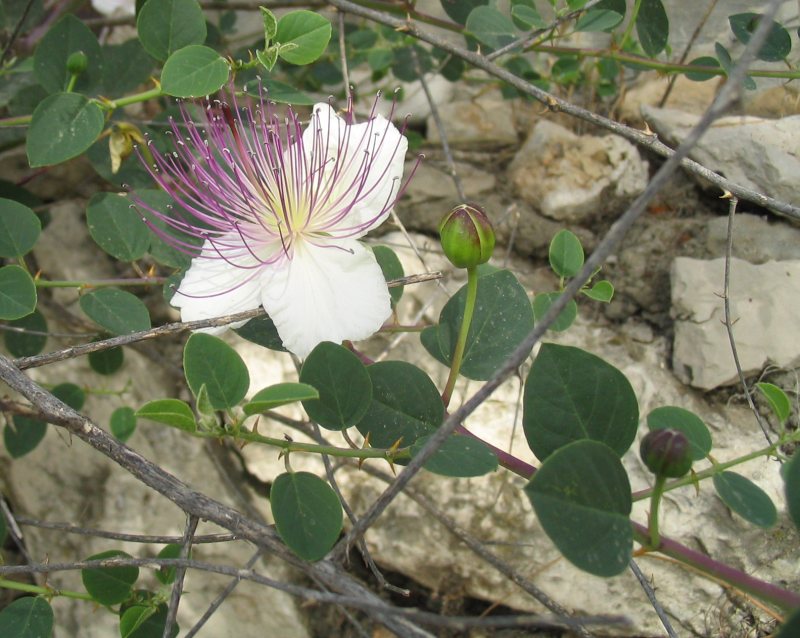 CaperCapparis spinosa
-
 KariraCapparis decidua
-
 Wild OrangeCapparis mitchellii
-
 African CaperCapparis tomentosa
-
 Ceylon CaperCapparis zeylanica
-
 Wild OrangeCapparis canescens
-
 NipanCapparis lasiantha
-
 Narrow-Leaved CaperbushCapparis brassii
Compare
Questions and answers
What is the scientific name of the Brush Caper Berry?
The scientific name of the Brush Caper Berry is Capparis arborea. Written with its author, the full name is Capparis arborea (F.Muell.) Maiden.
Which family does the Brush Caper Berry belong to?
Capparis arborea belongs to the family Capparaceae, in the order Capparales and the class Magnoliopsida.
Where is the Brush Caper Berry found?
Checklists and occurrence records place Capparis arborea in 1 country: Australia.
What is the conservation status of the Brush Caper Berry?
The IUCN Red List category recorded for Capparis arborea is Least Concern (LC).
Are caper berries edible?
The ripe fruit pulp surrounding the seeds of Brush Caper Berry is edible. Its fruit was used as a food source by Aboriginal people.[33][34]
What is a caperberry bush?
Brush Caper Berry is a small tree or scrambling shrub in the family Capparaceae. It has a short, crooked and irregular trunk, with young plants developing numerous sharp prickles.[1][2][3]
Sources
Passages the profile rests on
- Capparis arborea is a small tree or scrambling shrub. Source passage: “Small tree or scrambling shrub.” — plantnet.rbgsyd.nsw.gov.au
- The trunk is short, crooked and irregular in form. Source passage: “The trunk is crooked, short and irregular in appearance.” — English Wikipedia
- Young plants develop numerous sharp prickles. Source passage: “Many sharp prickles grow on younger plants.” — English Wikipedia
- Mature trees have grey bark and less sharply pointed spines. Source passage: “Older trees have grey bark, with less sharp spines.” — English Wikipedia
- The leaves are alternate, simple and oblong-lanceolate or oblong-ovate. Source passage: “Leaves alternate on the stem, and are simple, oblong-lanceolate or sometimes oblong-ovate in shape.” — English Wikipedia
- The leaves are generally rounded at their tips, although some have pointed tips. Source passage: “mostly rounded at the tip, although some leaves are pointed at the tip.” — English Wikipedia
- The leaf veins are visible on both surfaces, with the midrib raised underneath and sunken above. Source passage: “Leaf veins are visible on both surfaces with the midrib raised under the leaf, but sunken on top of the leaf.” — English Wikipedia
- The leaves are usually hairless but can be hairy on their lower surfaces. Source passage: “usually glabrous, sometimes pubescent below” — plantnet.rbgsyd.nsw.gov.au
- The leaves measure approximately 5–10 cm long and 1.5–5 cm wide. Source passage: “They are 5 to 10 cm long, and 1.5 to 5 cm wide” — English Wikipedia
- The flowers are solitary or sometimes occur in pairs. Source passage: “Flowers solitary or often in pairs” — plantnet.rbgsyd.nsw.gov.au
- The flowers are white and have petals approximately 15 mm long. Source passage: “Petals c. 15 mm long, white.” — plantnet.rbgsyd.nsw.gov.au
- The flowers are approximately 4 cm in diameter. Source passage: “Single white flowers form from the leaf axils and are 4 cm in diameter.” — English Wikipedia
- The fruit is globular, green and approximately 30 mm in diameter. Source passage: “Fruit globose, c. 30 mm diam., green;” — plantnet.rbgsyd.nsw.gov.au
- The fruit develops a yellow colour when ripe. Source passage: “The ripe fruit are yellow” — English Wikipedia
- The fruit has a smooth and soft surface. Source passage: “It is green, smooth and soft, globular in shape” — English Wikipedia
- The fruit measures approximately 2.5–6 cm in diameter. Source passage: “2.5 to 6 cm in diameter.” — English Wikipedia
- The seeds are round, flattened and approximately 8–10 mm in diameter. Source passage: “The seeds are round and flattened, and 8 to 10 mm in diameter.” — English Wikipedia
- The plant can reach 8 metres in height. Source passage: “Capparis arborea grows up to 8 metres tall” — English Wikipedia
- The stem can reach 25 cm in diameter. Source passage: “with a stem diameter of 25 cm” — English Wikipedia
- Juvenile leaves measure 1–6 cm long. Source passage: “juvenile leaves 1–6 cm long” — plantnet.rbgsyd.nsw.gov.au
- The petioles measure approximately 5–15 mm long. Source passage: “petiole 5–15 mm long” — plantnet.rbgsyd.nsw.gov.au
- The flower stalks measure approximately 3–5 cm long. Source passage: “The thin flower stalks are 3 to 5 cm long.” — English Wikipedia
- The flower pedicels measure approximately 30–60 mm long. Source passage: “pedicel 30–60 mm long.” — plantnet.rbgsyd.nsw.gov.au
- The gynophore measures approximately 30–50 mm long. Source passage: “Gynophore 30–50 mm long.” — plantnet.rbgsyd.nsw.gov.au
- The species grows in rainforest habitats, including riverine and littoral rainforest. Source passage: “Its habitat is rainforest, usually riverine, littoral or the drier rainforests.” — English Wikipedia
- The species occurs in warmer rainforest. Source passage: “Grows in warmer rainforest” — plantnet.rbgsyd.nsw.gov.au
- The species occurs in eastern Australia. Source passage: “Capparis arborea is a bush or small tree occurring in eastern Australia.” — English Wikipedia
- Its recorded distribution extends from the Hunter River in New South Wales to Cape Melville in tropical Queensland. Source passage: “It is distributed from the Hunter River, New South Wales to Cape Melville in tropical Queensland.” — English Wikipedia
- In New South Wales, the species occurs north from the Hunter Valley, mainly along the coast and also on Liverpool Range. Source passage: “north from the Hunter Valley; mainly on the coast, also on Liverpool Ra.” — plantnet.rbgsyd.nsw.gov.au
- The flowers develop from January to March. Source passage: “The attractive, open wiry flowers form from January to March.” — English Wikipedia
- The fruit develops from December to March. Source passage: “From December to March, a fruit resembling a guava forms.” — English Wikipedia
- Fresh seeds can begin germinating after approximately three weeks. Source passage: “with the first seeds germinating after three weeks.” — English Wikipedia
- The ripe fruit pulp surrounding the seeds is edible. Source passage: “the pulp surrounding the seeds being edible.” — English Wikipedia
- The fruit was used as a food source by Aboriginal people. Source passage: “They were a source of food for Aboriginal people.” — English Wikipedia
- Capparis arborea serves as a host plant for the caper white butterfly (Belenois java). Source passage: “Capparis arborea is a host plant for the caper white (Belenois java)” — English Wikipedia
- The chalky white butterfly (Elodina parthia) also feeds on this plant. Source passage: “It also feeds the chalky white (Elodina parthia)” — English Wikipedia
Data
- Catalogue of Life, 2026-10-16 XR cc by
- Global Biodiversity Information Facility CC BY 4.0
- Wikidata CC0
- GeoNames CC BY 4.0
- Wikimedia Commons per image; credit shown with each image
- Within the Catalogue of Life, this name comes from Synonymic Checklists of the Vascular Plants of the World cc by
References
- Maiden. (1904). Proc. Linn. Soc. New South Wales 28: 696 (1904). where the name was published
This species in other databases
- Catalogue of Life 5X9KZ
- Wikidata Q5036113
- iNaturalist 370466
- World Flora Online wfo-0000584492
- GRIN 508877
Page built on 29 November 2026. See how the catalog is made and all sources and licences.
Cite this page
ScientificNames.org. (2026). Capparis arborea (Brush Caper Berry). Retrieved November 29, 2026, from https://scientificnames.org/species/capparis-arborea
“Capparis arborea (Brush Caper Berry).” ScientificNames.org, 2026, scientificnames.org/species/capparis-arborea. Accessed 29 Nov. 2026.
ScientificNames.org. “Capparis arborea (Brush Caper Berry).” Accessed November 29, 2026. https://scientificnames.org/species/capparis-arborea.
@misc{scientificnames_capparis_arborea_brush_caper_berry,
  author = {{ScientificNames.org}},
  title = {Capparis arborea (Brush Caper Berry)},
  year = {2026},
  url = {https://scientificnames.org/species/capparis-arborea},
  note = {Accessed 2026-11-29}
}