Species · Flowering plants
Wild Orange Capparis canescens
The scientific name of the Wild Orange is Capparis canescens. It is a species of flowering plant in the family Capparaceae (caper family), order Capparales.
- Scientific name
- Capparis canescens Banks ex DC.
- Common name
- Wild Orange
- Genus
- Capparis
- Family
- Capparaceae (Caper Family)
- Order
- Capparales
- Class
- Magnoliopsida
- Red List category
- LC Least Concern
- Recorded in
- 1 country
- Name status
- accepted in the Catalogue of Life

Overview
Capparis canescens is native to north-eastern Australia, occurring mainly in eastern Queensland and extending into northern New South Wales. It grows as a shrub or small tree and has oval-shaped leaves, white flowers and round fruits.
Written 26 November 2026 from the sources listed below. Each statement was checked against the passage it cites; statements that could not be supported were removed.
Appearance
Wild Orange grows as a shrub or small tree and can reach a height of 4 metres.[1][2]
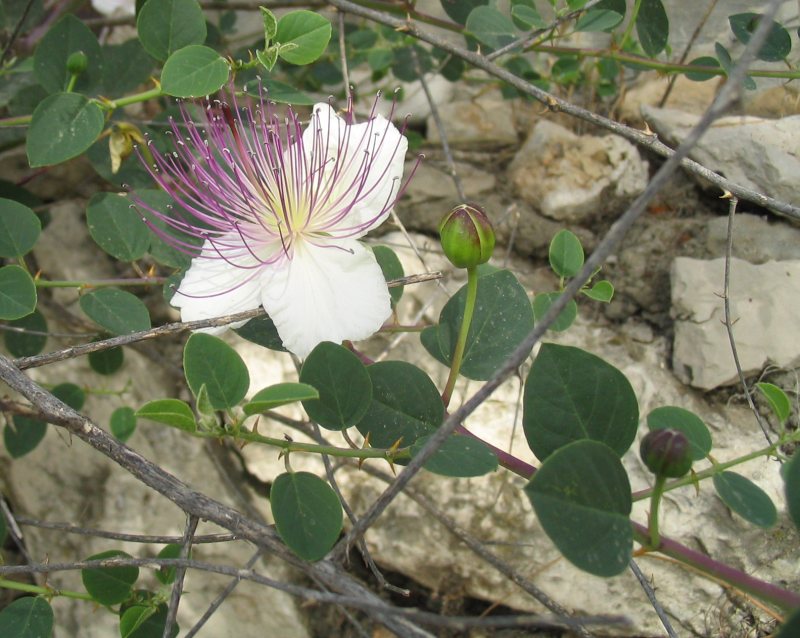
Its oval-shaped leaves measure 4.5–10 cm long and 2.5–6 cm wide. Its flowers are white and approximately 3 cm long, and its flower buds have four prominent ridges.[3][4][5][6]
Its fruits are round and measure 2.5–7.5 cm in diameter.[7][8]
Habitat
Wild Orange occurs in open eucalypt forest.[9]
It is native to north-eastern Australia, occurring mainly in eastern Queensland and extending into northern New South Wales.[10][11]
Classification of the Wild Orange
| Kingdom | Plantae |
|---|---|
| Subkingdom | Pteridobiotina |
| Phylum | Tracheophyta |
| Class | Magnoliopsida |
| Order | Capparales |
| Family | Capparaceae (Caper Family) |
| Tribe | Cappareae |
| Genus | Capparis (Caper) |
| Species | Capparis canescens Banks ex DC. |
Where the Wild Orange is found
Checklists and occurrence records place Capparis canescens in 1 country across Oceania. GBIF holds 851 georeferenced records of it.
Countries
Regions and cities with the most records
- Queensland, Australia 805
- Gladstone, Australia 27
- Rockhampton, Australia 21
- Townsville, Australia 15
- New South Wales, Australia 7
6 more countries have a few records outside this range
These countries hold a few records of Capparis canescens but lie outside the range the checklists give for it. Such records are often zoo or garden specimens, museum material or vagrants, so the species is not counted as occurring there.
Range as the checklists state it
Australia (E-Queensland)
A number beside a place is its count of GBIF occurrence records. A place without a number comes from a checklist alone. Records show where a species has been observed or collected, which can include escapes and vagrants.
Common names
English
- Wild Orange
- Native Caper
Synonyms
6 other scientific names have been used for this species and are now treated as synonyms of Capparis canescens.
- Busbeckea canescens (Banks ex DC.) F.Muell.
- Capparis areolata F.M.Bailey
- Capparis armata Domin
- Capparis canescens var. glauca Benth.
- Capparis muelleri Domin
- Capparis ovata var. canescens (Coss.) Heywood
Related species
-
 CaperCapparis spinosa
-
 KariraCapparis decidua
-
 Wild OrangeCapparis mitchellii
-
 African CaperCapparis tomentosa
-
 Ceylon CaperCapparis zeylanica
-
 Brush Caper BerryCapparis arborea
-
 NipanCapparis lasiantha
-
 Narrow-Leaved CaperbushCapparis brassii
Compare
Questions and answers
What is the scientific name of the Wild Orange?
The scientific name of the Wild Orange is Capparis canescens. Written with its author, the full name is Capparis canescens Banks ex DC..
Which family does the Wild Orange belong to?
Capparis canescens belongs to the family Capparaceae, in the order Capparales and the class Magnoliopsida.
Where is the Wild Orange found?
Checklists and occurrence records place Capparis canescens in 1 country: Australia.
What is the conservation status of the Wild Orange?
The IUCN Red List category recorded for Capparis canescens is Least Concern (LC).
What other names does the Wild Orange have?
Capparis canescens is also known in English as Native Caper.
Sources
Passages the profile rests on
- Capparis canescens grows as a shrub or small tree. Source passage: “The species grows as a shrub or small tree up to 4 m (13 ft).” — English Wikipedia
- Capparis canescens can reach a height of 4 metres. Source passage: “The species grows as a shrub or small tree up to 4 m (13 ft).” — English Wikipedia
- Its leaves are oval-shaped. Source passage: “The oval leaves are 4.5–10 cm (1.8–3.9 in) long by 2.5–6 cm (0.98–2.36 in) wide.” — English Wikipedia
- Its leaves measure 4.5–10 cm long and 2.5–6 cm wide. Source passage: “The oval leaves are 4.5–10 cm (1.8–3.9 in) long by 2.5–6 cm (0.98–2.36 in) wide.” — English Wikipedia
- Its flowers are white and approximately 3 cm long. Source passage: “The white flowers are 3 cm (1.2 in) long” — English Wikipedia
- Its flower buds have four prominent ridges. Source passage: “the buds having four prominent ridges.” — English Wikipedia
- Its fruits are round. Source passage: “The round fruits are 2.5–7.5 cm (0.98–2.95 in) in diameter.” — English Wikipedia
- Its fruits measure 2.5–7.5 cm in diameter. Source passage: “The round fruits are 2.5–7.5 cm (0.98–2.95 in) in diameter.” — English Wikipedia
- It occurs in open eucalypt forest. Source passage: “It occurs in open eucalypt forest.” — English Wikipedia
- Capparis canescens is native to north-eastern Australia. Source passage: “It is native to north-eastern Australia.” — English Wikipedia
- It occurs mainly in eastern Queensland and extends into northern New South Wales. Source passage: “The species is found mainly in eastern Queensland, extending into northern New South Wales.” — English Wikipedia
Data
- Catalogue of Life, 2026-10-16 XR cc by
- Global Biodiversity Information Facility CC BY 4.0
- Wikidata CC0
- GeoNames CC BY 4.0
- Wikimedia Commons per image; credit shown with each image
- Within the Catalogue of Life, this name comes from Synonymic Checklists of the Vascular Plants of the World cc by
References
- Banks ex DC. (1824). Prodr. [A.P. de Candolle] 1: 246 (1824). where the name was published
This species in other databases
Page built on 27 November 2026. See how the catalog is made and all sources and licences.
Cite this page
ScientificNames.org. (2026). Capparis canescens (Wild Orange). Retrieved November 27, 2026, from https://scientificnames.org/species/capparis-canescens
“Capparis canescens (Wild Orange).” ScientificNames.org, 2026, scientificnames.org/species/capparis-canescens. Accessed 27 Nov. 2026.
ScientificNames.org. “Capparis canescens (Wild Orange).” Accessed November 27, 2026. https://scientificnames.org/species/capparis-canescens.
@misc{scientificnames_capparis_canescens_wild_orange,
  author = {{ScientificNames.org}},
  title = {Capparis canescens (Wild Orange)},
  year = {2026},
  url = {https://scientificnames.org/species/capparis-canescens},
  note = {Accessed 2026-11-27}
}