Species · Flowering plants
African Caper Capparis tomentosa
The scientific name of the African Caper is Capparis tomentosa. It is a species of flowering plant in the family Capparaceae (caper family), order Capparales.
- Scientific name
- Capparis tomentosa Lam.
- Common name
- African Caper
- Genus
- Capparis
- Family
- Capparaceae (Caper Family)
- Order
- Capparales
- Class
- Magnoliopsida
- Recorded in
- 43 countries
- Name status
- accepted in the Catalogue of Life

Overview
Capparis tomentosa occurs in bushveld and forest habitats and is found in South Africa's Eastern Cape, KwaZulu-Natal, Mpumalanga and Limpopo provinces, as well as Mozambique, Botswana, Namibia, the range from Senegal to Eritrea and the Mascarene Islands. It is predominantly a robust woody climber with paired hooked spines, velvety yellow hairs on young stems and spines, and large flowers with pinkish-white stamens.
Written 26 November 2026 from the sources listed below. Each statement was checked against the passage it cites; statements that could not be supported were removed.
Appearance
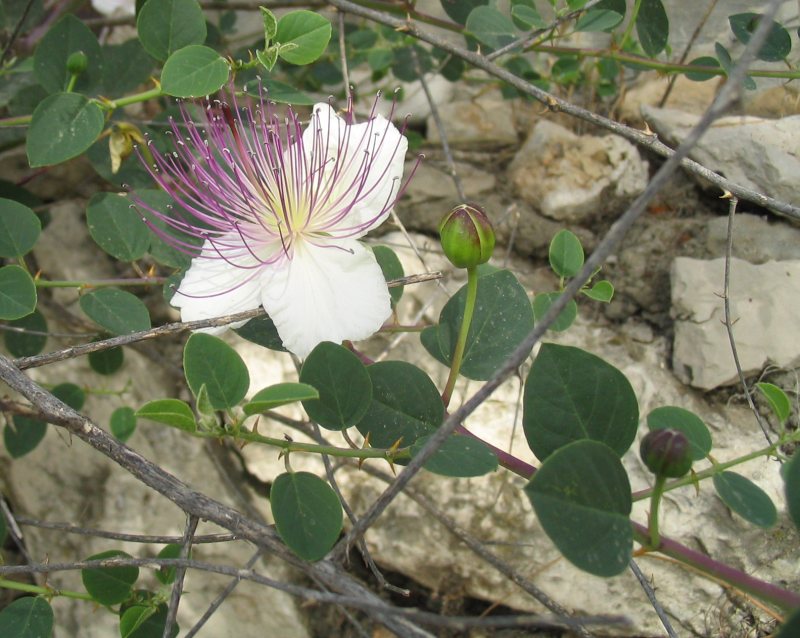
African caper is predominantly a robust woody climber, but it can also grow as a straggling shrub or small tree. Its stems bear sharp, paired, hooked spines, while young stems and spines are covered with dense, velvety yellow hairs.[1][2][3]
The leaves are alternate, ranging from oblong to broadly elliptic. They are greyish-olive green and may be velvety or smooth, with entire margins rolled under and petioles measuring 4–12 mm in length.[4][5][6][7]
The large, scented flowers are arranged in clusters, usually at branch tips or on short leafy lateral branchlets. They measure approximately 35 mm and have whitish petals and pinkish-white stamens measuring 20–35 mm, sometimes with crimson colouring at their bases.[8][9][10][11][12][13]
The boat-shaped sepals measure 8–10 mm in length. The petals measure 15–25 mm long and 7–10 mm wide.[14][15]
The fruits hang from elongated stalk-like branches called gynophores, which measure 25–50 mm in length. The fruits can reach 40 mm in diameter, with a stated maximum of 50 mm, and change from shiny green to pink or orange as they ripen.[16][17][18][19]
The fruits contain numerous seeds embedded in pinkish flesh. Dried and emptied fruits can remain hanging on the plant for some time.[20][21]
Habitat
African caper occurs in bushveld and forest habitats. Vegetation dominated by the species as its large shrub layer typically occurs in mesic-to-semi-arid riverine thickets.[22][23]
In South Africa, the species occurs in the Eastern Cape, KwaZulu-Natal, Mpumalanga and Limpopo provinces. It is also recorded in Mozambique, Botswana and Namibia, with its northern range extending from Senegal to Eritrea and its distribution including the Mascarene Islands.[24][25][26][27]
Behaviour
Dried and emptied fruits can remain hanging on the plant for some time.[21]
Diet
Several butterfly species use African caper as a larval food plant. These include Belenois gidica, Dixeia pigea, Eronia leda and Colotis evenina.[28][29]
Game animals browse the leaves. Monkeys and bushpigs eat the fruits.[30][31]
Uses
African caper has traditional medicinal and magical uses in Africa. It is traditionally used as a remedy for diarrhoea and to treat swelling and water retention.[32][33][34]
The plant is cultivated as a decorative garden plant. Its hooked spines make it suitable for hedging and use as a security barrier.[35][36]
People sometimes eat the fruits of African caper.[37]
Classification of the African Caper
| Kingdom | Plantae |
|---|---|
| Subkingdom | Pteridobiotina |
| Phylum | Tracheophyta |
| Class | Magnoliopsida |
| Order | Capparales |
| Family | Capparaceae (Caper Family) |
| Tribe | Cappareae |
| Genus | Capparis (Caper) |
| Species | Capparis tomentosa Lam. |
Where the African Caper is found
Checklists and occurrence records place Capparis tomentosa in 43 countries across Africa and Asia. GBIF holds 2,499 georeferenced records of it.
Countries
- Angola 41
- Benin 45
- Botswana 88
- Burkina Faso 20
- Burundi 41
- Cameroon 37
- Central African Republic 7
- Chad 63
- Democratic Republic of the Congo 141
- Eritrea 11
- Eswatini 25
- Ethiopia 212
- Gabon 9
- Gambia 7
- Ghana 42
- Guinea 3
- Indonesia 14
- Ivory Coast 7
- Kenya 192
- Malawi 43
- Mali 10
- Mauritania
- Mozambique 75
- Namibia 40
- Niger 9
- Nigeria 27
- Philippines 10
- Republic of the Congo 6
- Rwanda 79
- Sao Tome and Principe 31
- Saudi Arabia 14
- Senegal 111
- Somalia 3
- South Africa 513
- South Sudan 3
- Sudan 26
- Tanzania 203
- Thailand 9
- Togo 8
- Uganda 99
- Yemen 1
- Zambia 97
- Zimbabwe 77
Regions and cities with the most records
- Limpopo, South Africa 179
- KwaZulu-Natal, South Africa 151
- Mpumalanga, South Africa 106
- Oromiya, Ethiopia 74
- North-West, Botswana 40
- Chobe, Botswana 31
- Zambezi Region, Namibia 30
- Louis Trichardt, South Africa 25
- Meru County, Kenya 25
- Tema New Town, Ghana 24
- Gatumba, Burundi 23
- São Tomé, Sao Tome and Principe 23
- Bubanza, Burundi 22
- Mpanda, Burundi 22
- Yoff, Senegal 21
- Ashaiman, Ghana 20
- Bujumbura, Burundi 20
- Greater Accra, Ghana 20
- Lashibi, Ghana 20
- Tema, Ghana 20
- Maputo Province, Mozambique 19
- eMkhomazi, South Africa 18
- Guder, Ethiopia 17
- Hāgere Hiywet, Ethiopia 17
- Manicaland, Zimbabwe 17
- Amhara, Ethiopia 16
- Atlantique, Benin 15
- Zé, Benin 15
- Nakivale Refugee Camp, Uganda 14
- Arusha, Tanzania 13
- Laikipia, Kenya 13
- Thies, Senegal 13
- Chari-Baguirmi, Chad 12
- Dakar, Senegal 12
- Guédiawaye, Senegal 12
- Katima Mulilo, Namibia 12
Range as the checklists state it
Mauritania; Senegal; Gambia; Guinea; Mali; Burkina Faso; Ivory Coast; Ghana; Togo; Benin; Niger; N-Cameroon; São Tomé; Central African Republic; D. R. Congo [Zaire]; Chad; Sudan; South Sudan; Ethiopia; Eritrea; Somalia; Uganda; Kenya; Tanzania; Angola; Zambia; Malawi; Zimbabwe; Mozambique; Namibia; Botswana; South Africa (Limpopo, Mpulamanga, KwaZulu-Natal, E-Cape Prov.); Eswatini [Swaziland]; Saudi Arabia; N-Yemen
A number beside a place is its count of GBIF occurrence records. A place without a number comes from a checklist alone. Records show where a species has been observed or collected, which can include escapes and vagrants.
Common names
English
- African Caper
- Cape Bush
- Wollerige Kapperbos
- Woolly Caper Bush
Names in 35 other languages
- Afrikaans
- Katnael, Katnaelbos, wag-'n- bietjie
- Arabic
- sharube
- Finnish
- samettikapris
- Russian
- Каперсы войлочные
- Swahili
- Mbada Paka, makayo, mbeba, mkangwachare, mkongachare, mkoyo, mpapula-chui
- Tongan
- Mukorongwe, ngizi
- Tswana
- Kangok, Mparamau, Muoba - dali, Mutawana, Umukorochombwe, motawana, motawane, motowane
- Xhosa
- iMfishlo, inTshihlo, inTsihlo, itsihlo, umpasimani
- Zulu
- iliqwaningi, inkunzi-ebomvu, iqwanene, quanini, ukokwane, umQoqolo
- amh
- gumero
- dav
- Wangombei
- ful
- bugi baley, dalevi, gubi, gumi, gumi-baledi, gumi-baley, nguni daleewi
- gax
- gora gaala, gorrah-gel
- hau
- Gwanbazi, Haujeri, haujari, haujarin rakumi, haujerin, ja ni baibai, kabdarai, kabdodo
- heh
- mholihulu
- kam
- Kitandambo, Mutandambo, kitandabo, kitando, kitandombe
- loz
- chiwezeweze, mupapi
- luo
- Ongono
- luy
- Shikumbumbu
- mas
- Olaturdei, ol atorode
- mer
- makirutu
- mhw
- modyangwe, mudyangwe
- mlk
- Gora za jovu, Gora-nyilo, Namwaliko
- nyf
- Mzezagunga
- pkb
- Muchovi
- ppt
- tungula ngosa
- sna
- Chikatavuwa, Gonashindi
- som
- Gombor Lik
- srr
- bufo, igufor, ngubor, ngufor
- ssw
- imphololwane, inkhokhola, inkunzebovo, inkunzibomvu, inkunzibovu
- suk
- lubiso, lubisu, luwisu
- tir
- andel
- tso
- Khawa, khavu, nkawa
- tuv
- Ekorokorait
- ven
- Gwambadzi, Muobadali, gwambazi, luakhaboyi, mubadaki, mubadali, mubadati, muoba-dėali
Synonyms
14 other scientific names have been used for this species and are now treated as synonyms of Capparis tomentosa.
- Capparis alexandrae Chiov.
- Capparis biloba Hutch. & Dalziel
- Capparis corymbifera E.Mey. ex Harv. & Sond.
- Capparis globifera Delile
- Capparis hypericoides Hochst.
- Capparis lucens Hauman
- Capparis persicifolia A.Rich.
- Capparis puberula DC.
- Capparis subtomentosa De Wild.
- Capparis tomentosa var. persicifolia (A.Rich.) Penz.
- Capparis verdickii De Wild.
- Capparis volkensii Gilg
- Capparis floribunda Lepr. ex Walp. ambiguous synonym
- Capparis polymorpha A.Rich. ambiguous synonym
Related species
-
 CaperCapparis spinosa
-
 KariraCapparis decidua
-
 Wild OrangeCapparis mitchellii
-
 Ceylon CaperCapparis zeylanica
-
 Brush Caper BerryCapparis arborea
-
 Wild OrangeCapparis canescens
-
 NipanCapparis lasiantha
-
 Narrow-Leaved CaperbushCapparis brassii
Compare
Questions and answers
What is the scientific name of the African Caper?
The scientific name of the African Caper is Capparis tomentosa. Written with its author, the full name is Capparis tomentosa Lam..
Which family does the African Caper belong to?
Capparis tomentosa belongs to the family Capparaceae, in the order Capparales and the class Magnoliopsida.
Where is the African Caper found?
Checklists and occurrence records place Capparis tomentosa in 43 countries, including South Africa, Ethiopia, Tanzania, Kenya, Democratic Republic of the Congo and Senegal.
What other names does the African Caper have?
Capparis tomentosa is also known in English as Cape Bush, Wollerige Kapperbos and Woolly Caper Bush.
Where do caper plants grow naturally?
Capparis tomentosa occurs in bushveld and forest habitats, with vegetation dominated by the species typically found in mesic-to-semi-arid riverine thickets. Its recorded distribution includes South Africa's Eastern Cape, KwaZulu-Natal, Mpumalanga and Limpopo provinces, Mozambique, Botswana, Namibia, the range from Senegal to Eritrea and the Mascarene Islands.[22][23][24][25][26][27]
Sources
Passages the profile rests on
- Capparis tomentosa is predominantly a robust woody climber, but it can also grow as a straggling shrub or small tree. Source passage: “Mostly a robust woody climber; which in riverine vegetation may grow to the top of the canopy. It may also be a straggling shrub or small tree.” — English Wikipedia
- The stems bear sharp, paired, hooked spines. Source passage: “The stem has sharp, paired, hooked spines.” — English Wikipedia
- Young stems and spines are covered with dense, velvety yellow hairs. Source passage: “Young stems and spines are covered in dense velvety yellow hairs.” — English Wikipedia
- The leaves are alternate and range from oblong to broadly elliptic in shape. Source passage: “The leaves form between the spines and are alternate, oblong to broadly elliptic” — English Wikipedia
- The leaves are greyish-olive green and may be velvety or smooth. Source passage: “greyish-olive green, covered in velvet hairs (or smooth)” — English Wikipedia
- The leaf margins are entire and rolled under. Source passage: “margins entire, rolled under.” — English Wikipedia
- The leaf petiole measures 4–12 mm in length. Source passage: “The petiole is 4–12 mm long and velvety.” — English Wikipedia
- The flowers are arranged in clusters, usually at branch tips or on short leafy lateral branchlets. Source passage: “The flowers form in clusters; terminally on the primary branches or on short leafy lateral branchlets” — English Wikipedia
- The flowers are large and scented, with pinkish-white stamens. Source passage: “They are large (35 mm) and scented, with a mass of pinkish-white stamens” — English Wikipedia
- The flowers measure approximately 35 mm. Source passage: “They are large (35 mm)” — English Wikipedia
- The stamens measure 20–35 mm in length. Source passage: “which are each 20–35 mm in length” — English Wikipedia
- The stamens may have crimson colouring at their bases. Source passage: “may be crimson coloured at the base.” — English Wikipedia
- The petals are whitish. Source passage: “The petals are whitish;” — English Wikipedia
- The sepals are boat-shaped and measure 8–10 mm in length. Source passage: “The sepals are boat shaped and 8–10 mm long.” — English Wikipedia
- The petals measure 15–25 mm long and 7–10 mm wide. Source passage: “15–25 mm long and 7–10 mm wide.” — English Wikipedia
- The fruits hang from elongated stalk-like branches called gynophores. Source passage: “The fruits hang from a long (25–50 mm) stalk-like branch called a gynophore.” — English Wikipedia
- The fruit-bearing gynophore measures 25–50 mm in length. Source passage: “long (25–50 mm) stalk-like branch” — English Wikipedia
- The fruits can reach 40 mm in diameter, with a stated maximum of 50 mm. Source passage: “They are up to 40 mm (50 mm) in diameter;” — English Wikipedia
- The fruits are initially shiny green and ripen to pink or orange. Source passage: “shiny green at first, ripening to pink or orange.” — English Wikipedia
- The fruits contain numerous seeds embedded in pinkish flesh. Source passage: “The fruit contain many seeds embedded in a pinkish flesh.” — English Wikipedia
- Dried and emptied fruits can remain hanging on the plant for some time. Source passage: “Dried-out, emptied fruit may hang on the plant for some time.” — English Wikipedia
- Capparis tomentosa occurs in bushveld and forest habitats. Source passage: “Found in bushveld and forest” — English Wikipedia
- Vegetation dominated by Capparis tomentosa as its large shrub layer typically occurs in mesic-to-semi-arid riverine thickets. Source passage: “Vegetation in which Capparis tomentosa (wool-y caper-bush) forms the dominant large shrub layer typically corresponds to mesic-to-semi-arid riverine thickets,” — inaturalist.org
- The species occurs in South Africa's Eastern Cape, KwaZulu-Natal, Mpumalanga and Limpopo provinces. Source passage: “from the Eastern Cape of South Africa, through KwaZulu-Natal, Mpumalanga, Limpopo Province,” — English Wikipedia
- The species is recorded in Mozambique, Botswana and Namibia. Source passage: “Mozambique, Botswana, Namibia” — English Wikipedia
- The northern part of the species' range extends from Senegal to Eritrea. Source passage: “The northern part of the range extends from Senegal to Eritrea” — English Wikipedia
- The species is also found in the Mascarene Islands. Source passage: “this species is also found in the Mascarene Islands.” — English Wikipedia
- Several butterfly species use Capparis tomentosa as a larval food plant. Source passage: “Several species of butterfly use this plant as a larval food plant” — English Wikipedia
- The butterfly species recorded using the plant as a larval food plant include Belenois gidica, Dixeia pigea, Eronia leda and Colotis evenina. Source passage: “Belenois gidica, Dixeia pigea, Eronia leda and Colotis evenina.” — English Wikipedia
- Game animals browse the leaves of Capparis tomentosa. Source passage: “Game animals browse the leaves” — English Wikipedia
- Monkeys and bushpigs eat the fruits of Capparis tomentosa. Source passage: “monkeys and bushpigs eat the fruit.” — English Wikipedia
- Capparis tomentosa has traditional medicinal and magical uses in Africa. Source passage: “This species has traditional medicinal and magical uses in Africa.” — English Wikipedia
- The plant is traditionally used as a remedy for diarrhoea. Source passage: “it is used as a remedy for diarrhea,” — English Wikipedia
- The plant is traditionally used to treat swelling and water retention. Source passage: “swelling and water retention.” — English Wikipedia
- Capparis tomentosa is cultivated as a decorative garden plant. Source passage: “It is a decorative plant in gardens” — English Wikipedia
- The plant can be used for hedging and as a security barrier because of its hooked spines. Source passage: “can be used for hedging; being suitable as a security barrier because of the hooked spines.” — English Wikipedia
- People sometimes eat the fruits of Capparis tomentosa. Source passage: “The fruit may sometimes be eaten by people.” — English Wikipedia
Data
- Catalogue of Life, 2026-10-16 XR cc by
- Global Biodiversity Information Facility CC BY 4.0
- Wikidata CC0
- GeoNames CC BY 4.0
- Wikimedia Commons per image; credit shown with each image
- Within the Catalogue of Life, this name comes from Synonymic Checklists of the Vascular Plants of the World cc by
References
- Lam. (1785). Encycl. [J.Lamarck et al.] 1: 606 (1785). where the name was published
This species in other databases
- Catalogue of Life QS35
- Wikidata Q5036130
- iNaturalist 342724
- World Flora Online wfo-0000585223
- GRIN 411704
Page built on 28 November 2026. See how the catalog is made and all sources and licences.
Cite this page
ScientificNames.org. (2026). Capparis tomentosa (African Caper). Retrieved November 28, 2026, from https://scientificnames.org/species/capparis-tomentosa
“Capparis tomentosa (African Caper).” ScientificNames.org, 2026, scientificnames.org/species/capparis-tomentosa. Accessed 28 Nov. 2026.
ScientificNames.org. “Capparis tomentosa (African Caper).” Accessed November 28, 2026. https://scientificnames.org/species/capparis-tomentosa.
@misc{scientificnames_capparis_tomentosa_african_caper,
  author = {{ScientificNames.org}},
  title = {Capparis tomentosa (African Caper)},
  year = {2026},
  url = {https://scientificnames.org/species/capparis-tomentosa},
  note = {Accessed 2026-11-28}
}