Species · Mammals
Bahamian Hutia Geocapromys ingrahami
The scientific name of the Bahamian Hutia is Geocapromys ingrahami. It is a species of mammal in the family Echimyidae (coypu), order Rodentia. The name dates from 1891.
- Scientific name
- Geocapromys ingrahami (J. A. Allen, 1891)
- Common name
- Bahamian Hutia
- Genus
- Geocapromys
- Family
- Echimyidae (Coypu)
- Order
- Rodentia
- Class
- Mammalia
- Red List category
- CR Critically Endangered
- Recorded in
- 1 country
- Name status
- accepted in the Catalogue of Life

Overview
Geocapromys ingrahami is endemic to the Bahamas and has one ostensibly natural extant population on East Plana Cay and two introduced populations on Little Wax Cay and Warderick Wells. It has a rat-like body, a short tail, and fur that can be black, brown, grey, white, or reddish.
Written 26 November 2026 from the sources listed below. Each statement was checked against the passage it cites; statements that could not be supported were removed.
Appearance
The Bahamian Hutia has a rat-like body and a short tail. Its fur can be black, brown, grey, white, or reddish.[1][2]
Its body length ranges from 20 to 60 centimetres, excluding the tail.[3]
Habitat
The species inhabits subtropical or tropical moist lowland forests and subtropical or tropical dry shrubland. It lives in burrows in forests or shrubland.[4][5][6]
In forests, the species uses both trees and the ground.[7]
Diet
The Bahamian Hutia is predominantly vegetarian. It feeds on leaves, fruit, shoots, nuts, bark, and other plant matter.[8][9][10]
It occasionally eats insects and small lizards and has also been recorded eating seaweed.[11][12]
Some archaeological specimens show evidence of consuming carbon-13-enriched foods that may have been provisioned or opportunistically obtained. Indigenous people targeted Bahamian hutias as a food resource during pre-Columbian history.[13][14]
Behaviour
The species is nocturnal and remains underground during the day. It can climb trees but generally forages on or near the ground.[15][16]
Adults form lasting pair bonds and live in lifelong pairs, displaying social behaviour toward their partners. Individuals sometimes wrestle with one another in behaviour described as playful.[17][18][19]
The species marks its scent through urination. Biologist Garrett Clough describes it as a particularly peaceful rodent.[20][21]
Reproduction and life cycle
Breeding can occur throughout the year. Females have a gestation period of 17 to 18 weeks.[22][23]
A female can give birth to between one and four young. Young are born fully furred with their eyes open and can consume solid food within a few days of birth.[24][25][26]
Young may remain with their family group for up to two years. Individuals reach sexual maturity at approximately two years of age.[27][28]
Conservation
The species is classified as vulnerable and is also classified as critically endangered.[29][30]
The Bahamian Hutia is protected under the Wild Animals Protection Act of 1968. Introduced predators, including cats, dogs, and mongoose, are identified as threats.[31][32]
Hurricanes and introduced feral cats are identified as potential threats to the remaining population. Conservation efforts include relocating hutias to islands where they were previously absent.[33][34]
Uses
The species can be bred and studied in zoos. Scientists study it because it is endangered.[35][36]
Classification of the Bahamian Hutia
| Kingdom | Animalia |
|---|---|
| Phylum | Chordata |
| Subphylum | Vertebrata |
| Infraphylum | Gnathostomata |
| Parvphylum | Osteichthyes |
| Megaclass | Tetrapoda |
| Class | Mammalia (Mammal) |
| Subclass | Theria |
| Infraclass | Eutheria |
| Order | Rodentia (Rodent) |
| Suborder | Hystricomorpha |
| Infraorder | Hystricognathi (Hystricognath Rodents) |
| Family | Echimyidae (Coypu) |
| Subfamily | Capromyinae |
| Tribe | Capromyini |
| Genus | Geocapromys (Ground Hutias) |
| Species | Geocapromys ingrahami (J. A. Allen, 1891) |
Where the Bahamian Hutia is found
Checklists and occurrence records place Geocapromys ingrahami in 1 country across North America. GBIF holds 124 georeferenced records of it.
Countries
Regions and cities with the most records
Range as the checklists state it
Caribbean
A number beside a place is its count of GBIF occurrence records. A place without a number comes from a checklist alone. Records show where a species has been observed or collected, which can include escapes and vagrants.
Common names
English
- Bahamian Hutia
- Bahaman Hutia
- Ingraham's Hutia
Names in 9 other languages
- Czech
- hutia bahamská
- Dutch
- Bahamastompstaartrat
- French
- Hutia d'Ingraham, Hutia des Bahamas
- Hungarian
- Bahama-szigeteki hutia
- Japanese
- スワンフチア
- Norwegian Bokmål
- Bahamasbeverrotte
- Polish
- nocohutia bahamski
- Russian
- Хутия Инграхама
- Spanish
- Jutía de Bahamas
Synonyms
One other scientific name has been used for this species and is now treated as a synonym of Geocapromys ingrahami.
- Capromys ingrahami J. A. Allen, 1891
Related species
-
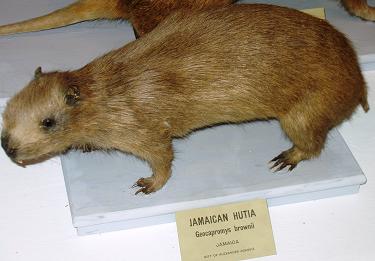 Jamaican ConeyGeocapromys brownii
- Cuban ConeyGeocapromys columbianus
-
 Little Swan Island HutiaGeocapromys thoracatus
-
 NutriaMyocastor coypus
-
 Red-crested Tree-ratSantamartamys rufodorsalis
-
 Desmarest's HutiaCapromys pilorides
-
 Hispaniolan HutiaPlagiodontia aedium
-
 Armored RatHoplomys gymnurus
Compare
Questions and answers
What is the scientific name of the Bahamian Hutia?
The scientific name of the Bahamian Hutia is Geocapromys ingrahami. Written with its author, the full name is Geocapromys ingrahami (J. A. Allen, 1891).
Which family does the Bahamian Hutia belong to?
Geocapromys ingrahami belongs to the family Echimyidae, in the order Rodentia and the class Mammalia.
Where is the Bahamian Hutia found?
Checklists and occurrence records place Geocapromys ingrahami in 1 country: Bahamas.
What is the conservation status of the Bahamian Hutia?
The IUCN Red List category recorded for Geocapromys ingrahami is Critically Endangered (CR).
What other names does the Bahamian Hutia have?
Geocapromys ingrahami is also known in English as Bahaman Hutia and Ingraham's Hutia.
Is the Bahamian hutia extinct?
No. The species has one ostensibly natural extant population on East Plana Cay and two introduced populations on Little Wax Cay and Warderick Wells.[37]
Where are hutias found?
The Bahamian Hutia is endemic to the Bahamas. It is mainly found on East Plana Cay, with introduced populations on Little Wax Cay and Warderick Wells.[38][39][37]
Sources
Passages the profile rests on
- The Bahamian hutia has a rat-like body and a short tail. Source passage: “The Bahamian hutia is a rat-like rodent with a short tail” — English Wikipedia
- Its fur can be black, brown, grey, white, or reddish. Source passage: “Its fur varies in colour and can be black, brown, grey, white or reddish.” — English Wikipedia
- Its body length ranges from 20 to 60 centimetres, excluding the tail. Source passage: “Its length ranges from 20 - 60 cm, not including the tail.” — animaldiversity.org
- The species inhabits subtropical or tropical moist lowland forests. Source passage: “subtropical or tropical moist lowland forest” — English Wikipedia
- The species inhabits subtropical or tropical dry shrubland. Source passage: “subtropical or tropical dry shrubland” — English Wikipedia
- The species lives in burrows in forests or shrubland. Source passage: “it lives in burrows in forests or shrubland” — English Wikipedia
- The species occurs in forests and uses both trees and the ground. Source passage: “It is found in the trees or on the ground.” — animaldiversity.org
- The species feeds on leaves, fruit, and other plant matter. Source passage: “to feed on leaves, fruit, and other plant matter.” — English Wikipedia
- Its diet includes shoots, nuts, and bark. Source passage: “feeding on leaves, shoots, fruit, nuts and bark” — English Wikipedia
- The species is predominantly vegetarian and eats bark, leaves, nuts, and fruits. Source passage: “The Bahamas Hutia is mostly a vegetarian. It eats bark, leaves, nuts, fruits” — animaldiversity.org
- The species occasionally eats insects and small lizards. Source passage: “and occasionally insects or small lizards.” — English Wikipedia
- The species has also been recorded eating seaweed. Source passage: “It has been known to feed on seaweed.” — English Wikipedia
- Some archaeological specimens show evidence of consuming carbon-13-enriched foods that may have been provisioned or opportunistically obtained. Source passage: “some hutias consumed 13C-enriched foods that were either provisioned or available for opportunistic consumption.” — pmc.ncbi.nlm.nih.gov
- Indigenous people targeted Bahamian hutias as a food resource during pre-Columbian history. Source passage: “Bahamian hutias were a targeted subsistence item among indigenous groups” — pmc.ncbi.nlm.nih.gov
- The species is nocturnal and remains underground during the day. Source passage: “The Bahamian hutia is a nocturnal species, remaining underground during the day.” — English Wikipedia
- The species can climb trees but generally forages on or near the ground. Source passage: “It can climb trees but mostly forages on or close to the ground” — English Wikipedia
- Individuals form lasting pair bonds as adults. Source passage: “Adults form lasting pair bonds” — English Wikipedia
- The species lives in lifelong pairs and displays social behaviour toward its partners. Source passage: “Hutia live in pairs all their lives. They are very social with each other.” — animaldiversity.org
- Individuals sometimes wrestle with one another in behaviour described as playful. Source passage: “they "wrestle" with each other. This "wrestling" is thought to be playful.” — animaldiversity.org
- The species marks its scent through urination. Source passage: “The Hutia also mark their scent by urinating.” — animaldiversity.org
- The species is described by biologist Garrett Clough as a particularly peaceful rodent. Source passage: “a most peaceable rodent” — English Wikipedia
- Breeding can occur throughout the year. Source passage: “breeding can occur at any time of year.” — English Wikipedia
- Females have a gestation period of 17 to 18 weeks. Source passage: “The gestation period is 17 - 18 weeks.” — animaldiversity.org
- A female can give birth to between one and four young. Source passage: “The female may have one to four young.” — animaldiversity.org
- Young are born fully furred with their eyes open. Source passage: “The young are born full of fur and with their eyes open.” — animaldiversity.org
- Young can consume solid food within a few days of birth. Source passage: “They are able to eat solid food after a few days” — English Wikipedia
- Young may remain with their family group for up to two years. Source passage: “may stay as a family group for up to two years” — English Wikipedia
- Individuals reach sexual maturity at approximately two years of age. Source passage: “Sexual maturity is two years old.” — animaldiversity.org
- The species is classified as vulnerable in the cited research article. Source passage: “are currently classified as a vulnerable species.” — pmc.ncbi.nlm.nih.gov
- The IUCN classifies the species as critically endangered in the cited Wikipedia document. Source passage: “the International Union for Conservation of Nature has rated its conservation status as being "critically endangered".” — English Wikipedia
- The species is protected under the Wild Animals Protection Act of 1968. Source passage: “The animal is protected under the Wild Animals Protection Act of 1968.” — animaldiversity.org
- Introduced predators, including cats, dogs, and mongoose, are identified as threats to the species. Source passage: “predation by introduced cats, dogs, and mongoose.” — animaldiversity.org
- Hurricanes and introduced feral cats are identified as potential threats to the remaining population. Source passage: “it could be threatened by adverse conditions, such as a hurricane, or by the arrival on the islands of predators, such as feral cats.” — English Wikipedia
- Conservation efforts include relocating hutias to islands where they were previously absent. Source passage: “Scientists have relocated some Hutia to other small islands of the Bahamas.” — animaldiversity.org
- The species can be bred and studied in zoos. Source passage: “The Bahamas Hutia can be easily bred and studied in zoos.” — animaldiversity.org
- Scientists study the species because it is endangered. Source passage: “Scientists also study this animal because it is endangered.” — animaldiversity.org
- The species has one ostensibly natural extant population on East Plana Cay and two introduced populations on Little Wax Cay and Warderick Wells. Source passage: “Bahamian hutias are now limited to one ostensibly natural population on East Plana Cay and two modern-introduced populations on Little Wax Cay and Warderick Wells” — pmc.ncbi.nlm.nih.gov
- The species is endemic to the Bahamas. Source passage: “Geocapromys ingrahami is endemic to the Bahamas.” — inaturalist.org
- The species is mainly found on East Plana Cay in the Bahamas. Source passage: “This species of Hutia is found mainly on the East Plana Cay of the Bahamas.” — animaldiversity.org
Data
- Catalogue of Life, 2026-10-16 XR cc by
- Global Biodiversity Information Facility CC BY 4.0
- Wikidata CC0
- GeoNames CC BY 4.0
- Wikimedia Commons per image; credit shown with each image
- Within the Catalogue of Life, this name comes from The Integrated Taxonomic Information System cc0
References
- Bull Am. Mus. Nat. Hist. vol.3 p.329 where the name was published
- Wilson, Don E., and DeeAnn M. Reeder, eds. (1993). Mammal Species of the World: A Taxonomic and Geographic Reference, 2nd Ed., 3rd Printing.
- Woods, Charles A., and C. William Kilpatrick / Wilson, Don E., and DeeAnn M. Reeder, eds. (2005). Infraorder Hystricognathi Brandt, 1855. Mammal Species of the World: A Taxonomic and Geographic Reference, 3rd Ed., Vol. 2.
- Wilson, Don E., T. E. Lacher Jr., and R. A. Mittermeier, eds. (2016). Handbook of the Mammals of the World. Vol. 6: Lagomorphs and Rodents I.
This species in other databases
Page built on 28 November 2026. See how the catalog is made and all sources and licences.
Cite this page
ScientificNames.org. (2026). Geocapromys ingrahami (Bahamian Hutia). Retrieved November 28, 2026, from https://scientificnames.org/species/geocapromys-ingrahami
“Geocapromys ingrahami (Bahamian Hutia).” ScientificNames.org, 2026, scientificnames.org/species/geocapromys-ingrahami. Accessed 28 Nov. 2026.
ScientificNames.org. “Geocapromys ingrahami (Bahamian Hutia).” Accessed November 28, 2026. https://scientificnames.org/species/geocapromys-ingrahami.
@misc{scientificnames_geocapromys_ingrahami_bahamian_hutia,
  author = {{ScientificNames.org}},
  title = {Geocapromys ingrahami (Bahamian Hutia)},
  year = {2026},
  url = {https://scientificnames.org/species/geocapromys-ingrahami},
  note = {Accessed 2026-11-28}
}