Species · Flowering plants
Cerastium utriense
Cerastium utriense has no English name on record in the checklists used here. It is a species of flowering plant in the family Caryophyllaceae (carnation), order Caryophyllales.
- Scientific name
- Cerastium utriense Barberis
- Genus
- Cerastium
- Family
- Caryophyllaceae (Carnation)
- Order
- Caryophyllales
- Class
- Magnoliopsida
- Recorded in
- 1 country
- Name status
- accepted in the Catalogue of Life

Overview
Cerastium utriense is endemic to Italy, with a restricted distribution in northwestern Italy, particularly in the Apennines of Liguria and Piedmont. It is distinguished from Cerastium arvense by its erect peduncles bearing ripe fruits.
Written 27 November 2026 from the sources listed below. Each statement was checked against the passage it cites; statements that could not be supported were removed.
Appearance
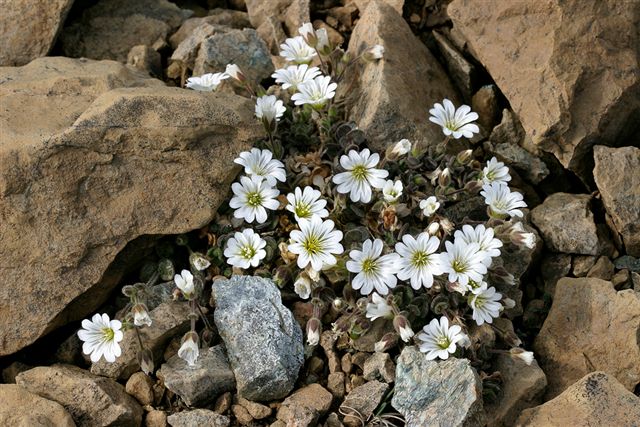
Cerastium utriense grows in a mat-forming or clumpy habit. It typically reaches 15–20 centimetres in height and can grow to approximately 25 centimetres.[1][2]
The plant is usually somewhat hairy, although its leaves are glabrous and linear to lance-shaped. Its inflorescence is generally a dense cluster containing numerous flowers.[3][4]
Each flower has five white, hairless petals, with two lobes on each petal, and five hairy sepals at its base.[5][6]
The fruit is a sub-cylindrical capsule measuring up to 1.5 centimetres long. Each capsule contains several brown seeds.[7][8]
Reproduction and life cycle
The flowering period extends from May through July.[9]
Similar species
Cerastium utriense resembles Cerastium arvense, but its erect peduncles bearing ripe fruits distinguish it.[10]
Habitat
Cerastium utriense grows on ultramafic outcrops and in mountain scrublands.[11]
The species occurs at elevations between 400 and 1,200 metres above sea level.[12]
Classification of Cerastium utriense
| Kingdom | Plantae |
|---|---|
| Subkingdom | Pteridobiotina |
| Phylum | Tracheophyta |
| Class | Magnoliopsida |
| Order | Caryophyllales |
| Family | Caryophyllaceae (Carnation) |
| Tribe | Alsineae |
| Genus | Cerastium (Chickweed) |
| Species | Cerastium utriense Barberis |
Where Cerastium utriense is found
Checklists and occurrence records place Cerastium utriense in 1 country across Europe. GBIF holds 109 georeferenced records of it.
Countries
Regions and cities with the most records
Range as the checklists state it
Italy
A number beside a place is its count of GBIF occurrence records. A place without a number comes from a checklist alone. Records show where a species has been observed or collected, which can include escapes and vagrants.
Common names
Names in 1 other language
- Italian
- Peverina di Voltri
Related species
-
 Snow in SummerCerastium tomentosum
-
 Common Mouse-EarCerastium fontanum
-
 Sticky Mouse-EarCerastium glomeratum
-
 Field ChickweedCerastium arvense
-
 Alpine ChickweedCerastium alpinum
-
 Cerastium nigrescens
-
 Gray ChickweedCerastium brachypetalum
-
 Common Mouse-ear ChickweedCerastium holosteoides
Compare
Questions and answers
Where is Cerastium utriense found?
It is endemic to Italy and has a restricted distribution in northwestern Italy, particularly in the Apennines of Liguria and Piedmont.[13][14]
What is the habitat of Cerastium utriense?
It grows on ultramafic outcrops and in mountain scrublands, at elevations between 400 and 1,200 metres above sea level.[11][12]
When does Cerastium utriense flower?
Its flowering period extends from May through July.[9]
How tall does Cerastium utriense grow?
It typically reaches 15–20 centimetres in height and can grow to approximately 25 centimetres.[2]
How is Cerastium utriense distinguished from Cerastium arvense?
Its erect peduncles bearing ripe fruits distinguish it from Cerastium arvense.[10]
When was Cerastium utriense first described?
It was first described in 1988.[15]
Sources
Passages the profile rests on
- Cerastium utriense grows in a mat-forming or clumpy growth habit. Source passage: “Cerastium utriense is a mat-forming or clumpy hemicryptophyte” — English Wikipedia
- The plant typically reaches 15–20 centimetres in height and can grow to approximately 25 centimetres. Source passage: “reaching 15–20 centimetres (5.9–7.9 in) in height, with a maximum of about 25 centimetres” — English Wikipedia
- The plant is usually somewhat hairy, although its leaves are glabrous and linear to lance-shaped. Source passage: “It is usually somewhat hairy in texture, with glabrous, linear to lance-shaped leaves a few centimeters long.” — English Wikipedia
- Its inflorescence is generally a dense cluster containing numerous flowers. Source passage: “The pubescent inflorescence is usually a dense cluster of many flowers.” — English Wikipedia
- Each flower has five white, hairless petals, with two lobes on each petal. Source passage: “The flower has five white, glabrous petals, each with two lobes” — English Wikipedia
- The flowers have five hairy sepals at their base. Source passage: “and five hairy sepals at the base.” — English Wikipedia
- The fruit is a sub-cylindrical capsule measuring up to 1.5 centimetres long. Source passage: “The fruit is a sub-cylindrical capsule up to 1.5 centimeters long” — English Wikipedia
- Each fruit capsule contains several brown seeds. Source passage: “containing several brown seeds.” — English Wikipedia
- The flowering period extends from May through July. Source passage: “The flowering period is May through July.” — English Wikipedia
- Cerastium utriense resembles Cerastium arvense, but its erect peduncles bearing ripe fruits distinguish it. Source passage: “This species is quite similar to Cerastium arvense, but it may be distinguished by the erect peduncles bearing the ripe fruits.” — English Wikipedia
- Cerastium utriense grows on ultramafic outcrops and in mountain scrublands. Source passage: “growing in ultramafic outcrops and mountain scrublands.” — English Wikipedia
- The species occurs at elevations between 400 and 1,200 metres above sea level. Source passage: “It occurs at an altitude of 400–1,200 metres (1,300–3,900 ft) above sea level.” — English Wikipedia
- Cerastium utriense is endemic to Italy. Source passage: “It is endemic to Italy.” — English Wikipedia
- The species has a restricted distribution in northwestern Italy, particularly in the Apennines of Liguria and Piedmont. Source passage: “It is limited to northwestern Italy, where it can be found in the Apennines of Liguria and Piedmont.” — English Wikipedia
- Cerastium utriense was first described in 1988. Source passage: “It was first described in 1988.” — English Wikipedia
Data
- Catalogue of Life, 2026-10-16 XR cc by
- Global Biodiversity Information Facility CC BY 4.0
- Wikidata CC0
- GeoNames CC BY 4.0
- Wikimedia Commons per image; credit shown with each image
- Within the Catalogue of Life, this name comes from Synonymic Checklists of the Vascular Plants of the World cc by
References
- Barberis. (1988). Webbia 42(2): 154 (1988). where the name was published
This species in other databases
Page built on 28 November 2026. See how the catalog is made and all sources and licences.
Cite this page
ScientificNames.org. (2026). Cerastium utriense. Retrieved November 28, 2026, from https://scientificnames.org/species/cerastium-utriense
“Cerastium utriense.” ScientificNames.org, 2026, scientificnames.org/species/cerastium-utriense. Accessed 28 Nov. 2026.
ScientificNames.org. “Cerastium utriense.” Accessed November 28, 2026. https://scientificnames.org/species/cerastium-utriense.
@misc{scientificnames_cerastium_utriense,
  author = {{ScientificNames.org}},
  title = {Cerastium utriense},
  year = {2026},
  url = {https://scientificnames.org/species/cerastium-utriense},
  note = {Accessed 2026-11-28}
}