Species · Flowering plants
Bulb-bearing Water-hemlock Cicuta bulbifera
The scientific name of the Bulb-bearing Water-hemlock is Cicuta bulbifera. It is a species of flowering plant in the family Apiaceae (umbellifer), order Apiales.
- Scientific name
- Cicuta bulbifera L.
- Common name
- Bulb-bearing Water-hemlock
- Genus
- Cicuta
- Family
- Apiaceae (Umbellifer)
- Order
- Apiales
- Class
- Magnoliopsida
- Red List category
- LC Least Concern
- Recorded in
- 2 countries
- Name status
- accepted in the Catalogue of Life

Overview
The bulb-bearing water-hemlock develops tiny bulbils in the leaf joints in its upper region. It grows along marsh edges and lake margins, in shallow standing water, and along slow-moving streams. It is distinguished from Cicuta douglasii by its narrow leaflet segments and bulbil-bearing upper leaf axils.
Written 26 November 2026 from the sources listed below. Each statement was checked against the passage it cites; statements that could not be supported were removed.
Appearance
The stems are light green to slightly reddish, smooth, and covered with a waxy coating. The plant has limited branching and typically reaches 1.5–3.5 feet (46–107 cm) in height.[1][2][3]
The leaves are alternate, compound, green, and waxy-coated except for their petioles. Lower leaves are bipinnate, whereas upper leaves are often simple-pinnate.[4][5]
The leaflets are linear to lanceolate-linear, toothed, and sometimes divided into narrow lobes. Individual leaflets can reach 3 inches (7.6 cm) in length and 0.33 inches (0.8 cm) in width.[6][7]
The upper leaf axils often contain sessile clusters of egg-shaped bulbils. The root system consists of clustered elongated fleshy roots.[8][9]
The stems end in compound umbels bearing small white flowers. Each compound umbel contains approximately eight umbellets, and each umbellet contains approximately 16 flowers.[10][11][12]
Individual flowers have five white petals, five stamens, two styles, and an ovary. They measure approximately 1/8 inch (3.2 mm) across and have no noticeable floral scent.[13][14][15]
The compound flower umbels measure approximately 2–4 inches (5.1–10.2 cm) across. The fruits are somewhat flattened, egg-shaped, and slightly notched at the apex.[16][17]
Habitat
The species grows along marsh edges and lake margins, in shallow standing water, and along slow-moving streams. It is normally associated with high-quality wetlands.[18][19][20]
The plant can establish itself on hummocks and floating mats. It can also grow on partially submerged rotting logs and beaver dams.[21][22]
Reproduction and life cycle
The species reproduces through both seeds and bulbils. The bulbils can develop into new plants.[23][24]
The flowering period occurs from late summer to early fall and lasts approximately one month.[25]
Similar species
Cicuta bulbifera can be distinguished from Cicuta douglasii by its narrow leaflet segments and bulbil-bearing upper leaf axils.[26]
Classification of the Bulb-bearing Water-hemlock
| Kingdom | Plantae |
|---|---|
| Subkingdom | Pteridobiotina |
| Phylum | Tracheophyta |
| Class | Magnoliopsida |
| Order | Apiales |
| Family | Apiaceae (Umbellifer) |
| Subfamily | Apioideae |
| Tribe | Oenantheae |
| Genus | Cicuta (Water-hemlock) |
| Species | Cicuta bulbifera L. |
Where the Bulb-bearing Water-hemlock is found
Checklists and occurrence records place Cicuta bulbifera in 2 countries across North America. GBIF holds 5,250 georeferenced records of it.
Countries
Regions and cities with the most records
- Ontario, Canada 731
- Wisconsin, United States 517
- Minnesota, United States 474
- Quebec, Canada 472
- Michigan, United States 282
- Pennsylvania, United States 183
- Connecticut, United States 127
- Vermont, United States 118
- Illinois, United States 114
- New York, United States 100
- New Hampshire, United States 95
- Roseville, United States 70
- Longfellow Community, United States 67
- Alberta, Canada 65
- Columbia Heights, United States 65
- New Brighton, United States 65
- New Brunswick, Canada 65
- Richfield, United States 64
- Crystal, United States 62
- Fridley, United States 62
- Golden Valley, United States 62
- Minneapolis, United States 62
- Manitoba, Canada 60
- Saint Louis Park, United States 60
- Brooklyn Center, United States 59
- Coon Rapids, United States 57
- Saint Paul, United States 57
- Inver Grove Heights, United States 55
- Nova Scotia, Canada 55
- Edina, United States 52
- Massachusetts, United States 52
- West Saint Paul, United States 52
- White Bear Lake, United States 50
- Bloomington, United States 49
- Maine, United States 48
- Hopkins, United States 47
1 more country has a few records outside this range
These countries hold a few records of Cicuta bulbifera but lie outside the range the checklists give for it. Such records are often zoo or garden specimens, museum material or vagrants, so the species is not counted as occurring there.
Range as the checklists state it
Alaska; Canada (Alberta, British Columbia, Labrador, Manitoba, New Brunswick, Newfoundland, Nova Scotia, Northern Territories, Nunavut, Ontario, Prince Edward Isl., Québec, Saskatchewan, Yukon); USA (Connecticut, Delaware, Florida, Iowa, Idaho, Illinois, Indiana, Kansas, Kentucky, Massachusetts, Maryland, Maine, Michigan, Minnesota, Montana, North Carolina, North Dakota, Nebraska, New Hampshire, New Jersey, New York, Ohio, Oregon, Pennsylvania, Rhode Island, South Dakota, Virginia, Vermont, Washington State, Wisconsin, West Virginia, Wyoming)
A number beside a place is its count of GBIF occurrence records. A place without a number comes from a checklist alone. Records show where a species has been observed or collected, which can include escapes and vagrants.
Common names
English
- Bulb-bearing Water-hemlock
- Bulbil-bearing Water-hemlock
- Bulblet Water Hemlock
- Bulblet-bearing Water-hemlock
- Bulbous Water Hemlock
- Bulbous Water-hemlock
- Water Hemlock
Names in 3 other languages
- Chinese
- 球花水毒芹
- French
- cicutaire bulbifère
- Russian
- Вех луковичконосный
Synonyms
2 other scientific names have been used for this species and are now treated as synonyms of Cicuta bulbifera.
- Cicutaria bulbifera (L.) Lam.
- Keraskomion bulbiferum (L.) Raf.
Related species
-
 CowbaneCicuta virosa
-
 Spotted Water-hemlockCicuta maculata
-
 Western Water-hemlockCicuta douglasii
-
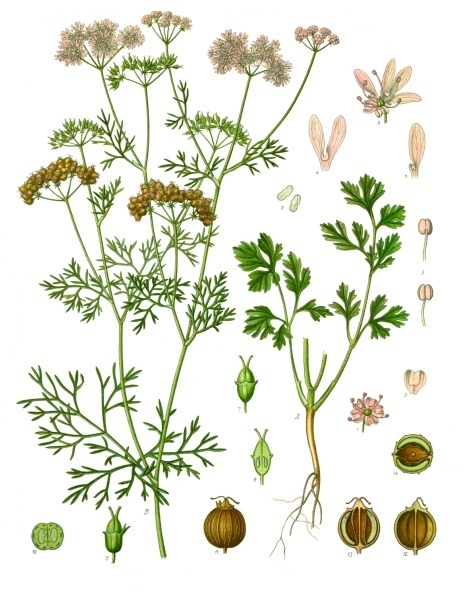 CorianderCoriandrum sativum
-
 Poison HemlockConium maculatum
-
 FennelFoeniculum vulgare
-
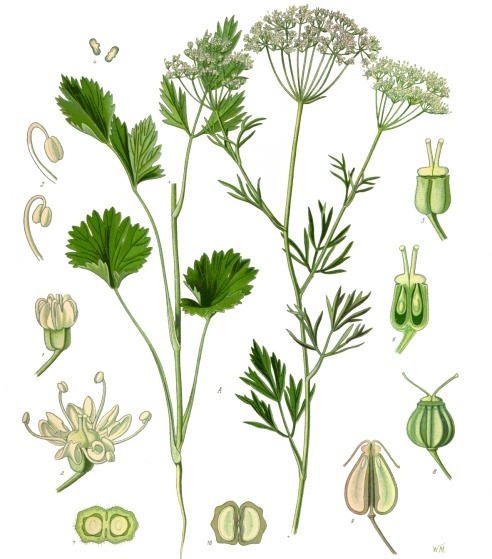 AnisePimpinella anisum
-
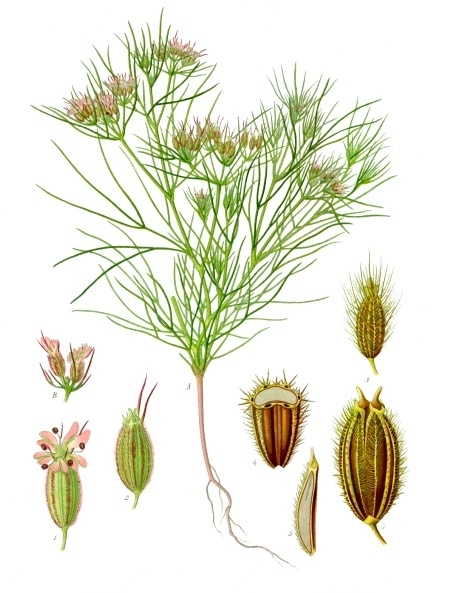 CuminCuminum cyminum
Compare
Questions and answers
What is the scientific name of the Bulb-bearing Water-hemlock?
The scientific name of the Bulb-bearing Water-hemlock is Cicuta bulbifera. Written with its author, the full name is Cicuta bulbifera L..
Which family does the Bulb-bearing Water-hemlock belong to?
Cicuta bulbifera belongs to the family Apiaceae, in the order Apiales and the class Magnoliopsida.
Where is the Bulb-bearing Water-hemlock found?
Checklists and occurrence records place Cicuta bulbifera in 2 countries: United States and Canada.
What is the conservation status of the Bulb-bearing Water-hemlock?
The IUCN Red List category recorded for Cicuta bulbifera is Least Concern (LC).
What other names does the Bulb-bearing Water-hemlock have?
Cicuta bulbifera is also known in English as Bulbil-bearing Water-hemlock, Bulblet Water Hemlock, Bulblet-bearing Water-hemlock, Bulbous Water Hemlock, Bulbous Water-hemlock and Water Hemlock.
Sources
Passages the profile rests on
- The stems are light green to slightly reddish, smooth, and covered with a waxy coating. Source passage: “The stems are light green to slightly reddish, glabrous, and glaucous from epicuticular wax.” — English Wikipedia
- Mature plants typically reach heights of 1.5–3.5 feet (46–107 cm). Source passage: “This perennial plant reaches 1.5–3.5 feet (46–107 cm) tall” — English Wikipedia
- The plant has limited branching. Source passage: “with limited branching.” — English Wikipedia
- The leaves are alternate, compound, green, and waxy-coated except for their petioles. Source passage: “The compound, alternate leaves are green, also glaucous (excluding petioles)” — English Wikipedia
- Lower leaves are bipinnate, whereas upper leaves are often simple-pinnate. Source passage: “Lower leaves are bipinnate, while the upper leaves are often simple-pinnate.” — English Wikipedia
- The leaflets are linear to lanceolate-linear, toothed, and sometimes divided into narrow lobes. Source passage: “they are linear to lanceolate-linear, dentate, and sometimes cleft into narrow lobes.” — English Wikipedia
- Individual leaflets can reach 3 inches (7.6 cm) in length and 0.33 inches (0.8 cm) in width. Source passage: “Leaflets (pinnae) are up to 3 inches (7.6 cm) long and 0.33 inches (0.8 cm) across” — English Wikipedia
- The upper leaf axils often contain sessile clusters of egg-shaped bulbils. Source passage: “The axils of the upper leaves often have sessile clusters of ovoid bulbils” — English Wikipedia
- The root system consists of clustered elongated fleshy roots. Source passage: “The root system consists of a cluster of elongated fleshy roots.” — English Wikipedia
- The stems end in compound umbels bearing small white flowers. Source passage: “The stems terminate into compound umbels of small white flowers” — English Wikipedia
- Each compound umbel contains approximately eight umbellets. Source passage: “comprises about 8 umbellets” — English Wikipedia
- Each umbellet contains approximately 16 flowers. Source passage: “themselves each composed of some 16 flowers.” — English Wikipedia
- Individual flowers have five white petals, five stamens, two styles, and an ovary. Source passage: “consist of 5 white petals, 5 stamens, 2 styles, and an ovary.” — English Wikipedia
- Individual flowers measure approximately 1/8 inch (3.2 mm) across. Source passage: “Flowers are about 1⁄8 inch (3.2 mm) across” — English Wikipedia
- The plant has no noticeable floral scent. Source passage: “There is no noticeable floral scent.” — English Wikipedia
- The fruits are somewhat flattened, egg-shaped, and slightly notched at the apex. Source passage: “somewhat flattened, egg-shaped, and slightly notched at its apex.” — English Wikipedia
- The compound flower umbels measure approximately 2–4 inches (5.1–10.2 cm) across. Source passage: “each of which spans about 2–4 inches (5.1–10.2 cm) across” — English Wikipedia
- The species grows along marsh edges and lake margins. Source passage: “It grows along the edges of marshes and lake margins” — English Wikipedia
- The species grows in shallow standing water and along slow-moving streams. Source passage: “shallow standing water and along slow-moving streams.” — English Wikipedia
- The species is normally associated with high-quality wetlands. Source passage: “This species is normally found in high-quality wetlands.” — English Wikipedia
- The plant can establish itself on hummocks and floating mats. Source passage: “It can also grow on hummocks and floating mats” — English Wikipedia
- The species can grow on partially submerged rotting logs and beaver dams. Source passage: “on partially submerged rotting logs, and is even known to grow on beaver dams.” — English Wikipedia
- The species reproduces through both seeds and bulbils. Source passage: “it reproduces by its seeds and bulbils.” — English Wikipedia
- The bulbils can develop into new plants. Source passage: “capable of giving rise to new plants.” — English Wikipedia
- The flowering period occurs from late summer to early fall and lasts approximately one month. Source passage: “The blooming period occurs during late summer to early fall and lasts about a month.” — English Wikipedia
- Cicuta bulbifera can be distinguished from Cicuta douglasii by its narrow leaflet segments and bulbil-bearing upper leaf axils. Source passage: “Cicuta bulbifera can be distinguished from Cicuta douglasii by its narrow leaflet segments (less than 1/4 of an inch wide) and its bulbil-bearing upper leaf axils.” — English Wikipedia
- All parts of the plant are highly poisonous to humans and livestock. Source passage: “All plant parts are highly poisonous to humans and livestock.” — English Wikipedia
- The tuberous roots, stem base, and young shoots are particularly toxic. Source passage: “The tuberous roots, stem base, and young shoots are especially toxic.” — English Wikipedia
- A root fragment approximately the size of a walnut can be fatal to a cow. Source passage: “A piece of root about the size of a walnut is enough to cause the death of a cow.” — English Wikipedia
Data
- Catalogue of Life, 2026-10-16 XR cc by
- Global Biodiversity Information Facility CC BY 4.0
- Wikidata CC0
- GeoNames CC BY 4.0
- Wikimedia Commons per image; credit shown with each image
- Within the Catalogue of Life, this name comes from Synonymic Checklists of the Vascular Plants of the World cc by
References
- L. (1753). Sp. Pl. [Linnaeus] 1: 255 (1753). where the name was published
This species in other databases
- Catalogue of Life VB4F
- Wikidata Q5119476
- iNaturalist 130369
- World Flora Online wfo-0000604466
- GRIN 404320
Page built on 28 November 2026. See how the catalog is made and all sources and licences.
Cite this page
ScientificNames.org. (2026). Cicuta bulbifera (Bulb-bearing Water-hemlock). Retrieved November 28, 2026, from https://scientificnames.org/species/cicuta-bulbifera
“Cicuta bulbifera (Bulb-bearing Water-hemlock).” ScientificNames.org, 2026, scientificnames.org/species/cicuta-bulbifera. Accessed 28 Nov. 2026.
ScientificNames.org. “Cicuta bulbifera (Bulb-bearing Water-hemlock).” Accessed November 28, 2026. https://scientificnames.org/species/cicuta-bulbifera.
@misc{scientificnames_cicuta_bulbifera_bulb_bearing_water_hemlock,
  author = {{ScientificNames.org}},
  title = {Cicuta bulbifera (Bulb-bearing Water-hemlock)},
  year = {2026},
  url = {https://scientificnames.org/species/cicuta-bulbifera},
  note = {Accessed 2026-11-28}
}