Species · Flowering plants
Cowbane Cicuta virosa
The scientific name of the Cowbane is Cicuta virosa. It is a species of flowering plant in the family Apiaceae (umbellifer), order Apiales.
- Scientific name
- Cicuta virosa L.
- Common name
- Cowbane
- Genus
- Cicuta
- Family
- Apiaceae (Umbellifer)
- Order
- Apiales
- Class
- Magnoliopsida
- Red List category
- LC Least Concern
- Recorded in
- 46 countries
- Name status
- accepted in the Catalogue of Life

Overview
Cowbane is a perennial herbaceous flowering plant in the family Apiaceae. It grows in wet meadows, along streambanks, and in other wet or marshy areas. It has hollow, purple-striped stems and clusters of white tuberous roots.
Written 26 November 2026 from the sources listed below. Each statement was checked against the passage it cites; statements that could not be supported were removed.
Appearance
Cowbane is a perennial herbaceous plant that can grow to a height of 1–2 m. Its stems are smooth, branching, swollen at the base, purple-striped, and hollow except at the partitions where the leaves meet the stem. The stems have one flat side and the remaining sides are rounded in cross section.[1][2][3][4]
The leaves are alternate, tripinnate, and only coarsely toothed. The small white flowers grow in umbrella-shaped inflorescences containing numerous flowered umbellets with unequal pedicels measuring 5–11 cm during fruiting.[5][6][7][8]
Cowbane has clusters of white tuberous roots. Cuts to the stems and roots release an oily yellow liquid with a rank smell resembling parsnips or carrots.[9][10]
Habitat
Cowbane grows in wet meadows, along streambanks, and in other wet or marshy areas.[11]
The species is native to northern and central Europe, northern Asia, and northwestern North America.[12]
Classification of the Cowbane
| Kingdom | Plantae |
|---|---|
| Subkingdom | Pteridobiotina |
| Phylum | Tracheophyta |
| Class | Magnoliopsida |
| Order | Apiales |
| Family | Apiaceae (Umbellifer) |
| Subfamily | Apioideae |
| Tribe | Oenantheae |
| Genus | Cicuta (Water-hemlock) |
| Species | Cicuta virosa L. |
Where the Cowbane is found
Checklists and occurrence records place Cicuta virosa in 46 countries across Asia, Europe and North America. GBIF holds 78,564 georeferenced records of it.
Countries
- Aland Islands 30
- Albania 4
- Austria 298
- Belarus 156
- Belgium 1,439
- Bulgaria
- Canada 362
- China 323
- Croatia 1
- Czechia 354
- Denmark 7,199
- Estonia 992
- Finland 11,565
- France 2,029
- Georgia
- Germany 4,529
- Greece 2
- Hungary 55
- India 3
- Ireland 111
- Italy 20
- Japan 809
- Kazakhstan 26
- Kosovo
- Kyrgyzstan 2
- Latvia 78
- Lithuania 157
- Moldova
- Mongolia 83
- North Korea 16
- Norway 2,018
- Poland 1,803
- Romania 12
- Russia 6,645
- Serbia
- Slovakia 126
- Slovenia
- South Korea 37
- Spain 3
- Sweden 14,731
- Switzerland 2,153
- The Netherlands 13,945
- Turkey 1
- Ukraine 1,350
- United Kingdom 4,844
- United States 253
Regions and cities with the most records
- Central Jutland, Denmark 3,788
- Mijdrecht, The Netherlands 3,671
- Woerden, The Netherlands 3,580
- Friesland, The Netherlands 3,331
- De Meern, The Netherlands 3,106
- Maarssen, The Netherlands 3,065
- Uithoorn, The Netherlands 2,963
- Amstelveen, The Netherlands 2,739
- Boskoop, The Netherlands 2,712
- Alphen aan den Rijn, The Netherlands 2,701
- Bodegraven, The Netherlands 2,689
- Gouda, The Netherlands 2,633
- Waddinxveen, The Netherlands 2,623
- Steenwijk, The Netherlands 2,415
- Drachten, The Netherlands 2,330
- Weesp, The Netherlands 2,219
- Leeuwarden, The Netherlands 2,184
- Overijssel, The Netherlands 2,037
- Benthuizen, The Netherlands 2,031
- Nieuw-Vennep, The Netherlands 1,983
- Meppel, The Netherlands 1,867
- Utrecht, The Netherlands 1,855
- England, United Kingdom 1,840
- Leiderdorp, The Netherlands 1,819
- Diemen, The Netherlands 1,773
- Heerenveen, The Netherlands 1,756
- Bussum, The Netherlands 1,740
- Naarden, The Netherlands 1,721
- Hilversum, The Netherlands 1,717
- Hoofddorp, The Netherlands 1,661
- Baarn, The Netherlands 1,632
- Bilthoven, The Netherlands 1,627
- Soest, The Netherlands 1,609
- Västra Götaland, Sweden 1,598
- South Denmark, Denmark 1,590
- Huizen, The Netherlands 1,586
Range as the checklists state it
England (England, Wales, Scotland); Ireland (Ireland, Northern Ireland); Denmark; Norway; Sweden; Finland; Netherlands; Belgium; Germany (Brandenburg, Berlin, Baden-Württemberg, Bayern, Hessen, Hamburg, Mecklenburg-Vorpommern, Niedersachsen, Nordrhein-Westfalen, Rheinland-Pfalz, Schleswig-Holstein, +Saarland, Sachsen, Sachsen-Anhalt, Thüringen); Switzerland; Austria; Poland; Czech Republic; Slovakia; Hungary; +Spain; France; Italy; Slovenia; Croatia; Serbia; Kosovo; Romania; Bulgaria; NW-Greece; S-European Russia; Estonia; Latvia; Lithuania; Belarus; C-European Russia; E-European Russia; N-European Russia; Moldova; Ukraine; Siberia (Altay, Buryatia, Chita, Irkutsk, Krasnoyarsk, Tuva, SW-Siberia, Siberian Urals, Yakutia); Russian Far East (Amur, Kamchatka, Khabarovsk, Kuril Isl., Magadan, Primorye, Sakhalin, Chukotka); Kazakhstan; Kyrgyzstan; Georgia [Caucasus]; Turkey (NE-Anatolia); China (Xinjiang, Gansu, Qinghai, Nei Mongol, Shaanxi, Shanxi, Hebei, Shandong, Heilongjiang, Jilin, Liaoning, Henan, Jiangsu, Fujian); Mongolia; North Korea; South Korea; NW-India (Jammu & Kashmir, Himachal Pradesh, Uttar Pradesh); Alaska; Canada (Alberta, British Columbia, Manitoba, Northern Territories, Ontario, Québec, Saskatchewan, Yukon)
A number beside a place is its count of GBIF occurrence records. A place without a number comes from a checklist alone. Records show where a species has been observed or collected, which can include escapes and vagrants.
Common names
English
- Cowbane
- European Waterhemlock
- European Water-hemlock
- Mackenzie's Water-hemlock
- Boreal Water-hemlock
- Northern Water Hemlock
- Northern Water-hemlock
- Water-hemlock
Names in 32 other languages
- Arabic
- بسباس سام
- Armenian
- Մոլեխինդ թունավոր
- Basque
- Uretako astaperrexil
- Belarusian
- Цыкута ядавітая
- Chinese
- 毒芹
- Czech
- rozpuk jizlivý
- Danish
- Gifttyde
- Dutch
- Waterscheerling
- Estonian
- harilik mürkputk
- Finnish
- myrkkykeiso
- French
- Ciguë aquatique, cicutaire du Nord, ciguë vireuse
- German
- Gift-Wasserschierling, Giftiger Wasserschierling, Wasserschierling
- Hungarian
- gyilkos csomorika
- Italian
- Cicuta acquatica
- Japanese
- ドクゼリ
- Korean
- Dong-mi-na-ri, 독미나리
- Latvian
- indīgais velnarutks
- Lithuanian
- Nuodingoji nuokana
- Mongolian
- Хахуун голынхор
- Northern Sami
- mirkorássi, mirkourttas
- Norwegian Bokmål
- selsnepe
- Polish
- Szalej jadowity
- Russian
- Вех ядовитый, Вёх ядовитый
- Serbian
- Барска кукута
- Slovak
- rozpuk jedovatý
- Slovenian
- velika trobelika
- Swedish
- sprängört
- Turkish
- Su baldıranı
- Ukrainian
- Цикута отруйна
- Welsh
- Buladd, Cas-Gan-Fuwch
- frr
- Gaalrut
- glv
- Aghaue veg
Synonyms
33 other scientific names have been used for this species and are now treated as synonyms of Cicuta virosa.
- Cicuta angustifolia Kit. ex Schult.
- Cicuta baldacciana Degen ex Bald.
- Cicuta cellulosa Gilib.
- Cicuta mackenzieana Raup
- Cicuta nipponica Franch.
- Cicuta orientalis Degen
- Cicuta pumila Behm
- Cicuta sachalinensis Koidz.
- Cicuta tenuifolia Schrank
- Cicuta virosa f. angustifolia (Kit.) Schube
- Cicuta virosa f. angustifolia (Kit.) Regel
- Cicuta virosa f. intermedia (Glaab) Thell.
- Cicuta virosa f. latisecta (Čelak.) Y.C.Chu
- Cicuta virosa f. latisecta (Čelak.) Thell.
- Cicuta virosa f. longiinvolucellata Y.C.Chu
- Cicuta virosa f. submersa Glück
- Cicuta virosa subsp. tenuifolia (Schrank) Schübl. & G.Martens
- Cicuta virosa var. angustifolia (Kit. ex Schult.) Schltdl.
- Cicuta virosa var. angustisecta Čelak.
- Cicuta virosa var. intermedia Glaab
- Cicuta virosa var. latifolia Schltdl.
- Cicuta virosa var. latisecta Čelak.
- Cicuta virosa var. nipponica (Franch.) Makino
- Cicuta virosa var. orientalis (Degen) Bald.
- Cicuta virosa var. stricta K.Schultz
- Cicuta virosa var. tenuifolia (A.Fröhl.) K.Koch
- Cicuta virosa var. tenuifolia (Schrank) Roth
- Cicuta virosa var. virosa
- Cicutaria aquatica Lam.
- Cicutaria virosa (L.) Delarbre
- Selinum virosum (L.) E.H.L.Krause
- Sium cicuta Weber
- Coriandrum cicuta Roth ambiguous synonym
Related species
-
 Spotted Water-hemlockCicuta maculata
-
 Western Water-hemlockCicuta douglasii
-
 Bulb-bearing Water-hemlockCicuta bulbifera
-
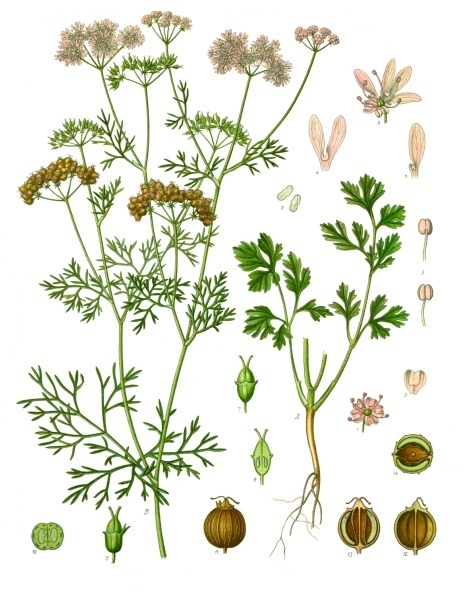 CorianderCoriandrum sativum
-
 Poison HemlockConium maculatum
-
 FennelFoeniculum vulgare
-
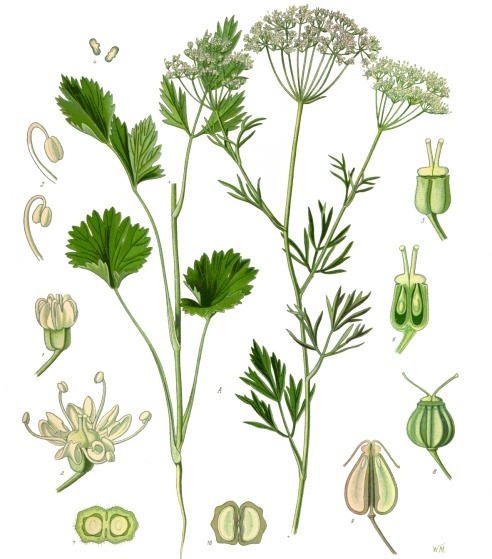 AnisePimpinella anisum
-
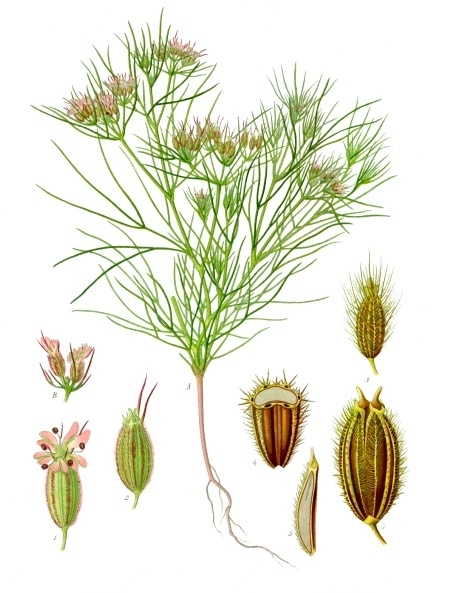 CuminCuminum cyminum
Compare
Questions and answers
What is the scientific name of the Cowbane?
The scientific name of the Cowbane is Cicuta virosa. Written with its author, the full name is Cicuta virosa L..
Which family does the Cowbane belong to?
Cicuta virosa belongs to the family Apiaceae, in the order Apiales and the class Magnoliopsida.
Where is the Cowbane found?
Checklists and occurrence records place Cicuta virosa in 46 countries, including Sweden, The Netherlands, Finland, Denmark, Russia and United Kingdom.
What is the conservation status of the Cowbane?
The IUCN Red List category recorded for Cicuta virosa is Least Concern (LC).
What other names does the Cowbane have?
Cicuta virosa is also known in English as European Waterhemlock, European Water-hemlock, Mackenzie's Water-hemlock, Boreal Water-hemlock, Northern Water Hemlock and Northern Water-hemlock.
Sources
Passages the profile rests on
- Cicuta virosa is a perennial herbaceous plant. Source passage: “It is a perennial herbaceous plant” — English Wikipedia
- The stems are smooth, branching, swollen at the base, purple-striped, and hollow except at the partitions where the leaves meet the stem. Source passage: “The stems are smooth, branching, swollen at the base, purple-striped, and hollow except for partitions at the junction of the leaves and stem.” — English Wikipedia
- The stems have one flat side and the remaining sides are rounded in cross section. Source passage: “In cross section the stems have one flat side and the other sides are rounded.” — English Wikipedia
- Cicuta virosa can grow to a height of 1–2 m. Source passage: “grows up to 1–2 m tall.” — English Wikipedia
- The leaves are alternate, tripinnate, and only coarsely toothed. Source passage: “The leaves are alternate, tripinnate, only coarsely toothed” — English Wikipedia
- The flowers are small and white and grow in umbrella-shaped inflorescences. Source passage: “The flowers are small, white and clustered in umbrella shaped inflorescences typical of the family.” — English Wikipedia
- The flower clusters contain numerous flowered umbellets with unequal pedicels measuring 5–11 cm during fruiting. Source passage: “The many flowered umbellets have unequal pedicels that range from 5 to 11 cm long during fruiting.” — English Wikipedia
- Its unequal flower pedicels measure 5–11 cm long during fruiting. Source passage: “The many flowered umbellets have unequal pedicels that range from 5 to 11 cm long during fruiting.” — English Wikipedia
- Cuts to the stems and roots release an oily yellow liquid with a rank smell resembling parsnips or carrots. Source passage: “An oily, yellow liquid oozes from cuts to the stems and roots. This liquid has a rank smell resembling that of parsnips or carrots.” — English Wikipedia
- The plant has clusters of white tuberous roots. Source passage: “clusters of white tuberous roots” — English Wikipedia
- The species grows in wet meadows, along streambanks, and in other wet or marshy areas. Source passage: “It grows in wet meadows, along streambanks and other wet and marshy areas.” — English Wikipedia
- Cicuta virosa is native to northern and central Europe, northern Asia, and northwestern North America. Source passage: “native to northern and central Europe, northern Asia and northwestern North America.” — English Wikipedia
Data
- Catalogue of Life, 2026-10-16 XR cc by
- Global Biodiversity Information Facility CC BY 4.0
- Wikidata CC0
- GeoNames CC BY 4.0
- Wikimedia Commons per image; credit shown with each image
- Within the Catalogue of Life, this name comes from Synonymic Checklists of the Vascular Plants of the World cc by
References
- L. (1753). Sp. Pl. [Linnaeus] 1: 255 (1753). where the name was published
This species in other databases
Page built on 28 November 2026. See how the catalog is made and all sources and licences.
Cite this page
ScientificNames.org. (2026). Cicuta virosa (Cowbane). Retrieved November 28, 2026, from https://scientificnames.org/species/cicuta-virosa
“Cicuta virosa (Cowbane).” ScientificNames.org, 2026, scientificnames.org/species/cicuta-virosa. Accessed 28 Nov. 2026.
ScientificNames.org. “Cicuta virosa (Cowbane).” Accessed November 28, 2026. https://scientificnames.org/species/cicuta-virosa.
@misc{scientificnames_cicuta_virosa_cowbane,
  author = {{ScientificNames.org}},
  title = {Cicuta virosa (Cowbane)},
  year = {2026},
  url = {https://scientificnames.org/species/cicuta-virosa},
  note = {Accessed 2026-11-28}
}