Species · Birds
Hispaniolan Lizard Cuckoo Coccyzus longirostris
The scientific name of the Hispaniolan Lizard Cuckoo is Coccyzus longirostris. It is a species of bird in the family Cuculidae (cuckoo), order Cuculiformes. The name dates from 1783.
- Scientific name
- Coccyzus longirostris (Hermann, 1783)
- Common name
- Hispaniolan Lizard Cuckoo
- Genus
- Coccyzus
- Family
- Cuculidae (Cuckoo)
- Order
- Cuculiformes
- Class
- Aves
- Red List category
- LC Least Concern
- Recorded in
- 2 countries
- Name status
- accepted in the Catalogue of Life

Overview
Coccyzus longirostris is endemic to Hispaniola, an island shared by Haiti and the Dominican Republic. Adults measure 41–46 cm in length, with approximately half of their body length consisting of the tail.
Written 26 November 2026 from the sources listed below. Each statement was checked against the passage it cites; statements that could not be supported were removed.
Appearance
Adults measure 41–46 cm in length, with approximately half of their body length consisting of the tail. Males weigh approximately 83–99 g, while females weigh approximately 92–128 g.[1][2][3]
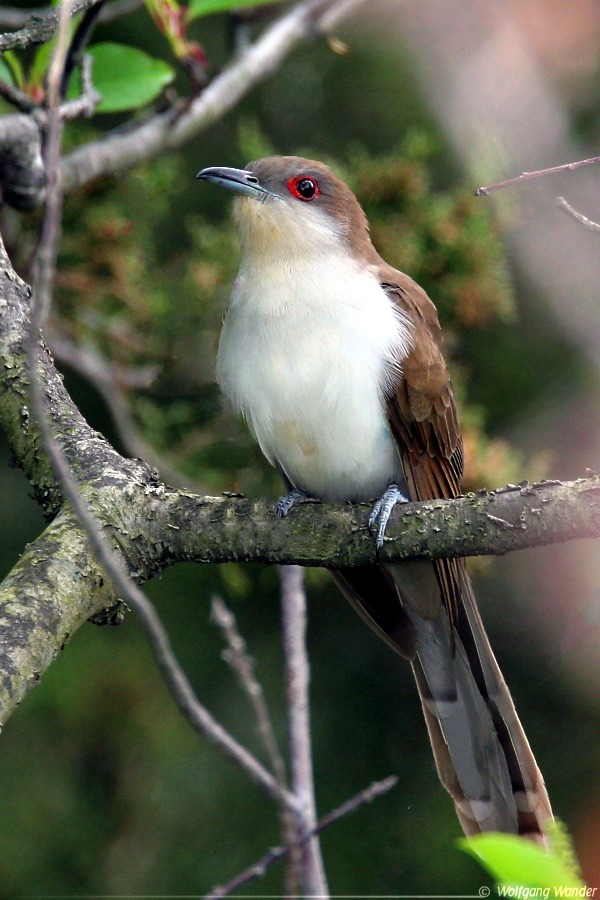
Both subspecies have a long, straight bill with a black upper mandible and a paler lower mandible. Adult males and females within the same subspecies have identical plumage, and their eyes are surrounded by bare red skin.[4][5][6]
Adults of the nominate subspecies have entirely gray upperparts and chestnut-colored wings containing a rufous patch. They have a rufous throat, pale gray breast, rufous belly, and black tail with large white tips on the undersides of its feathers.[7][8][9][10]
Juveniles have brownish-gray upperparts, a whitish throat, and a narrower brown tail with buff tips. The subspecies C. l. petersi is paler overall than the nominate subspecies and has a whitish throat.[11][12]
The species has two recognized subspecies, C. l. longirostris and C. l. petersi.[13]
Habitat
The Hispaniolan Lizard Cuckoo inhabits tropical deciduous and evergreen forests, more open woodland, and thickets. It also occurs on mountain slopes with bushes and inhabits plantations and gardens.[14][15][16][17]
Its recorded elevational range extends from sea level to 2,200 m.[18]
The nominate subspecies occurs on the main island of Hispaniola and the offshore islands of Tortuga and Saona. The subspecies C. l. petersi occurs exclusively on Gonâve Island off western Haiti.[19][20]
Diet
The Hispaniolan Lizard Cuckoo eats lizards, small snakes, and various types of adult and larval insects.[21][22][23]
Behaviour
The species remains resident throughout its range throughout the year. It usually forages in the middle and upper forest levels but also hunts close to the ground.[24][25]
It hunts by walking along branches and moving among them. It sometimes participates in mixed-species feeding flocks.[26][27]
Reproduction and life cycle
The principal breeding season extends from March through June. The species constructs a flat platform nest made of leaves, placed on a stump or in a tree.[28][29][30]
Its clutch typically contains two or three eggs.[31]
Conservation
The Hispaniolan Lizard Cuckoo is classified as Least Concern by the IUCN. Its population size is unknown and is believed to be declining.[32][33]
No immediate threats to the species have been identified. It is generally widespread but locally scarce in some parts of Haiti.[34][35]
Uses
The Hispaniolan Lizard Cuckoo is hunted in rural areas for use as a traditional medicinal digestive aid.[36]
Classification of the Hispaniolan Lizard Cuckoo
| Kingdom | Animalia |
|---|---|
| Phylum | Chordata |
| Subphylum | Vertebrata |
| Infraphylum | Gnathostomata |
| Parvphylum | Osteichthyes |
| Megaclass | Tetrapoda |
| Class | Aves (Bird) |
| Order | Cuculiformes (Cuckoo) |
| Family | Cuculidae (Cuckoo) |
| Genus | Coccyzus (Spotted-tailed Cuckoos) |
| Species | Coccyzus longirostris (Hermann, 1783) |
Where the Hispaniolan Lizard Cuckoo is found
Checklists and occurrence records place Coccyzus longirostris in 2 countries across North America. GBIF holds 12,970 georeferenced records of it.
Countries
Regions and cities with the most records
- La Altagracia Province, Dominican Republic 1,977
- Santo Domingo Oeste, Dominican Republic 1,933
- Santo Domingo, Dominican Republic 1,893
- Bajos de Haina, Dominican Republic 1,839
- Santo Domingo Este, Dominican Republic 1,796
- San Cristóbal, Dominican Republic 1,580
- Independencia, Dominican Republic 1,428
- Punta Cana, Dominican Republic 1,345
- María Trinidad Sánchez, Dominican Republic 992
- La Vega, Dominican Republic 659
- Jarabacoa, Dominican Republic 564
- Hato Mayor Province, Dominican Republic 538
- Barahona Province, Dominican Republic 504
- Puerto Plata, Dominican Republic 500
- Sud, Haiti 491
- Kenscoff, Haiti 474
- Santo Domingo Province, Dominican Republic 464
- La Vega, Dominican Republic 456
- Santa Cruz de Barahona, Dominican Republic 452
- Pedernales Province, Dominican Republic 424
- Ouest, Haiti 416
- Sud-Est, Haiti 416
- La Romana, Dominican Republic 406
- Pétionville, Haiti 396
- Les Cayes, Haiti 388
- Monte Llano, Dominican Republic 354
- Río Grande, Dominican Republic 338
- Santiago Province, Dominican Republic 320
- Puerto Plata, Dominican Republic 297
- Delmas, Haiti 269
- Croix-des-Bouquets, Haiti 267
- Carrefour, Haiti 266
- Port-au-Prince, Haiti 266
- San Francisco de Macorís, Dominican Republic 266
- Cité Soleil, Haiti 265
- Duarte Province, Dominican Republic 265
Range as the checklists state it
Caribbean
A number beside a place is its count of GBIF occurrence records. A place without a number comes from a checklist alone. Records show where a species has been observed or collected, which can include escapes and vagrants.
Common names
English
- Hispaniolan Lizard Cuckoo
- Hispaniolan Lizard-Cuckoo
Names in 27 other languages
- Arabic
- وقواق السحالي الهيسبانيولي
- Catalan
- cucut sargantaner de la Hispaniola
- Chinese
- 希斯潘諾拉島蜥鵑, 长嘴蜥鹃
- Croatian
- hispaniolska kukavica
- Czech
- kukačka haitská, kukačka hispaniolská
- Danish
- Hispaniolaøglegøg, Hispañiolaøglegøg
- Dutch
- Hispaniolahagediskoekoek
- Esperanto
- hispaniola kukolo
- Estonian
- haiti sisalikukägu
- Finnish
- haitinliskokäki, hispaniolanliskokäki
- French
- Tacco d'Hispaniola, Tacco d’Hispaniola
- German
- Haitikuckuck, Hispaniolakuckuck
- Hungarian
- hispaniolai gyíkászkakukk
- Italian
- Cuculo lacertiero di Hispaniola
- Japanese
- イスパニオラトゲカッコウ, ヒスパニオラトゲカッコウ, ヒスパニョラトゲカッコウ
- Lithuanian
- haitinė driežinė gegutė
- Norwegian
- hispaniolaøglegjøk
- Polish
- jaszczurkojad szary
- Portuguese
- cuco-dominicano, papa-lagarta-haitiano
- Russian
- Гаитянская американская кукушка, Гаитянская пиайя
- Serbian
- Gušterojeda kukavica sa Hispaniole
- Slovak
- kukavka dlhozobá
- Spanish
- Cuco lagartero de La Española, Pájaro Bobo, Tacó
- Swedish
- hispaniolaödlegök
- Turkish
- Hispanyola Kertenkele Guguğu, İspanya kertenkele guguğu
- Ukrainian
- тако гаїтянський
- hat
- Tako
Synonyms
5 other scientific names have been used for this species and are now treated as synonyms of Coccyzus longirostris.
- Cuculus longirostris Hermann, 1783
- Saurothera longirostris BirdLife International (2004)
- Saurothera longirostris (Hermann, 1783)
- Saurothera longirostris Sibley & Monroe (1990, 1993)
- Saurothera longirostris Stotz et al. (1996)
Subspecies and varieties
- Coccyzus longirostris longirostris subspecies
- Coccyzus longirostris petersi (Gonâve Island Lizard-Cuckoo) subspecies
Related species
-
 Yellow-billed CuckooCoccyzus americanus
-
 Black-billed CuckooCoccyzus erythropthalmus
-
 Mangrove CuckooCoccyzus minor
-
 Great Lizard CuckooCoccyzus merlini
-
 Dark-billed CuckooCoccyzus melacoryphus
-
 Puerto Rican Lizard CuckooCoccyzus vieilloti
-
 Cocos CuckooCoccyzus ferrugineus
-
 Bay-breasted CuckooCoccyzus rufigularis
Compare
Questions and answers
What is the scientific name of the Hispaniolan Lizard Cuckoo?
The scientific name of the Hispaniolan Lizard Cuckoo is Coccyzus longirostris. Written with its author, the full name is Coccyzus longirostris (Hermann, 1783).
Which family does the Hispaniolan Lizard Cuckoo belong to?
Coccyzus longirostris belongs to the family Cuculidae, in the order Cuculiformes and the class Aves.
Where is the Hispaniolan Lizard Cuckoo found?
Checklists and occurrence records place Coccyzus longirostris in 2 countries: Dominican Republic and Haiti.
What is the conservation status of the Hispaniolan Lizard Cuckoo?
The IUCN Red List category recorded for Coccyzus longirostris is Least Concern (LC).
What other names does the Hispaniolan Lizard Cuckoo have?
Coccyzus longirostris is also known in English as Hispaniolan Lizard-Cuckoo.
Sources
Passages the profile rests on
- Adults measure 41–46 cm in length, with approximately half of their body length consisting of the tail. Source passage: “The Hispaniolan lizard cuckoo is 41 to 46 cm (16 to 18 in) long, about half of which is the tail.” — English Wikipedia
- Males weigh approximately 83–99 g. Source passage: “Males weigh about 83 to 99 g (2.9 to 3.5 oz)” — English Wikipedia
- Females weigh approximately 92–128 g. Source passage: “females about 92 to 128 g (3.2 to 4.5 oz).” — English Wikipedia
- Both subspecies have a long, straight bill with a black upper mandible and a paler lower mandible. Source passage: “Both subspecies have a long straight bill with a black maxilla and a paler mandible.” — English Wikipedia
- Adult males and females within the same subspecies have identical plumage. Source passage: “The sexes within a subspecies have the same plumage.” — English Wikipedia
- The eye is surrounded by bare red skin. Source passage: “Their eye is surrounded by bare red skin.” — English Wikipedia
- Adults of the nominate subspecies have entirely gray upperparts. Source passage: “Adults of the nominate subspecies have entirely gray upperparts.” — English Wikipedia
- The wings of nominate-subspecies adults are chestnut-colored and contain a rufous patch. Source passage: “Their wings are chestnut with a rufous patch.” — English Wikipedia
- Adults of the nominate subspecies have a rufous throat, pale gray breast, and rufous belly. Source passage: “Their throat is rufous, the breast pale gray, and the belly rufous.” — English Wikipedia
- The tail of nominate-subspecies adults is black with large white tips on the undersides of its feathers. Source passage: “Their tail is black, and the underside of the feathers have large white tips.” — English Wikipedia
- Juveniles have brownish-gray upperparts, a whitish throat, and a narrower brown tail with buff tips. Source passage: “Juveniles have brownish gray upperparts, a whitish throat, and a narrower brown tail with buff tips.” — English Wikipedia
- The subspecies C. l. petersi is paler overall than the nominate subspecies and has a whitish throat. Source passage: “The subspecies C. l. petersi is paler overall than the nominate, and has a whitish throat.” — English Wikipedia
- The species has two recognized subspecies, C. l. longirostris and C. l. petersi. Source passage: “The Hispaniolan species has two subspecies: the nominate C. l. longirostris and C. l. petersi.” — English Wikipedia
- The species inhabits tropical deciduous and evergreen forests. Source passage: “The species inhabits tropical deciduous and evergreen forests” — English Wikipedia
- The species also occupies more open woodland and thickets. Source passage: “more open woodland, thickets” — English Wikipedia
- The species occurs on mountain slopes with bushes. Source passage: “mountain slopes with bushes” — English Wikipedia
- The species also inhabits plantations and gardens. Source passage: “plantations, and gardens.” — English Wikipedia
- Its recorded elevational range extends from sea level to 2,200 m. Source passage: “In elevation, it ranges from sea level to 2,200 m (7,200 ft).” — English Wikipedia
- The nominate subspecies occurs on the main island of Hispaniola and the offshore islands of Tortuga and Saona. Source passage: “The nominate subspecies of Hispaniolan lizard cuckoo is found on the main island of Hispaniola and the offshore islands of Tortuga and Saona.” — English Wikipedia
- The subspecies C. l. petersi occurs exclusively on Gonâve Island off western Haiti. Source passage: “C. l. petersi is found only on Gonâve Island off western Haiti.” — English Wikipedia
- Its diet includes lizards. Source passage: “Its diet includes lizards, small snakes, and many types of adult and larval insects.” — English Wikipedia
- Its diet includes small snakes. Source passage: “Its diet includes lizards, small snakes, and many types of adult and larval insects.” — English Wikipedia
- It eats various types of adult and larval insects. Source passage: “many types of adult and larval insects.” — English Wikipedia
- The species remains resident throughout its range throughout the year. Source passage: “The Hispaniolan lizard cuckoo is a year-round resident throughout the island.” — English Wikipedia
- It usually forages in the middle and upper forest levels but also hunts close to the ground. Source passage: “The Hispaniolan lizard cuckoo usually forages from the middle to upper levels of the forest, though it also hunts near the ground.” — English Wikipedia
- It hunts by walking along branches and moving among them. Source passage: “It hunts by walking along and among branches.” — English Wikipedia
- The species sometimes participates in mixed-species feeding flocks. Source passage: “It sometimes joins mixed-species feeding flocks.” — English Wikipedia
- Its principal breeding season extends from March through June. Source passage: “The Hispaniolan lizard cuckoo's core breeding season is March to June.” — English Wikipedia
- It constructs a flat platform nest made of leaves. Source passage: “It makes a flat platform nest of leaves placed on a stump or in a tree.” — English Wikipedia
- Its nest is placed on a stump or in a tree. Source passage: “placed on a stump or in a tree.” — English Wikipedia
- Its clutch typically contains two or three eggs. Source passage: “The clutch size is two or three eggs.” — English Wikipedia
- The species is classified as Least Concern by the IUCN. Source passage: “The IUCN has assessed the Hispaniolan lizard cuckoo as being of Least Concern” — English Wikipedia
- Its population size is unknown and is believed to be declining. Source passage: “though its population size is not known and is believed to be decreasing.” — English Wikipedia
- No immediate threats to the species have been identified. Source passage: “No immediate threats have been identified.” — English Wikipedia
- The species is generally widespread but locally scarce in some parts of Haiti. Source passage: “It is generally widespread, but locally scarce in parts of Haiti.” — English Wikipedia
- The species is hunted in rural areas for use as a traditional medicinal digestive aid. Source passage: “In rural areas, it is hunted as a traditional medicine digestive aid.” — English Wikipedia
Data
- Catalogue of Life, 2026-10-16 XR cc by
- Global Biodiversity Information Facility CC BY 4.0
- Wikidata CC0
- GeoNames CC BY 4.0
- Wikimedia Commons per image; credit shown with each image
- Within the Catalogue of Life, this name comes from The Integrated Taxonomic Information System cc0
References
- Dickinson, E. C., and J. V. Remsen Jr., eds. (2013). The Howard and Moore Complete Checklist of the Birds of the World, 4th Edition, Vol. 1 Non-Passerines.
This species in other databases
Page built on 29 November 2026. See how the catalog is made and all sources and licences.
Cite this page
ScientificNames.org. (2026). Coccyzus longirostris (Hispaniolan Lizard Cuckoo). Retrieved November 29, 2026, from https://scientificnames.org/species/coccyzus-longirostris
“Coccyzus longirostris (Hispaniolan Lizard Cuckoo).” ScientificNames.org, 2026, scientificnames.org/species/coccyzus-longirostris. Accessed 29 Nov. 2026.
ScientificNames.org. “Coccyzus longirostris (Hispaniolan Lizard Cuckoo).” Accessed November 29, 2026. https://scientificnames.org/species/coccyzus-longirostris.
@misc{scientificnames_coccyzus_longirostris_hispaniolan_lizard_cuckoo,
  author = {{ScientificNames.org}},
  title = {Coccyzus longirostris (Hispaniolan Lizard Cuckoo)},
  year = {2026},
  url = {https://scientificnames.org/species/coccyzus-longirostris},
  note = {Accessed 2026-11-29}
}