Species · Birds
Mangrove Cuckoo Coccyzus minor
The scientific name of the Mangrove Cuckoo is Coccyzus minor. It is a species of bird in the family Cuculidae (cuckoo), order Cuculiformes. The name dates from 1788.
- Scientific name
- Coccyzus minor (J. F. Gmelin, 1788)
- Common name
- Mangrove Cuckoo
- Genus
- Coccyzus
- Family
- Cuculidae (Cuckoo)
- Order
- Cuculiformes
- Class
- Aves
- Red List category
- LC Least Concern
- Environment
- terrestrial
- Recorded in
- 42 countries
- Name status
- accepted in the Catalogue of Life

Overview
Coccyzus minor is resident in southern Florida in the United States and occurs along both coasts of Mexico and Central America, with its South American Atlantic coastal range extending south to the mouth of the Amazon River. It is distinguished by a black facial mask, buff-coloured underparts, a yellow eye ring, and a long tail with black-and-white markings on the underside.
Written 26 November 2026 from the sources listed below. Each statement was checked against the passage it cites; statements that could not be supported were removed.
Appearance
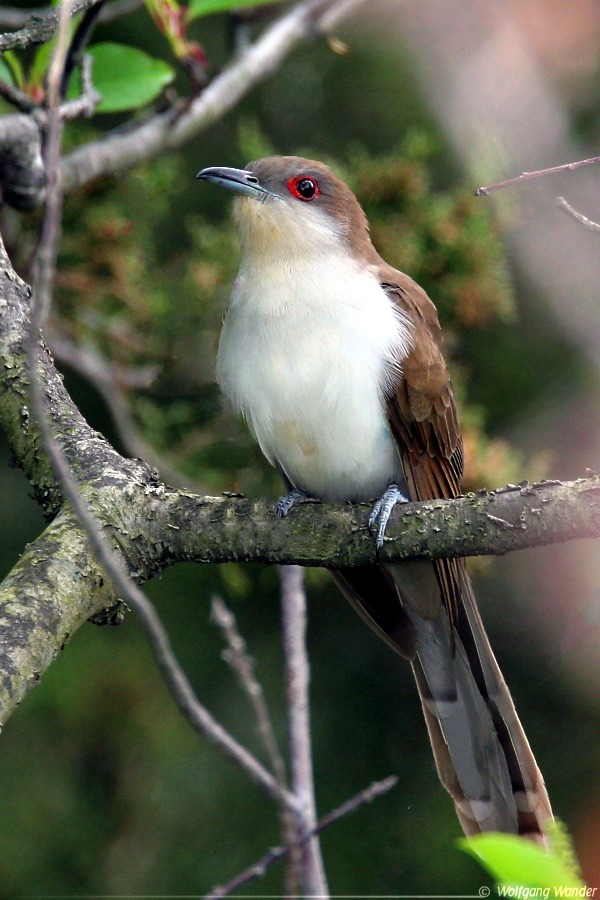
Adults have brown upperparts and a long tail with black-and-white markings on the underside. The head and upper parts are brown, and a yellow ring surrounds the eye.[1][2][3]
The species has a black facial mask and buff-coloured underparts. Its bill is black and curved, with yellow colouring on the lower mandible.[4][5]
Adults measure 28–34 cm in length, weigh 64 to 102 g, and have a wingspan of 38 to 43 cm. The Mangrove Cuckoo is the largest on average among North America's three Coccyzus cuckoo species.[6][7][8][9]
Habitat
The Mangrove Cuckoo primarily inhabits mangrove swamps and hammocks.[10]
It is resident in southern Florida in the United States and occurs along both coasts of Mexico and Central America. Its South American Atlantic coastal range extends south to the mouth of the Amazon River.[11][12][13]
Diet
The Mangrove Cuckoo has a varied diet that includes insects and insect larvae. Its preferred foods include caterpillars and grasshoppers.[14][15][16][17]
The species sometimes consumes nestlings of small birds.[18]
Behaviour
The Mangrove Cuckoo commonly produces a guttural call consisting of repeated 'gawk' notes. It also produces a single-note 'whit' call.[19][20]
Reproduction and life cycle
The species nests approximately 2–3 m above water in mangrove trees. It also nests above ground in forks of trees.[21][22]
The typical clutch contains two eggs measuring 31 mm by 23 mm. Both parents provide food to the chicks.[23][24][25]
Conservation
The IUCN Red List classifies the Mangrove Cuckoo as Least Concern. Human development of mangrove habitat is identified as a potential threat to the species.[26][27]
Classification of the Mangrove Cuckoo
| Kingdom | Animalia |
|---|---|
| Phylum | Chordata |
| Subphylum | Vertebrata |
| Infraphylum | Gnathostomata |
| Parvphylum | Osteichthyes |
| Megaclass | Tetrapoda |
| Class | Aves (Bird) |
| Order | Cuculiformes (Cuckoo) |
| Family | Cuculidae (Cuckoo) |
| Genus | Coccyzus (Spotted-tailed Cuckoos) |
| Species | Coccyzus minor (J. F. Gmelin, 1788) |
Where the Mangrove Cuckoo is found
Checklists and occurrence records place Coccyzus minor in 42 countries across North America and South America. GBIF holds 58,099 georeferenced records of it.
Countries
- Anguilla 118
- Antigua and Barbuda 388
- Aruba 33
- Bahamas 1,714
- Belize 742
- Bonaire, Saint Eustatius and Saba 16
- Brazil 94
- British Virgin Islands 140
- Cayman Islands 918
- Colombia 406
- Costa Rica 4,774
- Cuba 1,306
- Curacao 42
- Dominica 466
- Dominican Republic 2,980
- El Salvador 180
- French Guiana 45
- Grenada 1,855
- Guadeloupe 2,693
- Guatemala 161
- Guyana 64
- Haiti 220
- Honduras 697
- Jamaica 1,229
- Martinique 473
- Mexico 5,298
- Montserrat 758
- Nicaragua 587
- Panama 1,014
- Puerto Rico 18,346
- Saint Barthelemy 9
- Saint Kitts and Nevis 14
- Saint Lucia 1,543
- Saint Martin 60
- Saint Vincent and the Grenadines 448
- Sint Maarten 43
- Suriname 31
- Trinidad and Tobago 294
- Turks and Caicos Islands 344
- U.S. Virgin Islands 1,516
- United States 6,028
- Venezuela 12
Regions and cities with the most records
- Florida, United States 5,538
- Guaynabo, Puerto Rico 3,426
- Carolina, Puerto Rico 3,346
- Trujillo Alto, Puerto Rico 3,323
- Cataño, Puerto Rico 3,289
- San Juan, Puerto Rico 3,205
- Bayamón, Puerto Rico 3,114
- Barceloneta, Puerto Rico 2,761
- Manatí, Puerto Rico 2,644
- Caguas, Puerto Rico 2,098
- Candelaria, Puerto Rico 2,086
- Arecibo, Puerto Rico 2,050
- Iona, United States 1,961
- Levittown, Puerto Rico 1,961
- Puntarenas Province, Costa Rica 1,952
- Yauco, Puerto Rico 1,906
- Guanacaste Province, Costa Rica 1,820
- Cabo Rojo, Puerto Rico 1,751
- Fajardo, Puerto Rico 1,594
- Vega Baja, Puerto Rico 1,560
- Arecibo, Puerto Rico 1,472
- Castries, Saint Lucia 1,354
- Saint George's, Grenada 1,279
- Yucatán, Mexico 1,254
- Petit-Bourg, Guadeloupe 1,253
- Lajas, Puerto Rico 1,125
- Cutler, United States 1,070
- Palmetto Bay, United States 1,069
- Cutler Bay, United States 1,028
- Cutler Ridge, United States 1,027
- Baie-Mahault, Guadeloupe 1,026
- South Miami Heights, United States 1,025
- Richmond West, United States 1,024
- Sainte-Rose, Guadeloupe 1,024
- Quintana Roo, Mexico 999
- Trujillo Alto, Puerto Rico 983
1 more country has a few records outside this range
These countries hold a few records of Coccyzus minor but lie outside the range the checklists give for it. Such records are often zoo or garden specimens, museum material or vagrants, so the species is not counted as occurring there.
Range as the checklists state it
North America
South America
Caribbean
A number beside a place is its count of GBIF occurrence records. A place without a number comes from a checklist alone. Records show where a species has been observed or collected, which can include escapes and vagrants.
Common names
English
- Mangrove Cuckoo
Names in 29 other languages
- Arabic
- وقواق الأيكة الساحلية
- Catalan
- cucut dels manglars
- Chinese
- 紅樹美洲鵑, 红树美洲鹃
- Croatian
- mangrovska kukavica
- Czech
- kukačka mangrovová
- Danish
- Mangrovegøg
- Dutch
- mangrovekoekoek
- Esperanto
- mangrova kukolo
- Estonian
- mangroovikägu (mangroovi-vihmakägu)
- Finnish
- mangrovekäki
- French
- Coulicou manioc
- German
- Mangrovekuckuck, Mangrovenkuckuck
- Hungarian
- mangrovekakukk
- Italian
- Cuculo delle mangrovie
- Japanese
- マングローブカッコウ
- Latvian
- mangrovju dzeguze
- Lithuanian
- mangrovinė amerikinė gegutė
- Norwegian
- mangrovegjøk
- Papiamento
- Cucu Mangel, Kuku di Mangel
- Polish
- kukawik namorzynowy
- Portuguese
- cuco-dos-mangais, papa-lagarta-do-mangue
- Russian
- Мангровая американская кукушка, Мангровая пиайя
- Serbian
- Mangrovska američka kukavica
- Slovak
- kukavka mangrovová
- Spanish
- Cuclillo de Antifaz, Cuclillo de manglar, Cuclillo manglero, Primavera, Pájaro Bobo Menor
- Swedish
- mangroveregngök
- Turkish
- Mangrov Guguğu
- Ukrainian
- кукліло мангровий
- Welsh
- cog mangrof
Synonyms
3 other scientific names have been used for this species and are now treated as synonyms of Coccyzus minor.
- Coccyzus minor maynardi Ridgway, 1887
- Coccyzus minor minor (J. F. Gmelin, 1788)
- Cuculus minor J. F. Gmelin, 1788
Related species
-
 Yellow-billed CuckooCoccyzus americanus
-
 Black-billed CuckooCoccyzus erythropthalmus
-
 Great Lizard CuckooCoccyzus merlini
-
 Dark-billed CuckooCoccyzus melacoryphus
-
 Puerto Rican Lizard CuckooCoccyzus vieilloti
-
 Cocos CuckooCoccyzus ferrugineus
-
 Hispaniolan Lizard CuckooCoccyzus longirostris
-
 Bay-breasted CuckooCoccyzus rufigularis
Compare
Questions and answers
What is the scientific name of the Mangrove Cuckoo?
The scientific name of the Mangrove Cuckoo is Coccyzus minor. Written with its author, the full name is Coccyzus minor (J. F. Gmelin, 1788).
Which family does the Mangrove Cuckoo belong to?
Coccyzus minor belongs to the family Cuculidae, in the order Cuculiformes and the class Aves.
Where is the Mangrove Cuckoo found?
Checklists and occurrence records place Coccyzus minor in 42 countries, including Puerto Rico, United States, Mexico, Costa Rica, Dominican Republic and Guadeloupe.
What is the conservation status of the Mangrove Cuckoo?
The IUCN Red List category recorded for Coccyzus minor is Least Concern (LC).
What sound does a mangrove cuckoo make?
The Mangrove Cuckoo commonly makes a guttural call consisting of repeated 'gawk' notes. It also produces a single-note 'whit' call.[19][20]
What food do cuckoos eat?
The Mangrove Cuckoo eats caterpillars, grasshoppers, other insects, and insect larvae. It sometimes consumes nestlings of small birds.[14][15][16][18]
Do cuckoos eat other birds?
The Mangrove Cuckoo sometimes consumes nestlings of small birds.[18]
Sources
Passages the profile rests on
- Adults have brown upperparts and a long tail with black-and-white markings on the underside. Source passage: “Adults have a long tail, brown above and black-and-white below” — English Wikipedia
- The head and upper parts of adults are brown. Source passage: “The head and upper parts are brown.” — English Wikipedia
- A yellow ring surrounds the eye. Source passage: “There is a yellow ring around the eye.” — English Wikipedia
- The Mangrove Cuckoo has a black curved bill with yellow colouring on its lower mandible. Source passage: “a black curved bill with yellow on the lower mandible.” — English Wikipedia
- The species is distinguished by a black facial mask and buff-coloured underparts. Source passage: “This bird is best distinguished by its black facial mask and buffy underparts.” — English Wikipedia
- Adults measure 28–34 cm in length. Source passage: “Adults measure 28–34 cm (11–13 in) in length” — English Wikipedia
- Adult body mass ranges from 64 to 102 g. Source passage: “weigh 64–102 g (2.3–3.6 oz)” — English Wikipedia
- Adult wingspan ranges from 38 to 43 cm. Source passage: “span 38–43 cm (15–17 in) across the wings.” — English Wikipedia
- The Mangrove Cuckoo is the largest on average among North America's three Coccyzus cuckoo species. Source passage: “this species is on average the largest of North America's three Coccyzus cuckoos.” — English Wikipedia
- The species primarily inhabits mangrove swamps and hammocks. Source passage: “It is found primarily in mangrove swamps and hammocks.” — English Wikipedia
- The Mangrove Cuckoo is resident in southern Florida in the United States. Source passage: “The mangrove cuckoo is a resident of southern Florida in the United States” — English Wikipedia
- The species occurs along both coasts of Mexico and Central America. Source passage: “both coasts of Mexico and Central America” — English Wikipedia
- Its South American Atlantic coastal range extends south to the mouth of the Amazon River. Source passage: “the Atlantic coast of South America as far south as the mouth of the Amazon River.” — English Wikipedia
- Caterpillars are among the preferred foods of the Mangrove Cuckoo. Source passage: “It prefers caterpillars and grasshoppers” — English Wikipedia
- Grasshoppers are among the preferred foods of the species. Source passage: “It prefers caterpillars and grasshoppers” — English Wikipedia
- The species also eats other insects and insect larvae. Source passage: “other insects, insect larvae” — English Wikipedia
- The Mangrove Cuckoo has a varied diet that includes insects and larvae. Source passage: “Mangrove Cuckoos have a varied diet that includes insects and larvae” — allaboutbirds.org
- The Mangrove Cuckoo sometimes consumes nestlings of small birds. Source passage: “nestlings of small birds” — English Wikipedia
- The species commonly produces a guttural call consisting of repeated 'gawk' notes. Source passage: “The most common call is a guttural "gawk gawk gawk gawk gauk gauk".” — English Wikipedia
- The Mangrove Cuckoo also produces a single-note 'whit' call. Source passage: “It will also call a single "whit".” — English Wikipedia
- The species nests approximately 2–3 m above water in mangrove trees. Source passage: “It nests 2–3 m (6 ft 7 in – 9 ft 10 in) above water in a mangrove tree” — English Wikipedia
- The species also nests above ground in forks of trees. Source passage: “or above ground in a fork of a tree.” — English Wikipedia
- The typical clutch contains two eggs. Source passage: “The clutch is usually two eggs.” — English Wikipedia
- The eggs measure 31 mm by 23 mm. Source passage: “measure 31 mm × 23 mm (1.22 in × 0.91 in).” — English Wikipedia
- Both parents provide food to the chicks. Source passage: “Both parents bring food to the chicks.” — English Wikipedia
- Human development of mangrove habitat is identified as a potential threat to the species. Source passage: “This bird could be threatened by human development of mangrove habitat.” — English Wikipedia
- The IUCN Red List classifies the Mangrove Cuckoo as Least Concern. Source passage: “Mangrove Cuckoo: Coccyzus minor is listed as Least Concern.” — iucnredlist.org
Data
- Catalogue of Life, 2026-10-16 XR cc by
- Global Biodiversity Information Facility CC BY 4.0
- Wikidata CC0
- GeoNames CC BY 4.0
- Wikimedia Commons per image; credit shown with each image
- Within the Catalogue of Life, this name comes from The Integrated Taxonomic Information System cc0
References
- Syst. Nat., 1(1): 411. 1788 where the name was published
- Banks, R. C., R. W. McDiarmid, and A. L. Gardner. (1987). Checklist of Vertebrates of the United States, the U.S. Territories, and Canada. Resource Publication, No. 166.
- Gill, Frank, & and Minturn Wright. (2006). Birds of the World: Recommended English Names.
- Dickinson, E. C., and J. V. Remsen Jr., eds. (2013). The Howard and Moore Complete Checklist of the Birds of the World, 4th Edition, Vol. 1 Non-Passerines.
This species in other databases
- Catalogue of Life 5ZHPK
- Wikidata Q18923
- iNaturalist 1964
- WoRMS urn:lsid:marinespecies.org:taxname:422610
- Avibase mancuc
Page built on 28 November 2026. See how the catalog is made and all sources and licences.
Cite this page
ScientificNames.org. (2026). Coccyzus minor (Mangrove Cuckoo). Retrieved November 28, 2026, from https://scientificnames.org/species/coccyzus-minor
“Coccyzus minor (Mangrove Cuckoo).” ScientificNames.org, 2026, scientificnames.org/species/coccyzus-minor. Accessed 28 Nov. 2026.
ScientificNames.org. “Coccyzus minor (Mangrove Cuckoo).” Accessed November 28, 2026. https://scientificnames.org/species/coccyzus-minor.
@misc{scientificnames_coccyzus_minor_mangrove_cuckoo,
  author = {{ScientificNames.org}},
  title = {Coccyzus minor (Mangrove Cuckoo)},
  year = {2026},
  url = {https://scientificnames.org/species/coccyzus-minor},
  note = {Accessed 2026-11-28}
}