Species · Birds
Bay-breasted Cuckoo Coccyzus rufigularis
The scientific name of the Bay-breasted Cuckoo is Coccyzus rufigularis. It is a species of bird in the family Cuculidae (cuckoo), order Cuculiformes. The name dates from 1852.
- Scientific name
- Coccyzus rufigularis Hartlaub, 1852
- Common name
- Bay-breasted Cuckoo
- Genus
- Coccyzus
- Family
- Cuculidae (Cuckoo)
- Order
- Cuculiformes
- Class
- Aves
- Red List category
- EN Endangered
- Recorded in
- 2 countries
- Name status
- accepted in the Catalogue of Life

Overview
The species is endemic to Hispaniola and was known to nest in two areas of the Dominican Republic by 2020. It is a large cuckoo with a prominent tail and a rich maroon throat and breast.
Written 26 November 2026 from the sources listed below. Each statement was checked against the passage it cites; statements that could not be supported were removed.
Appearance
The Bay-breasted Cuckoo measures 46–51 cm in length, with approximately half its length consisting of its tail. One male specimen weighed 128 g.[1][2]
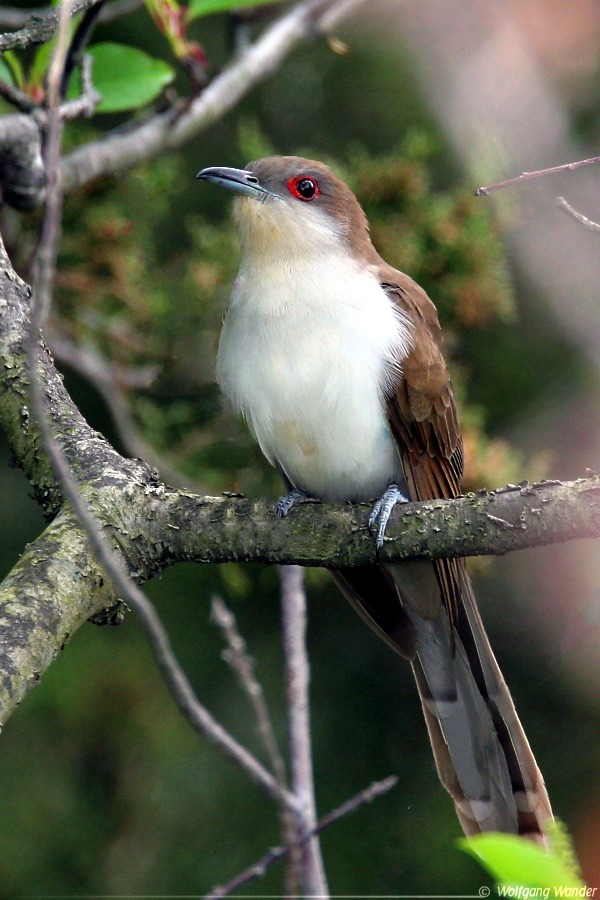
Adult males and females have the same plumage. Adults have gray upperparts and faces, chestnut primary feathers, dark chestnut chins and breasts, pale rufous bellies, and gray undertail coverts.[3][4][5]
The tail is black with large white tips. The bill is stout and decurved, with a black upper mandible and yellow lower mandible.[6][7]
Juveniles apparently differ from adults only in having narrower tail feathers.[8]
Habitat
The Bay-breasted Cuckoo inhabits lowlands and foothills at elevations reaching at least 900 m. It occurs in low-to-moderate elevation deciduous woodlands and several other forest types, particularly in narrow transition zones between dry and moist areas.[9][10][11]
By 2020, the species was known to nest in only two areas of the Dominican Republic. One is on the northern slope of Sierra de Bahoruco in Independencia Province, and the other is Nalga de Maco National Park on the lower southern slope of the Cordillera Central.[12][13][14]
Diet
The Bay-breasted Cuckoo eats adult insects, caterpillars, grubs, lizards, and mice. Young birds are fed mostly cicadas.[15][16]
Behaviour
The species forages mainly between the forest mid-story and canopy, leaping between branches while feeding. It is non-migratory.[17][18][19]
One distinctive vocalization consists of a forceful 'cua' followed by an accelerating sequence of 'u-ak' notes. Another vocalization resembles a lamb's bleat.[20][21]
Reproduction and life cycle
The breeding season extends from February until the beginning of the wet season in June. The breeding phenology of the Bay-breasted Cuckoo is almost unknown.[22][23]
The species builds a loose platform nest of twigs in a tree, usually 3–6 m above the ground. The nest is concealed in dense foliage or a bromeliad.[24][25][26]
Clutches consist of two or three eggs.[27]
Conservation
The Bay-breasted Cuckoo is classified as Endangered. Its population declined dramatically after 1900, and the estimated population in 2020 was 300–2,900 mature individuals.[28][29][30]
The population decline was believed to be continuing in 2020. The species occurs in four protected areas but is rare in all of them.[31][32]
Deforestation for agriculture and charcoal production contributes to the species' shrinking range and population. Habitat degradation caused by grazing is another identified threat, while agrochemical use is considered a possible threat.[33][34][35]
Climate change is expected to alter moisture regimes in the species' habitat. Natural and human-caused fires are considered likely to become more frequent there.[36][37]
The species historically occurred widely in both the Dominican Republic and Haiti. By 2020, it was possibly extirpated from mainland Haiti and definitely extirpated from Gonâve Island.[38][39]
Classification of the Bay-breasted Cuckoo
| Kingdom | Animalia |
|---|---|
| Phylum | Chordata |
| Subphylum | Vertebrata |
| Infraphylum | Gnathostomata |
| Parvphylum | Osteichthyes |
| Megaclass | Tetrapoda |
| Class | Aves (Bird) |
| Order | Cuculiformes (Cuckoo) |
| Family | Cuculidae (Cuckoo) |
| Genus | Coccyzus (Spotted-tailed Cuckoos) |
| Species | Coccyzus rufigularis Hartlaub, 1852 |
Where the Bay-breasted Cuckoo is found
Checklists and occurrence records place Coccyzus rufigularis in 2 countries across North America. GBIF holds 808 georeferenced records of it.
Countries
Regions and cities with the most records
- Independencia, Dominican Republic 643
- Ouest, Haiti 26
- Pedernales Province, Dominican Republic 17
- Azua Province, Dominican Republic 13
- Barahona Province, Dominican Republic 11
- Santiago Province, Dominican Republic 11
- Neiba, Dominican Republic 10
- San José de Ocoa, Dominican Republic 9
- Santa Cruz de Barahona, Dominican Republic 7
- Azua, Dominican Republic 6
- Grand Gosier, Haiti 5
- Sud-Est, Haiti 5
- San José de Ocoa, Dominican Republic 3
- Santiago Rodríguez, Dominican Republic 3
Range as the checklists state it
Caribbean
A number beside a place is its count of GBIF occurrence records. A place without a number comes from a checklist alone. Records show where a species has been observed or collected, which can include escapes and vagrants.
Common names
English
- Bay-breasted Cuckoo
- Rufous-breasted Cuckoo
Names in 28 other languages
- Arabic
- وقواق أكمت الصدر
- Catalan
- cucut becgròs de la Hispaniola
- Chinese
- 栗胸棕鵑, 栗胸鹃
- Croatian
- kestenjastoprsa kukavica
- Czech
- kukačka dominikánská
- Danish
- Hispaniolagøg, Hispañiolagøg
- Dutch
- Mantero
- Esperanto
- brunbrusta kukolo
- Estonian
- haiti oravkägu
- Finnish
- haitinruostekäki, hispaniolanruostekäki
- French
- Piaye cabrite, Tacco cabrite
- German
- Dominikanerkuckuck
- Italian
- Cuculo pettobaio
- Japanese
- クリムネリスカッコウ
- Lithuanian
- dominikinis hietornis
- Norwegian
- brunbrystgjøk
- Norwegian Nynorsk
- Brunbrystgauk
- Polish
- kukawik rdzawogardły
- Portuguese
- cuco-de-garganta-ruiva, cuco-de-peito-baio
- Russian
- Доминиканская пиайа, Доминиканская пиайя
- Serbian
- Smeđogruda američka kukavica
- Slovak
- kukavka hrdzavohrdlá
- Spanish
- Cuco picogordo de La Española, Cúa, Tacó
- Swedish
- hispaniolaregngök
- Turkish
- Defne göğüslü guguk, Kızıl Göğüslü Guguk
- Ukrainian
- піая гаїтянська
- Welsh
- Cog frongoch Hispaniola
- hat
- Tako kabrit
Synonyms
3 other scientific names have been used for this species and are now treated as synonyms of Coccyzus rufigularis.
- Hyetornis rufigularis (Hartlaub, 1852)
- Piaya rufigularis Hartlaub, KJG, 1852
- Piaya rufigularis rufigularis (Hartlaub, 1852) Stotz et al., 1996
Related species
-
 Yellow-billed CuckooCoccyzus americanus
-
 Black-billed CuckooCoccyzus erythropthalmus
-
 Mangrove CuckooCoccyzus minor
-
 Great Lizard CuckooCoccyzus merlini
-
 Dark-billed CuckooCoccyzus melacoryphus
-
 Puerto Rican Lizard CuckooCoccyzus vieilloti
-
 Cocos CuckooCoccyzus ferrugineus
-
 Hispaniolan Lizard CuckooCoccyzus longirostris
Compare
Questions and answers
What is the scientific name of the Bay-breasted Cuckoo?
The scientific name of the Bay-breasted Cuckoo is Coccyzus rufigularis. Written with its author, the full name is Coccyzus rufigularis Hartlaub, 1852.
Which family does the Bay-breasted Cuckoo belong to?
Coccyzus rufigularis belongs to the family Cuculidae, in the order Cuculiformes and the class Aves.
Where is the Bay-breasted Cuckoo found?
Checklists and occurrence records place Coccyzus rufigularis in 2 countries: Dominican Republic and Haiti.
What is the conservation status of the Bay-breasted Cuckoo?
The IUCN Red List category recorded for Coccyzus rufigularis is Endangered (EN).
What other names does the Bay-breasted Cuckoo have?
Coccyzus rufigularis is also known in English as Rufous-breasted Cuckoo.
Sources
Passages the profile rests on
- The species measures 46–51 cm in length, with approximately half its length consisting of its tail. Source passage: “The bay-breasted cuckoo is 46 to 51 cm (18 to 20 in) long, about half of which is the tail.” — English Wikipedia
- One male specimen weighed 128 g. Source passage: “One male specimen weighed 128 g (4.5 oz).” — English Wikipedia
- Adult males and females have the same plumage. Source passage: “Males and females have the same plumage.” — English Wikipedia
- Adults have gray upperparts and gray faces, with chestnut primary feathers. Source passage: “Adults have gray upperparts with chestnut on the wing's primaries, a gray face” — English Wikipedia
- Adults have dark chestnut chins and breasts, pale rufous bellies, and gray undertail coverts. Source passage: “a dark chestnut chin and breast, a pale rufous belly, and gray undertail coverts.” — English Wikipedia
- The species has a stout, decurved bill with a black upper mandible and yellow lower mandible. Source passage: “The species' bill is stout and decurved, with a black maxilla and a yellow mandible.” — English Wikipedia
- The tail is black with large white tips. Source passage: “Their tail is black with large white tips.” — English Wikipedia
- Juveniles apparently differ from adults only by having narrower tail feathers. Source passage: “Juveniles apparently differ from adults only in having narrower tail feathers.” — English Wikipedia
- The species inhabits lowlands and foothills at elevations reaching at least 900 m. Source passage: “The bay-breasted cuckoo inhabits lowlands and foothills up to at least 900 m (3,000 ft).” — English Wikipedia
- The species occurs in several forest types, particularly in narrow transition zones between dry and moist areas. Source passage: “It is found in several forest types, but mostly in the narrow transition zone between dry and moist areas.” — English Wikipedia
- The species is found in low-to-moderate elevation deciduous woodlands. Source passage: “Found in low-to-moderate elevation deciduous woodlands.” — ebird.org
- By 2020, the species was known to nest in only two areas of the Dominican Republic. Source passage: “and was known to nest in only two areas of the Dominican Republic.” — English Wikipedia
- One known nesting area is on the northern slope of Sierra de Bahoruco in Independencia Province. Source passage: “One is on the northern slope of Sierra de Bahoruco in Independencia Province where it is present in two protected areas.” — English Wikipedia
- Another known nesting area is Nalga de Maco National Park on the lower southern slope of the Cordillera Central. Source passage: “The other is in Nalga de Maco National Park on the lower southern slope of the Cordillera Central.” — English Wikipedia
- The species eats adult insects, caterpillars, grubs, lizards, and mice. Source passage: “The bay-breasted cuckoo has a varied diet that includes adult insects, caterpillars, grubs, lizards, and mice.” — English Wikipedia
- Young Bay-breasted Cuckoos are fed mostly cicadas. Source passage: “Young birds are mostly fed cicadas.” — English Wikipedia
- The species forages mainly between the forest mid-story and canopy. Source passage: “It forages mostly from the forest mid-story to the canopy” — English Wikipedia
- While foraging, the species leaps between branches. Source passage: “leaping between branches.” — English Wikipedia
- The Bay-breasted Cuckoo is non-migratory. Source passage: “The bay-breasted cuckoo is not migratory.” — English Wikipedia
- One distinctive vocalization consists of a forceful 'cua' followed by an accelerating sequence of 'u-ak' notes. Source passage: “a forceful cua, often followed by accelerating u-ak-u-ak-ak-ak-ak-ak-ak ak-ak.” — English Wikipedia
- The species produces a vocalization described as resembling a lamb's bleat. Source passage: “It also "bleats like a lamb"” — English Wikipedia
- The species' breeding season extends from February until the beginning of the wet season in June. Source passage: “Its breeding season is from February to the beginning of the wet season in June.” — English Wikipedia
- The breeding phenology of the Bay-breasted Cuckoo is almost unknown. Source passage: “The bay-breasted cuckoo's breeding phenology is almost unknown.” — English Wikipedia
- The species builds a loose platform nest made of twigs in a tree. Source passage: “It builds a loose platform nest of twigs in a tree.” — English Wikipedia
- The nest is usually positioned 3–6 m above the ground. Source passage: “It usually places the nest 3 to 6 m (10 to 20 ft) above the ground” — English Wikipedia
- The nest is concealed in dense foliage or a bromeliad. Source passage: “and hidden in dense foliage or a bromeliad.” — English Wikipedia
- The species lays clutches of two or three eggs. Source passage: “The clutch size is two or three eggs.” — English Wikipedia
- The Bay-breasted Cuckoo is classified as Endangered. Source passage: “The IUCN has assessed the bay-breasted cuckoo as Endangered.” — English Wikipedia
- The species' population declined dramatically after 1900. Source passage: “Its population has dramatically declined since 1900” — English Wikipedia
- The estimated population in 2020 was 300–2,900 mature individuals. Source passage: “the 2020 estimate of 300 to 2900 mature individuals” — English Wikipedia
- The species' population decline was believed to be continuing in 2020. Source passage: “and the decrease is believed to be continuing.” — English Wikipedia
- The species occurs in four protected areas but is rare in all of them. Source passage: “It is found in four protected areas, but is rare in all of them.” — English Wikipedia
- Deforestation for agriculture and charcoal production contributes to the species' shrinking range and population. Source passage: “The shrinking of its range and population are attributed to deforestation for agriculture and charcoal production” — English Wikipedia
- Habitat degradation caused by grazing is identified as a threat to the species. Source passage: “degradation of habitat by grazing” — English Wikipedia
- Agrochemical use is considered a possible threat to the species. Source passage: “and possibly agrochemical use.” — English Wikipedia
- Climate change is expected to alter moisture regimes in the species' habitat. Source passage: “Climate change is expected to alter the areas' moisture regimes” — English Wikipedia
- Natural and human-caused fires are considered likely to become more frequent in the species' habitat. Source passage: “both natural and human-caused fires are believed to be more likely in the future.” — English Wikipedia
- The species historically occurred widely in both the Dominican Republic and Haiti. Source passage: “The bay-breasted cuckoo historically ranged widely in both the Dominican Republic and Haiti.” — English Wikipedia
- By 2020, the species was possibly extirpated from mainland Haiti and definitely extirpated from Gonâve Island. Source passage: “As of 2020, it had possibly been extirpated from mainland Haiti and definitely from Gonâve Island” — English Wikipedia
Data
- Catalogue of Life, 2026-10-16 XR cc by
- Global Biodiversity Information Facility CC BY 4.0
- Wikidata CC0
- GeoNames CC BY 4.0
- Wikimedia Commons per image; credit shown with each image
- Within the Catalogue of Life, this name comes from The Integrated Taxonomic Information System cc0
References
- Peters, & James Lee. (1940). Check-List of Birds of the World, Vol. 4.
- Dickinson, E. C., and J. V. Remsen Jr., eds. (2013). The Howard and Moore Complete Checklist of the Birds of the World, 4th Edition, Vol. 1 Non-Passerines.
This species in other databases
Page built on 27 November 2026. See how the catalog is made and all sources and licences.
Cite this page
ScientificNames.org. (2026). Coccyzus rufigularis (Bay-breasted Cuckoo). Retrieved November 27, 2026, from https://scientificnames.org/species/coccyzus-rufigularis
“Coccyzus rufigularis (Bay-breasted Cuckoo).” ScientificNames.org, 2026, scientificnames.org/species/coccyzus-rufigularis. Accessed 27 Nov. 2026.
ScientificNames.org. “Coccyzus rufigularis (Bay-breasted Cuckoo).” Accessed November 27, 2026. https://scientificnames.org/species/coccyzus-rufigularis.
@misc{scientificnames_coccyzus_rufigularis_bay_breasted_cuckoo,
  author = {{ScientificNames.org}},
  title = {Coccyzus rufigularis (Bay-breasted Cuckoo)},
  year = {2026},
  url = {https://scientificnames.org/species/coccyzus-rufigularis},
  note = {Accessed 2026-11-27}
}