Species · Flowering plants
Fireberry Hawthorn Crataegus chrysocarpa
The scientific name of the Fireberry Hawthorn is Crataegus chrysocarpa. It is a species of flowering plant in the family Rosaceae (rose family), order Rosales.
- Scientific name
- Crataegus chrysocarpa Ashe
- Common name
- Fireberry Hawthorn
- Genus
- Crataegus
- Family
- Rosaceae (Rose Family)
- Order
- Rosales
- Class
- Magnoliopsida
- Red List category
- LC Least Concern
- Recorded in
- 3 countries
- Name status
- accepted in the Catalogue of Life

Overview
Fireberry hawthorn (Crataegus chrysocarpa Ashe) is a perennial, multi-stemmed shrub with a rounded crown in the family Rosaceae, order Rosales, and class Magnoliopsida. The species is native to much of the continental United States and Canada. It produces red fruits measuring 8–15 mm in diameter and has straight to curved thorns measuring 3–6 cm long.
Written 26 November 2026 from the sources listed below. Each statement was checked against the passage it cites; statements that could not be supported were removed.
Appearance
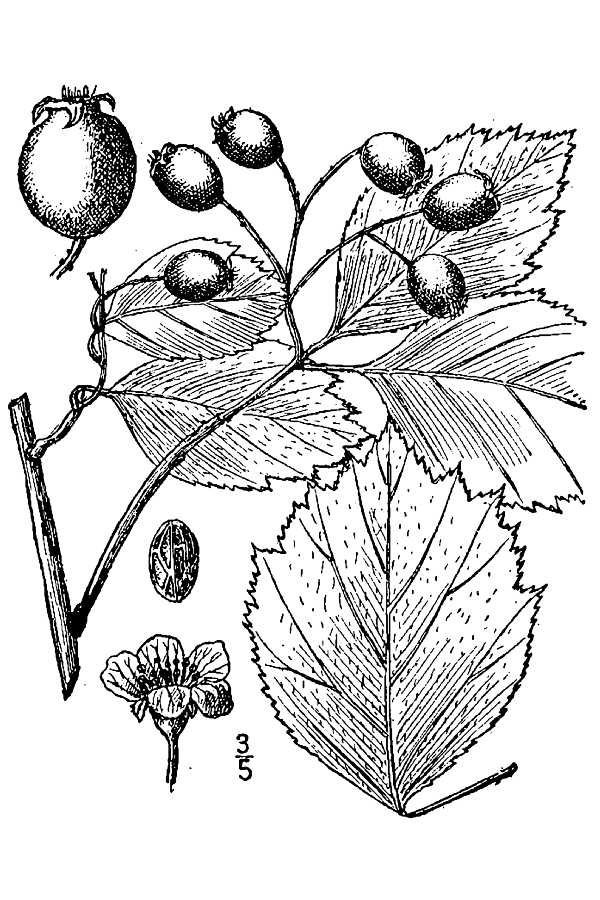
Fireberry hawthorn is a perennial, multi-stemmed shrub with a rounded crown. Its young stems are light brown and turn gray as they age. Its straight to curved thorns measure 3–6 cm long.[1][2][3]
Its inflorescences are terminal clusters containing 5–12 flowers. Each flower has a hairy, cup-shaped hypanthium, five sepals measuring 2–4 mm long, and five round, white petals measuring 7–10 mm long. Each flower also has ten stamens and an inferior ovary with three or four styles.[4][5][6][7]
Its fruit is a red pome measuring 8–15 mm in diameter. Young fruits are sparsely hairy and become smooth as they mature. Mature fruit is red, while the fruit of var. vernonensis can become deep claret-colored and nearly black when overripe.[8][9][10]
Its stipules measure 6–9 mm long.[11]
Habitat
The species grows in full sun to partial shade and performs best in well-drained, lighter soils with high organic content. It tolerates mesic to medium-wet water conditions.[12][13][14]
Established plants tolerate dry conditions but tend to produce fewer leaves and fruits under those conditions. Fruit production increases with greater light exposure.[15][16]
Diet
Birds feed on the fruits of fireberry hawthorn.[17]
Reproduction and life cycle
Fireberry hawthorn flowers in May and June. Its flowers are pollinated by bumblebees.[18][19]
Ripe red fruits can be collected for seed in late summer and autumn. Seeds are best sown in autumn because they have strong dormancy.[20][21]
Some seeds germinate in spring, while additional seeds germinate the following year.[22]
Uses
Fireberry hawthorn can be planted to stabilize hillsides and form hedges. Its substantial thorns make it suitable for use as a fence.[23][24]
The species is used in mass plantings as a border. Its fruits are edible, although their texture can be somewhat mealy.[25][26]
Classification of the Fireberry Hawthorn
| Kingdom | Plantae |
|---|---|
| Subkingdom | Pteridobiotina |
| Phylum | Tracheophyta |
| Class | Magnoliopsida |
| Order | Rosales |
| Family | Rosaceae (Rose Family) |
| Subfamily | Amygdaloideae |
| Tribe | Maleae |
| Subtribe | Malinae |
| Genus | Crataegus (Hawthorn) |
| Species | Crataegus chrysocarpa Ashe |
Where the Fireberry Hawthorn is found
Checklists and occurrence records place Crataegus chrysocarpa in 3 countries across Europe and North America. GBIF holds 6,818 georeferenced records of it.
Countries where it is native or its origin is not stated
Countries where it has been introduced
Regions and cities with the most records
- Minnesota, United States 819
- Quebec, Canada 749
- Wisconsin, United States 444
- Ontario, Canada 372
- Montana, United States 283
- Mont-Royal, Canada 220
- Longueuil, Canada 218
- Montréal, Canada 218
- Le Plateau-Mont-Royal, Canada 217
- Rosemont–La Petite-Patrie, Canada 217
- Westmount, Canada 213
- Ville-Marie, Canada 212
- Le Sud-Ouest, Canada 207
- Greenfield Park, Canada 204
- Laflèche, Canada 203
- Villeray–Saint-Michel–Parc-Extension, Canada 203
- Brossard, Canada 193
- Saint-Michel, Canada 184
- Mercier–Hochelaga-Maisonneuve, Canada 182
- Côte-Saint-Luc, Canada 179
- La Prairie, Canada 167
- Boucherville, Canada 165
- Saint-Bruno-de-Montarville, Canada 164
- Montréal-Nord, Canada 162
- Saint-Vincent-de-Paul, Canada 160
- Laval, Canada 158
- Val-des-Arbres, Canada 155
- Rivière-des-Prairies–Pointe-aux-Trembles, Canada 154
- Laval-des-Rapides, Canada 149
- L'Ancienne-Lorette, Canada 146
- Cartierville, Canada 143
- Neufchâtel-Est–Lebourgneuf, Canada 142
- Sainte-Julie, Canada 142
- Sainte-Catherine, Canada 141
- Candiac, Canada 140
- Saint-Augustin-de-Desmaures, Canada 133
8 more countries have a few records outside this range
These countries hold a few records of Crataegus chrysocarpa but lie outside the range the checklists give for it. Such records are often zoo or garden specimens, museum material or vagrants, so the species is not counted as occurring there.
Range as the checklists state it
Estonia [I]; Siberia [I]; Canada (Alberta, Manitoba, New Brunswick, Newfoundland, Nova Scotia, Ontario, Prince Edward Isl., Québec, Saskatchewan); USA (Colorado, Connecticut, Iowa, Idaho, Illinois, Indiana, Kentucky, Massachusetts, Maryland, Maine, Michigan, Minnesota, Missouri, Montana, North Dakota, Nebraska, New Hampshire, New Jersey, New Mexico, New York, Ohio, Oregon, Pennsylvania, Rhode Island, South Dakota, Utah, Virginia, Vermont, Wisconsin, West Virginia, Wyoming)
A number beside a place is its count of GBIF occurrence records. A place without a number comes from a checklist alone. Records show where a species has been observed or collected, which can include escapes and vagrants.
Common names
English
- Fireberry Hawthorn
- Fire-berry Hawthorn
- Round-leaved Hawthorn
Names in 10 other languages
- Chinese
- 火莓山楂
- Czech
- hloh okrouhlolistý
- Estonian
- Faxoni viirpuu, tulipunane viirpuu
- Finnish
- nystyorapihlaja
- French
- aubépine dorée, aubépine à feuilles rondes, aubépine à pommes dorées
- Norwegian Bokmål
- ildhagtorn
- Norwegian Nynorsk
- eldhagtorn
- Russian
- Боярышник золотистоплодный
- Slovak
- hloh zlatoplodý
- oji
- Miinesak
Synonyms
42 other scientific names have been used for this species and are now treated as synonyms of Crataegus chrysocarpa.
- Crataegus aboriginum Sarg.
- Crataegus brunetiana Sarg.
- Crataegus brunetiana var. fernaldii (Sarg.) E.J.Palmer
- Crataegus caliciglabra Schuette
- Crataegus caliciglabrata Schuette
- Crataegus chrysocarpa f. chrysocarpa
- Crataegus chrysocarpa f. rubescens (Sarg.) E.J.Palmer
- Crataegus chrysocarpa subsp. phoenicea E.J.Palmer ex J.B.Phipps
- Crataegus chrysocarpa var. aboriginum (Sarg.) Kruschke
- Crataegus chrysocarpa var. fernaldii (Sargent) E.J. Palmer
- Crataegus chrysocarpa var. longiacuminata Kruschke
- Crataegus chrysocarpa var. phoenicea E.J.Palmer
- Crataegus chrysocarpa var. phoenicea E.J.Palmer ex J.B.Phipps
- Crataegus chrysophyta Ashe
- Crataegus coccinata Sarg.
- Crataegus coccinea var. rotundifolia (M.Roem.) Sarg.
- Crataegus coloradoides Ramaley
- Crataegus columbiana var. brunetiana (Sarg.) Eggl.
- Crataegus columbiana var. chrysocarpa (Ashe) Dorn
- Crataegus doddsii Ramaley
- Crataegus fernaldii Sarg.
- Crataegus glabrifolia Sarg.
- Crataegus horrida f. rubescens (Sarg.) Cinovskis
- Crataegus horrida var. aboriginum (Sarg.) Cinovskis
- Crataegus horrida var. chrysocarpa (Ashe) Cinovskis
- Crataegus horrida var. longiacuminata (Kruschke) Cinovskis
- Crataegus illuminata Sarg.
- Crataegus keepii Sarg.
- Crataegus laurentiana var. brunetiana (Sarg.) Kruschke
- Crataegus laurentiana var. dissimilifolia Kruschke ex J.B.Phipps
- Crataegus mercerensis Sarg.
- Crataegus praetermissa Sarg.
- Crataegus putnamiana Sarg.
- Crataegus rotundifolia f. rubescens Sarg.
- Crataegus rotundifolia var. aboriginum (Sarg.) Sarg.
- Crataegus rotundifolia var. chrysocarpa (Ashe) Eggl.
- Crataegus rotundifolia var. pubera Sarg.
- Crataegus sheridanii A.Nelson
- Crataegus sicca Sarg.
- Crataegus sicca var. glabrifolia (Sarg.) E.J.Palmer
Showing 40 of 42.
Subspecies and varieties
- Crataegus chrysocarpa var. blanchardii (Blanchard's Hawthorn) variety
- Crataegus chrysocarpa var. chrysocarpa (Fireberry Hawthorn) variety
- Crataegus chrysocarpa var. duchesnensis variety
- Crataegus chrysocarpa var. faxonii (Faxon's Hawthorn) variety
- Crataegus chrysocarpa var. phoeniceoides (Glabrous-fruited Fireberry Hawthorn) variety
- Crataegus chrysocarpa var. praecox variety
- Crataegus chrysocarpa var. rotundifolia variety
- Crataegus chrysocarpa var. subrotundifolia (Lesser Round-leaved Hawthorn) variety
- Crataegus chrysocarpa var. vernonensis (Vernon Hawthorn) variety
- Crataegus chrysocarpa var. vigintistamina (Twenty-stamen Hawthorn) variety
Related species
-
 Common HawthornCrataegus monogyna
-
 Chinese HawthornCrataegus pinnatifida
-
 Mexican HawthornCrataegus mexicana
-
 AzaroleCrataegus azarolus
-
 English HawthornCrataegus laevigata
-
 Cockspur HawthornCrataegus crus-galli
-
 Oriental HawthornCrataegus orientalis
-
 Black HawthornCrataegus douglasii
Compare
Questions and answers
What is the scientific name of the Fireberry Hawthorn?
The scientific name of the Fireberry Hawthorn is Crataegus chrysocarpa. Written with its author, the full name is Crataegus chrysocarpa Ashe.
Which family does the Fireberry Hawthorn belong to?
Crataegus chrysocarpa belongs to the family Rosaceae, in the order Rosales and the class Magnoliopsida.
Where is the Fireberry Hawthorn found?
Checklists and occurrence records place Crataegus chrysocarpa in 3 countries, including United States and Canada.
What is the conservation status of the Fireberry Hawthorn?
The IUCN Red List category recorded for Crataegus chrysocarpa is Least Concern (LC).
What other names does the Fireberry Hawthorn have?
Crataegus chrysocarpa is also known in English as Fire-berry Hawthorn and Round-leaved Hawthorn.
Can humans eat hawthorn berries?
Fireberry hawthorn fruits are edible, although their texture can be somewhat mealy.[25]
Sources
Passages the profile rests on
- The species is a perennial, multi-stemmed shrub with a rounded crown. Source passage: “Crataegus chrysocarpa is a perennial multi-stemmed shrub, 2–4 m tall, with a rounded top” — openprairie.sdstate.edu
- Its young stems are light brown and turn gray as they age. Source passage: “the young stems are light brown and become gray with age.” — openprairie.sdstate.edu
- Its thorns are straight to curved and measure 3–6 cm long. Source passage: “straight to curved thorns 3–6 cm long” — openprairie.sdstate.edu
- Its inflorescences are terminal clusters containing 5–12 flowers. Source passage: “The inflorescence consists of small terminal clusters of 5- to 12 flowers” — openprairie.sdstate.edu
- Each flower has a hairy, cup-shaped hypanthium and five sepals measuring 2–4 mm long. Source passage: “Each flower has a hairy, cup-shaped hypanthium with 5 sepals 2–4 mm long” — openprairie.sdstate.edu
- Its flowers have five round, white petals measuring 7–10 mm long. Source passage: “The 5 petals are round, white, 7–10 mm long” — openprairie.sdstate.edu
- Each flower has ten stamens and an inferior ovary with three or four styles. Source passage: “There are 10 stamens and an inferior ovary with 3 or 4 styles.” — openprairie.sdstate.edu
- Its fruit is a red pome measuring 8–15 mm in diameter. Source passage: “The fruit is a red pome, 8–15 mm in diameter” — openprairie.sdstate.edu
- Its young fruits are sparsely hairy and become smooth as they mature. Source passage: “sparsely pubescent when young and later becoming smooth.” — openprairie.sdstate.edu
- Its mature fruit is red, while the fruit of var. vernonensis can become deep claret-colored and nearly black when overripe. Source passage: “although the mature fruit is red and in var. vernonensis is "deep claret-colored … nearly black when over-ripe".” — English Wikipedia
- Its stipules measure 6–9 mm long. Source passage: “with 6-9 mm long stipules” — openprairie.sdstate.edu
- The species grows in full sun to partial shade. Source passage: “Light: Full sun to partial shade.” — openprairie.sdstate.edu
- It performs best in well-drained, lighter soils with high organic content. Source passage: “does best in well drained lighter soils with a high organic content.” — openprairie.sdstate.edu
- The species tolerates mesic to medium-wet water conditions. Source passage: “Water: Mesic to medium wet.” — openprairie.sdstate.edu
- Established plants tolerate dry conditions but tend to produce fewer leaves and fruits under those conditions. Source passage: “They will tolerate dry conditions when established but tend to have fewer leaves and fruit.” — openprairie.sdstate.edu
- Its fruit production increases with greater light exposure. Source passage: “Fruit production is enhanced by light.” — openprairie.sdstate.edu
- Birds feed on the species' fruits. Source passage: “birds that feed on the fruit.” — openprairie.sdstate.edu
- The species flowers in May and June. Source passage: “Fireberry hawthorn blooms in May and June” — openprairie.sdstate.edu
- Its flowers are pollinated by bumblebees. Source passage: “attracting bumblebee pollinators” — openprairie.sdstate.edu
- Ripe red fruits can be collected for seed in late summer and autumn. Source passage: “Red ripe fruit can be collected in late summer and fall.” — openprairie.sdstate.edu
- Seeds are best sown in autumn because they have strong dormancy. Source passage: “the seeds have a hard dormancy and are best sown in the fall.” — openprairie.sdstate.edu
- Some seeds germinate in spring, while additional seeds germinate the following year. Source passage: “Some seed will germinate in the spring and more will germinate the following year.” — openprairie.sdstate.edu
- The species can be planted to stabilize hillsides and form hedges. Source passage: “can be planted to stabilize hillsides and to form a dramatic hedge.” — openprairie.sdstate.edu
- Its substantial thorns make the species suitable for use as a fence. Source passage: “The substantial thorns make it useful as a fence.” — openprairie.sdstate.edu
- Its fruits are edible, although their texture can be somewhat mealy. Source passage: “The fruit are edible and can be tasty, if somewhat mealy.” — openprairie.sdstate.edu
- The species is used in mass plantings as a border. Source passage: “Used in mass plantings as a border.” — extension.psu.edu
- In South Dakota, the species occurs on open wooded hillsides and in prairie ravines. Source passage: “on open wooded hillside and prairie ravines of the eastern and western borders of South Dakota.” — openprairie.sdstate.edu
Data
- Catalogue of Life, 2026-10-16 XR cc by
- Global Biodiversity Information Facility CC BY 4.0
- Wikidata CC0
- GeoNames CC BY 4.0
- Wikimedia Commons per image; credit shown with each image
- Within the Catalogue of Life, this name comes from Synonymic Checklists of the Vascular Plants of the World cc by
References
- Ashe. (1900). North Carolina Agric. Exp. Sta. Bull. 175: 110 (1900). where the name was published
This species in other databases
- Catalogue of Life 6BBCW
- Wikidata Q2714887
- iNaturalist 54817
- World Flora Online wfo-0001010118
- GRIN 313702
Page built on 29 November 2026. See how the catalog is made and all sources and licences.
Cite this page
ScientificNames.org. (2026). Crataegus chrysocarpa (Fireberry Hawthorn). Retrieved November 29, 2026, from https://scientificnames.org/species/crataegus-chrysocarpa
“Crataegus chrysocarpa (Fireberry Hawthorn).” ScientificNames.org, 2026, scientificnames.org/species/crataegus-chrysocarpa. Accessed 29 Nov. 2026.
ScientificNames.org. “Crataegus chrysocarpa (Fireberry Hawthorn).” Accessed November 29, 2026. https://scientificnames.org/species/crataegus-chrysocarpa.
@misc{scientificnames_crataegus_chrysocarpa_fireberry_hawthorn,
  author = {{ScientificNames.org}},
  title = {Crataegus chrysocarpa (Fireberry Hawthorn)},
  year = {2026},
  url = {https://scientificnames.org/species/crataegus-chrysocarpa},
  note = {Accessed 2026-11-29}
}