Species · Flowering plants
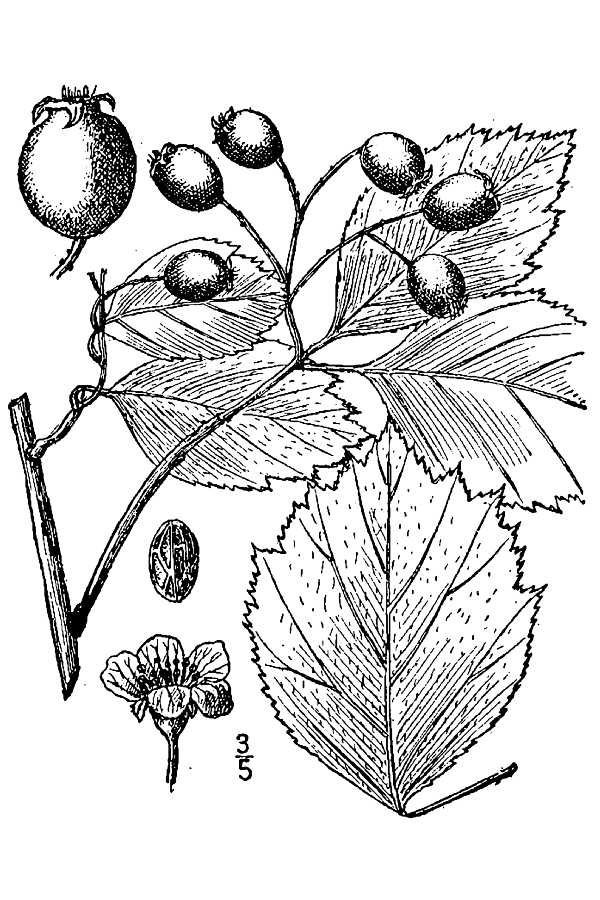
Scarlet Hawthorn Crataegus coccinea
The scientific name of the Scarlet Hawthorn is Crataegus coccinea. It is a species of flowering plant in the family Rosaceae (rose family), order Rosales.
- Scientific name
- Crataegus coccinea L.
- Common name
- Scarlet Hawthorn
- Genus
- Crataegus
- Family
- Rosaceae (Rose Family)
- Order
- Rosales
- Class
- Magnoliopsida
- Red List category
- LC Least Concern
- Recorded in
- 7 countries
- Name status
- accepted in the Catalogue of Life

Overview
Written 26 November 2026 from the sources listed below. Each statement was checked against the passage it cites; statements that could not be supported were removed.
Similar species
Crataegus pedicellata Sarg. is classified as a heterotypic synonym of Crataegus coccinea L. The two names are considered taxonomically identical, and Crataegus coccinea is preferred because it is the older name.[1][2][3]
The name Crataegus coccinea was historically confused with other hawthorn species because it was misapplied. It was also incorrectly applied to specimens of Crataegus intricata Lange.[4][5]
Crataegus pedicellata Sarg. was the generally used name for this species for almost a century, particularly after 1910.[6]
Linnaeus's original description was insufficient to distinguish Crataegus coccinea from several unrelated species, including Crataegus nigra, Crataegus phaenopyrum, and Crataegus mollis.[7][8]
Charles Sprague Sargent selected a lectotype for Crataegus coccinea in 1901 from Linnaeus's specimens. His initial selection resembled Crataegus dodgei Ashe, and he corrected his erroneous lectotype opinion in 1909.[9][10][11]
John Claudius Loudon established series Coccineae based on Crataegus coccinea. The series includes Crataegus pedicellata.[12][13]
Classification of the Scarlet Hawthorn
| Kingdom | Plantae |
|---|---|
| Subkingdom | Pteridobiotina |
| Phylum | Tracheophyta |
| Class | Magnoliopsida |
| Order | Rosales |
| Family | Rosaceae (Rose Family) |
| Subfamily | Amygdaloideae |
| Tribe | Maleae |
| Subtribe | Malinae |
| Genus | Crataegus (Hawthorn) |
| Species | Crataegus coccinea L. |
Where the Scarlet Hawthorn is found
Checklists and occurrence records place Crataegus coccinea in 7 countries across Europe and North America. GBIF holds 3,536 georeferenced records of it.
Countries where it is native or its origin is not stated
Countries where it has been introduced
Regions and cities with the most records
- Ontario, Canada 239
- Pennsylvania, United States 206
- Vermont, United States 95
- Ohio, United States 86
- Bavaria, Germany 85
- New York, United States 76
- Michigan, United States 69
- Wisconsin, United States 63
- Pittsburgh, United States 59
- Wilkinsburg, United States 59
- Allison Park, United States 57
- Connecticut, United States 55
- Mount Lebanon, United States 55
- Upper Saint Clair, United States 54
- Baldwin, United States 53
- Bethel Park, United States 53
- West Mifflin, United States 53
- McKeesport, United States 52
- Monroeville, United States 41
- Rutland, United States 40
- Bad Kissingen, Germany 37
- Plum, United States 36
- Stow, United States 35
- Hudson, United States 34
- Bad Neustadt an der Saale, Germany 32
- Streetsboro, United States 30
- Twinsburg, United States 30
- Tallmadge, United States 29
- Cuyahoga Falls, United States 28
- Kent, United States 27
- Wexford, United States 27
- Broadview Heights, United States 25
- Solon, United States 25
- Aurora, United States 23
- Hamilton, Canada 23
- London, Canada 23
13 more countries have a few records outside this range
These countries hold a few records of Crataegus coccinea but lie outside the range the checklists give for it. Such records are often zoo or garden specimens, museum material or vagrants, so the species is not counted as occurring there.
Range as the checklists state it
Germany [I]; Poland [I]; Czech Republic [I]; France [I]; Italy [I]; Canada (Ontario); USA (Maine, New Hampshire, Vermont, Massachusetts, Rhode Island, Connecticut, New York, Pennsylvania, West Virginia, Maryland, North Carolina, Virginia, Ohio, Wisconsin, Minnesota)
A number beside a place is its count of GBIF occurrence records. A place without a number comes from a checklist alone. Records show where a species has been observed or collected, which can include escapes and vagrants.
Common names
English
- Scarlet Hawthorn
- Pear-Fruited Cockspur-Thorn
- Pear-fruited Cockspurthorn
- Pear-fruit Cockspurthorn
- Red Haw
- Red-fruit Hawthorn
Names in 3 other languages
- French
- aubépine écarlate, épine écarlate
- Swedish
- skafthagtorn
- Welsh
- Draenen Wen Aeron Gellygaidd, Drain Gwyn Aeron Gellygaidd
Synonyms
48 other scientific names have been used for this species and are now treated as synonyms of Crataegus coccinea.
- Crataegus acclivis Sarg.
- Crataegus assurgens Sarg.
- Crataegus coccinea subsp. eglandulosa Schuette
- Crataegus coccinea var. cordata Lavallée
- Crataegus coccinea var. cornifolia Münchh.
- Crataegus coccinea var. cuneata Wender.
- Crataegus coccinea var. indentata Lodd. ex Loudon
- Crataegus coccinea var. macrocarpa (Anon.) Lavallée
- Crataegus coccinea var. maxima Lodd. ex Loudon
- Crataegus coccinea var. oligandra Torr. & A.Gray
- Crataegus coccinea var. populifolia Torr. & A.Gray
- Crataegus coccinea var. spina-sancta Merrem
- Crataegus confinis Sarg.
- Crataegus delecta Sarg.
- Crataegus elliptica var. minor Torr. & A.Gray
- Crataegus flava var. lobata Lindl.
- Crataegus flava var. pubescens A.Gray
- Crataegus habereri Sarg.
- Crataegus indentata Lodd.
- Crataegus letchworthiana Sarg.
- Crataegus lobata Loudon
- Crataegus pedicellata Sarg.
- Crataegus pedicellata f. assurgens (Sarg.) Kruschke
- Crataegus pedicellata var. assurgens (Sarg.) E.J.Palmer
- Crataegus polita Sarg.
- Crataegus robbinsiana Sarg.
- Crataegus sejuncta Sarg.
- Crataegus spissiflora Sarg.
- Crataegus uticaensis Sarg.
- Crataegus virginica Lodd. ex Loudon
- Crataegus vivida Sarg.
- Crataegus × aulica Sarg.
- Mespilus coccinea subvar. indentata (Lodd. ex Loudon) Asch. & Graebn.
- Mespilus elliptica (Aiton) Lam.
- Mespilus elliptica (Aiton) Poir.
- Oxyacantha coccinea (L.) Nieuwl.
- Phaenopyrum coccineum (L.) M.Roem.
- Phaenopyrum ellipticum (Aiton) M.Roem.
- Phaenopyrum virginicum (Lodd. ex Loudon) M.Roem.
- Crataegus coccinea var. macracantha Dudley ambiguous synonym
Showing 40 of 48.
Subspecies and varieties
- Crataegus coccinea var. coccinea (Scarlet Hawthorn) variety
- Crataegus coccinea var. fulleriana variety
- Crataegus coccinea var. pringlei (Pringle's Hawthorn) variety
Related species
-
 Common HawthornCrataegus monogyna
-
 Chinese HawthornCrataegus pinnatifida
-
 Mexican HawthornCrataegus mexicana
-
 AzaroleCrataegus azarolus
-
 English HawthornCrataegus laevigata
-
 Cockspur HawthornCrataegus crus-galli
-
 Oriental HawthornCrataegus orientalis
-
 Black HawthornCrataegus douglasii
Compare
Questions and answers
What is the scientific name of the Scarlet Hawthorn?
The scientific name of the Scarlet Hawthorn is Crataegus coccinea. Written with its author, the full name is Crataegus coccinea L..
Which family does the Scarlet Hawthorn belong to?
Crataegus coccinea belongs to the family Rosaceae, in the order Rosales and the class Magnoliopsida.
Where is the Scarlet Hawthorn found?
Checklists and occurrence records place Crataegus coccinea in 7 countries, including United States and Canada.
What is the conservation status of the Scarlet Hawthorn?
The IUCN Red List category recorded for Crataegus coccinea is Least Concern (LC).
What other names does the Scarlet Hawthorn have?
Crataegus coccinea is also known in English as Pear-Fruited Cockspur-Thorn, Pear-fruited Cockspurthorn, Pear-fruit Cockspurthorn, Red Haw and Red-fruit Hawthorn.
Sources
Passages the profile rests on
- Crataegus coccinea is considered taxonomically identical to Crataegus pedicellata. Source passage: “It has been shown to be the same as C. pedicellata” — English Wikipedia
- Crataegus pedicellata Sarg. is classified as a heterotypic synonym of Crataegus coccinea L. Source passage: “C. pedicellata Sarg. is a heterotypic synonym of C. coccinea L.” — English Wikipedia
- The scientific name Crataegus coccinea is preferred over Crataegus pedicellata under botanical nomenclature because it is the older name. Source passage: “under the rules of botanical nomenclature, the older name (C. coccinea) should be used.” — English Wikipedia
- Crataegus coccinea has historically been confused with other hawthorn species because its scientific name was misapplied. Source passage: “there is considerable confusion because the name has been misapplied for a long time.” — English Wikipedia
- The name Crataegus coccinea was also historically applied incorrectly to specimens of Crataegus intricata Lange. Source passage: “The name C. coccinea has also been misapplied to specimens of C. intricata Lange.” — English Wikipedia
- Crataegus pedicellata Sarg. was the generally used name for this species for almost a century, particularly after 1910. Source passage: “For almost 100 years, particularly since 1910, this species was generally called Crataegus pedicellata Sarg.” — English Wikipedia
- Linnaeus's original description was insufficient to distinguish Crataegus coccinea from several unrelated species. Source passage: “Linnaeus's original description was inadequate to make a decision between various unrelated species” — English Wikipedia
- The unrelated species considered in connection with the ambiguity of Linnaeus's original description included Crataegus nigra, Crataegus phaenopyrum, and Crataegus mollis. Source passage: “including C. nigra, C. phaenopyrum, and C. mollis.” — English Wikipedia
- Charles Sprague Sargent selected a lectotype for Crataegus coccinea in 1901 from Linnaeus's specimens. Source passage: “In 1901, Charles Sprague Sargent chose a lectotype for Crataegus coccinea from among Linnaeus's specimens” — English Wikipedia
- Sargent's initial lectotype selection resembled Crataegus dodgei Ashe. Source passage: “but chose a specimen that resembles C. dodgei Ashe.” — English Wikipedia
- Sargent corrected his erroneous lectotype opinion in 1909. Source passage: “Sargent's lectotype opinion was followed by other authors until he realized his error and corrected it in 1909.” — English Wikipedia
- John Claudius Loudon established series Coccineae based on Crataegus coccinea. Source passage: “John Claudius Loudon had founded series Coccineae on C. coccinea” — English Wikipedia
- The series Coccineae established by Loudon includes Crataegus pedicellata. Source passage: “which includes C. pedicellata” — English Wikipedia
Data
- Catalogue of Life, 2026-10-16 XR cc by
- Global Biodiversity Information Facility CC BY 4.0
- Wikidata CC0
- GeoNames CC BY 4.0
- Wikimedia Commons per image; credit shown with each image
- Within the Catalogue of Life, this name comes from Synonymic Checklists of the Vascular Plants of the World cc by
References
- L. (1753). Sp. Pl. [Linnaeus] 1: 476 (1753). where the name was published
This species in other databases
Page built on 28 November 2026. See how the catalog is made and all sources and licences.
Cite this page
ScientificNames.org. (2026). Crataegus coccinea (Scarlet Hawthorn). Retrieved November 28, 2026, from https://scientificnames.org/species/crataegus-coccinea
“Crataegus coccinea (Scarlet Hawthorn).” ScientificNames.org, 2026, scientificnames.org/species/crataegus-coccinea. Accessed 28 Nov. 2026.
ScientificNames.org. “Crataegus coccinea (Scarlet Hawthorn).” Accessed November 28, 2026. https://scientificnames.org/species/crataegus-coccinea.
@misc{scientificnames_crataegus_coccinea_scarlet_hawthorn,
  author = {{ScientificNames.org}},
  title = {Crataegus coccinea (Scarlet Hawthorn)},
  year = {2026},
  url = {https://scientificnames.org/species/crataegus-coccinea},
  note = {Accessed 2026-11-28}
}