Species · Flowering plants
Big-fruit Hawthorn Crataegus macrosperma
The scientific name of the Big-fruit Hawthorn is Crataegus macrosperma. It is a species of flowering plant in the family Rosaceae (rose family), order Rosales.
- Scientific name
- Crataegus macrosperma Ashe
- Common name
- Big-fruit Hawthorn
- Genus
- Crataegus
- Family
- Rosaceae (Rose Family)
- Order
- Rosales
- Class
- Magnoliopsida
- Red List category
- LC Least Concern
- Recorded in
- 2 countries
- Name status
- accepted in the Catalogue of Life

Overview
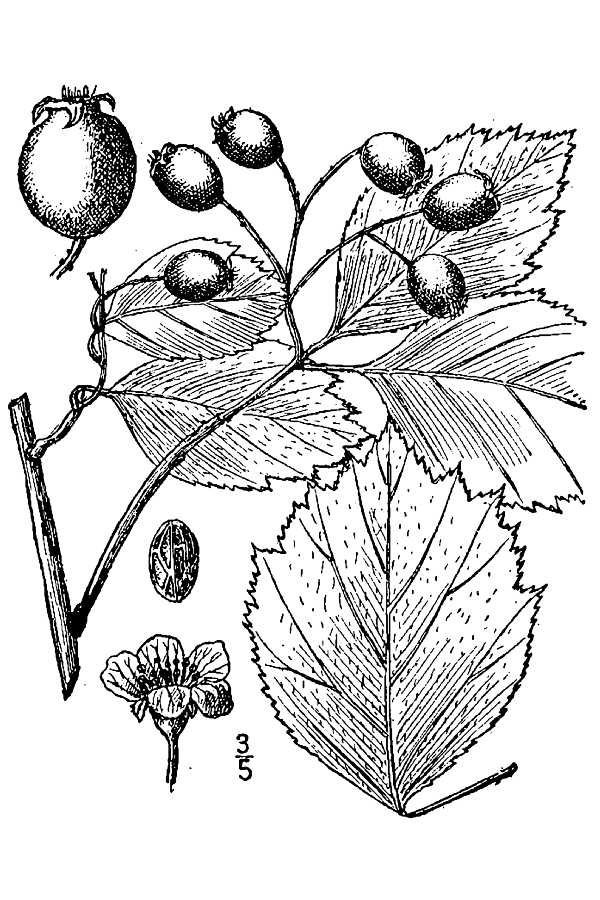
Crataegus macrosperma is native to most of the eastern United States and adjacent parts of Canada. It has long, straight thorns, white spring flowers, and reddish-orange fruits.
Written 26 November 2026 from the sources listed below. Each statement was checked against the passage it cites; statements that could not be supported were removed.
Similar species
Big-fruit Hawthorn is sometimes misidentified as Crataegus flabellata.[1]
Appearance
Big-fruit Hawthorn is a small tree with long, straight thorns. It produces white flowers in spring and reddish-orange fruits.[2][3][4]
Habitat
Big-fruit Hawthorn tolerates clay soils. It is native to most of the eastern United States and adjacent parts of Canada.[5][6]
It is uncommon at lower elevations in the southern part of its range.[7]
Behaviour
Big-fruit Hawthorn is among the earliest hawthorn species to flower in spring. Its flowers attract midges through an odor resembling dead fish.[8][9]
Reproduction and life cycle
Midges fertilize the flowers of Big-fruit Hawthorn. The species produces fruits during autumn.[10][11]
Seed-grown trees generally require 5–8 years before producing fruit. Grafted trees often produce flowers by their third year.[12][13]
Uses
The fruits of Big-fruit Hawthorn can be eaten raw. Its leaves, berries, and flowers are used medicinally for cardiovascular health.[14][15]
Classification of the Big-fruit Hawthorn
| Kingdom | Plantae |
|---|---|
| Subkingdom | Pteridobiotina |
| Phylum | Tracheophyta |
| Class | Magnoliopsida |
| Order | Rosales |
| Family | Rosaceae (Rose Family) |
| Subfamily | Amygdaloideae |
| Tribe | Maleae |
| Subtribe | Malinae |
| Genus | Crataegus (Hawthorn) |
| Species | Crataegus macrosperma Ashe |
Where the Big-fruit Hawthorn is found
Checklists and occurrence records place Crataegus macrosperma in 2 countries across North America. GBIF holds 6,185 georeferenced records of it.
Countries
Regions and cities with the most records
- Pennsylvania, United States 380
- Ontario, Canada 208
- Wisconsin, United States 177
- Vermont, United States 171
- New Jersey, United States 153
- Minnesota, United States 119
- Quebec, Canada 106
- Michigan, United States 89
- Connecticut, United States 85
- New Hampshire, United States 79
- North Carolina, United States 76
- New York, United States 63
- Allentown, United States 54
- Whitehall Township, United States 53
- Rutland, United States 50
- Bethlehem, United States 36
- Greenfield, United States 36
- Maine, United States 36
- Franklin, United States 35
- Nova Scotia, Canada 35
- Milwaukee, United States 33
- Muskego, United States 33
- South Burlington, United States 33
- Wauwatosa, United States 33
- West Allis, United States 33
- Brookfield, United States 32
- Cudahy, United States 32
- L'Ancienne-Lorette, Canada 32
- Neufchâtel-Est–Lebourgneuf, Canada 32
- Burlington, United States 31
- Colchester, United States 31
- New Berlin, United States 31
- South Milwaukee, United States 31
- Massachusetts, United States 29
- Radnor, United States 29
- Québec, Canada 28
Range as the checklists state it
Canada (Ontario, Québec); USA (Arkansas, Connecticut, Delaware, Georgia, Illinois, Indiana, Kentucky, Louisiana, Massachusetts, Maryland, Maine, Michigan, Minnesota, Mississippi, North Carolina, New Hampshire, New Jersey, New York, Ohio, Pennsylvania, Rhode Island, South Carolina, Tennessee, Virginia, Vermont, Wisconsin, West Virginia)
A number beside a place is its count of GBIF occurrence records. A place without a number comes from a checklist alone. Records show where a species has been observed or collected, which can include escapes and vagrants.
Common names
English
- Big-fruit Hawthorn
- Big-fruited Hawthorn
- Variable Hawthorn
Names in 4 other languages
- Chinese
- 大果山楂
- Estonian
- suureseemneline viirpuu
- French
- aubépine à lobes aigus
- Slovak
- hloh veľkosemenný
Synonyms
34 other scientific names have been used for this species and are now treated as synonyms of Crataegus macrosperma.
- Crataegus apiomorpha var. cyanophylla (Sarg.) Kruschke
- Crataegus atropurpurea Ashe
- Crataegus benigna Sarg.
- Crataegus brumalis Ashe
- Crataegus chadsfordiana Sarg.
- Crataegus cordifolia var. macrosperma (Ashe) Farw.
- Crataegus cordifolia var. matura (Sarg.) Farw.
- Crataegus cordifolia var. pastorum (Sarg.) Farw.
- Crataegus cyanophylla Sarg.
- Crataegus demissa Sarg.
- Crataegus eganii Ashe
- Crataegus glaucophylla Sarg.
- Crataegus heidelbergensis Sarg.
- Crataegus iracunda var. brumalis (Ashe) Kruschke
- Crataegus macrosperma var. acutiloba (Sarg.) Eggl.
- Crataegus macrosperma var. demissa (Sarg.) Eggl.
- Crataegus macrosperma var. eganii (Ashe) Kruschke
- Crataegus macrosperma var. matura (Sarg.) Eggl.
- Crataegus macrosperma var. pastorum (Sarg.) Eggl.
- Crataegus macrosperma var. pentandra (Sarg.) Eggl.
- Crataegus macrosperma var. roanensis (Ashe) E.J.Palmer
- Crataegus matura Sarg.
- Crataegus otiosa Ashe
- Crataegus pastorum Sarg.
- Crataegus pentandra Sarg.
- Crataegus randiana Sarg.
- Crataegus roanensis Ashe
- Crataegus roanensis var. heidelbergensis (Sarg.) Kruschke
- Crataegus sextilis Sarg.
- Crataegus tenella Ashe
- Crataegus velata Ashe
- Oxyacantha macrosperma (Ashe) Nieuwl.
- Crataegus acutiloba Sarg. ambiguous synonym
- Crataegus tenuifolia Britton ambiguous synonym
Related species
-
 Common HawthornCrataegus monogyna
-
 Chinese HawthornCrataegus pinnatifida
-
 Mexican HawthornCrataegus mexicana
-
 AzaroleCrataegus azarolus
-
 English HawthornCrataegus laevigata
-
 Cockspur HawthornCrataegus crus-galli
-
 Oriental HawthornCrataegus orientalis
-
 Black HawthornCrataegus douglasii
Compare
Questions and answers
What is the scientific name of the Big-fruit Hawthorn?
The scientific name of the Big-fruit Hawthorn is Crataegus macrosperma. Written with its author, the full name is Crataegus macrosperma Ashe.
Which family does the Big-fruit Hawthorn belong to?
Crataegus macrosperma belongs to the family Rosaceae, in the order Rosales and the class Magnoliopsida.
Where is the Big-fruit Hawthorn found?
Checklists and occurrence records place Crataegus macrosperma in 2 countries: United States and Canada.
What is the conservation status of the Big-fruit Hawthorn?
The IUCN Red List category recorded for Crataegus macrosperma is Least Concern (LC).
What other names does the Big-fruit Hawthorn have?
Crataegus macrosperma is also known in English as Big-fruited Hawthorn and Variable Hawthorn.
What is the habitat of hawthorn?
Big-fruit Hawthorn tolerates clay soils and is native to most of the eastern United States and adjacent parts of Canada.[5][6]
What kind of food is hawthorn?
The fruits of Big-fruit Hawthorn can be eaten raw.[14]
Sources
Passages the profile rests on
- Crataegus macrosperma is sometimes misidentified as Crataegus flabellata. Source passage: “It is sometimes misidentified as C. flabellata.” — English Wikipedia
- Crataegus macrosperma is a small tree with long, straight thorns. Source passage: “It is a small tree with long straight thorns.” — English Wikipedia
- The species produces white flowers in spring. Source passage: “It has white flowers that bloom during the spring” — English Wikipedia
- Its fruits are reddish-orange. Source passage: “resulting in edible reddish-orange fruits” — English Wikipedia
- The species tolerates clay soils. Source passage: “It tolerates clay soils” — English Wikipedia
- Crataegus macrosperma is native to most of the eastern United States and adjacent parts of Canada. Source passage: “native to most of the eastern United States and adjacent Canada” — English Wikipedia
- The species is uncommon at lower elevations in the southern part of its range. Source passage: “though uncommon at lower altitudes in the south.” — English Wikipedia
- Crataegus macrosperma is among the earliest hawthorn species to flower in spring. Source passage: “It is one of the earliest hawthorns to bloom in spring.” — English Wikipedia
- Its flowers attract midges through an odor resembling dead fish. Source passage: “that smell like dead fish, attracting midges” — English Wikipedia
- Midges fertilize the flowers of Crataegus macrosperma. Source passage: “attracting midges that fertilize the flowers” — English Wikipedia
- The species produces fruits during autumn. Source passage: “fruits that appear during the fall.” — English Wikipedia
- Seed-grown trees generally require 5–8 years before producing fruit. Source passage: “Seed-grown trees will take 5–8 years before producing fruit” — English Wikipedia
- Grafted trees often produce flowers by their third year. Source passage: “grafted trees often have flowers by the third year.” — English Wikipedia
- The fruits of Crataegus macrosperma can be eaten raw. Source passage: “The fruit can be eaten raw” — English Wikipedia
- The leaves, berries, and flowers are used medicinally for cardiovascular health. Source passage: “The leaves, berries, and flowers are used in medicine for cardiovascular health.” — English Wikipedia
Data
- Catalogue of Life, 2026-10-16 XR cc by
- Global Biodiversity Information Facility CC BY 4.0
- Wikidata CC0
- GeoNames CC BY 4.0
- Wikimedia Commons per image; credit shown with each image
- Within the Catalogue of Life, this name comes from Synonymic Checklists of the Vascular Plants of the World cc by
References
- Ashe. (1900). J. Elisha Mitchell Sci. Soc. 16(2): 73 (1900). where the name was published
This species in other databases
- Catalogue of Life Z86Z
- Wikidata Q5182572
- iNaturalist 161041
- World Flora Online wfo-0001010479
- GRIN 313734
Page built on 28 November 2026. See how the catalog is made and all sources and licences.
Cite this page
ScientificNames.org. (2026). Crataegus macrosperma (Big-fruit Hawthorn). Retrieved November 28, 2026, from https://scientificnames.org/species/crataegus-macrosperma
“Crataegus macrosperma (Big-fruit Hawthorn).” ScientificNames.org, 2026, scientificnames.org/species/crataegus-macrosperma. Accessed 28 Nov. 2026.
ScientificNames.org. “Crataegus macrosperma (Big-fruit Hawthorn).” Accessed November 28, 2026. https://scientificnames.org/species/crataegus-macrosperma.
@misc{scientificnames_crataegus_macrosperma_big_fruit_hawthorn,
  author = {{ScientificNames.org}},
  title = {Crataegus macrosperma (Big-fruit Hawthorn)},
  year = {2026},
  url = {https://scientificnames.org/species/crataegus-macrosperma},
  note = {Accessed 2026-11-28}
}