Species · Flowering plants
Western Mayhaw Crataegus opaca
The scientific name of the Western Mayhaw is Crataegus opaca. It is a species of flowering plant in the family Rosaceae (rose family), order Rosales.
- Scientific name
- Crataegus opaca Hook. & Arn.
- Common name
- Western Mayhaw
- Genus
- Crataegus
- Family
- Rosaceae (Rose Family)
- Order
- Rosales
- Class
- Magnoliopsida
- Red List category
- LC Least Concern
- Recorded in
- 1 country
- Name status
- accepted in the Catalogue of Life

Overview
The western mayhaw is a hawthorn species. It occurs in low woods, creeks, and river bottoms, often in standing water, within a native range extending from Alabama westward to Texas and northward to Arkansas. It is distinguished by its relatively large, cranberry-red fruits, known as mayhaws.
Written 26 November 2026 from the sources listed below. Each statement was checked against the passage it cites; statements that could not be supported were removed.
Appearance
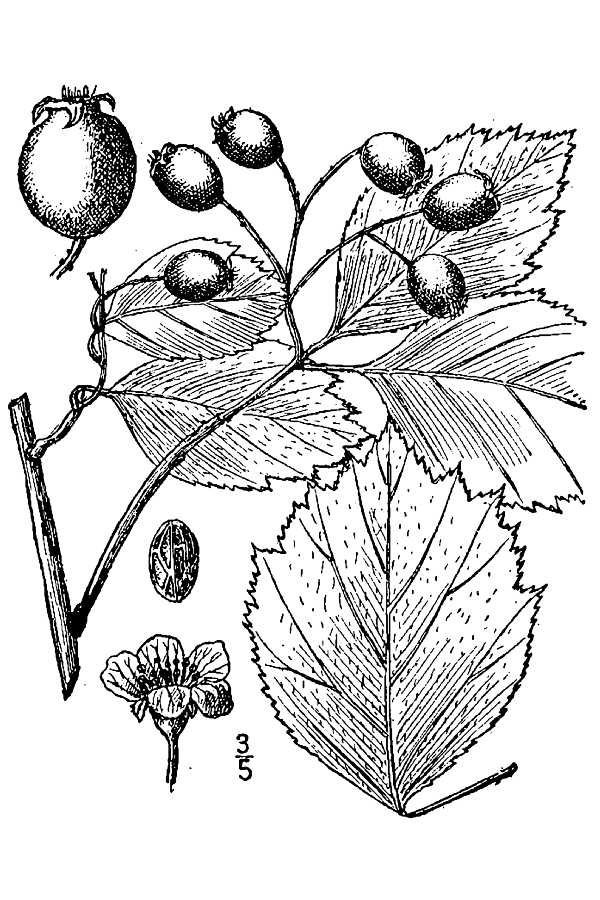
The western mayhaw grows as either a small tree or a large shrub and typically reaches a height of 12–36 feet (3.7–11.0 m). It has a tall, narrow trunk, a rounded crown, and spiny branches.[1][2][3]
Its leaves are oval and dark green. Its flowers grow in clusters and may be pink or white, while its ripe fruits are relatively large and cranberry-red.[4][5][6]
Habitat
The western mayhaw prefers wet, rich, acidic soils. It occurs in low woods, creeks, and river bottoms, often in standing water.[7][8]
Its native range extends from Alabama westward to Texas and northward to Arkansas.[9]
Reproduction and life cycle
The western mayhaw usually flowers between February and March. Its fruits generally ripen between May and June.[10][11]
Uses
Its fruits, known as mayhaws, are commonly made into jams, preserves, and jellies. The fruits taste bitter when eaten raw, but the jelly made from them is highly prized for its flavor.[12][13]
Classification of the Western Mayhaw
| Kingdom | Plantae |
|---|---|
| Subkingdom | Pteridobiotina |
| Phylum | Tracheophyta |
| Class | Magnoliopsida |
| Order | Rosales |
| Family | Rosaceae (Rose Family) |
| Subfamily | Amygdaloideae |
| Tribe | Maleae |
| Subtribe | Malinae |
| Genus | Crataegus (Hawthorn) |
| Species | Crataegus opaca Hook. & Arn. |
Where the Western Mayhaw is found
Checklists and occurrence records place Crataegus opaca in 1 country across North America. GBIF holds 583 georeferenced records of it.
Countries
Regions and cities with the most records
- Texas, United States 63
- Arkansas, United States 50
- Louisiana, United States 39
- Mississippi, United States 16
- Houston, United States 11
- Missouri City, United States 10
- Stafford, United States 10
- Florida, United States 7
- Pennsylvania, United States 7
- Monroe, United States 6
- Deer Park, United States 5
- Baytown, United States 4
- Channelview, United States 4
- La Porte, United States 4
- Humble, United States 3
- Nacogdoches, United States 3
- Pasadena, United States 3
- Pearland, United States 3
- South Houston, United States 3
- Spring, United States 3
- The Woodlands, United States 3
- Alabama, United States 1
Range as the checklists state it
USA (Alabama, Arkansas, Louisiana, Mississippi, Texas)
A number beside a place is its count of GBIF occurrence records. A place without a number comes from a checklist alone. Records show where a species has been observed or collected, which can include escapes and vagrants.
Common names
English
- Western Mayhaw
- Apple Haw
- River-flat Hawthorn
Names in 1 other language
- Chinese
- 美西五月楂
Synonyms
4 other scientific names have been used for this species and are now treated as synonyms of Crataegus opaca.
- Anthomeles opaca (Hook. & Arn.) M.Roem.
- Crataegus nudiflora Nutt. ex Torr. & A.Gray
- Crataegus opica Ashe
- Crataegus aestivalis Tidestr. ambiguous synonym
Related species
-
 Common HawthornCrataegus monogyna
-
 Chinese HawthornCrataegus pinnatifida
-
 Mexican HawthornCrataegus mexicana
-
 AzaroleCrataegus azarolus
-
 English HawthornCrataegus laevigata
-
 Cockspur HawthornCrataegus crus-galli
-
 Oriental HawthornCrataegus orientalis
-
 Black HawthornCrataegus douglasii
Compare
Questions and answers
What is the scientific name of the Western Mayhaw?
The scientific name of the Western Mayhaw is Crataegus opaca. Written with its author, the full name is Crataegus opaca Hook. & Arn..
Which family does the Western Mayhaw belong to?
Crataegus opaca belongs to the family Rosaceae, in the order Rosales and the class Magnoliopsida.
Where is the Western Mayhaw found?
Checklists and occurrence records place Crataegus opaca in 1 country: United States.
What is the conservation status of the Western Mayhaw?
The IUCN Red List category recorded for Crataegus opaca is Least Concern (LC).
What other names does the Western Mayhaw have?
Crataegus opaca is also known in English as Apple Haw and River-flat Hawthorn.
Are hawthorn fruits edible?
Western mayhaw fruits are used to make jams, preserves, and jellies. They taste bitter when eaten raw, but the jelly made from them is highly prized for its flavor.[12][13]
What is Crataegus good for?
Crataegus opaca fruits, known as mayhaws, are commonly made into jams, preserves, and jellies.[12]
Sources
Passages the profile rests on
- Crataegus opaca grows as either a small tree or a large shrub. Source passage: “Crataegus opaca can be characterized as either a small tree or large shrub” — English Wikipedia
- The species typically reaches a height of 12–36 feet (3.7–11.0 m). Source passage: “typical height ranging from 12–36 feet (3.7–11.0 m).” — English Wikipedia
- The species has a tall, narrow trunk, a rounded crown, and spiny branches. Source passage: “It has a tall and narrow trunk with a rounded crown and spiny branches.” — English Wikipedia
- Its leaves are oval and dark green. Source passage: “It has oval, dark green leaves” — English Wikipedia
- Its flowers grow in clusters and may be pink or white. Source passage: “clusters of pink or white flowers.” — English Wikipedia
- Its ripe fruits are relatively large and cranberry-red. Source passage: “Its fruits are relatively large and have a cranberry-red color when ripe.” — English Wikipedia
- The species prefers wet, rich, acidic soils. Source passage: “This species prefers wet, rich, and acidic soils” — English Wikipedia
- It occurs in low woods, creeks, and river bottoms, often in standing water. Source passage: “located in low woods, creeks, and river bottoms, often in standing water.” — English Wikipedia
- Its native range extends from Alabama westward to Texas and northward to Arkansas. Source passage: “Its native distribution ranges from Alabama west to Texas, and north to Arkansas.” — English Wikipedia
- The species usually flowers between February and March. Source passage: “Blooms usually appear between February and March” — English Wikipedia
- Its fruits generally ripen between May and June. Source passage: “the fruit ripens from May to June.” — English Wikipedia
- Its fruits, known as mayhaws, are commonly made into jams, preserves, and jellies. Source passage: “The fruits, known as mayhaws, are commonly used to make jams, preserves, and jellies.” — English Wikipedia
- The fruits taste bitter when eaten raw, but the jelly made from them is highly prized for its flavor. Source passage: “While the fruits are bitter raw, the jelly produced from them is highly prized for its flavor.” — English Wikipedia
Data
- Catalogue of Life, 2026-10-16 XR cc by
- Global Biodiversity Information Facility CC BY 4.0
- Wikidata CC0
- GeoNames CC BY 4.0
- Wikimedia Commons per image; credit shown with each image
- Within the Catalogue of Life, this name comes from Synonymic Checklists of the Vascular Plants of the World cc by
References
- Hook. & Arn. (1835). Compan. Bot. Mag. 1: 25 (1835). where the name was published
This species in other databases
- Catalogue of Life 6BB68
- Wikidata Q18555704
- iNaturalist 161056
- World Flora Online wfo-0001010519
- GRIN 313708
Page built on 28 November 2026. See how the catalog is made and all sources and licences.
Cite this page
ScientificNames.org. (2026). Crataegus opaca (Western Mayhaw). Retrieved November 28, 2026, from https://scientificnames.org/species/crataegus-opaca
“Crataegus opaca (Western Mayhaw).” ScientificNames.org, 2026, scientificnames.org/species/crataegus-opaca. Accessed 28 Nov. 2026.
ScientificNames.org. “Crataegus opaca (Western Mayhaw).” Accessed November 28, 2026. https://scientificnames.org/species/crataegus-opaca.
@misc{scientificnames_crataegus_opaca_western_mayhaw,
  author = {{ScientificNames.org}},
  title = {Crataegus opaca (Western Mayhaw)},
  year = {2026},
  url = {https://scientificnames.org/species/crataegus-opaca},
  note = {Accessed 2026-11-28}
}