Species · Flowering plants
Fleshy Hawthorn Crataegus succulenta
The scientific name of the Fleshy Hawthorn is Crataegus succulenta. It is a species of flowering plant in the family Rosaceae (rose family), order Rosales.
- Scientific name
- Crataegus succulenta Schrad. ex Link
- Common name
- Fleshy Hawthorn
- Genus
- Crataegus
- Family
- Rosaceae (Rose Family)
- Order
- Rosales
- Class
- Magnoliopsida
- Red List category
- LC Least Concern
- Recorded in
- 2 countries
- Name status
- accepted in the Catalogue of Life

Overview
Fleshy hawthorn is a hawthorn species native to North America. It occurs from southern Manitoba to Nova Scotia and south to Maine and Colorado. It produces plump, dark red fruits.
Written 26 November 2026 from the sources listed below. Each statement was checked against the passage it cites; statements that could not be supported were removed.
Appearance
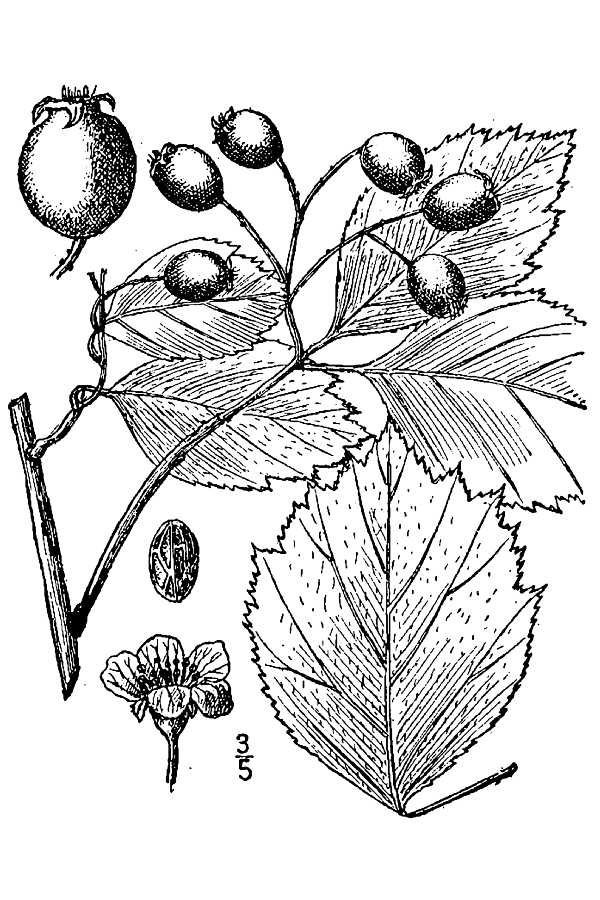
The leaves have shallow lobes around their middle and small, sharp teeth. Two toothed, leaf-like stipules occur at the base of each leaf.[1][2]
The lateral buds are similar in appearance, somewhat smaller, and often occur in groups of two or three. One adjacent lateral bud may develop into a thorn while another develops into a leafy or flowering shoot, or both may develop.[3][4]
The leaf scars are narrow and somewhat raised, with three vein scars. Long shoots may be straight or zigzag-shaped and bear smooth, glossy, rigid, stout, very sharp thorns that are sometimes branched.[5][6]
The dwarf shoots often bear terminal clusters of flowers and fruit. The flowers are arranged in flat-topped clusters at the ends of dwarf shoots.[7][8]
Each flower has five sepals, five petals, between five and twenty-five stamens, and between one and five pistils. The fruit resembles a small apple, with thin flesh and between one and five seeds.[9][10]
The species grows between 6 and 22 feet tall.[11]
Habitat
Fleshy hawthorn grows in sunny to shaded locations and prefers moist, very well-drained soils. It occurs on abandoned farmland, along streams, and in forest openings, particularly on calcium-rich soils.[12][13]
Reproduction and life cycle
The flowers appear in May or June. Each flower has five sepals and five petals, with five to twenty-five stamens and one to five pistils.[14][15]
The seeds germinate following stratification in a cool, moist environment. Germinating seedlings produce two small, leaf-like cotyledons that emerge above ground.[16][17]
Diet
The fruits are edible and can be used to prepare jelly or tea.[18]
Uses
The edible fruits can be processed into jelly or crushed to make tea.[19]
Similar species
Crataegus succulenta is thought to be one of the parent species of the tetraploid Crataegus persimilis, together with Crataegus crus-galli.[20]
Classification of the Fleshy Hawthorn
| Kingdom | Plantae |
|---|---|
| Subkingdom | Pteridobiotina |
| Phylum | Tracheophyta |
| Class | Magnoliopsida |
| Order | Rosales |
| Family | Rosaceae (Rose Family) |
| Subfamily | Amygdaloideae |
| Tribe | Maleae |
| Subtribe | Malinae |
| Genus | Crataegus (Hawthorn) |
| Species | Crataegus succulenta Schrad. ex Link |
Where the Fleshy Hawthorn is found
Checklists and occurrence records place Crataegus succulenta in 2 countries across North America. GBIF holds 2,862 georeferenced records of it.
Countries
Regions and cities with the most records
- Wisconsin, United States 290
- Ontario, Canada 179
- Minnesota, United States 110
- Pennsylvania, United States 106
- Colorado, United States 66
- Franklin, United States 62
- Brookfield, United States 58
- Vermont, United States 56
- Greenfield, United States 55
- New Berlin, United States 55
- Muskego, United States 54
- Michigan, United States 49
- Côte-Saint-Luc, Canada 47
- Mont-Royal, Canada 47
- Illinois, United States 45
- Le Sud-Ouest, Canada 45
- Sainte-Catherine, Canada 45
- Westmount, Canada 45
- South Milwaukee, United States 44
- West Allis, United States 44
- Waukesha, United States 43
- Wauwatosa, United States 43
- Montréal, Canada 42
- Quebec, Canada 42
- Ville-Marie, Canada 42
- Cudahy, United States 41
- Dorval, Canada 41
- Oak Creek, United States 41
- Candiac, Canada 40
- Cartierville, Canada 40
- Châteauguay, Canada 40
- La Prairie, Canada 40
- Le Plateau-Mont-Royal, Canada 40
- Rosemont–La Petite-Patrie, Canada 40
- Saint-Constant, Canada 38
- Brossard, Canada 37
4 more countries have a few records outside this range
These countries hold a few records of Crataegus succulenta but lie outside the range the checklists give for it. Such records are often zoo or garden specimens, museum material or vagrants, so the species is not counted as occurring there.
Range as the checklists state it
Canada (Manitoba, Ontario, Québec); USA (Connecticut, Illinois, Indiana, Iowa, Maine, Maryland, Michigan, Massachusetts, Minnesota, Missouri, New Hampshire, New York, Ohio, Oregon, Pennsylvania, Rhode Island, Tennessee, Vermont, Virginia, West Virginia, Wisconsin)
A number beside a place is its count of GBIF occurrence records. A place without a number comes from a checklist alone. Records show where a species has been observed or collected, which can include escapes and vagrants.
Common names
English
- Fleshy Hawthorn
- Round-Fruited Cockspur-Thorn
- Round-fruited Cockspurthorn
- Round-fruit Cockspurthorn
- Succulent Hawthorn
Names in 8 other languages
- Chinese
- 鮮潤山楂
- Czech
- hloh tlustotrnný
- Estonian
- lihakas viirpuu, nahkjalehine viirpuu
- Finnish
- koralliorapihlaja
- French
- aubépine succulente
- Russian
- Боярышник сочный
- Slovak
- hloh šťavnatý
- Welsh
- Draenen Wen Aeron Crynion, Drain Gwyn Aeron Crynion
Synonyms
48 other scientific names have been used for this species and are now treated as synonyms of Crataegus succulenta.
- Crataegus ambrosia Sarg.
- Crataegus ardua Sarg.
- Crataegus colorado Ashe
- Crataegus columbiana var. occidentalis (Britton) Dorn
- Crataegus ferta Sarg.
- Crataegus florifera var. celsa (Sarg.) Kruschke
- Crataegus florifera var. mortonis (Laughlin) Kruschke
- Crataegus florifera var. shirleyensis (Sarg.) Kruschke
- Crataegus florifera var. virilis (Sarg.) Kruschke
- Crataegus gemmosa Sarg.
- Crataegus glandulosa var. michiganensis (Ashe) Farw.
- Crataegus glandulosa var. succulenta (Schrad. ex Link) K.Koch
- Crataegus halliana Sarg.
- Crataegus incerta Sarg.
- Crataegus integriloba Sarg.
- Crataegus laxiflora Sarg.
- Crataegus leucantha Laughlin
- Crataegus longispina Sarg.
- Crataegus macracantha var. colorado (Ashe) Kruschke
- Crataegus macracantha var. divida (Sarg.) Kruschke
- Crataegus macracantha var. integriloba (Sarg.) Kruschke
- Crataegus macracantha var. pertomentosa (Ashe) Kruschke
- Crataegus macracantha var. rhombifolia (Sarg.) Eggl.
- Crataegus membranacea Sarg.
- Crataegus michiganensis Ashe
- Crataegus mortonis Laughlin
- Crataegus pisifera Sarg.
- Crataegus rhombifolia Sarg.
- Crataegus rotundifolia var. succulenta Dippel
- Crataegus rutila Sarg.
- Crataegus saeva Sarg.
- Crataegus shirleyensis Sarg.
- Crataegus sonnenbergensis Sarg.
- Crataegus succulenta var. gemmosa (Sarg.) Kruschke
- Crataegus succulenta var. laxiflora (Sarg.) Kruschke
- Crataegus succulenta var. membranacea (Sarg.) E.J.Palmer
- Crataegus succulenta var. michiganensis (Ashe) E.J.Palmer
- Crataegus succulenta var. pertomentosa (Ashe) E.J.Palmer
- Crataegus succulenta var. pisifera (Sarg.) Kruschke
- Crataegus succulenta var. rhombifolia (Sargent) Eggleston
Showing 40 of 48.
Subspecies and varieties
- Crataegus succulenta var. neofluvialis variety
- Crataegus succulenta var. succulenta (Fleshy Hawthorn) variety
Related species
-
 Common HawthornCrataegus monogyna
-
 Chinese HawthornCrataegus pinnatifida
-
 Mexican HawthornCrataegus mexicana
-
 AzaroleCrataegus azarolus
-
 English HawthornCrataegus laevigata
-
 Cockspur HawthornCrataegus crus-galli
-
 Oriental HawthornCrataegus orientalis
-
 Black HawthornCrataegus douglasii
Compare
Questions and answers
What is the scientific name of the Fleshy Hawthorn?
The scientific name of the Fleshy Hawthorn is Crataegus succulenta. Written with its author, the full name is Crataegus succulenta Schrad. ex Link.
Which family does the Fleshy Hawthorn belong to?
Crataegus succulenta belongs to the family Rosaceae, in the order Rosales and the class Magnoliopsida.
Where is the Fleshy Hawthorn found?
Checklists and occurrence records place Crataegus succulenta in 2 countries: United States and Canada.
What is the conservation status of the Fleshy Hawthorn?
The IUCN Red List category recorded for Crataegus succulenta is Least Concern (LC).
What other names does the Fleshy Hawthorn have?
Crataegus succulenta is also known in English as Round-Fruited Cockspur-Thorn, Round-fruited Cockspurthorn, Round-fruit Cockspurthorn and Succulent Hawthorn.
What is the habitat of hawthorn?
Fleshy hawthorn grows in sunny to shaded locations and prefers moist, very well-drained soils. It occurs on abandoned farmland, along streams, and in forest openings, particularly on calcium-rich soils.[12][13]
Sources
Passages the profile rests on
- The leaves have shallow lobes around their middle and small, sharp teeth. Source passage: “Shallowly lobed about the middle, with small sharp teeth” — tidcf.nrcan.gc.ca
- The species has two toothed, leaf-like stipules at the base of its leaves. Source passage: “2 toothed leaf-like stipules at the base” — tidcf.nrcan.gc.ca
- Its lateral buds are similar in appearance, somewhat smaller, and often occur in groups of two or three. Source passage: “Lateral buds similar, somewhat smaller, often 2 or 3 side by side” — tidcf.nrcan.gc.ca
- Of the adjacent lateral buds, one develops into a thorn while another develops into a leafy or flowering shoot, or both. Source passage: “One develops into a thorn, the other into a new shoot bearing leaves or flowers, or both” — tidcf.nrcan.gc.ca
- The leaf scars are narrow and somewhat raised, with three vein scars. Source passage: “Leaf scars narrow, somewhat elevated, with 3 vein scars” — tidcf.nrcan.gc.ca
- Long shoots may be straight or zigzag-shaped and bear smooth, glossy, rigid, stout, very sharp thorns that are sometimes branched. Source passage: “Long shoots straight or zigzag, lustrous, with smooth, shiny, rigid, stout, glossy, very sharp thorns that are sometimes branched” — tidcf.nrcan.gc.ca
- The dwarf shoots often bear terminal clusters of flowers and fruit. Source passage: “Dwarf shoots often bear terminal flower clusters and fruit” — tidcf.nrcan.gc.ca
- The flowers are arranged in flat-topped clusters at the ends of dwarf shoots. Source passage: “Arranged in flat-topped clusters at the end of dwarf shoots” — tidcf.nrcan.gc.ca
- Each flower has five sepals, five petals, between five and twenty-five stamens, and between one and five pistils. Source passage: “Each flower with 5 sepals, 5 petals, 5–25 stamens, and 1–5 pistils” — tidcf.nrcan.gc.ca
- The fruit resembles a small apple and has thin flesh and between one and five seeds. Source passage: “Similar to a small apple (a pome) with thin flesh and 1–5 seeds” — tidcf.nrcan.gc.ca
- The species grows between 6 and 22 feet tall. Source passage: “Single to multi-stemmed trunks that range from 6 to 22 feet tall.” — extension.psu.edu
- The species grows in sunny to shaded locations and prefers moist, very well-drained soils. Source passage: “Grows in sun to shade, prefers moist, very well-drained soils.” — extension.psu.edu
- The species occurs on abandoned farmland, along streams, and in forest openings, particularly on calcium-rich soils. Source passage: “Abandoned farmland, along streams and in forest openings, especially on soils rich in calcium” — tidcf.nrcan.gc.ca
- The flowers appear in May or June. Source passage: “White flowers appear in May or June” — extension.psu.edu
- The flowers have five sepals and five petals, with five to twenty-five stamens and one to five pistils. Source passage: “Each flower with 5 sepals, 5 petals, 5–25 stamens, and 1–5 pistils” — tidcf.nrcan.gc.ca
- The seeds germinate following stratification in a cool, moist environment. Source passage: “Germinate after stratification in a cool, moist environment” — tidcf.nrcan.gc.ca
- Germinating seedlings produce two small, leaf-like cotyledons that emerge above ground. Source passage: “Bear 2 small leaf-like cotyledons that are raised above the ground” — tidcf.nrcan.gc.ca
- The fruit is edible and can be used to prepare jelly or tea. Source passage: “The fruit is edible and can be made into jelly or crushed to make tea.” — English Wikipedia
- The species' edible fruits can be processed into jelly or crushed to make tea. Source passage: “The fruit is edible and can be made into jelly or crushed to make tea.” — English Wikipedia
- Crataegus succulenta is thought to be one of the parent species of the tetraploid Crataegus persimilis, together with Crataegus crus-galli. Source passage: “It is thought to be the parent, along with Crataegus crus-galli, of the tetraploid species Crataegus persimilis.” — English Wikipedia
- The species produces plump, dark red fruits. Source passage: “White flowers appear in May or June and form plump, dark red fruits.” — extension.psu.edu
Data
- Catalogue of Life, 2026-10-16 XR cc by
- Global Biodiversity Information Facility CC BY 4.0
- Wikidata CC0
- GeoNames CC BY 4.0
- Wikimedia Commons per image; credit shown with each image
- Within the Catalogue of Life, this name comes from Synonymic Checklists of the Vascular Plants of the World cc by
References
- Schrad. ex Link. (1831). Handbuch [Link] 2: 78 (1831). where the name was published
This species in other databases
Page built on 28 November 2026. See how the catalog is made and all sources and licences.
Cite this page
ScientificNames.org. (2026). Crataegus succulenta (Fleshy Hawthorn). Retrieved November 28, 2026, from https://scientificnames.org/species/crataegus-succulenta
“Crataegus succulenta (Fleshy Hawthorn).” ScientificNames.org, 2026, scientificnames.org/species/crataegus-succulenta. Accessed 28 Nov. 2026.
ScientificNames.org. “Crataegus succulenta (Fleshy Hawthorn).” Accessed November 28, 2026. https://scientificnames.org/species/crataegus-succulenta.
@misc{scientificnames_crataegus_succulenta_fleshy_hawthorn,
  author = {{ScientificNames.org}},
  title = {Crataegus succulenta (Fleshy Hawthorn)},
  year = {2026},
  url = {https://scientificnames.org/species/crataegus-succulenta},
  note = {Accessed 2026-11-28}
}