Species · Flowering plants
Three-flowered Hawthorn Crataegus triflora
The scientific name of the Three-flowered Hawthorn is Crataegus triflora. It is a species of flowering plant in the family Rosaceae (rose family), order Rosales.
- Scientific name
- Crataegus triflora Chapm.
- Common name
- Three-flowered Hawthorn
- Genus
- Crataegus
- Family
- Rosaceae (Rose Family)
- Order
- Rosales
- Class
- Magnoliopsida
- Recorded in
- 1 country
- Name status
- accepted in the Catalogue of Life

Overview
Three-flowered Hawthorn (Crataegus triflora Chapm.) is a flowering plant in the family Rosaceae, order Rosales, and class Magnoliopsida. It occurs in pine forests and canopy gaps within hardwood forests in six southeastern United States states. It is a multi-stemmed shrub with broadly elliptic leaves, thin dark thorns, and nearly spherical red fruits.
Written 27 November 2026 from the sources listed below. Each statement was checked against the passage it cites; statements that could not be supported were removed.
Appearance
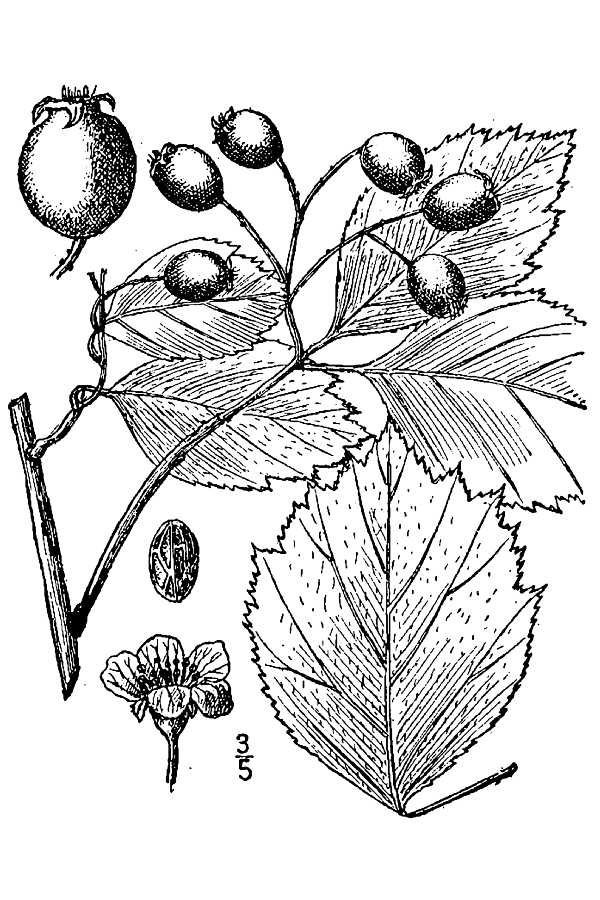
Three-flowered Hawthorn is a multi-stemmed shrub approximately 3–5 metres tall. Its twigs are brown or gray and bear straight, very thin, dark gray or black thorns approximately 2–4 cm long.[1][2][3]
The leaves are green, simple, and ovate, with broadly elliptic blades, toothed edges, and shallow lobes. Each leaf has a single blade and 5–7 veins on each side.[4][5][6][7]
The flowers are approximately 25–30 mm wide and have between 10 and 45 stamens per flower. The inflorescences generally contain 2–6 flowers, although some clusters have as many as 12, and develop on lateral peduncles.[8][9][10][11]
The fruit is medium-sized, nearly spherical, hairy, and red, with long spreading calyx lobes. Each fruit contains approximately 3–5 nutlets.[12][13]
Habitat
Three-flowered Hawthorn occurs in pine forests and grows in canopy gaps within hardwood forests. It is most frequently found in ecosystems with shrubs, small trees, and openings that admit light.[14][15][16]
The species prefers extremely fertile, clay-rich areas.[17]
It occurs in six southeastern United States states, primarily Alabama, Mississippi, and Georgia, with rarer occurrences in Tennessee, Arkansas, and Louisiana.[18]
Diet
The flowers provide nectar and pollen to animals.[19]
Behaviour
The flowers are pollinated by bees, wasps, and flies.[20]
Birds consume the fruits and contribute to seed dispersal. The shrubs also provide shelter and nesting sites for animals.[21][22]
Conservation
The species has an S2 conservation status in Alabama and Mississippi and an S1 conservation status in Arkansas, Louisiana, and Georgia.[23][24]
There are 44 known populations within the species' core range. Each known population contains fewer than 50 individual plants.[25][26]
Identified threats include grazing, fire, land clearing, and cedar apple rust.[27]
Similar species
The flowers are similar in size to those of wild roses in the genus Rosa.[28]
Mespilus canescens shares the characteristic of producing inflorescences on the sides of stems.[29]
Classification of the Three-flowered Hawthorn
| Kingdom | Plantae |
|---|---|
| Subkingdom | Pteridobiotina |
| Phylum | Tracheophyta |
| Class | Magnoliopsida |
| Order | Rosales |
| Family | Rosaceae (Rose Family) |
| Subfamily | Amygdaloideae |
| Tribe | Maleae |
| Subtribe | Malinae |
| Genus | Crataegus (Hawthorn) |
| Species | Crataegus triflora Chapm. |
Where the Three-flowered Hawthorn is found
Checklists and occurrence records place Crataegus triflora in 1 country across North America. GBIF holds 473 georeferenced records of it.
Countries
Regions and cities with the most records
- Alabama, United States 91
- Mississippi, United States 47
- Georgia, United States 19
- Millbrook, United States 19
- Montgomery, United States 19
- Prattville, United States 19
- Anniston, United States 18
- Arkansas, United States 18
- Oxford, United States 18
- Hot Springs, United States 16
- Louisiana, United States 10
- Hattiesburg, United States 9
- Warner Robins, United States 6
- Perry, United States 4
- Tennessee, United States
Range as the checklists state it
USA (Alabama, Georgia, Louisiana, Mississippi, Tennessee)
A number beside a place is its count of GBIF occurrence records. A place without a number comes from a checklist alone. Records show where a species has been observed or collected, which can include escapes and vagrants.
Common names
English
- Three-flowered Hawthorn
- Three-flower Hawthorn
Names in 2 other languages
- Czech
- hloh trojkvětý
- Slovak
- hloh trojkvetý
Related species
-
 Common HawthornCrataegus monogyna
-
 Chinese HawthornCrataegus pinnatifida
-
 Mexican HawthornCrataegus mexicana
-
 AzaroleCrataegus azarolus
-
 English HawthornCrataegus laevigata
-
 Cockspur HawthornCrataegus crus-galli
-
 Oriental HawthornCrataegus orientalis
-
 Black HawthornCrataegus douglasii
Compare
Questions and answers
What is the scientific name of the Three-flowered Hawthorn?
The scientific name of the Three-flowered Hawthorn is Crataegus triflora. Written with its author, the full name is Crataegus triflora Chapm..
Which family does the Three-flowered Hawthorn belong to?
Crataegus triflora belongs to the family Rosaceae, in the order Rosales and the class Magnoliopsida.
Where is the Three-flowered Hawthorn found?
Checklists and occurrence records place Crataegus triflora in 1 country: United States.
What other names does the Three-flowered Hawthorn have?
Crataegus triflora is also known in English as Three-flower Hawthorn.
What is the scientific name of hawthorn?
The scientific name of Three-flowered Hawthorn is Crataegus triflora Chapm.[30]
What is the difference between black hawthorn and English hawthorn?
The available description identifies Three-flowered Hawthorn by its broadly elliptic leaves, thin dark thorns, and nearly spherical red fruits. It does not provide comparative characteristics of black hawthorn and English hawthorn.[6][1][12]
What is special about hawthorn?
Three-flowered Hawthorn has flower clusters that generally contain 2–6 flowers, with some clusters containing as many as 12. Its nearly spherical, hairy, red fruits have long spreading calyx lobes.[9][12]
What is the habitat of hawthorn?
Three-flowered Hawthorn occurs in pine forests and canopy gaps within hardwood forests. It is most frequently found in ecosystems with shrubs, small trees, and light-admitting openings, and prefers extremely fertile, clay-rich areas.[14][15][16][17]
Are Crataegus berries edible?
The fruits of Three-flowered Hawthorn are consumed by birds, which contribute to seed dispersal. Their edibility for humans is not established.[21]
Sources
Passages the profile rests on
- The twigs are brown or gray and bear straight, very thin, dark gray or black thorns. Source passage: “The twigs are a brown, gray color. Thorns are located on the twigs. They are straight, dark gray or black, and extremely thin (around 2-4 cm).” — English Wikipedia
- The thorns are approximately 2–4 cm long. Source passage: “extremely thin (around 2-4 cm).” — English Wikipedia
- The plant is a multi-stemmed shrub approximately 3–5 metres tall. Source passage: “It is a multi-stemmed shrub 3 to 5 metres (10 to 16 feet) tall.” — English Wikipedia
- The leaves are green and oval-shaped with toothed edges and shallow lobes. Source passage: “Leaves of Crataegus triflora are green and oval-shaped. Each leaf has a toothed edge and shallow lobes.” — English Wikipedia
- Each leaf has a single blade and 5–7 veins on each side. Source passage: “Each leaf has a single blade and 5-7 veins per side.” — English Wikipedia
- The leaf blade is broadly elliptic. Source passage: “The leaf shape is “blade broadly elliptic (3-8 cm)”” — English Wikipedia
- The leaves are simple and ovate. Source passage: “Leaf Type. simple ; Leaf Shape. ovate” — warcapps.usgs.gov
- The flowers are approximately 25–30 mm wide. Source passage: “Crataegus triflora produces flowers approximately 25-30 mm wide” — English Wikipedia
- The inflorescences generally contain 2–6 flowers, although some clusters have as many as 12. Source passage: “Its inflorescences usually contain clusters of 2-6 flowers, though clusters can contain up to 12” — English Wikipedia
- The flower clusters develop on lateral peduncles. Source passage: “developed on peduncles around 2-5 centers arising laterally from the extension of shoots rather than short woody shoots.” — English Wikipedia
- The flowers have between 10 and 45 stamens per flower. Source passage: “ranging from 10 to up to 45 per flower.” — English Wikipedia
- The fruit is medium-sized, nearly spherical, hairy, and red, with long spreading calyx lobes. Source passage: “The fruit is medium-sized, sub globose, hairy, red, and has long, spreading calyx lobes.” — English Wikipedia
- The fruit contains approximately 3–5 nutlets. Source passage: “It is also medium-sized, including about 3-5 nutlets.” — English Wikipedia
- The species occurs in pine forests. Source passage: “Examples of the habitats are pine forests, canopy gaps in hardwood forests, and prairie margins.” — English Wikipedia
- The species grows in canopy gaps within hardwood forests. Source passage: “canopy gaps in hardwood forests” — English Wikipedia
- The species is most frequently found in ecosystems with shrubs, small trees, and openings that admit light. Source passage: “most frequently in an ecosystem with an influx of shrubs, small trees, and light openings.” — English Wikipedia
- The species prefers extremely fertile, clay-rich areas. Source passage: “Additionally, these flowers prefer extremely fertile clay rich areas.” — English Wikipedia
- The species occurs in six southeastern United States states, primarily Alabama, Mississippi, and Georgia, with rarer occurrences in Tennessee, Arkansas, and Louisiana. Source passage: “Primarily found in Alabama, Mississippi, Georgia, with rarer appeareances in Tennessee, Arkansas, and Louisiana.” — English Wikipedia
- The flowers provide nectar and pollen to animals. Source passage: “Their flowers provide nectar and pollen” — English Wikipedia
- The flowers are pollinated by bees, wasps, and flies. Source passage: “are pollinated by insects such as bees, wasps, and flies.” — English Wikipedia
- Birds consume the fruits and contribute to seed dispersal. Source passage: “Birds feed on the hawthorns fruits and help disperse the seeds to new areas.” — English Wikipedia
- The shrubs provide shelter and nesting sites for animals. Source passage: “C. triflora’s shrubs provide shelter and nesting sites.” — English Wikipedia
- The species has an S2 conservation status in Alabama and Mississippi. Source passage: “In the states of Alabama and Mississippi, Crataegus triflora holds a S2 conservation status, meaning that it is imperiled.” — English Wikipedia
- The species has an S1 conservation status in Arkansas, Louisiana, and Georgia. Source passage: “In the states of Arkansas, Louisiana, and Georgia, the Crataegus triflora holds an S1 conservation status, meaning that it is critically imperiled.” — English Wikipedia
- There are 44 known populations within the species' core range. Source passage: “Within this range, there are 44 known occurrences (populations)” — English Wikipedia
- Each known population contains fewer than 50 individual plants. Source passage: “but each one has less than 50 individual plants present.” — English Wikipedia
- Grazing, fire, land clearing, and cedar apple rust are identified threats to the species. Source passage: “The main threats to the Crataegus triflora are grazing, fire, clearing, and cedar apple rust.” — English Wikipedia
- The flowers are similar in size to those of wild roses in the genus Rosa. Source passage: “Crataegus triflora, specifically, share many similarities with wild roses, genus Rosa, like its flower size and number.” — English Wikipedia
- Mespilus canescens shares the characteristic of producing inflorescences on the sides of stems. Source passage: “For example, Mespulis canescens typically produce inflorescenses on the sides of the stems instead of the top of the stem.” — English Wikipedia
- The species belongs to the flowering plants category in the U.S. Fish and Wildlife Service classification. Source passage: “FWS Category Flowering Plants” — fws.gov
Data
- Catalogue of Life, 2026-10-16 XR cc by
- Global Biodiversity Information Facility CC BY 4.0
- Wikidata CC0
- GeoNames CC BY 4.0
- Wikimedia Commons per image; credit shown with each image
- Within the Catalogue of Life, this name comes from Synonymic Checklists of the Vascular Plants of the World cc by
References
- Chapm. Fl. South. U.S. Suppl. 2. 684 (1892). where the name was published
This species in other databases
- Catalogue of Life Z8J7
- Wikidata Q5182590
- iNaturalist 161102
- World Flora Online wfo-0001004174
- GRIN 464375
Page built on 27 November 2026. See how the catalog is made and all sources and licences.
Cite this page
ScientificNames.org. (2026). Crataegus triflora (Three-flowered Hawthorn). Retrieved November 27, 2026, from https://scientificnames.org/species/crataegus-triflora
“Crataegus triflora (Three-flowered Hawthorn).” ScientificNames.org, 2026, scientificnames.org/species/crataegus-triflora. Accessed 27 Nov. 2026.
ScientificNames.org. “Crataegus triflora (Three-flowered Hawthorn).” Accessed November 27, 2026. https://scientificnames.org/species/crataegus-triflora.
@misc{scientificnames_crataegus_triflora_three_flowered_hawthorn,
  author = {{ScientificNames.org}},
  title = {Crataegus triflora (Three-flowered Hawthorn)},
  year = {2026},
  url = {https://scientificnames.org/species/crataegus-triflora},
  note = {Accessed 2026-11-27}
}