Species · Reptiles
Eastern Small-eyed Snake Cryptophis nigrescens
The scientific name of the Eastern Small-eyed Snake is Cryptophis nigrescens. It is a species of reptile in the family Elapidae (cobras), order Squamata. The name dates from 1862.
- Scientific name
- Cryptophis nigrescens (Günther, 1862)
- Common name
- Eastern Small-eyed Snake
- Genus
- Cryptophis
- Family
- Elapidae (Cobras)
- Order
- Squamata
- Class
- Reptilia
- Red List category
- LC Least Concern
- Recorded in
- 1 country
- Name status
- accepted in the Catalogue of Life

Overview
Cryptophis nigrescens occurs in New South Wales, Queensland, and Victoria, between northern Cape York Peninsula in Queensland and eastern Victoria. It is distinguished by its steely blue-black upper surface, small dark eyes, and ventral colouration ranging from cream to bright coral pink.
Written 26 November 2026 from the sources listed below. Each statement was checked against the passage it cites; statements that could not be supported were removed.
Appearance
The Eastern Small-eyed Snake has a slightly flattened head that is barely distinguishable from its solid body. Its back, sides, and upper surface of the head and body are steely blue-black.[1][2]
The ventral surface ranges in colour from cream in southern populations to bright coral pink in northern populations. The ventral scales are often flecked or blotched with black, and the colouration does not extend onto the lower lateral rows.[3][4][5]
The species has smooth, glossy scales and small, darkly coloured eyes. It has 15 rows of midbody scales, with single anal and subcaudal scales.[6][7][8][9]
Its average total length is approximately 50 cm, although individuals may exceed one metre. Northern populations tend to be larger than southern populations, and males tend to be larger than females.[10][11][12][13]
Habitat
The Eastern Small-eyed Snake inhabits rainforest, wet sclerophyll forest, woodlands, heaths, and rock outcrops. It also occupies saxicoline habitats, areas beneath bark, closed forests, and closed heaths.[14][15][16]
It shelters beneath stones, exfoliated rock, loose bark, and fallen timber, as well as inside rock crevices.[17][18]
During winter in sandstone escarpment country southwest of Sydney, individuals shelter inside crevices and beneath rocks. They may actively select winter shelter sites with narrow crevices and warm temperatures.[19][20]
Diet
The Eastern Small-eyed Snake consumes a variety of ectothermic prey. Documented prey includes lizard eggs, dragons, legless lizards, skinks, blind snakes, and other small snakes.[21][22]
Skinks are its predominant prey.[23]
Behaviour
The Eastern Small-eyed Snake is nocturnal and terrestrial. It is usually found on the surface at night and beneath cover during the day.[24][25]
It may forage actively at night for diurnal lizards sheltering in nocturnal sleeping places or ambush diurnal lizards sheltering beneath surface cover during the day. It may combine active searching with ambush predation.[26][27][28]
The species may form winter aggregations containing as many as 29 individuals. It occasionally exhibits cannibalism.[29][30]
When disturbed, it may thrash aggressively but is usually reluctant to bite.[31]
Reproduction and life cycle
The Eastern Small-eyed Snake gives birth to live young. Litters contain up to eight young, with an average litter size of four.[32][33]
Gravid females have been recorded from late September to mid-April. Females brought into captivity after being captured gravid in the wild gave birth during February and March.[34][35]
Females appear capable of reproducing annually.[36]
Females attain sexual maturity at approximately 285 mm in Victoria, 300 mm in New South Wales, and 293 mm in Queensland snout-vent length. Males attain sexual maturity at different snout-vent lengths in Victoria, New South Wales, and Queensland.[37][38]
Male combat has been observed on a bitumen road at night during October.[39]
Conservation
The Eastern Small-eyed Snake is described as common throughout its range.[40]
Classification of the Eastern Small-eyed Snake
| Kingdom | Animalia |
|---|---|
| Phylum | Chordata |
| Subphylum | Vertebrata |
| Infraphylum | Gnathostomata |
| Parvphylum | Osteichthyes |
| Megaclass | Tetrapoda |
| Class | Reptilia (Reptile) |
| Order | Squamata (Snakes) |
| Suborder | Serpentes (Snakes) |
| Infraorder | Alethinophidia |
| Family | Elapidae (Cobras) |
| Subfamily | Hydrophiinae |
| Genus | Cryptophis (Small-eyed Snakes) |
| Species | Cryptophis nigrescens (Günther, 1862) |
Where the Eastern Small-eyed Snake is found
Checklists and occurrence records place Cryptophis nigrescens in 1 country across Oceania. GBIF holds 5,949 georeferenced records of it.
Countries
Regions and cities with the most records
- New South Wales, Australia 3,229
- Queensland, Australia 2,029
- Victoria, Australia 488
- Wollongong, Australia 313
- Brisbane, Australia 177
- Logan City, Australia 104
- Coffs Harbour, Australia 98
- Capalaba, Australia 95
- Sydney, Australia 66
- Grafton, Australia 59
- Gold Coast, Australia 58
- Toowoomba, Australia 56
- Narangba, Australia 54
- Balwyn North, Australia 53
- Burwood, Australia 50
- Batemans Bay, Australia 48
- Central Coast, Australia 48
- Parramatta, Australia 45
- Cairns, Australia 40
- Sunshine Coast, Australia 38
- Hornsby, Australia 36
- Caloundra, Australia 31
- Taree, Australia 30
- Port Macquarie, Australia 27
- Frankston East, Australia 24
- Maryborough, Australia 24
- Australian Capital Territory, Australia 18
- Cessnock, Australia 18
- Bairnsdale, Australia 17
- Liverpool, Australia 15
- Gympie, Australia 14
- Bundaberg, Australia 13
- Tuggeranong, Australia 11
- Armidale, Australia 10
- Bacchus Marsh, Australia 8
- Hervey Bay, Australia 8
Range as the checklists state it
Australia (New South Wales, Queensland, Victoria)
A number beside a place is its count of GBIF occurrence records. A place without a number comes from a checklist alone. Records show where a species has been observed or collected, which can include escapes and vagrants.
Common names
English
- Eastern Small-eyed Snake
- Short-tailed Snake
- Small-eyed Snake
Names in 4 other languages
- German
- Östliche Kleinaugenotter
- Italian
- Serpente occhi piccoli orientale
- Portuguese
- Cobra-de-olhos-pequenos-oriental
- Russian
- Черноватый скрытоглазый аспид
Synonyms
5 other scientific names have been used for this species and are now treated as synonyms of Cryptophis nigrescens.
- Alecto permixta Jan, 1863
- Cryptophis edwardsi Hoser, 2012
- Hoplocephalus assimilis Macleay, 1885
- Hoplocephalus nigrescens Günther, 1862
- Rhinoplocephalus nigrescens (Günther, 1862)
Related species
- Pink SnakeCryptophis incredibilis
-
 Black-striped SnakeCryptophis nigrostriatus
-
 Northern Small-eyed SnakeCryptophis pallidiceps
- Carpentaria Whip SnakeCryptophis boschmai
-
 King CobraOphiophagus hannah
-
 Inland TaipanOxyuranus microlepidotus
-
 Black MambaDendroaspis polylepis
-
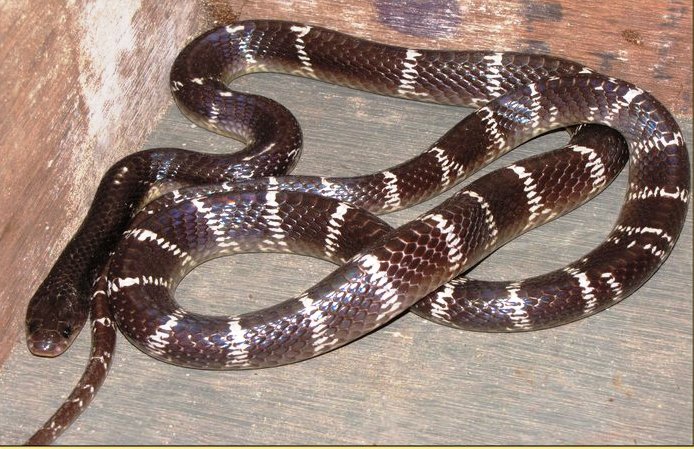 Common KraitBungarus caeruleus
Compare
Questions and answers
What is the scientific name of the Eastern Small-eyed Snake?
The scientific name of the Eastern Small-eyed Snake is Cryptophis nigrescens. Written with its author, the full name is Cryptophis nigrescens (Günther, 1862).
Which family does the Eastern Small-eyed Snake belong to?
Cryptophis nigrescens belongs to the family Elapidae, in the order Squamata and the class Reptilia.
Where is the Eastern Small-eyed Snake found?
Checklists and occurrence records place Cryptophis nigrescens in 1 country: Australia.
What is the conservation status of the Eastern Small-eyed Snake?
The IUCN Red List category recorded for Cryptophis nigrescens is Least Concern (LC).
What other names does the Eastern Small-eyed Snake have?
Cryptophis nigrescens is also known in English as Short-tailed Snake and Small-eyed Snake.
How venomous is the small-eyed snake?
The Eastern Small-eyed Snake's venom contains a long-acting myotoxin that continues damaging muscle tissue for days after envenomation. Effects in humans range from no symptoms to renal failure and possibly death. One fatal human envenomation has been recorded.[41][42][43]
Sources
Passages the profile rests on
- The species has a slightly flattened head that is barely distinguishable from its solid body. Source passage: “The head is slightly flattened and barely distinct from the solid body.” — australian.museum
- The back, sides, and upper surface of the head and body are steely blue-black. Source passage: “The back, sides and top of the head and body are steely blue-black.” — australian.museum
- The ventral surface ranges in colour from cream in southern populations to bright coral pink in northern populations. Source passage: “The ventral colour ranges from cream (in the south) to bright coral pink (in the north)” — australian.museum
- The ventral scales are often flecked or blotched with black. Source passage: “and is often flecked or blotched with black.” — australian.museum
- The ventral colouration is restricted to the ventral scales and does not extend onto the lower lateral rows. Source passage: “This colouration is confined wholly to the ventral scales and does not show on the lower lateral rows.” — australian.museum
- The species has smooth, glossy scales. Source passage: “Scales are smooth and glossy.” — australian.museum
- Its eyes are small and darkly coloured. Source passage: “The eyes are small and darkly coloured.” — australian.museum
- The species has 15 rows of midbody scales. Source passage: “Midbody scales in 15 rows” — australian.museum
- Its anal and subcaudal scales are single. Source passage: “anal and subcaudal scales single.” — australian.museum
- The species has an average total length of approximately 50 cm. Source passage: “however the average size is around 50cm (total length).” — australian.museum
- Individuals may exceed one metre in length. Source passage: “The Small-eyed Snake may grow to over a metre” — australian.museum
- Northern populations tend to be larger than southern populations. Source passage: “Size seems to be greater in northern populations compared to southern populations” — australian.museum
- Males tend to be larger than females. Source passage: “and also in males vs females.” — australian.museum
- The species inhabits rainforest and wet sclerophyll forest. Source passage: “including rainforest and wet sclerophyll forest” — australian.museum
- The species occurs in woodlands, heaths, and rock outcrops. Source passage: “as well as woodlands, heaths and rock outcrops.” — australian.museum
- The species occupies saxicoline habitats, areas beneath bark, closed forests, closed heaths, and woodlands. Source passage: “Habitats saxicoline, under bark, closed forest, closed heath, woodland” — australian.museum
- The species shelters beneath stones, exfoliated rock, loose bark, and fallen timber. Source passage: “They shelter beneath stones, exfoliated rock, loose bark and fallen timber” — australian.museum
- The species also shelters inside rock crevices. Source passage: “and also within rock crevices.” — australian.museum
- During winter in sandstone escarpment country southwest of Sydney, individuals shelter inside crevices and beneath rocks. Source passage: “During winter in sandstone escarpment country southwest of Sydney, the species brumates inside crevices and under rocks.” — australian.museum
- The species may actively select winter shelter sites with narrow crevices and warm temperatures. Source passage: “they actively chose artificial shelter sites with narrow crevices and warm temperatures” — australian.museum
- The species consumes a variety of ectothermic prey. Source passage: “In the wild, Small-eyed Snakes eat a wide variety of ectothermic prey” — australian.museum
- Documented prey includes lizard eggs, dragons, legless lizards, skinks, blind snakes, and other small snakes. Source passage: “including lizard eggs, dragons, legless lizards, skinks, blind snakes, and other small snakes.” — australian.museum
- Skinks are the predominant prey of the species. Source passage: “However, skinks are the predominant prey.” — australian.museum
- The species is nocturnal and terrestrial. Source passage: “Life history mode nocturnal, terrestrial” — australian.museum
- The species is usually found on the surface at night and beneath cover during the day. Source passage: “In the wild, the Small-eyed Snake is usually only found on the surface at night, and under cover during the day.” — australian.museum
- The species may forage actively at night for diurnal lizards sheltering in nocturnal sleeping places. Source passage: “searching for diurnal lizards in their nocturnal sleeping places.” — australian.museum
- The species may also ambush diurnal lizards sheltering beneath surface cover during the day. Source passage: “they may also be considered an ambush predator of diurnal lizards temporarily seeking shelter under surface cover during the day” — australian.museum
- The species may combine active searching with ambush predation. Source passage: “It is possible that Small-eyed Snakes are both an active searcher and an ambush predator.” — australian.museum
- The species may form winter aggregations containing as many as 29 individuals. Source passage: “This species may form winter aggregations, with up to 29 individuals being found sheltering together.” — australian.museum
- The species occasionally exhibits cannibalism. Source passage: “The Small-eyed Snake may occasionally fall prey to its own kind (cannibalistic).” — australian.museum
- When disturbed, the species may thrash aggressively but is usually reluctant to bite. Source passage: “When disturbed it may thrash about aggressively, but it is usually disinclined to bite.” — australian.museum
- The species gives birth to live young. Source passage: “Cryptophis nigrescens is viviparous.” — English Wikipedia
- The species produces litters of up to eight young, with an average litter size of four. Source passage: “with up to 8 young being born (average of 4).” — australian.museum
- Gravid females have been recorded from late September to mid-April. Source passage: “Gravid females occur over a broad season, from early spring to early autumn (late September to mid-April).” — australian.museum
- Females brought into captivity after being captured gravid in the wild gave birth during February and March. Source passage: “Gravid females captured in the wild and brought into captivity gave birth in late summer to early autumn (February-March).” — australian.museum
- Females appear capable of reproducing annually. Source passage: “It would appear that females are able to reproduce yearly.” — australian.museum
- Males attain sexual maturity at different snout-vent lengths in Victoria, New South Wales, and Queensland. Source passage: “Sexual maturity is attained in males at a snout-vent length of about 263mm in Victoria, 287mm in New South Wales and 298mm in Queensland” — australian.museum
- Females attain sexual maturity at approximately 285 mm in Victoria, 300 mm in New South Wales, and 293 mm in Queensland snout-vent length. Source passage: “and in females at about 285mm in Victoria, 300mm in New South Wales and 293mm in Queensland.” — australian.museum
- Male combat has been observed on a bitumen road at night during October. Source passage: “Male combat has been observed on a bitumen road at night in the first half of spring (October).” — australian.museum
- The species is described as common throughout its range. Source passage: “Though common through its range” — australian.museum
- The species' venom contains a long-acting myotoxin that continues damaging muscle tissue for days after envenomation. Source passage: “The venom contains a long-acting myotoxin that continues to attack muscle tissue (including heart muscle) for days after envenomation.” — australian.museum
- The effects of envenomation in humans range from no symptoms to renal failure and possibly death. Source passage: “the effect on humans can range from no symptoms to renal failure and possibly death” — australian.museum
- One fatal human envenomation has been recorded. Source passage: “(one recorded fatality).” — australian.museum
- The species is endemic to eastern Australia. Source passage: “The species is endemic to eastern Australia.” — English Wikipedia
- The species occurs in New South Wales, Queensland, and Victoria. Source passage: “Cryptophis nigrescens is found in the Australian states of New South Wales, Queensland, and Victoria.” — English Wikipedia
Data
- Catalogue of Life, 2026-10-16 XR cc by
- Global Biodiversity Information Facility CC BY 4.0
- Wikidata CC0
- GeoNames CC BY 4.0
- Wikimedia Commons per image; credit shown with each image
- Within the Catalogue of Life, this name comes from The Reptile Database cc by
References
- Günther, & ALBERT. (1862). On new species of snakes in the collection of the British Museum. Ann. Mag. Nat. Hist. (3) 9: 52-67.
- Günther, A. (1862). On new species of snakes in the collection of the British Museum. Ann. Mag. Nat. Hist. (3) 9: 124-132.
- Macleay, W. (1885). On some Reptilia lately received from the Herbert River District, Queensland. Proc. Linn. Soc. New South Wales 10: 64-68.
- Worrell, E. (1961). Herpetological Name Changes. Western Australian Naturalist 8: 18—27.
- Hutchinson, M. N. (1979). The reptiles of Kinglake National Park. Victorian Naturalist 96: 124-134.
- Bridge, G. (1979). The small-eyed snake (Cryptophis nigrescens). Vict. Herp. Soc. Newsletter 13: 17-18.
- Coventry, A. J., & Rawlinson, P. A. (1980). Taxonomic revision of the elapid snake genus Drysdalia Worrell, 1961. Mem. Natl. Mus. Vict. 41: 65-78.
- Shine, & Richard. (1994). Sexual size dimorphism in snakes revisited. Copeia 1994 (2): 326-346.
- Murphy, Michael J. (1994). Reptiles and amphibians of Seven Mile Beach National park, NSW. Herpetofauna (Sydney) 24 (2): 24-30.
- Cogger, H. G. (2000). Reptiles and Amphibians of Australia, 6th ed. Ralph Curtis Publishing, Sanibel Island, 808 Pp.
- Fearn, S. (2000). Record of an extreme leucistic Rhinoplocephalus nigrescens (Serpentes: Elapidae). Herpetofauna (Sydney) 30 (2): 55.
- STAPLEY, Jessica; CHRISTINE M. HAYES; JONATHAN K. WEBB and J . SCOTT KEOGH. (2005). Novel microsatellite loci identified from the Australian eastern small-eyed snake (Elapidae: Rhinocephalus nigrescens) and cross species amplification in the related genus Suta. Molecular Ecology Notes 5: 54–56.
- Brischoux F, Pizzatto L, Shine R. (2010). Insights into the adaptive significance of vertical pupil shape in snakes. J Evol Biol. 23(9): 1878-85.
- Llewelyn, John, Jonathan K. Webb and Richard Shine. (2010). Flexible defense: context-dependent antipredator responses of two species of Australian elapid snakes. Herpetologica 66 (1): 1-11.
- Wilson, S., & Swan, G. (2010). A complete guide to reptiles of Australia, 3rd ed. Chatswood: New Holland, 558 Pp.
- Hoser, R. T. (2012). Some new small-eyed snakes from Australia and New Guinea (Serpentes: Elapidae). Australasian J. Herpetol. 13:3–7. (Dubious Journal).
- Kaiser, H.; Crother, B.I.; Kelly, C.M.R.; Luiselli, L.; O’Shea, M.; Ota, H.; Passos, P.; Schleip, W.D. & Wüster, W. (2013). Best Practices: In the 21st Century, Taxonomic Decisions in Herpetology are Acceptable Only When Supported by a Body of Evidence and Published via Peer-Review. Herpetological Review 44 (1): 8-23.
- Kay, G.M.; D. Michael; M. Crane; S. Okada; C. MacGregor; D. Florance; D. Trengove; L. McBurney; D. Blair; D.B. Lindenmayer. (2013). A list of reptiles and amphibians from Box Gum Grassy Woodlands in south-eastern Australia. Check List 9 (3):476-481.
- Cogger, H. G. (2014). Reptiles and Amphibians of Australia, 7th ed. CSIRO Publishing, Xxx + 1033 Pp.
- Wallach, Van; Kenneth L. Williams, Jeff Boundy. (2014). Snakes of the World: A Catalogue of Living and Extinct Species. [type catalogue]. Taylor and Francis, CRC Press, 1237 Pp.
- Lettoof, Damian and Samantha K. Travers. (2015). Cryptophis nigrescens (eastern small-eyed snake) diet. Herpetological Review 46 (4): 642.
- Mirtschin, P., Rasmussen, A. R., & Weinstein, S. A. (2017). Australia’s Dangerous snakes. CSIRO Publishing, 424 Pp.
- Swan, G., Sadlier, R., & Shea, G. (2017). A field guide to reptiles of New South Wales. Reed New Holland, 328 Pp.
- Turner, & S, G. (2018). Cryptophis nigrescens (Eastern Small-eyed Snake) Diet. Herpetological Review 49 (2): 339.
- Eipper T, & Eipper S. (2024). SNAKES OF AUSTRALIA. Princeton University Press, Princeton and Oxford, 368 Pp.
This species in other databases
Page built on 27 November 2026. See how the catalog is made and all sources and licences.
Cite this page
ScientificNames.org. (2026). Cryptophis nigrescens (Eastern Small-eyed Snake). Retrieved November 27, 2026, from https://scientificnames.org/species/cryptophis-nigrescens
“Cryptophis nigrescens (Eastern Small-eyed Snake).” ScientificNames.org, 2026, scientificnames.org/species/cryptophis-nigrescens. Accessed 27 Nov. 2026.
ScientificNames.org. “Cryptophis nigrescens (Eastern Small-eyed Snake).” Accessed November 27, 2026. https://scientificnames.org/species/cryptophis-nigrescens.
@misc{scientificnames_cryptophis_nigrescens_eastern_small_eyed_snake,
  author = {{ScientificNames.org}},
  title = {Cryptophis nigrescens (Eastern Small-eyed Snake)},
  year = {2026},
  url = {https://scientificnames.org/species/cryptophis-nigrescens},
  note = {Accessed 2026-11-27}
}