Species · Flowering plants
Cushaw Pumpkin Cucurbita argyrosperma
The scientific name of the Cushaw Pumpkin is Cucurbita argyrosperma. It is a species of flowering plant in the family Cucurbitaceae (gourd family), order Cucurbitales.
- Scientific name
- Cucurbita argyrosperma K.Koch
- Common name
- Cushaw Pumpkin
- Genus
- Cucurbita
- Family
- Cucurbitaceae (Gourd Family)
- Order
- Cucurbitales
- Class
- Magnoliopsida
- Red List category
- LC Least Concern
- Recorded in
- 12 countries
- Name status
- accepted in the Catalogue of Life
Overview
The species is cultivated in North and Central America. Its fruits occur in green-striped, orange-striped, and white forms.
Written 26 November 2026 from the sources listed below. Each statement was checked against the passage it cites; statements that could not be supported were removed.
Appearance
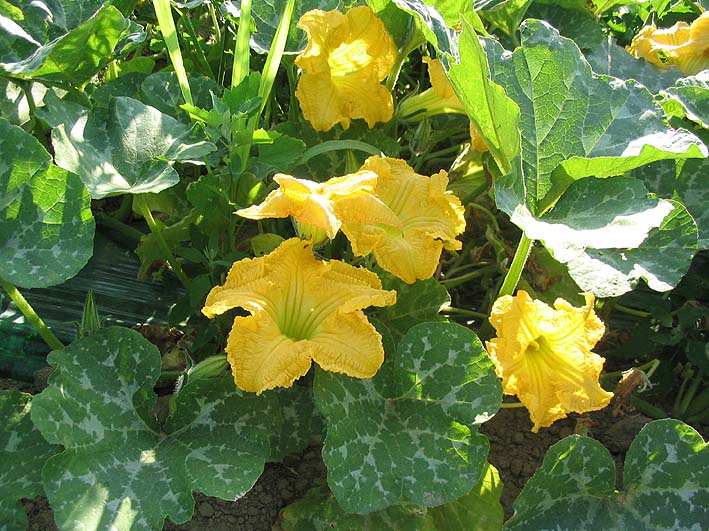
The plant produces orange or yellow flowers. Its fruits occur in green-striped, orange-striped, and white forms.[1][2]
The plant grows approximately 1 foot tall. Most fruits weigh between 10 and 20 pounds, although a recorded cushaw pumpkin reached 57 pounds in Ohio.[3][4][5]
Habitat
The wild sororia type occurs at elevations ranging from sea level to 1,900 metres and extends from northern Mexico through Central America to Nicaragua. Domesticated plants are adapted to warm climates and are most commonly cultivated at low elevations.[6][7][8]
The domesticated subspecies argyrosperma reaches a maximum elevation of approximately 1,800 metres above sea level. The species is believed to have originated in Mexico and is cultivated in North and Central America.[9][10][11]
The plant grows in soil with good drainage and high organic material content. It can be cultivated in USDA growing zones 3–10 and in locations receiving at least six hours of full sunlight daily.[12][13][14]
Reproduction and life cycle
The plant produces both male and female flowers, which bloom in July or August. The species is primarily pollinated by insects.[15][16][17]
Individual plants can produce multiple fruits.[18]
Uses
The seeds are an important food product in Mexico and are consumed raw, roasted, toasted, or ground. Some varieties produce seeds containing up to 39 percent oil and 44 percent protein.[19][20][21]
The seeds are used in traditional sauces. The fruits can be used to prepare baked or fried summer-squash dishes and can be pureed to prepare pies.[22][23][24]
The fruit of some varieties is traditionally used as livestock feed. The fruits can be stored for up to six months under suitable storage conditions.[25][26]
Wild gourd shells are used to make handicrafts in Chiapas. Wild gourds have traditionally been used as soap in Oaxaca and Michoacán.[27][28]
Similar species
Cucurbita argyrosperma is closely related to Cucurbita moschata, but genetic research identifies them as distinct species.[29]
Classification of the Cushaw Pumpkin
| Kingdom | Plantae |
|---|---|
| Subkingdom | Pteridobiotina |
| Phylum | Tracheophyta |
| Class | Magnoliopsida |
| Order | Cucurbitales |
| Family | Cucurbitaceae (Gourd Family) |
| Tribe | Cucurbiteae |
| Genus | Cucurbita (Gourd) |
| Species | Cucurbita argyrosperma K.Koch |
Where the Cushaw Pumpkin is found
Checklists and occurrence records place Cucurbita argyrosperma in 12 countries across Asia, Europe and North America. GBIF holds 2,608 georeferenced records of it.
Countries where it is native or its origin is not stated
- Belize 8
- Costa Rica 22
- El Salvador 23
- Guadeloupe 3
- Guatemala 115
- Honduras 8
- Martinique 3
- Mexico 2,312
- United States 81
Countries where it has been introduced
Regions and cities with the most records
- Sinaloa, Mexico 331
- Veracruz, Mexico 206
- Jalisco, Mexico 194
- Sonora, Mexico 156
- Oaxaca, Mexico 144
- Guerrero, Mexico 128
- Michoacán, Mexico 82
- Chiapas, Mexico 81
- Culiacán, Mexico 81
- Yucatán, Mexico 79
- Colima, Mexico 75
- Nayarit, Mexico 72
- San Luis Potosí, Mexico 59
- Ciudad de Villa de Álvarez, Mexico 53
- Tamaulipas, Mexico 47
- Colima, Mexico 45
- El Grullo, Mexico 41
- Petén, Guatemala 40
- Autlán de Navarro, Mexico 29
- Mazatlán, Mexico 27
- Crucecita, Mexico 26
- Xalisco, Mexico 25
- Chihuahua, Mexico 24
- Guanajuato, Mexico 24
- Poza Rica de Hidalgo, Mexico 24
- Tepic, Mexico 24
- Benito Juarez, Mexico 23
- Ciudad Nezahualcoyotl, Mexico 23
- Coyoacán, Mexico 23
- Cuauhtémoc, Mexico 23
- Emiliano Zapata, Mexico 23
- Iztacalco, Mexico 23
- Iztapalapa, Mexico 23
- Los Reyes Acaquilpan, Mexico 23
- Magdalena Contreras, Mexico 23
- Mexico City, Mexico 23
4 more countries have a few records outside this range
These countries hold a few records of Cucurbita argyrosperma but lie outside the range the checklists give for it. Such records are often zoo or garden specimens, museum material or vagrants, so the species is not counted as occurring there.
A number beside a place is its count of GBIF occurrence records. A place without a number comes from a checklist alone. Records show where a species has been observed or collected, which can include escapes and vagrants.
Common names
English
- Cushaw Pumpkin
- Japanese Pie Pumpkin
- Silver-seed Gourd
Names in 8 other languages
- Arabic
- قرع فضي البذور
- Czech
- tykev pomíchaná
- Dutch
- Ayote
- Polish
- Dynia Ayote
- Portuguese
- Abóbora-batata-doce, Mogango-de-pescoço, Mogango-gringo
- Slovak
- tekvica striebristosemenná
- Spanish
- Calabaza de Castilla, Calabaza del desierto, Calabaza rayada, Chichicayoctli
- Thai
- ฟักทองพายญี่ปุ่น
Subspecies and varieties
- Cucurbita argyrosperma subsp. argyrosperma (Cushaw) subspecies
- Cucurbita argyrosperma subsp. sororia subspecies
Related species
-
 ZucchiniCucurbita pepo
-
 PumpkinCucurbita maxima
-
 Butternut SquashCucurbita moschata
-
 Fig-leaf GourdCucurbita ficifolia
-
 Buffalo GourdCucurbita foetidissima
-
 Coyote-melonCucurbita palmata
-
 Finger-leaf GourdCucurbita digitata
-
 Okeechobee GourdCucurbita okeechobeensis
Compare
Questions and answers
What is the scientific name of the Cushaw Pumpkin?
The scientific name of the Cushaw Pumpkin is Cucurbita argyrosperma. Written with its author, the full name is Cucurbita argyrosperma K.Koch.
Which family does the Cushaw Pumpkin belong to?
Cucurbita argyrosperma belongs to the family Cucurbitaceae, in the order Cucurbitales and the class Magnoliopsida.
Where is the Cushaw Pumpkin found?
Checklists and occurrence records place Cucurbita argyrosperma in 12 countries, including Mexico, Guatemala, United States, El Salvador, Costa Rica and Belize.
What is the conservation status of the Cushaw Pumpkin?
The IUCN Red List category recorded for Cucurbita argyrosperma is Least Concern (LC).
What other names does the Cushaw Pumpkin have?
Cucurbita argyrosperma is also known in English as Japanese Pie Pumpkin and Silver-seed Gourd.
Sources
Passages the profile rests on
- The plant produces orange or yellow flowers. Source passage: “The flowers are orange or yellow” — English Wikipedia
- The fruits of the species occur in green-striped, orange-striped, and white forms. Source passage: “the most common are green striped, orange striped and white.” — chatham.ces.ncsu.edu
- The plant grows approximately 1 foot tall. Source passage: “The plant grows about 1 foot high” — English Wikipedia
- Most fruits weigh between 10 and 20 pounds. Source passage: “most fruits are in the 10-20 lb. range” — chatham.ces.ncsu.edu
- A recorded cushaw pumpkin reached a weight of 57 pounds in Ohio. Source passage: “A record setting cushaw tipped the scales at 57 lbs. in Ohio” — chatham.ces.ncsu.edu
- The wild sororia type occurs at elevations ranging from sea level to 1,900 metres. Source passage: “at elevations from sea level to 1,900m.” — English Wikipedia
- Domesticated plants of the species are adapted to warm climates and are most commonly cultivated at low elevations. Source passage: “is adapted to warm climates and is most commonly cultivated at low elevations.” — English Wikipedia
- The wild sororia type occurs from northern Mexico through Central America to Nicaragua. Source passage: “from northern Mexico through Central America to Nicaragua” — English Wikipedia
- The domesticated subspecies argyrosperma reaches a maximum elevation of approximately 1,800 metres above sea level. Source passage: “The maximum elevation for this subspecies is at approximately 1,800 m above sea level.” — English Wikipedia
- The species is believed to have originated in Mexico. Source passage: “The species is believed to have originated in Mexico” — English Wikipedia
- The species is cultivated in North and Central America. Source passage: “grown most frequently in North and Central America” — English Wikipedia
- The plant grows in soil with good drainage and high organic material content. Source passage: “They like soil that has good drainage, high in organic material” — chatham.ces.ncsu.edu
- The plant can be cultivated in USDA growing zones 3–10. Source passage: “can be grown in zones 3-10” — chatham.ces.ncsu.edu
- The plant can grow in locations receiving at least six hours of full sunlight daily. Source passage: “at least six hrs. of full sun daily.” — chatham.ces.ncsu.edu
- The plant produces both male and female flowers. Source passage: “has both male and female flowers.” — English Wikipedia
- The flowers bloom in July or August. Source passage: “bloom in July or August.” — English Wikipedia
- The species is primarily pollinated by insects. Source passage: “These plants are open pollinated primarily by insects” — chatham.ces.ncsu.edu
- Individual plants can produce multiple fruits. Source passage: “each plant supports multiple fruits.” — chatham.ces.ncsu.edu
- The seeds are an important food product in Mexico. Source passage: “In Mexico, C. argyrosperma seeds are an important food product.” — English Wikipedia
- Some varieties produce seeds containing up to 39 percent oil and 44 percent protein. Source passage: “oil content as high as 39 percent and protein content 44 percent.” — English Wikipedia
- The seeds are consumed raw, roasted, toasted, or ground. Source passage: “Seeds are eaten raw, roasted, toasted, or ground.” — English Wikipedia
- The seeds are used in traditional sauces. Source passage: “Cucurbita seeds and C. argyrosperma seeds in particular are an important part of recipes for traditional sauces.” — English Wikipedia
- The species can be used to prepare baked or fried summer-squash dishes. Source passage: “It can be used like a normal summer squash and be baked or fried.” — chatham.ces.ncsu.edu
- The fruits can be pureed to prepare pies. Source passage: “It can be used like a pumpkin and pureed to make the most delicious pies.” — chatham.ces.ncsu.edu
- The fruit of some varieties is traditionally used as livestock feed. Source passage: “The fruit of some varieties is traditionally fed to livestock.” — English Wikipedia
- The fruits can be stored for up to six months under suitable storage conditions. Source passage: “They an be stored at 50-60°F with 50-70% relative humidity and good ventilation for up to 6 months.” — chatham.ces.ncsu.edu
- Wild gourd shells are used to make handicrafts in Chiapas. Source passage: “Wild C. argyrosperma gourd shells are used for handicrafts in Chiapas.” — English Wikipedia
- The wild gourds have traditionally been used as soap in Oaxaca and Michoacán. Source passage: “The wild gourds have been used in Oaxaca and Michoacán as soap.” — English Wikipedia
- Cucurbita argyrosperma is closely related to Cucurbita moschata, but genetic research identifies them as distinct species. Source passage: “Genetic research shows that C. argyrosperma and C. moschata are closely related but distinct.” — English Wikipedia
- The flowers, stems, shoots, ripe fruits, and unripe fruits are consumed as vegetables. Source passage: “The flowers, stems, shoots, ripe fruits and unripe fruits of the species are consumed as vegetables” — English Wikipedia
Data
- Catalogue of Life, 2026-10-16 XR cc by
- Global Biodiversity Information Facility CC BY 4.0
- Wikidata CC0
- GeoNames CC BY 4.0
- Within the Catalogue of Life, this name comes from Synonymic Checklists of the Vascular Plants of the World cc by
References
- Koch, K. where the name was published
This species in other databases
Page built on 28 November 2026. See how the catalog is made and all sources and licences.
Cite this page
ScientificNames.org. (2026). Cucurbita argyrosperma (Cushaw Pumpkin). Retrieved November 28, 2026, from https://scientificnames.org/species/cucurbita-argyrosperma
“Cucurbita argyrosperma (Cushaw Pumpkin).” ScientificNames.org, 2026, scientificnames.org/species/cucurbita-argyrosperma. Accessed 28 Nov. 2026.
ScientificNames.org. “Cucurbita argyrosperma (Cushaw Pumpkin).” Accessed November 28, 2026. https://scientificnames.org/species/cucurbita-argyrosperma.
@misc{scientificnames_cucurbita_argyrosperma_cushaw_pumpkin,
  author = {{ScientificNames.org}},
  title = {Cucurbita argyrosperma (Cushaw Pumpkin)},
  year = {2026},
  url = {https://scientificnames.org/species/cucurbita-argyrosperma},
  note = {Accessed 2026-11-28}
}