Species · Flowering plants
Buffalo Gourd Cucurbita foetidissima
The scientific name of the Buffalo Gourd is Cucurbita foetidissima. It is a species of flowering plant in the family Cucurbitaceae (gourd family), order Cucurbitales.
- Scientific name
- Cucurbita foetidissima Kunth
- Common name
- Buffalo Gourd
- Genus
- Cucurbita
- Family
- Cucurbitaceae (Gourd Family)
- Order
- Cucurbitales
- Class
- Magnoliopsida
- Red List category
- LC Least Concern
- Recorded in
- 2 countries
- Name status
- accepted in the Catalogue of Life

Overview
Buffalo gourd (Cucurbita foetidissima Kunth) is a perennial flowering plant in the family Cucurbitaceae. It is native to North America and grows in semiarid and arid environments in the United States and Mexico. It develops a fleshy taproot for storage and overwintering, and its leaves have a strong smell and rough surface.
Written 26 November 2026 from the sources listed below. Each statement was checked against the passage it cites; statements that could not be supported were removed.
Appearance
The leaves are typically entire and heart-shaped, with a rough, scabrous surface and a strong smell.[1][2]
The leaves have a base width of 10–13 cm and a length of 20–25 cm. The fruits measure 7–10 cm in diameter and weigh approximately 120–150 g individually.[3][4][5]
The plant develops a central taproot that can weigh as much as 72 kg. A cultivated four-year-old root can reach 2.5 m in length.[6][7]
Habitat
Buffalo gourd grows in semiarid and arid environments and is adapted to sandy loam soils with good drainage.[8][9]
The species is native to North America. Its United States distribution includes Arizona, Arkansas, southern California, Colorado, Kansas, Missouri, southern Nebraska, southern Nevada, New Mexico, Oklahoma, Texas, and southern Utah.[10][11]
Its Mexican distribution includes Aguascalientes, Chihuahua, Coahuila, Guanajuato, Guerrero, Hidalgo, northern Jalisco, Nuevo León, Querétaro, San Luis Potosí, Sonora, Tamaulipas, and Zacatecas.[12]
Diet
Fresh young fruits can be eaten as squash, while mature fruits are inedible because they contain bitter compounds. The seeds can be consumed after roasting or boiling.[13][14][15]
Fresh leaves and whole plants can be used as animal food. The fruit is consumed by humans and animals.[16][17]
Uses
Buffalo gourd has potential as a crop for arid and semiarid lands. It can also serve as groundcover to protect banks from erosion.[18][19]
The seeds contain approximately 31% crude protein suitable for human consumption and animal feed. Whole seeds contain 24.3% to 50% oil, and the seed oil contains 38% to 65% linoleic acid.[20][21][22]
The dried taproot contains approximately 47.5% to 56% starch. Carbohydrates stored in the taproot are considered a potential source for biofuel production, and seed oil can be used to produce biodiesel.[23][24][25]
The plant's protein can be used in water paints, paper coatings, adhesives, and textile sizing.[26]
The Zuni people use powdered seeds, flowers, and saliva to prepare medicinal poultices for swellings. The Cahuilla people have used the fruit and other plant parts as laundry soap because of their saponin content.[27][28]
Southwestern Native American tribes used the plant for food, crafts, medicine, and horse tack.[29]
Behaviour
Buffalo gourd spreads through tubers that store energy and help protect the plant during winter. Its fleshy taproot serves as a storage and overwintering structure.[30][31]
The plant requires warm weather during a vegetation period lasting five to eight months.[32]
Reproduction and life cycle
The flowers grow singly at the vine nodes after a period of annual vegetative growth. The species can also reproduce asexually from nodal roots.[33][34]
Seeds can remain viable inside an undamaged gourd for months or years. Germination can occur at temperatures between 15 °C and 37 °C, with an optimum temperature of 25 °C.[35][36]
Successful germination is possible at depths of up to 12 cm.[37]
Conservation
Buffalo gourd is highly resistant to cucumber beetles and squash bugs.[38]
Classification of the Buffalo Gourd
| Kingdom | Plantae |
|---|---|
| Subkingdom | Pteridobiotina |
| Phylum | Tracheophyta |
| Class | Magnoliopsida |
| Order | Cucurbitales |
| Family | Cucurbitaceae (Gourd Family) |
| Tribe | Cucurbiteae |
| Genus | Cucurbita (Gourd) |
| Species | Cucurbita foetidissima Kunth |
Where the Buffalo Gourd is found
Checklists and occurrence records place Cucurbita foetidissima in 2 countries across North America. GBIF holds 17,287 georeferenced records of it.
Countries
Regions and cities with the most records
- Texas, United States 5,533
- California, United States 4,986
- New Mexico, United States 1,808
- Irvine, United States 985
- Lake Forest, United States 919
- Laguna Woods, United States 908
- Laguna Hills, United States 905
- Tustin, United States 892
- Arizona, United States 879
- Aliso Viejo, United States 809
- Mission Viejo, United States 804
- North Tustin, United States 795
- Santa Ana, United States 770
- Ladera Ranch, United States 735
- Laguna Niguel, United States 732
- Laguna Beach, United States 715
- Colorado, United States 691
- Orange, United States 682
- Rancho Santa Margarita, United States 638
- San Juan Capistrano, United States 586
- Austin, United States 559
- Yorba Linda, United States 539
- Round Rock, United States 535
- Costa Mesa, United States 531
- Newport Beach, United States 530
- Placentia, United States 525
- Brea, United States 518
- Dana Point, United States 508
- Anaheim, United States 481
- Kansas, United States 478
- Garden Grove, United States 476
- Brushy Creek, United States 471
- Fullerton, United States 441
- Georgetown, United States 436
- Chino Hills, United States 403
- El Monte, United States 403
2 more countries have a few records outside this range
These countries hold a few records of Cucurbita foetidissima but lie outside the range the checklists give for it. Such records are often zoo or garden specimens, museum material or vagrants, so the species is not counted as occurring there.
Range as the checklists state it
USA (Arkansas, Arizona, California, Colorado, Florida, Iowa, Illinois, Indiana, Kansas, Kentucky, Michigan, Missouri, Nebraska, New Mexico, Nevada, Ohio, Oklahoma, Texas, Utah, Virginia, Wisconsin, Wyoming); Mexico (Aguascalientes, Baja California Norte, Chihuahua, Coahuila, Colima, Durango, Guanajuato, Hidalgo, Jalisco, México State, Michoacán, Nuevo León, Querétaro, San Luis Potosí, Sinaloa, Sonora, Tamaulipas, Veracruz, Zacatecas)
A number beside a place is its count of GBIF occurrence records. A place without a number comes from a checklist alone. Records show where a species has been observed or collected, which can include escapes and vagrants.
Common names
English
- Buffalo Gourd
- Coyote Melon
- Prairie Gourd
- Wild Pumkin
Names in 12 other languages
- Arabic
- قرع الجاموس, قرع بري, قرع ميسوري
- Chinese
- 油瓜
- Czech
- tykev smrdutá
- French
- Courge des prairies
- German
- Prärie-Kürbis
- Portuguese
- Cabaça-de-búfalo
- Russian
- Тыква вонючая
- Slovak
- tekvica smradľavá
- Spanish
- Calabacilla, Calabacilla loca, Calabacilla silvestre, Calabaza de burro, Calabaza del diablo, calabacilla amarga, calabazilla, chilicote
- Swedish
- bisonpumpa
- Thai
- ฟักทองป่า
- kio
- daachá'is'ąąde
Synonyms
6 other scientific names have been used for this species and are now treated as synonyms of Cucurbita foetidissima.
- Cucumis foetidissimus Hemsl.
- Cucumis perennis E.James
- Cucurbita foetidissima var. foetidissima
- Cucurbita perennis (E.James) A.Gray
- Ozodycus perennis (E.James) Raf.
- Pepo foetidissimus (Kunth) Britton
Related species
-
 ZucchiniCucurbita pepo
-
 PumpkinCucurbita maxima
-
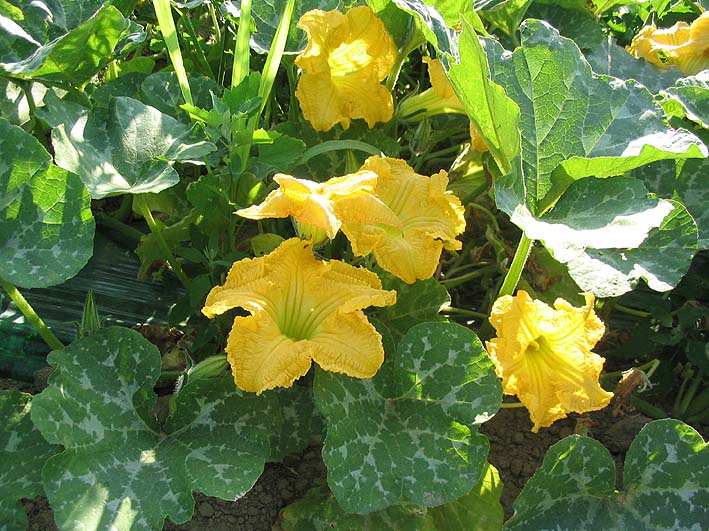 Butternut SquashCucurbita moschata
-
 Fig-leaf GourdCucurbita ficifolia
- Cushaw PumpkinCucurbita argyrosperma
-
 Coyote-melonCucurbita palmata
-
 Finger-leaf GourdCucurbita digitata
-
 Okeechobee GourdCucurbita okeechobeensis
Compare
Questions and answers
What is the scientific name of the Buffalo Gourd?
The scientific name of the Buffalo Gourd is Cucurbita foetidissima. Written with its author, the full name is Cucurbita foetidissima Kunth.
Which family does the Buffalo Gourd belong to?
Cucurbita foetidissima belongs to the family Cucurbitaceae, in the order Cucurbitales and the class Magnoliopsida.
Where is the Buffalo Gourd found?
Checklists and occurrence records place Cucurbita foetidissima in 2 countries: United States and Mexico.
What is the conservation status of the Buffalo Gourd?
The IUCN Red List category recorded for Cucurbita foetidissima is Least Concern (LC).
What other names does the Buffalo Gourd have?
Cucurbita foetidissima is also known in English as Coyote Melon, Prairie Gourd and Wild Pumkin.
What are buffalo gourds used for?
Buffalo gourd has potential as a crop for arid and semiarid lands and can serve as groundcover to protect banks from erosion. Its seeds provide protein and oil, which have food, feed, and industrial applications. Seed oil can be used to produce biodiesel, while taproot carbohydrates are a potential source for biofuel production. The plant has also been used for food, crafts, medicine, laundry soap, and horse tack.[18][19][20][21][22][24][25][26][27][28][29]
Sources
Passages the profile rests on
- The leaves are typically entire and heart-shaped. Source passage: “The leaves of the buffalo gourd are typically entire and heart-shaped” — English Wikipedia
- The leaves have a strong smell and a rough, scabrous surface. Source passage: “the leaves have a very strong smell and are very rough and scabrous.” — lee.ces.ncsu.edu
- The leaves have a base width of 10–13 cm and a length of 20–25 cm. Source passage: “base of 10–13 cm (4–5 in) and length of 20–25 cm (8–10 in).” — English Wikipedia
- The fruit measures 7–10 cm in diameter. Source passage: “The fruit has a diameter of 7–10 cm (3–4 in).” — English Wikipedia
- Individual fruits weigh approximately 120–150 g. Source passage: “The fruit weighs 120 g to 150 g” — English Wikipedia
- The central taproot can weigh as much as 72 kg. Source passage: “The central tap root can weigh up to 72 kg (159 lb).” — English Wikipedia
- A cultivated four-year-old root can reach 2.5 m in length. Source passage: “A four-year-old root grown under cultivation can reach a fresh weight of 45 kg (99 lb) and a length of 2.5 m (8.2 ft).” — English Wikipedia
- The species grows in semiarid and arid environments. Source passage: “Cucurbita foetidissima requires little water and grows best in semiarid and arid environments.” — English Wikipedia
- The species is adapted to sandy loam soils with good drainage. Source passage: “This perennial is well adapted to marginal agricultural lands such as sandy loam soils which have to be well-drained.” — English Wikipedia
- The species is native to North America. Source passage: “Cucurbita foetidissima is native to North America.” — English Wikipedia
- Its United States distribution includes Arizona, Arkansas, southern California, Colorado, Kansas, Missouri, southern Nebraska, southern Nevada, New Mexico, Oklahoma, Texas, and southern Utah. Source passage: “Arizona, Arkansas, southern California, Colorado, Kansas, Missouri, southern Nebraska, southern Nevada, New Mexico, Oklahoma, Texas, and southern Utah.” — English Wikipedia
- Its Mexican distribution includes Aguascalientes, Chihuahua, Coahuila, Guanajuato, Guerrero, Hidalgo, northern Jalisco, Nuevo León, Querétaro, San Luis Potosí, Sonora, Tamaulipas, and Zacatecas. Source passage: “In Mexico, it can be found in Aguascalientes, Chihuahua, Coahuila, Guanajuato, Guerrero, Hidalgo; northern Jalisco, Mexico; Nuevo León, Querétaro, San Luis Potosí, Sonora, Tamaulipas, and Zacatecas.” — English Wikipedia
- The fresh young fruits can be eaten as squash. Source passage: “The fresh young gourd can be eaten like squash.” — English Wikipedia
- Mature fruits are inedible because they contain bitter compounds. Source passage: “The mature fruit is no longer edible, due to bitter compounds.” — English Wikipedia
- The seeds can be consumed after roasting or boiling. Source passage: “Seeds may be eaten after being prepared by roasting or boiling.” — English Wikipedia
- Fresh leaves and whole plants can be used as animal food. Source passage: “Fresh leaves or the whole plants can be used as animal food.” — English Wikipedia
- The fruit is consumed by humans and animals. Source passage: “The fruit is consumed by both humans and animals.” — English Wikipedia
- The species has potential as a crop for arid and semiarid lands. Source passage: “The buffalo gourd has the potential of being a crop adapted to arid to semiarid lands.” — English Wikipedia
- The plant can serve as groundcover to protect banks from erosion. Source passage: “It is also used as a durable groundcover for hiding and protecting banks from erosion.” — English Wikipedia
- The seeds contain approximately 31% crude protein suitable for human consumption and animal feed. Source passage: “Whole buffalo gourd seeds contain approximately 31% crude protein, which is usable for human consumption and for feed.” — English Wikipedia
- The oil content of whole seeds ranges from 24.3% to 50%. Source passage: “The extractable oil content in whole seeds reaches from 24.3% to 50%.” — English Wikipedia
- The seed oil contains 38% to 65% linoleic acid. Source passage: “Linoleic acid, an essential polyunsaturated fatty acid, comprises 38% to 65% of the oil.” — English Wikipedia
- The dried taproot contains approximately 47.5% to 56% starch. Source passage: “The starch content in the dried root is between 47.5% and 56%.” — English Wikipedia
- The seed oil can be used to produce biodiesel. Source passage: “Biodiesel can be produced from the oil in the seeds.” — English Wikipedia
- The carbohydrates stored in the taproot are considered a potential source for biofuel production. Source passage: “But the main interest to produce renewable fuels is to produce biofuel with the carbohydrates which are located in the tap root.” — English Wikipedia
- The plant's protein can be used in water paints, paper coatings, adhesives, and textile sizing. Source passage: “the protein can be used for industrial purposes (water paints, paper coating, adhesives and textile sizing).” — English Wikipedia
- The Zuni people use powdered seeds, flowers, and saliva to prepare medicinal poultices for swellings. Source passage: “The Zuni people use a medicinal poultice of powdered seeds, flowers and saliva for swellings.” — English Wikipedia
- The Cahuilla people have used the fruit and other plant parts as laundry soap because of their saponin content. Source passage: “In the Cahuilla Native American culture, the fruit and other parts of the plant have been used for their saponin content as laundry soap” — English Wikipedia
- Southwestern Native American tribes used the plant for food, crafts, medicine, and horse tack. Source passage: “The Native American tribes in the Southwest had many uses for this plant, including food, crafts, medicine, and even tack for their horses!” — lee.ces.ncsu.edu
- The species spreads through tubers that store energy and help protect it during winter. Source passage: “This species spreads through these tubers, which store a lot of energy and help protect the plant in the winter.” — lee.ces.ncsu.edu
- The species develops a fleshy taproot that serves as a storage and overwintering structure. Source passage: “The plant forms a fleshy tap root that is used as a storage and overwintering structure.” — English Wikipedia
- The species requires warm weather during a vegetation period lasting five to eight months. Source passage: “Warm weather is required during the five- to eight-month vegetation period.” — English Wikipedia
- The flowers grow singly at the vine nodes after a period of annual vegetative growth. Source passage: “The flowers are borne singly at the nodes of the vines after a certain amount of annual vegetative growth has taken place.” — English Wikipedia
- The species can reproduce asexually from nodal roots. Source passage: “Asexual propagation is possible from nodal roots.” — English Wikipedia
- The seeds can remain viable inside an undamaged gourd for months or years. Source passage: “The seeds often remain viable for months or even years within an undamaged gourd.” — English Wikipedia
- The species can germinate at temperatures between 15 °C and 37 °C, with an optimum temperature of 25 °C. Source passage: “Germination temperature range is between 15 °C and 37 °C with an optimum at 25 °C.” — English Wikipedia
- Successful germination is possible at depths of up to 12 cm. Source passage: “The maximum depth for a successful germination is 12 cm.” — English Wikipedia
- The species is highly resistant to cucumber beetles and squash bugs. Source passage: “the plant is highly resistant to cucumber beetle and squash bug.” — English Wikipedia
Data
- Catalogue of Life, 2026-10-16 XR cc by
- Global Biodiversity Information Facility CC BY 4.0
- Wikidata CC0
- GeoNames CC BY 4.0
- Wikimedia Commons per image; credit shown with each image
- Within the Catalogue of Life, this name comes from Synonymic Checklists of the Vascular Plants of the World cc by
References
- Kunth. (1817). Nov. Gen. Sp. [H.B.K.] 2: 123 (1817). where the name was published
This species in other databases
Page built on 28 November 2026. See how the catalog is made and all sources and licences.
Cite this page
ScientificNames.org. (2026). Cucurbita foetidissima (Buffalo Gourd). Retrieved November 28, 2026, from https://scientificnames.org/species/cucurbita-foetidissima
“Cucurbita foetidissima (Buffalo Gourd).” ScientificNames.org, 2026, scientificnames.org/species/cucurbita-foetidissima. Accessed 28 Nov. 2026.
ScientificNames.org. “Cucurbita foetidissima (Buffalo Gourd).” Accessed November 28, 2026. https://scientificnames.org/species/cucurbita-foetidissima.
@misc{scientificnames_cucurbita_foetidissima_buffalo_gourd,
  author = {{ScientificNames.org}},
  title = {Cucurbita foetidissima (Buffalo Gourd)},
  year = {2026},
  url = {https://scientificnames.org/species/cucurbita-foetidissima},
  note = {Accessed 2026-11-28}
}