Species · Flowering plants
Zucchini Cucurbita pepo
The scientific name of the Zucchini is Cucurbita pepo. It is a species of flowering plant in the family Cucurbitaceae (gourd family), order Cucurbitales.
- Scientific name
- Cucurbita pepo L.
- Common name
- Zucchini
- Genus
- Cucurbita
- Family
- Cucurbitaceae (Gourd Family)
- Order
- Cucurbitales
- Class
- Magnoliopsida
- Red List category
- LC Least Concern
- Recorded in
- 139 countries
- Name status
- accepted in the Catalogue of Life

Overview
Zucchini is a flowering plant in the family Cucurbitaceae, order Cucurbitales and class Magnoliopsida. The species has been cultivated in the Americas for thousands of years and occurs in environments ranging from arid to moist, at elevations from sea level to slightly above 2,000 m.
Written 26 November 2026 from the sources listed below. Each statement was checked against the passage it cites; statements that could not be supported were removed.
Appearance
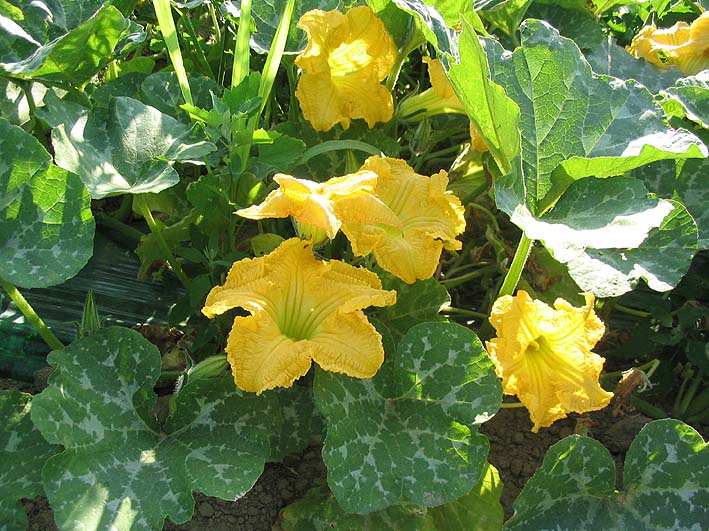
The leaves have three to five lobes and measure 20–35 cm across. The fruits vary considerably in shape and colour among varieties.[1][2]
Domesticated forms have larger fruits and larger but fewer seeds than their wild counterparts.[3]
Habitat
The species occurs at elevations ranging from sea level to slightly above 2,000 m. Some varieties grow in arid environments, while others occur in moist environments.[4][5]
The species has been cultivated in the Americas for thousands of years and was subsequently introduced to Europe and other parts of the Old World.[6]
Before European arrival, the species had spread across suitable growing areas throughout North America. Its ancient distribution extended from Texas through the Greater Mississippi River Valley to Illinois and eastward to Florida, possibly reaching Maine.[7][8]
Uses
The species produces cultivated varieties used as winter squash, pumpkins and summer squash. Its fruits are widely used as a food source.[9][10]
Fresh squash can be sliced into spiral strips, dried and stored for winter consumption. Fresh fruits can also be roasted whole or in pieces in ashes.[11][12]
The blossoms are fried in grease and served as a delicacy alongside other foods.[13]
The Zuni people traditionally used the gourds as cups, ladles, dippers and storage containers. They also incorporated them into ceremonial rattles and dances symbolizing fructification.[14][15]
Seeds and blossoms were used to prepare poultices for treating cactus scratches.[16]
Similar species
Cucurbita fraterna is considered one of the closest relatives of Cucurbita pepo.[17]
Behaviour
The species serves as a host for melonworm moths, squash vine borers and pickleworms.[18]
Reproduction and life cycle
The species includes domesticated forms originating from two distinct domestication events in Mexico and the eastern United States. Certain cultivars can produce fruit through parthenocarpy.[19][20]
Squash bees are the primary pollinators of the species in the Americas. Its subspecies, varieties and cultivars are capable of interbreeding.[21][22]
Classification of the Zucchini
| Kingdom | Plantae |
|---|---|
| Subkingdom | Pteridobiotina |
| Phylum | Tracheophyta |
| Class | Magnoliopsida |
| Order | Cucurbitales |
| Family | Cucurbitaceae (Gourd Family) |
| Tribe | Cucurbiteae |
| Genus | Cucurbita (Gourd) |
| Species | Cucurbita pepo L. |
Where the Zucchini is found
Checklists and occurrence records place Cucurbita pepo in 139 countries across Africa, Asia, Europe, North America, Oceania and South America. GBIF holds 20,009 georeferenced records of it.
Countries where it is native or its origin is not stated
- Afghanistan 563
- Albania 40
- Algeria 9
- American Samoa 5
- Argentina 80
- Armenia 123
- Australia 196
- Austria 335
- Azerbaijan 31
- Bahamas
- Bangladesh
- Belarus 14
- Belgium 306
- Benin 65
- Bhutan 10
- Bolivia 70
- Brazil 223
- Bulgaria 448
- Burkina Faso 2
- Burundi 12
- Cabo Verde
- Cambodia
- Cameroon 12
- Canada 222
- Central African Republic
- Chad
- Chile 15
- China 170
- Colombia 206
- Cook Islands 19
- Costa Rica 45
- Croatia 26
- Cuba 10
- Czechia 92
- Democratic Republic of the Congo 11
- Denmark 121
- Dominican Republic 2
- Ecuador 52
- Egypt 80
- El Salvador 5
- Estonia 38
- Ethiopia 31
- Fiji 2
- Finland 131
- France 577
- French Polynesia 36
- Georgia 154
- Germany 806
- Ghana 6
- Greece 65
- Guadeloupe 5
- Guam
- Guatemala 215
- Haiti 1
- Honduras 6
- Hungary 596
- India 130
- Indonesia 120
- Iran 206
- Iraq 31
- Isle of Man 3
- Israel 19
- Italy 305
- Jamaica 1
- Japan 47
- Kazakhstan 77
- Kenya 8
- Kiribati 5
- Laos 6
- Lebanon 27
- Libya 10
- Lithuania 32
- Luxembourg 6
- Madagascar 3
- Malaysia 10
- Maldives
- Marshall Islands 13
- Martinique 3
- Mauritius
- Mayotte 3
- Mexico 1,351
- Micronesia 9
- Moldova 26
- Mongolia 5
- Myanmar
- Nauru
- Nepal 3
- New Caledonia 6
- New Zealand 51
- Nicaragua 1
- Nigeria 12
- Niue 1
- North Korea 7
- North Macedonia 129
- Northern Mariana Islands 3
- Norway 101
- Pakistan 48
- Palau 4
- Panama 8
- Paraguay 6
- Peru 14
- Philippines
- Poland 389
- Portugal 168
- Reunion 11
- Romania 621
- Russia 769
- Seychelles 3
- Singapore 3
- Slovakia 41
- Slovenia 5
- Somalia
- South Africa 40
- South Korea 18
- Spain 1,241
- Sri Lanka 7
- Sweden 2,036
- Switzerland 108
- Syria 115
- Tajikistan 21
- Tanzania 15
- Thailand 13
- The Netherlands 314
- Togo 2
- Trinidad and Tobago
- Tunisia 13
- Turkey 781
- Turkmenistan 54
- Tuvalu
- Ukraine 415
- United States 2,763
- Uruguay 17
- Uzbekistan 94
- Venezuela 1
- Vietnam 53
- Yemen 3
- Zambia 8
- Zimbabwe 28
Countries where it has been introduced
Regions and cities with the most records
- England, United Kingdom 579
- Kalmar, Sweden 385
- Skåne, Sweden 324
- Bavaria, Germany 319
- Valencia, Spain 287
- Kalmar, Sweden 227
- Stockholm, Sweden 220
- Pennsylvania, United States 211
- Texas, United States 199
- Canary Islands, Spain 186
- Halland, Sweden 181
- Västra Götaland, Sweden 163
- Oaxaca, Mexico 161
- Catalonia, Spain 158
- Östergötland, Sweden 150
- Bogota D.C., Colombia 146
- Bogotá, Colombia 145
- Funza, Colombia 145
- Mosquera, Colombia 145
- Solna, Sweden 137
- Sundbyberg, Sweden 136
- Upplands Väsby, Sweden 134
- Danderyd, Sweden 132
- Jakobsberg, Sweden 132
- Malmö, Sweden 132
- Staffanstorp, Sweden 130
- New York, United States 128
- Rinkeby, Sweden 128
- Björlanda, Sweden 127
- Täby, Sweden 127
- Partille, Sweden 126
- Cota, Colombia 125
- Sollentuna, Sweden 124
- Uppsala, Sweden 121
- Vallentuna, Sweden 120
- Gothenburg, Sweden 119
Range as the checklists state it
England [I] (England [I], Wales [I], Isles of Scilly [I]); Germany [c]; Slovakia [c]; Hungary [c]; Slovenia [c]; Croatia [c]; Bosnia & Hercegovina [c]; North Macedonia [c]; S-Europe [c]; Canary Isl. [c] (Tenerife [c]); Cape Verde Isl. [c] (Ilha de Sao Nicolau [c]); Burkina Faso [c]; Togo [c]; Benin [c]; Chad [c]; Cameroon [c]; Central African Republic [c]; Somalia [c]; St. Helena [c]; Mauritius [c]; La Réunion [c]; Rodrigues [c]; Agalega Isl. [c]; Siberia [c]; Russian Far East [c]; Kazakhstan [c]; Turkmenistan [c]; Uzbekistan [c]; Tajikistan [c]; Turkey [c]; China [c]; South Korea [c]; Japan [c]; Pakistan [c]; Nepal [c]; India [c] (widespread); Bangladesh [c]; Maldives [c]; Andaman Isl. [c]; Nicobar Isl. [c]; Myanmar [c]; Thailand [c]; Cambodia [c]; Vietnam [c]; Philippines [c]; Australia [c] (Queensland [c]); New Zealand [c]; New Caledonia [c]; Rotuma Isl. [c]; Niue [c]; Fiji [c]; Tuvalu [c] (Nui Atoll [c]); Gilbert Isl. [c] (Tarawa [c]); Nauru [c]; N-Line Isl. [c] (Teraina [c], Tabueran [c], Kiritimati [c]); S-Line Isl. [c] (Caroline Atoll [c]); Cook Isl. [c] (Rarotonga [c], Aitutaki [c], Atiu [c], Manihiki [c], Rakahanga [c]); Society Isl. [c] (Huahine [c], Maupiti [c], Tahiti [c]); Austral Isl. [c]; Palau [c]; Guam [c]; Fed. States of Micronesia [c] (Yap [c], Murilo [c], Woleai [c], Truk [c], Pohnpei [c], Piis [c], Namonuito [c], Nomwin [c]); Marshall Isl. [c] (Kwajalein [c], Majuro [c], Arno [c], Kili [c], Jaluit [c]); Wake Isl. [c]; Canada [c] (Ontario [c], Québec [c]); USA [c] (Alabama [c], California [c], Connecticut [c], Kansas [c], Kentucky [c], Louisiana [c], Massachusetts [c], Michigan [c], North Carolina [c], New Hampshire [c], New Mexico [c], Nevada [c], New York [c], Ohio [c], Pennsylvania [c], South Carolina [c], Tennessee [c], Utah [c], Virginia [c]); Mexico (Aguascalientes, Campeche, Chiapas, Michoacán, Coahuila, Colima, Guerrero, Hidalgo, Jalisco, México State, Michoacán, Morelos, Nayarit, Nuevo León, Oaxaca, Puebla, Quintana Roo, San Luis Potosí, Sinaloa, Tabasco, Tamaulipas, Tlaxcala, Veracruz, Yucatán, Zacatecas); Guatemala; Honduras; Nicaragua; Costa Rica [c]; Panama; Bahamas [c]; Cuba [c]; Cayman Isl. [c]; Jamaica [c]; Dominican Republic [c]; Haiti [c]; Trinidad & Tobago [c]; Colombia [c]; Isla Margarita [c]; Venezuela [c]; Bolivia [c]; Argentina [c]
A number beside a place is its count of GBIF occurrence records. A place without a number comes from a checklist alone. Records show where a species has been observed or collected, which can include escapes and vagrants.
Common names
English
- Zucchini
- Acorn Squash
- American Pumpkin and Summer Squashes
- American Pumpkin
- Bitter Bottle Gourd
- Brazilian Pumpkin
- Bush Squash
- Courgette
- Kamokamo
- Kumikumi
- Marrow
- Ribbed Pumpkin
- Scallopini
- Ornamental Gourd
- Pumpkin
- Vegetable Marrow
Names in 31 other languages
- Arabic
- قرع الكوسة
- Chinese
- xi hu lu, 美國南瓜
- Czech
- tykev obecná
- Dutch
- Sierpompoen, pompoen
- Estonian
- harilik kõrvits
- Finnish
- kurpitsa, satokurpitsa
- French
- Citrouille iroquoise, Giraumon, citrouille, courge pepon, courge pépon
- German
- Feld-Kürbis, Gemüse-Kürbis, Patisson
- Hebrew
- דלעת הקישוא, קישוא
- Hungarian
- közönséges tök
- Italian
- Zucca, Zucca e Zucchina, Zucchina, zucchino
- Japanese
- ウリカボチャ
- Korean
- 율호박
- Lithuanian
- Paprastasis agurotis
- Norwegian Bokmål
- graskar, gresskar
- Polish
- Dynia zwyczajna, cukinia, dynia makaronowa, kabaczek, patison
- Portuguese
- Abobrinha, Abobrinha-ornamental, Abóbora, Abóbora-de-coco, Abóbora-estrela, Abóbora-ovo, Abóbora-teta-de-égua, Jerimum
- Russian
- Тыква обыкновенная
- Slovak
- tekvica obyčajná
- Spanish
- Ahuyamín, Calabaza, Calabaza de Castilla, Zapallo angola, calabacín
- Swedish
- prydnadspumpa, pumpa, squash
- Thai
- ฟักทองอเมริกัน
- Turkish
- Kabak, Sakız Kabağı
- Ukrainian
- Гарбуз звичайний, Диня, Кабак, Кабаки, Кабачки, Кабачок, Патисон, Патісони
- Welsh
- Maro, Maros, Pwmpen
- hch
- xusi-te
- hus
- calam
- oji
- Missa'bîgon
- sei
- cayixam
- tsz
- cus
- yua
- ka
Synonyms
61 other scientific names have been used for this species and are now treated as synonyms of Cucurbita pepo.
- Citrullus variegatus Schrad. ex M.Roem.
- Cucumis pepo (L.) Dumort.
- Cucumis zapallo Steud.
- Cucurbita aurantia Willd.
- Cucurbita ceratoceras Haberle ex Mart.
- Cucurbita citrullus var. alba M.Roem.
- Cucurbita citrullus var. flava M.Roem.
- Cucurbita citrullus var. grisea M.Roem.
- Cucurbita citrullus var. variegata M.Roem.
- Cucurbita citrullus var. viridis M.Roem.
- Cucurbita clodiensis Naccari
- Cucurbita clodiensis Nocca
- Cucurbita courgero Ser.
- Cucurbita elongata Bean ex Schrad.
- Cucurbita esculenta Gray
- Cucurbita fastuosa Salisb.
- Cucurbita hybrida Bertol. ex Naudin
- Cucurbita lignosa Mill.
- Cucurbita mammeata Molina
- Cucurbita mammosa J.F.Gmel.
- Cucurbita marsupiiformis Haberle ex M.Roem.
- Cucurbita oblonga Link
- Cucurbita pepo subsp. gumala Teppner
- Cucurbita pepo subsp. pepo
- Cucurbita pepo subvar. nigra Harz
- Cucurbita pepo var. akoda Makino
- Cucurbita pepo var. americana Zhit.
- Cucurbita pepo var. bicolor Harz
- Cucurbita pepo var. citrulina Filov, nom. nud.
- Cucurbita pepo var. condensa L.H.Bailey
- Cucurbita pepo var. elongata Harz
- Cucurbita pepo var. fibropulposa Makino
- Cucurbita pepo var. flogra Teppner
- Cucurbita pepo var. georgica Teppner
- Cucurbita pepo var. giraumontia Filov, nom. nud.
- Cucurbita pepo var. kintogwa Makino
- Cucurbita pepo var. medullosa Harz
- Cucurbita pepo var. medullosa Alefeld
- Cucurbita pepo var. praecox Harz
- Cucurbita pepo var. styriaca Greb.
Showing 40 of 61.
Subspecies and varieties
- Cucurbita pepo var. giromontiina variety
Related species
-
 PumpkinCucurbita maxima
-
 Butternut SquashCucurbita moschata
-
 Fig-leaf GourdCucurbita ficifolia
- Cushaw PumpkinCucurbita argyrosperma
-
 Buffalo GourdCucurbita foetidissima
-
 Coyote-melonCucurbita palmata
-
 Finger-leaf GourdCucurbita digitata
-
 Okeechobee GourdCucurbita okeechobeensis
Compare
Questions and answers
What is the scientific name of the Zucchini?
The scientific name of the Zucchini is Cucurbita pepo. Written with its author, the full name is Cucurbita pepo L..
Which family does the Zucchini belong to?
Cucurbita pepo belongs to the family Cucurbitaceae, in the order Cucurbitales and the class Magnoliopsida.
Where is the Zucchini found?
Checklists and occurrence records place Cucurbita pepo in 139 countries, including United States, Sweden, Mexico, Spain, Germany and Turkey.
What is the conservation status of the Zucchini?
The IUCN Red List category recorded for Cucurbita pepo is Least Concern (LC).
What other names does the Zucchini have?
Cucurbita pepo is also known in English as Acorn Squash, American Pumpkin and Summer Squashes, American Pumpkin, Bitter Bottle Gourd, Brazilian Pumpkin and Bush Squash.
Sources
Passages the profile rests on
- Its leaves have three to five lobes and measure 20–35 cm across. Source passage: “The leaves have three to five lobes and are 20–35 centimetres (8–14 in) wide.” — English Wikipedia
- Its fruits include varieties with substantially different shapes and colours. Source passage: “These eight edible cultivated varieties of C. pepo vary widely in shape and color” — English Wikipedia
- Domesticated forms have larger fruits and larger but fewer seeds than their wild counterparts. Source passage: “The domesticated species have larger fruits and larger yet fewer seeds.” — English Wikipedia
- The species occurs at elevations ranging from sea level to slightly above 2,000 m. Source passage: “The species is found from sea level to slightly above 2,000 m (6,600 ft).” — English Wikipedia
- Some varieties of this species grow in arid environments, while others occur in moist environments. Source passage: “Some varieties grow in arid regions and some in moist regions.” — English Wikipedia
- The species has been cultivated in the Americas for thousands of years and was subsequently introduced to Europe and other parts of the Old World. Source passage: “It has been domesticated in the Americas for thousands of years, from where it was spread by early colonisers to Europe and later across the rest of the Old World” — English Wikipedia
- Before European arrival, the species had spread across suitable growing areas throughout North America. Source passage: “Before the arrival of Europeans, C. pepo, along with C. moschata, had been carried over all parts of North America where they could be grown.” — English Wikipedia
- Its ancient distribution extended from Texas through the Greater Mississippi River Valley to Illinois and eastward to Florida, possibly reaching Maine. Source passage: “The ancient territory of C. pepo extended north into Texas and up the Greater Mississippi River Valley into Illinois and east to Florida, and possibly even to Maine.” — English Wikipedia
- The species produces cultivated varieties used as winter squash, pumpkins and summer squash. Source passage: “It yields varieties of winter squash and pumpkin, but the most widespread varieties belong to the subspecies Cucurbita pepo subsp. pepo, called summer squash.” — English Wikipedia
- The fruits of this species are widely used as a food source. Source passage: “They have a wide variety of uses, especially as a food source.” — English Wikipedia
- Fresh squash from this species can be sliced into spiral strips, dried and stored for winter consumption. Source passage: “Fresh squash is cut into spiral strips, folded into hanks and hung up to dry for winter use.” — English Wikipedia
- The fresh fruits can be roasted whole or in pieces in ashes for consumption. Source passage: “Fresh squash, either whole or in pieces, is roasted in ashes and used for food.” — English Wikipedia
- The blossoms are fried in grease and served as a delicacy alongside other foods. Source passage: “The blossoms are fried in grease and used as a delicacy in combination with other foods.” — English Wikipedia
- The Zuni people traditionally used the gourds as cups, ladles, dippers and storage containers. Source passage: “In the Zuni culture, the gourds are made into cups, ladles, dippers, and storage receptacles.” — English Wikipedia
- The Zuni incorporated the gourds into ceremonial rattles and dances symbolizing fructification. Source passage: “The Zuni also wore the gourds in phallic dances, symbolizing fructification, or made them into ceremonial rattles.” — English Wikipedia
- Seeds and blossoms were used to prepare poultices for treating cactus scratches. Source passage: “A poultice of seeds and blossoms was used to treat cactus scratches.” — English Wikipedia
- Cucurbita fraterna is considered one of the closest relatives of Cucurbita pepo. Source passage: “C. pepo seems more closely related to C. fraterna” — English Wikipedia
- This species serves as a host for melonworm moths, squash vine borers and pickleworms. Source passage: “It is a host species for the melonworm moth, the squash vine borer, and the pickleworm.” — English Wikipedia
- Certain cultivars of this species can produce fruit through parthenocarpy. Source passage: “Parthenocarpy is known to occur in certain cultivars of C. pepo.” — English Wikipedia
- The species includes domesticated forms originating from two distinct domestication events in Mexico and the eastern United States. Source passage: “Recent biosystematic investigations indicate two distinct domestication events in two different areas: one in Mexico and one in the eastern United States” — English Wikipedia
- Squash bees are the primary pollinators of this species in the Americas. Source passage: “They are also the preferred pollen source for squash bees, which are the primary pollinators in the Americas.” — English Wikipedia
- The subspecies, varieties and cultivars within this species are capable of interbreeding. Source passage: “All the subspecies, varieties, and cultivars are conspecific and interfertile.” — English Wikipedia
Data
- Catalogue of Life, 2026-10-16 XR cc by
- Global Biodiversity Information Facility CC BY 4.0
- Wikidata CC0
- GeoNames CC BY 4.0
- Wikimedia Commons per image; credit shown with each image
- Within the Catalogue of Life, this name comes from Synonymic Checklists of the Vascular Plants of the World cc by
References
- L. (1753). Sp. Pl. [Linnaeus] 2: 1010 (1753). where the name was published
This species in other databases
- Catalogue of Life 329ZP
- Wikidata Q7229863
- iNaturalist 76541
- World Flora Online wfo-0000629123
- GRIN 12606
Page built on 27 November 2026. See how the catalog is made and all sources and licences.
Cite this page
ScientificNames.org. (2026). Cucurbita pepo (Zucchini). Retrieved November 27, 2026, from https://scientificnames.org/species/cucurbita-pepo
“Cucurbita pepo (Zucchini).” ScientificNames.org, 2026, scientificnames.org/species/cucurbita-pepo. Accessed 27 Nov. 2026.
ScientificNames.org. “Cucurbita pepo (Zucchini).” Accessed November 27, 2026. https://scientificnames.org/species/cucurbita-pepo.
@misc{scientificnames_cucurbita_pepo_zucchini,
  author = {{ScientificNames.org}},
  title = {Cucurbita pepo (Zucchini)},
  year = {2026},
  url = {https://scientificnames.org/species/cucurbita-pepo},
  note = {Accessed 2026-11-27}
}