Species · Flowering plants
Coyote-melon Cucurbita palmata
The scientific name of the Coyote-melon is Cucurbita palmata. It is a species of flowering plant in the family Cucurbitaceae (gourd family), order Cucurbitales.
- Scientific name
- Cucurbita palmata S.Watson
- Common name
- Coyote-melon
- Genus
- Cucurbita
- Family
- Cucurbitaceae (Gourd Family)
- Order
- Cucurbitales
- Class
- Magnoliopsida
- Red List category
- DD Data Deficient
- Recorded in
- 2 countries
- Name status
- accepted in the Catalogue of Life

Overview
Cucurbita palmata is native to northeastern Baja California, southeastern California, and southwestern Arizona, extending to an area near the Colorado River. It is distinguished by its sharply divided leaves, yellow flowers, and smooth, spherical or oblate fruits.
Written 26 November 2026 from the sources listed below. Each statement was checked against the passage it cites; statements that could not be supported were removed.
Appearance
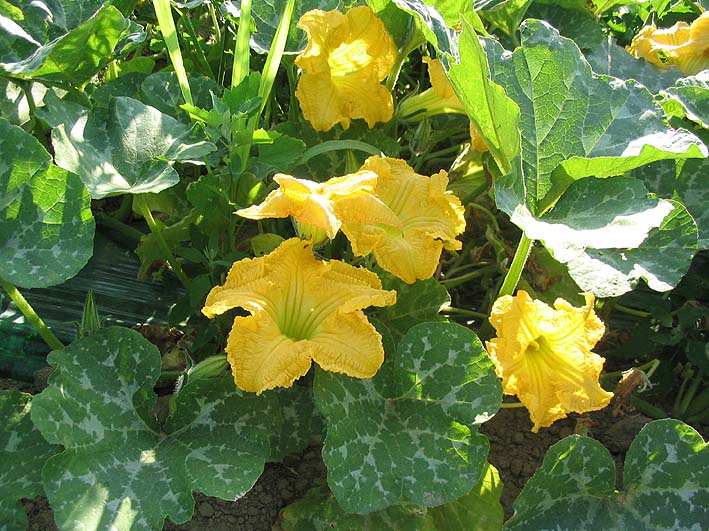
Coyote-melon grows as a sprawling vine with rough stems covered in stiff hairs. Its dark green leaves have light-colored veins and are sharply palmately divided, usually into five long triangular points.[1][2]
Its yellow flowers are stiff and curling, measuring 6–8 centimeters across.[3][4]
Its smooth fruits are spherical or oblate and measure 8–10 centimeters across. They range in color from bright yellow to dark green and may have white stripes.[5][6][7]
The fruit rind is hard and becomes thinner as it ages.[8]
Habitat
Coyote-melon occurs in hot, arid regions with low rainfall. It prefers loose, gravelly, well-drained soil.[9][10]
Diet
The fruits have a very bitter flavor and are inedible.[11]
Uses
Native Americans used the fruits to make soap and ground the seeds for use as food. Dried gourds were used as rattles in traditional dance ceremonies.[12][13][14]
Classification of the Coyote-melon
| Kingdom | Plantae |
|---|---|
| Subkingdom | Pteridobiotina |
| Phylum | Tracheophyta |
| Class | Magnoliopsida |
| Order | Cucurbitales |
| Family | Cucurbitaceae (Gourd Family) |
| Tribe | Cucurbiteae |
| Genus | Cucurbita (Gourd) |
| Species | Cucurbita palmata S.Watson |
Where the Coyote-melon is found
Checklists and occurrence records place Cucurbita palmata in 2 countries across North America. GBIF holds 3,720 georeferenced records of it.
Countries
Regions and cities with the most records
- California, United States 2,637
- Nevada, United States 293
- Cathedral City, United States 205
- Rancho Mirage, United States 199
- Palm Desert, United States 197
- Yucca Valley, United States 169
- Twentynine Palms, United States 163
- Baja California, Mexico 151
- Palm Springs, United States 146
- La Quinta, United States 135
- Arizona, United States 123
- Indio, United States 118
- Desert Hot Springs, United States 117
- Henderson, United States 115
- Rancho San Diego, United States 114
- Boulder City, United States 113
- Casa de Oro-Mount Helix, United States 112
- El Cajon, United States 112
- La Presa, United States 112
- Spring Valley, United States 112
- Bostonia, United States 110
- North Las Vegas, United States 108
- Las Vegas, United States 107
- Paradise, United States 106
- Sunrise Manor, United States 106
- Whitney, United States 105
- Winchester, United States 105
- Coachella, United States 59
- Winter Gardens, United States 55
- Mead Valley, United States 47
- Perris, United States 42
- Lemon Grove, United States 39
- La Mesa, United States 38
- Menifee, United States 36
- Tecate, Mexico 36
- Poway, United States 32
1 more country has a few records outside this range
These countries hold a few records of Cucurbita palmata but lie outside the range the checklists give for it. Such records are often zoo or garden specimens, museum material or vagrants, so the species is not counted as occurring there.
Range as the checklists state it
USA (Arizona, California, Nevada, Utah); Mexico (Baja California, Durango, Sonora)
A number beside a place is its count of GBIF occurrence records. A place without a number comes from a checklist alone. Records show where a species has been observed or collected, which can include escapes and vagrants.
Common names
English
- Coyote-melon
- Coyote Melon
- Finger-leaved Gourd
Names in 6 other languages
- Arabic
- قرع أصبعي الأوراق
- Chinese
- 狼瓜
- Russian
- Тыква дланевидная
- Spanish
- calabacilla, chichicayote, meloncillo
- Thai
- ฟักทองใบรูปฝ่ามือ
- chl
- nexiš
Synonyms
One other scientific name has been used for this species and is now treated as a synonym of Cucurbita palmata.
- Cucurbita californica Torr. ex S.Watson
Related species
-
 ZucchiniCucurbita pepo
-
 PumpkinCucurbita maxima
-
 Butternut SquashCucurbita moschata
-
 Fig-leaf GourdCucurbita ficifolia
- Cushaw PumpkinCucurbita argyrosperma
-
 Buffalo GourdCucurbita foetidissima
-
 Finger-leaf GourdCucurbita digitata
-
 Okeechobee GourdCucurbita okeechobeensis
Compare
Questions and answers
What is the scientific name of the Coyote-melon?
The scientific name of the Coyote-melon is Cucurbita palmata. Written with its author, the full name is Cucurbita palmata S.Watson.
Which family does the Coyote-melon belong to?
Cucurbita palmata belongs to the family Cucurbitaceae, in the order Cucurbitales and the class Magnoliopsida.
Where is the Coyote-melon found?
Checklists and occurrence records place Cucurbita palmata in 2 countries: United States and Mexico.
What is the conservation status of the Coyote-melon?
The IUCN Red List category recorded for Cucurbita palmata is Data Deficient (DD).
What other names does the Coyote-melon have?
Cucurbita palmata is also known in English as Coyote Melon and Finger-leaved Gourd.
What are coyote melons good for?
Native Americans used the fruits to make soap and ground the seeds for use as food. Dried gourds were used as rattles in traditional dance ceremonies.[12][13][14]
Is coyote melon safe to eat?
The fruits have a very bitter flavor and are inedible.[11]
Are coyote melons edible?
The fruits have a very bitter flavor and are inedible.[11]
Where do gourds grow naturally?
Coyote-melon is native to northeastern Baja California, southeastern California, and southwestern Arizona, extending to an area near the Colorado River.[15]
Sources
Passages the profile rests on
- Cucurbita palmata grows as a sprawling vine with rough stems covered in stiff hairs. Source passage: “Cucurbita palmata is a sprawling vine with rough, stiff-haired stems and leaves.” — English Wikipedia
- Its leaves are dark green, have light-colored veins, and are sharply palmately divided, usually into five long triangular points. Source passage: “The dark green, light-veined leaves are sharply palmate with usually five long triangular points.” — English Wikipedia
- Its flowers are yellow, stiff, and curling. Source passage: “The stiff, curling yellow flowers are 6 to 8 centimeters wide.” — English Wikipedia
- Its flowers measure 6–8 centimeters across. Source passage: “The stiff, curling yellow flowers are 6 to 8 centimeters wide.” — English Wikipedia
- Its fruits are smooth and spherical or oblate. Source passage: “The plant bears smooth spherical or oblate squash fruits 8 to 10 centimeters wide.” — English Wikipedia
- Its fruits measure 8–10 centimeters across. Source passage: “The plant bears smooth spherical or oblate squash fruits 8 to 10 centimeters wide.” — English Wikipedia
- Its fruits range in color from bright yellow to dark green and may have white stripes. Source passage: “The fruits may be bright yellow to dark green and may have white stripes.” — English Wikipedia
- Its fruit rind is hard and becomes thinner as it ages. Source passage: “The rind is hard and thins with age.” — English Wikipedia
- The species occurs in hot, arid regions with low rainfall. Source passage: “Each group member is found in hot, arid regions with low rainfall.” — English Wikipedia
- The species prefers loose, gravelly, well-drained soil. Source passage: “They prefer soil that is loose, gravelly, and well-drained.” — English Wikipedia
- The fruits have a very bitter flavor and are inedible. Source passage: “With a very bitter flavor the fruits are inedible” — English Wikipedia
- Native Americans used the fruits of Cucurbita palmata to make soap. Source passage: “though Native Americans used them for soap” — English Wikipedia
- Native Americans ground the seeds for use as food. Source passage: “also ground the seeds to use as food.” — English Wikipedia
- Dried gourds were used as rattles in traditional dance ceremonies. Source passage: “Dried gourds were also used as rattles for traditional dance ceremonies.” — English Wikipedia
- The species is native to northeastern Baja California, southeastern California, and southwestern Arizona, extending to an area near the Colorado River. Source passage: “C. palmata is native to northeastern Baja California, southeastern California, and southwestern Arizona to a point near the Colorado River.” — English Wikipedia
Data
- Catalogue of Life, 2026-10-16 XR cc by
- Global Biodiversity Information Facility CC BY 4.0
- Wikidata CC0
- GeoNames CC BY 4.0
- Wikimedia Commons per image; credit shown with each image
- Within the Catalogue of Life, this name comes from Synonymic Checklists of the Vascular Plants of the World cc by
References
- Watson, S. (1876). Proc. Amer. Acad. Arts 11: 137 (1876). where the name was published
This species in other databases
- Catalogue of Life 329ZL
- Wikidata Q4466998
- iNaturalist 58139
- World Flora Online wfo-0000629120
- GRIN 405507
Page built on 26 November 2026. See how the catalog is made and all sources and licences.
Cite this page
ScientificNames.org. (2026). Cucurbita palmata (Coyote-melon). Retrieved November 26, 2026, from https://scientificnames.org/species/cucurbita-palmata
“Cucurbita palmata (Coyote-melon).” ScientificNames.org, 2026, scientificnames.org/species/cucurbita-palmata. Accessed 26 Nov. 2026.
ScientificNames.org. “Cucurbita palmata (Coyote-melon).” Accessed November 26, 2026. https://scientificnames.org/species/cucurbita-palmata.
@misc{scientificnames_cucurbita_palmata_coyote_melon,
  author = {{ScientificNames.org}},
  title = {Cucurbita palmata (Coyote-melon)},
  year = {2026},
  url = {https://scientificnames.org/species/cucurbita-palmata},
  note = {Accessed 2026-11-26}
}