Species · Flowering plants
Drosera derbyensis
Drosera derbyensis has no English name on record in the checklists used here. It is a species of flowering plant in the family Droseraceae (sundew family), order Caryophyllales.
- Scientific name
- Drosera derbyensis Lowrie
- Genus
- Drosera
- Family
- Droseraceae (Sundew Family)
- Order
- Caryophyllales
- Class
- Magnoliopsida
- Red List category
- LC Least Concern
- Recorded in
- 1 country
- Name status
- accepted in the Catalogue of Life

Overview
Drosera derbyensis is a perennial carnivorous plant belonging to the genus Drosera. The species is endemic to Western Australia and occurs between Derby and Beverley Springs in the Kimberley region of Western Australia. It is distinguished from Drosera lanata by the non-dendritic hairs covering its leaves.
Written 26 November 2026 from the sources listed below. Each statement was checked against the passage it cites; statements that could not be supported were removed.
Habitat
Drosera derbyensis grows in sandy soils in floodways or near rock outcrops. It occurs between Derby and Beverley Springs in the Kimberley region of Western Australia.[1][2]
Appearance
The plant has fibrous roots. Its erect or semi-erect leaves are arranged in rosettes, with one or more rosettes emerging from the rootstock.[3][4]
The petioles are narrowly oblanceolate and measure 0.8–1.0 mm wide at their proximal ends and 1.3–1.7 mm wide at their apices. They narrow to 0.5–0.7 mm at the laminar base and are frequently 35–45 mm long when the plant is flowering.[5][6][7]
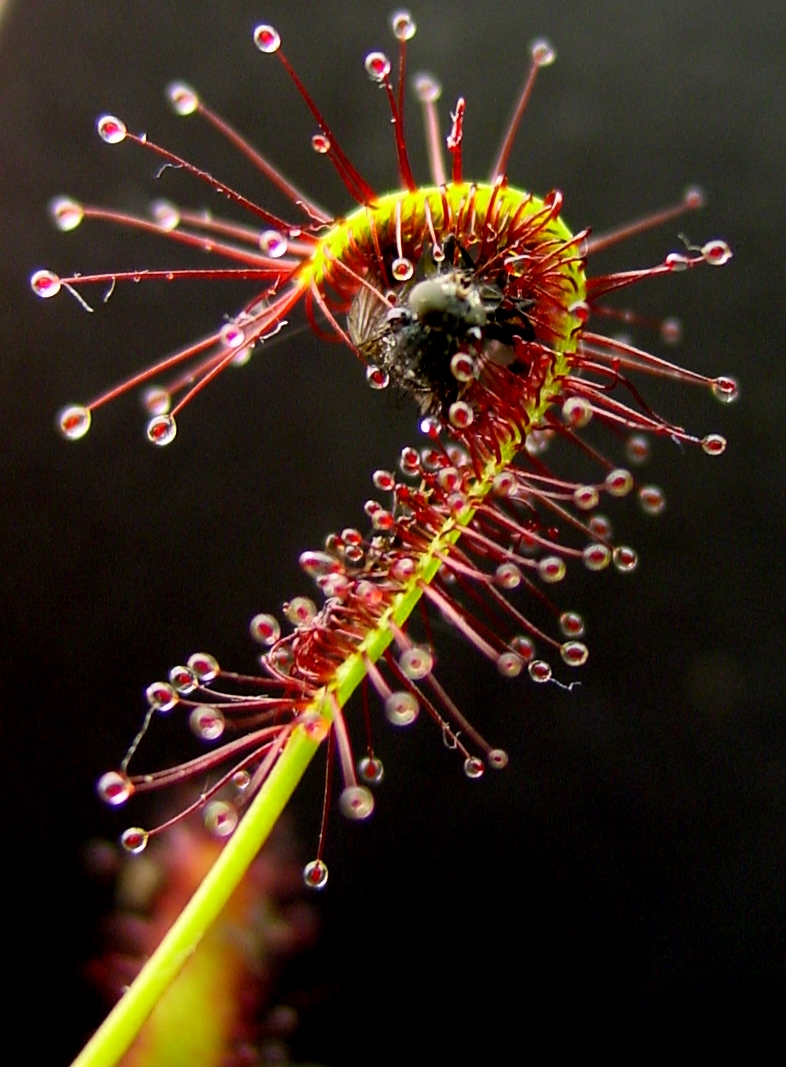
The petioles are covered with white woolly non-dendritic hairs. The insect-trapping leaf lamina is orbicular and measures 2–3 mm in diameter, with insect-trapping glands covering its adaxial surface.[8][9][10][11]
The upper portion of the scape and the abaxial surface of the sepals are covered with white woolly non-dendritic hairs.[12][13]
Reproduction and life cycle
Each rosette produces between one and four raceme inflorescences measuring 25–35 cm in length. Each inflorescence bears 30–50 white flowers.[14][15][16]
Flowering occurs between March and June.[17]
Conservation
Allen Lowrie assessed Drosera derbyensis as locally common and not under threat in 1996.[18]
Uses
Drosera derbyensis is grown in cultivation and has been found to thrive in heated water.[19][20]
Similar species
Drosera derbyensis is closely related to Drosera lanata within the Drosera petiolaris complex. It differs from Drosera lanata by having non-dendritic hairs covering its leaves.[21][22]
The non-dendritic hairs of Drosera derbyensis are assumed to help prevent desiccation during the dry season.[23]
Classification of Drosera derbyensis
| Kingdom | Plantae |
|---|---|
| Subkingdom | Pteridobiotina |
| Phylum | Tracheophyta |
| Class | Magnoliopsida |
| Order | Caryophyllales |
| Family | Droseraceae (Sundew Family) |
| Genus | Drosera (Sundew) |
| Species | Drosera derbyensis Lowrie |
Where Drosera derbyensis is found
Checklists and occurrence records place Drosera derbyensis in 1 country across Oceania. GBIF holds 124 georeferenced records of it.
Countries
Regions and cities with the most records
Range as the checklists state it
Australia (Northern Territory)
A number beside a place is its count of GBIF occurrence records. A place without a number comes from a checklist alone. Records show where a species has been observed or collected, which can include escapes and vagrants.
Common names
Names in 1 other language
- Chinese
- 北领地珊瑚茅膏菜
Related species
-
 Drosera capensis
-
 Common SundewDrosera rotundifolia
-
 Rosy SundewDrosera spathulata
-
 English SundewDrosera × anglica
-
 Long-Leaved SundewDrosera intermedia
-
 Fork-leaved SundewDrosera binata
-
 Scarlet SundewDrosera glanduligera
-
 Northern Threadleaf SundewDrosera filiformis
Compare
Questions and answers
Sources
Passages the profile rests on
- Drosera derbyensis grows in sandy soils in floodways or near rock outcrops. Source passage: “Drosera derbyensis grows in sandy soils in floodways or near rock outcrops” — English Wikipedia
- The species occurs between Derby and Beverley Springs in the Kimberley region of Western Australia. Source passage: “from Derby to Beverley Springs in the Kimberley region.” — English Wikipedia
- The leaves are erect or semi-erect and arranged in rosettes, with one or more rosettes emerging from the rootstock. Source passage: “Its erect or semi-erect leaves are arranged in a rosette with one or more rosettes emerging from the root stock.” — English Wikipedia
- The plant has fibrous roots. Source passage: “Its roots are fibrous.” — English Wikipedia
- The petioles are narrowly oblanceolate and measure 0.8–1.0 mm wide at their proximal ends and 1.3–1.7 mm wide at their apices. Source passage: “The petioles are narrowly oblanceolate, 0.8–1.0 mm wide at the proximate end and 1.3–1.7 mm wide at the apex” — English Wikipedia
- The petioles narrow to 0.5–0.7 mm at the laminar base. Source passage: “narrowing to 0.5–0.7 mm at the laminar base.” — English Wikipedia
- The petioles are frequently 35–45 mm long when the plant is flowering. Source passage: “The petioles are frequently 35–45 mm long when the plant is in flower” — English Wikipedia
- The petioles are covered with white woolly non-dendritic hairs. Source passage: “are covered in white woolly non-dendritic hairs.” — English Wikipedia
- The insect-trapping leaf lamina is orbicular. Source passage: “The insect-trapping leaf lamina is orbicular” — English Wikipedia
- The leaf lamina measures 2–3 mm in diameter. Source passage: “at only 2–3 mm in diameter.” — English Wikipedia
- The adaxial surface of the lamina is covered with insect-trapping glands. Source passage: “The laminar adaxial surface is covered in insect-trapping glands.” — English Wikipedia
- The upper portion of the scape is covered with white woolly non-dendritic hairs. Source passage: “The upper portion of the scape and the abaxial surface of the sepals are covered with white woolly non-dendritic hairs.” — English Wikipedia
- The abaxial surface of the sepals is covered with white woolly non-dendritic hairs. Source passage: “the abaxial surface of the sepals are covered with white woolly non-dendritic hairs.” — English Wikipedia
- Each rosette produces between one and four raceme inflorescences. Source passage: “Each rosette produces 1–4 raceme inflorescences” — English Wikipedia
- The raceme inflorescences measure 25–35 cm in length. Source passage: “which are 25–35 cm (10–14 in) long.” — English Wikipedia
- Each inflorescence bears 30–50 white flowers. Source passage: “Each inflorescence bears 30–50 white flowers” — English Wikipedia
- Flowering occurs between March and June. Source passage: “with flowering occurring from March to June.” — English Wikipedia
- Allen Lowrie assessed Drosera derbyensis as locally common and not under threat in 1996. Source passage: “Lowrie assessed its conservation status in 1996 as locally common and not under any threat.” — English Wikipedia
- Drosera derbyensis is grown in cultivation. Source passage: “Drosera derbyensis is grown in cultivation” — English Wikipedia
- Drosera derbyensis has been found to thrive in heated water. Source passage: “has been found to thrive in heated water.” — English Wikipedia
- Drosera derbyensis is closely related to Drosera lanata within the Drosera petiolaris complex. Source passage: “Among the Drosera petiolaris-complex, D. derbyensis is closely related to D. lanata” — English Wikipedia
- Drosera derbyensis differs from Drosera lanata by having non-dendritic hairs covering its leaves. Source passage: “but differs from that species by the non-dendritic hairs covering the leaves.” — English Wikipedia
- The non-dendritic hairs of Drosera derbyensis are assumed to help prevent desiccation during the dry season. Source passage: “The hairs covering this species is assumed to be an adaptation to avoid desiccation during the dry season.” — English Wikipedia
- Drosera derbyensis is a perennial carnivorous plant belonging to the genus Drosera. Source passage: “Drosera derbyensis is a perennial carnivorous plant in the genus Drosera” — English Wikipedia
Data
- Catalogue of Life, 2026-10-16 XR cc by
- Global Biodiversity Information Facility CC BY 4.0
- Wikidata CC0
- GeoNames CC BY 4.0
- Wikimedia Commons per image; credit shown with each image
- Within the Catalogue of Life, this name comes from Synonymic Checklists of the Vascular Plants of the World cc by
References
- Lowrie. (1996). Nuytsia 11(1): 63 (1996). where the name was published
This species in other databases
- Catalogue of Life 37QQG
- Wikidata Q148391
- iNaturalist 895802
- World Flora Online wfo-0000945897
- GRIN 495742
Page built on 26 November 2026. See how the catalog is made and all sources and licences.
Cite this page
ScientificNames.org. (2026). Drosera derbyensis. Retrieved November 26, 2026, from https://scientificnames.org/species/drosera-derbyensis
“Drosera derbyensis.” ScientificNames.org, 2026, scientificnames.org/species/drosera-derbyensis. Accessed 26 Nov. 2026.
ScientificNames.org. “Drosera derbyensis.” Accessed November 26, 2026. https://scientificnames.org/species/drosera-derbyensis.
@misc{scientificnames_drosera_derbyensis,
  author = {{ScientificNames.org}},
  title = {Drosera derbyensis},
  year = {2026},
  url = {https://scientificnames.org/species/drosera-derbyensis},
  note = {Accessed 2026-11-26}
}