Species · Reptiles
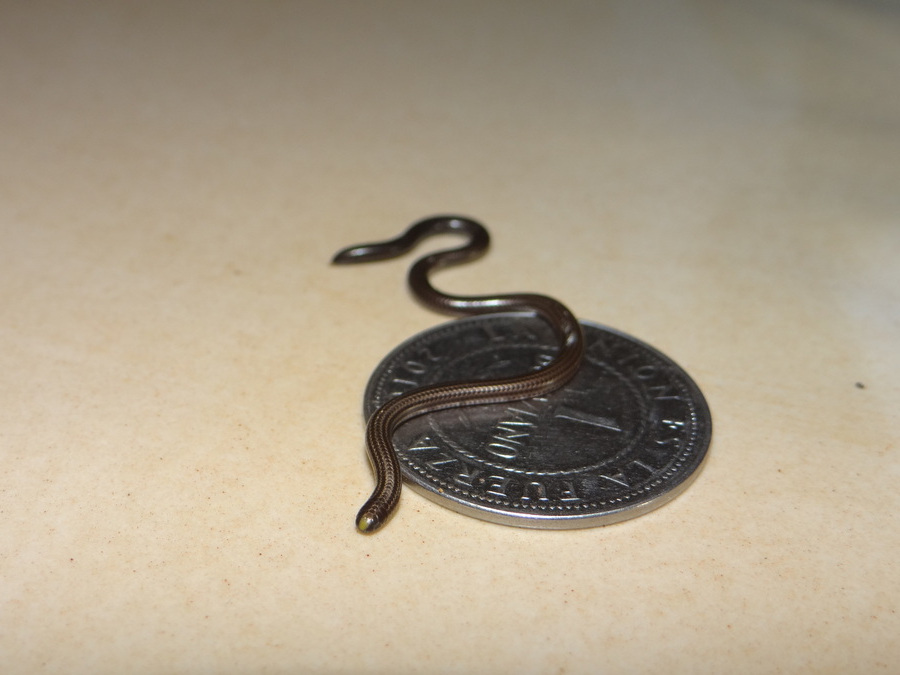
Black Blind Snake Epictia ater
The scientific name of the Black Blind Snake is Epictia ater. It is a species of reptile in the family Leptotyphlopidae (thread snakes), order Squamata. The name dates from 1940.
- Scientific name
- Epictia ater (Taylor, 1940)
- Common name
- Black Blind Snake
- Genus
- Epictia
- Family
- Leptotyphlopidae (Thread Snakes)
- Order
- Squamata
- Class
- Reptilia
- Red List category
- LC Least Concern
- Recorded in
- 5 countries
- Name status
- accepted in the Catalogue of Life
Overview
Epictia ater, or black blind snake, is a species of snake in the family Leptotyphlopidae.
Classification of the Black Blind Snake
| Kingdom | Animalia |
|---|---|
| Phylum | Chordata |
| Subphylum | Vertebrata |
| Infraphylum | Gnathostomata |
| Parvphylum | Osteichthyes |
| Megaclass | Tetrapoda |
| Class | Reptilia (Reptile) |
| Order | Squamata (Snakes) |
| Suborder | Serpentes (Snakes) |
| Infraorder | Scolecophidia |
| Family | Leptotyphlopidae (Thread Snakes) |
| Subfamily | Epictinae |
| Genus | Epictia (Neotropical Thread Snakes) |
| Species | Epictia ater (Taylor, 1940) |
Where the Black Blind Snake is found
Checklists and occurrence records place Epictia ater in 5 countries across North America. GBIF holds 161 georeferenced records of it.
Countries
Regions and cities with the most records
- Guanacaste Province, Costa Rica 60
- Cañas, Costa Rica 25
- Puntarenas Province, Costa Rica 13
- Liberia, Costa Rica 10
- Managua, Nicaragua 8
- Yoro Department, Honduras 7
- Diriamba, Nicaragua 6
- Esparza, Costa Rica 6
- Jinotepe, Nicaragua 6
- Managua Department, Nicaragua 6
- Masatepe, Nicaragua 6
- San Marcos, Nicaragua 6
- Chacarita, Costa Rica 5
- El Crucero, Nicaragua 5
- Masaya, Nicaragua 5
- Puntarenas, Costa Rica 5
- Alajuela Province, Costa Rica 4
- Comayagua, Honduras 4
- La Paz, Honduras 4
- La Paz Department, Honduras 4
- Villa de San Antonio, Honduras 4
- Cofradía, Honduras 3
- Cortés Department, Honduras 3
- El Paraíso Department, Honduras 3
- La Lima, Honduras 3
- Masaya Department, Nicaragua 3
- Nandaime, Nicaragua 3
- Potrerillos, Honduras 3
- Rivas Department, Nicaragua 3
- San Pedro Sula, Honduras 3
- Tipitapa, Nicaragua 3
- Villanueva, Honduras 3
- Morazan, El Salvador
Range as the checklists state it
Guatemala (Izabel); W Honduras (Choluteca, Comayagua, Copán, Cortés, Francisco Morazán, Gracias a Dios, Intibucá, Lempira, Santa Barbara, Valle, Yoro, including Isla Zacate Grande, elev. NSL–1,350 m); El Salvador (Morazán, San Miguel, San Salvador, 250–960 m); W Nicaragua (Carazo, Chinandega, Estelí, Granada, Managua, Rivas, elev. 40–1,100 m); and NW Costa Rica (Alajuela, Guanacaste, N Puntarenas, including Islas Murciélagos, San José, elev. NSL–1,125 m), overall elevevation 0–1,350 m
A number beside a place is its count of GBIF occurrence records. A place without a number comes from a checklist alone. Records show where a species has been observed or collected, which can include escapes and vagrants.
Common names
English
- Black Blind Snake
- Taylor's Blind Snake
Names in 3 other languages
- Italian
- Serpente cieco di Taylor
- Russian
- Никарагуанская узкоротая змея
- Spanish
- culebrilla ciega hormiguera
Synonyms
4 other scientific names have been used for this species and are now treated as synonyms of Epictia ater.
- Epictia nasalis (Taylor, 1940)
- Leptotyphlops ater Taylor, 1940
- Leptotyphlops goudotii ater Taylor, 1940
- Leptotyphlops nasalis Taylor, 1940
Related species
-
 Black Blind SnakeEpictia goudotii
-
 Guyana Blind SnakeEpictia tenella
- Tucuman ThreadsnakeEpictia albipuncta
-
 Rio Grande Do Sul Blind SnakeEpictia munoai
- Guyana Blind SnakeEpictia albifrons
-
 Klauber's Blind SnakeEpictia subcrotilla
- Northern Blind SnakeEpictia teaguei
- Slinder ThreadsnakeEpictia phenops
Compare
Questions and answers
What is the scientific name of the Black Blind Snake?
The scientific name of the Black Blind Snake is Epictia ater. Written with its author, the full name is Epictia ater (Taylor, 1940).
Which family does the Black Blind Snake belong to?
Epictia ater belongs to the family Leptotyphlopidae, in the order Squamata and the class Reptilia.
Where is the Black Blind Snake found?
Checklists and occurrence records place Epictia ater in 5 countries: Costa Rica, Nicaragua, Honduras, El Salvador and Guatemala.
What is the conservation status of the Black Blind Snake?
The IUCN Red List category recorded for Epictia ater is Least Concern (LC).
What other names does the Black Blind Snake have?
Epictia ater is also known in English as Taylor's Blind Snake.
Sources
Data
- Catalogue of Life, 2026-10-16 XR cc by
- Global Biodiversity Information Facility CC BY 4.0
- Wikidata CC0
- English Wikipedia CC BY-SA 4.0
- GeoNames CC BY 4.0
- Within the Catalogue of Life, this name comes from The Reptile Database cc by
References
- Taylor, E. H. (1940). Herpetological miscellany, no. I. Univ. Kansas Sci. Bull. 26 [1939] (15): 489-571.
- Taylor, E. H. (1955). Additions to the known herpetological fauna of Costa Rica with comments on other species. No. II. Univ. Kansas Sci. Bull. 37: 499-575.
- Cochran, Doris M. (1961). Type specimens of reptiles and amphibians in the United States National Museum. [type catalogue]. Bull. US Natl. Mus. (220): Xvi + 291 Pp.
- Peters, James A.; Donoso-Barros, Roberto & Orejas-Miranda, Braulio. (1970). Catalogue of the Neotropical Squamata: Part I Snakes. Bull. US Natl. Mus. 297: 347 Pp.
- Hahn, D. E. (1980). Liste der rezenten Amphibien und Reptilien. Anomalepididae, Leptotyphlopidae, Typhlopidae. Das Tierreich, de Gruyter (Berlin) 101: 45.
- Villa J D. (1990). Leptotyphlops nasalis Taylor. Catalogue of American Amphibians and Reptiles ( 473: 1.
- McDiarmid, R.W.; Campbell, J.A. & Touré,T.A. (1999). Snake species of the world. Vol. 1. [type catalogue]. Herpetologists’ League, 511 Pp.
- Savage, J. M. (2002). The Amphibians and Reptiles of Costa Rica: A Herpetofauna Between Two Continents, Between Two Seas. University of Chicago Press, 934 Pp. [Review in Copeia 2003 (1): 205].
- Solorzano, A. (2004). Serpientes de Costa Rica - Snakes of Costa Rica. Editorial INBio, Costa Rica, 792 Pp.
- Savage, J. M., & Bolaños, F. (2009). A checklist of the Amphibians and Reptiles of Costa Rica: Additions and nomenclatural revisions. Zootaxa 2005: 1–23.
- Adalsteinsson, S.A.; Branch, W.R.; Trapé, S.; Vitt, L.J. & Hedges, S.B. (2009). Molecular phylogeny, classification, and biogeography of snakes of the Family Leptotyphlopidae (Reptilia, Squamata). Zootaxa 2244: 1-50.
- FRANCISCO, BÁRBARA CRISTINA S.; ROBERTA R. PINTO & DANIEL S. FERNANDES. (2012). Taxonomy of Epictia munoai (Orejas-Miranda, 1961) (Squamata: Serpentes: Leptotyphlopidae). Zootaxa 3512: 42–52.
- Sunyer, & Javier. (2014). An updated checklist of the amphibians and reptiles of Nicaragua. Mesoamerican Herpetology 1 (2): 186–202.
- Stark, T., & Carlijn Laurijssens, a. M. W. (2014). Distributional and natural history notes on five species of amphibians and reptiles from Isla Ometepe, Nicaragua. Mesoamerican Herpetology 1 (2): 308.
- Solís, J. M., L. D. Wilson, and J. H. Townsend. (2014). An updated list of the amphibians and reptiles of Honduras, with comments on their nomenclature. Mesoamerican Herpetology 1: 123–144.
- Wallach, Van; Kenneth L. Williams, Jeff Boundy. (2014). Snakes of the World: A Catalogue of Living and Extinct Species. [type catalogue]. Taylor and Francis, CRC Press, 1237 Pp.
- McCranie, James R. (2015). A checklist of the amphibians and reptiles of Honduras, with additions, comments on taxonomy, some recent taxonomic decisions, and areas of further studies needed. Zootaxa 3931 (3): 352–386.
- Wallach, Van. (2016). Morphological review and taxonomic status of the Epictia phenops species group of Mesoamerica, with description of six new species and discussion of South American Epictia albifrons, E. goudotii, and E. tenella (Serpentes: Leptotyphlopidae: Epictinae). Mesoamerican Herpetology 3 (2): 216-374.
- McCranie JR, Hedges SB. (2016). Molecular phylogeny and taxonomy of the Epictia goudotii Species complex (Serpentes: Leptotyphlopidae: Epictinae) in Middle America and northern South America. PeerJ 4:E1551.
- McCranie, James R., and Alexander Gutsche. (2016). The herpetofauna of islands in the Golfo de Fonseca and adjacent waters, Honduras. Mesoamerican Herpetology 3 (4): 842–899.
- Francisco, Bárbara C. S.; Roberta R. Pinto, and Daniel S. Fernandes. (2018). Taxonomic Notes on the Genus Siagonodon Peters, 1881, with a Report on Morphological Variation in Siagonodon cupinensis (Bailey and Carvalho, 1946) (Serpentes: Leptotyphlopidae). Copeia 106 (2): 321-328.
- Lillywhite, H. B. (2022). Discovering snakes in wild places. ECO Publishing, Rodeo, NM, 164 Pp.
- Sunyer, Javier & José́ Gabriel Martínez-Fonseca. (2023). An updated country checklist to the amphibians and reptiles of Nicaragua. Revista Nicaragüense de Biodiversidad (100): 1-25.
- Sasa, M., Arias, E., & Chaves, G. (2025). Annotated list of amphibians and reptiles of Costa Rica: The role of the Museum of Zoology in cataloging the country’s herpetological diversity. Revista de Biología Tropical, 73(S2): E64536-E64536.
This species in other databases
Page built on 27 November 2026. See how the catalog is made and all sources and licences.
Cite this page
ScientificNames.org. (2026). Epictia ater (Black Blind Snake). Retrieved November 27, 2026, from https://scientificnames.org/species/epictia-ater
“Epictia ater (Black Blind Snake).” ScientificNames.org, 2026, scientificnames.org/species/epictia-ater. Accessed 27 Nov. 2026.
ScientificNames.org. “Epictia ater (Black Blind Snake).” Accessed November 27, 2026. https://scientificnames.org/species/epictia-ater.
@misc{scientificnames_epictia_ater_black_blind_snake,
  author = {{ScientificNames.org}},
  title = {Epictia ater (Black Blind Snake)},
  year = {2026},
  url = {https://scientificnames.org/species/epictia-ater},
  note = {Accessed 2026-11-27}
}