Species · Reptiles
Epictia striatula
Epictia striatula has no English name on record in the checklists used here. It is a species of reptile in the family Leptotyphlopidae (thread snakes), order Squamata. The name dates from 1945.
- Scientific name
- Epictia striatula (Smith & Laufe, 1945)
- Genus
- Epictia
- Family
- Leptotyphlopidae (Thread Snakes)
- Order
- Squamata
- Class
- Reptilia
- Red List category
- VU Vulnerable
- Recorded in
- 4 countries
- Name status
- accepted in the Catalogue of Life
Overview
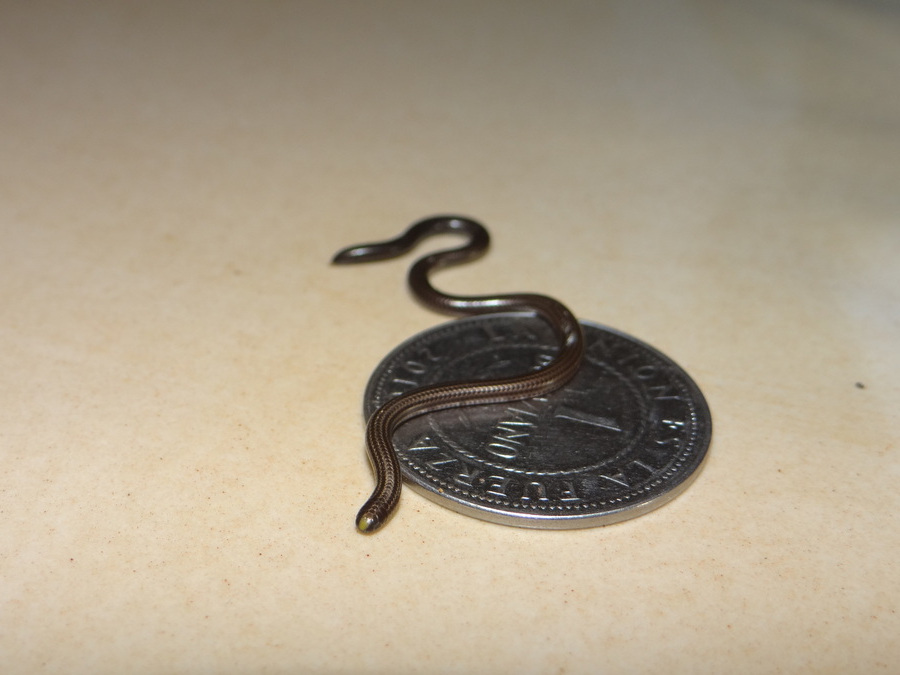
Epictia striatula is a species of snake in the family Leptotyphlopidae.
Classification of Epictia striatula
| Kingdom | Animalia |
|---|---|
| Phylum | Chordata |
| Subphylum | Vertebrata |
| Infraphylum | Gnathostomata |
| Parvphylum | Osteichthyes |
| Megaclass | Tetrapoda |
| Class | Reptilia (Reptile) |
| Order | Squamata (Snakes) |
| Suborder | Serpentes (Snakes) |
| Infraorder | Scolecophidia |
| Family | Leptotyphlopidae (Thread Snakes) |
| Subfamily | Epictinae |
| Genus | Epictia (Neotropical Thread Snakes) |
| Species | Epictia striatula (Smith & Laufe, 1945) |
Where Epictia striatula is found
Checklists and occurrence records place Epictia striatula in 4 countries across South America. GBIF holds 39 georeferenced records of it.
Countries
Regions and cities with the most records
Range as the checklists state it
Bolivia, Argentina (Salta), Peru, Brazil
A number beside a place is its count of GBIF occurrence records. A place without a number comes from a checklist alone. Records show where a species has been observed or collected, which can include escapes and vagrants.
Common names
Names in 1 other language
- Spanish
- culebra ciega del baritú
Synonyms
2 other scientific names have been used for this species and are now treated as synonyms of Epictia striatula.
- Leptotyphlops melanotermus Peters & Orejas-Miranda, 1970
- Leptotyphlops striatula Smith & Laufe, 1945
Related species
-
 Black Blind SnakeEpictia goudotii
-
 Guyana Blind SnakeEpictia tenella
- Tucuman ThreadsnakeEpictia albipuncta
-
 Rio Grande Do Sul Blind SnakeEpictia munoai
- Wagler's Blind SnakeEpictia albifrons
-
 Klauber's Blind SnakeEpictia subcrotilla
- Northern Blind SnakeEpictia teaguei
- Slinder ThreadsnakeEpictia phenops
Compare
Sources
Data
- Catalogue of Life, 2026-10-16 XR cc by
- Global Biodiversity Information Facility CC BY 4.0
- Wikidata CC0
- English Wikipedia CC BY-SA 4.0
- GeoNames CC BY 4.0
- Within the Catalogue of Life, this name comes from The Reptile Database cc by
References
- Smith H. M., Laufe L. E. 1945. A new South American Leptotyphlops. Proceedings of the Biological Society of Washington 58: 29 - 32. where the name was published
- Smith, H. M., & LAUFE, L. E. (1945). A new South American Leptotyphlops. Proc. Biol. Soc. Washington, 58: 29-32.
- Laurent R F. (1984). El genero Leptotyphlops en la coleccion de la Fundacion Miguel Lillo. Acta Zoologica Lilloana 38 (1): 29-34.
- McDiarmid, R.W.; Campbell, J.A. & Touré,T.A. (1999). Snake species of the world. Vol. 1. [type catalogue]. Herpetologists’ League, 511 Pp.
- Adalsteinsson, S.A.; Branch, W.R.; Trapé, S.; Vitt, L.J. & Hedges, S.B. (2009). Molecular phylogeny, classification, and biogeography of snakes of the Family Leptotyphlopidae (Reptilia, Squamata). Zootaxa 2244: 1-50.
- FRANCISCO, BÁRBARA CRISTINA S.; ROBERTA R. PINTO & DANIEL S. FERNANDES. (2012). Taxonomy of Epictia munoai (Orejas-Miranda, 1961) (Squamata: Serpentes: Leptotyphlopidae). Zootaxa 3512: 42–52.
- Hedges, S. B., Marion, A. B., Lipp, K. M., Marin, J., & Vidal, N. (2014). A taxonomic framework for typhlopid snakes from the Caribbean and other regions (Reptilia, Squamata). Caribbean Herpetology 49: 1–61.
- Wallach, Van; Kenneth L. Williams, Jeff Boundy. (2014). Snakes of the World: A Catalogue of Living and Extinct Species. [type catalogue]. Taylor and Francis, CRC Press, 1237 Pp.
- Natera-Mumaw, Marco; Luis Felipe Esqueda-González & Manuel Castelaín-Fernández. (2015). Atlas Serpientes de Venezuela. Santiago de Chile, Dimacofi Negocios Avanzados S.A., 456 Pp.
- Costa, Henrique Caldeira, & Renato Silveira Bérnils. (2015). Répteis brasileiros: lista de espécies 2015. Herpetologia Brasileira 4 (3): 75-93.
- Nogueira, Cristiano C.; Antonio J.S. Argôlo, Vanesa Arzamendia, Josué A. Azevedo, Fausto E. Barbo, Renato S. Bérnils, Bruna E. Bolochio, Marcio Borges-Martins, Marcela Brasil-Godinho, Henrique Braz, Marcus A. Buononato, Diego F. Cisneros-Heredia, Guarino R. Colli, Henrique C. Costa, Francisco L. Franco, Alejandro Giraudo, Rodrigo C. Gonzalez, Thaís Guedes, Marinus S. Hoogmoed, Otavio A.V. Marques, Giovanna G. Montingelli, Paulo Passos, Ana L.C. Prudente, Gilson A. Rivas, Paola M. Sanchez, Filipe C. Serrano, Nelson J. Silva Jr., Christine Strüssmann, João Paulo S. Vieira-Alencar, Hussam Zaher, Ricardo J. Sawaya, Marcio Martins. (2019). Atlas of Brazilian snakes: verified point-locality maps to mitigate the Wallacean shortfall in a megadiverse snake fauna. South American J. Herp. 14 (Special Issue 1):1-274.
- Cabral, H., A. Romero-Muñoz, D. J. Santana, et al. (2025). Diversity Loss and Homogenization in Snake Communities in a Deforestation Hotspot. Diversity and Distributions 31, No. 10: E70105.
- Gómez-Murillo, Pedro; Oliver Quinteros-Muñoz, Enrique Domic, Teresa Camacho-Badani, Romeo Rojas-Estrada, Irene Arellano-Martín, Rodrigo Aguayo, Lucindo Gonzales, Luis F. Esqueda, Carlos Urdiales Alonso, Dennis E. Lizarro (†), Edson Cortez, Mauricio Ocampo, Steffen Reichle, Octavio Jiménez-Robles, Rene Carpio-Rea, Omar M. Entiauspe- Neto, Luis Rolando Rivas, Alfonso Llobet, Alejandro Bruno Miranda-Calle, Alvaro J. Aguilar-Kirigin & Ignacio De la Riva. (2025). Catalogue of the reptiles (Reptilia) of Bolivia: checklist, distribution and literature. Cuadernos de Herpetología 39(S1):2-185.
- Arzamendia, V., Bellini, G. P., Ulibarrie, A. A., & Giraudo, A. R. (2026). Fighting biodiversity loss in the Anthropocene: the INALI snake collection as a key resource for natural history in the Global South. Biological Journal of the Linnean Society, 147(1), Blaf132.
This species in other databases
Page built on 29 November 2026. See how the catalog is made and all sources and licences.
Cite this page
ScientificNames.org. (2026). Epictia striatula. Retrieved November 29, 2026, from https://scientificnames.org/species/epictia-striatula
“Epictia striatula.” ScientificNames.org, 2026, scientificnames.org/species/epictia-striatula. Accessed 29 Nov. 2026.
ScientificNames.org. “Epictia striatula.” Accessed November 29, 2026. https://scientificnames.org/species/epictia-striatula.
@misc{scientificnames_epictia_striatula,
  author = {{ScientificNames.org}},
  title = {Epictia striatula},
  year = {2026},
  url = {https://scientificnames.org/species/epictia-striatula},
  note = {Accessed 2026-11-29}
}