Species · Fishes
Inshore Hagfish Eptatretus burgeri
The scientific name of the Inshore Hagfish is Eptatretus burgeri. It is a species of fish in the family Myxinidae (hagfishes), order Myxiniformes. The name dates from 1855.
- Scientific name
- Eptatretus burgeri (Girard, 1855)
- Common name
- Inshore Hagfish
- Genus
- Eptatretus
- Family
- Myxinidae (Hagfishes)
- Order
- Myxiniformes
- Class
- Myxini
- Red List category
- NT Near Threatened
- Environment
- marine
- Recorded in
- 5 countries
- Name status
- accepted in the Catalogue of Life

Overview
Eptatretus burgeri occurs in the Northwest Pacific, from the Sea of Japan across eastern Japan to Taiwan, and in the southern Korean Peninsula. It has six pairs of gill pouches and gill apertures, with a seventh gill aperture positioned close to but separately from the pharyngocutaneous duct.
Written 26 November 2026 from the sources listed below. Each statement was checked against the passage it cites; statements that could not be supported were removed.
Appearance
The Inshore Hagfish has six pairs of gill pouches and gill apertures. Its seventh gill aperture is positioned close to, but separately from, the pharyngocutaneous duct.[1][2]
Habitat
The Inshore Hagfish inhabits the sublittoral zone. Individuals usually live buried in bottom mud.[3][4]
Behaviour
Individuals migrate into deeper water to spawn. The species produces slime when agitated.[5][6]
The species expels all its gut contents at once in the form of large feces.[7]
Reproduction and life cycle
The Inshore Hagfish is the only member of the Myxinidae family reported to have a seasonal reproductive cycle. Laboratory breeding has been successfully achieved.[8][9]
Uses
The species is valued as food on the Korean Peninsula and among Korean communities in Japan. It is eaten as a local delicacy in parts of Japan, particularly Nagasaki and Niigata Prefectures.[10][11]
Its hide is processed into eel skin in Korea and exported internationally. Slime can be collected by placing a live individual in a container and striking the container with a stick.[12][13]
Conservation
FishBase reports a moderate to high vulnerability score of 49 out of 100 for the species. Its minimum population doubling time is estimated at 4.5–14 years.[14][15]
Diet
The species typically takes 8–10 days to digest its food.[16]
Classification of the Inshore Hagfish
| Kingdom | Animalia |
|---|---|
| Phylum | Chordata |
| Subphylum | Vertebrata |
| Infraphylum | Agnatha |
| Superclass | Cyclostomi |
| Class | Myxini |
| Order | Myxiniformes (Hagfish) |
| Family | Myxinidae (Hagfishes) |
| Subfamily | Eptatretinae |
| Genus | Eptatretus |
| Species | Eptatretus burgeri (Girard, 1855) |
Where the Inshore Hagfish is found
Checklists and occurrence records place Eptatretus burgeri in 5 countries. GBIF holds 436 georeferenced records of it.
Countries
Regions and cities with the most records
- Gyeongsangbuk-do, South Korea 31
- Heunghae, South Korea 31
- Pohang, South Korea 31
- Yeonil, South Korea 31
- Hayama, Japan 29
- Kamakura, Japan 29
- Zushi, Japan 29
- Kurihama, Japan 28
- Yokosuka, Japan 28
- Kanagawa, Japan 25
- Miura, Japan 25
- Taiwan, Taiwan 22
- Tongyeong, South Korea 13
- Goseong, South Korea 12
- Gyeongsangnam-do, South Korea 12
- Gohyakkoku, Japan 11
- Kamiichi, Japan 11
- Kurobe-shi, Japan 11
- Kyosai, South Korea 11
- Namerikawa, Japan 11
- Nyūzen, Japan 11
- Sinhyeon, South Korea 11
- Toyama, Japan 11
- Uozu, Japan 11
- Sugita, Japan 7
- Isogo, Japan 6
- Kawasaki, Japan 6
- Kikugawa, Japan 6
- Maruobara, Japan 6
- Omaezaki, Japan 6
- Sagara, Japan 6
- Sumiyoshi, Japan 6
- Yilan, Taiwan 6
- Yokohama, Japan 6
- Ōyama, Japan 6
- Fujisawa, Japan 5
A number beside a place is its count of GBIF occurrence records. A place without a number comes from a checklist alone. Records show where a species has been observed or collected, which can include escapes and vagrants.
Common names
English
- Inshore Hagfish
Names in 10 other languages
- Chinese
- 布氏黏盲鰻, 無目鰻, 蒲氏黏盲鰻, 青眠鰻, 鰻背, 龍筋
- Czech
- pasliznatka Burgerova
- Dutch
- Japanse slijmprik
- Finnish
- rantalimaaja
- German
- Bürgers Hexenfisch, Bürgers Inger, Bürgers Schleimaal
- Japanese
- Nuta-unagi, ヌタウナギ
- Korean
- Meog-jung-eo, 먹장어
- Mandarin Chinese
- 无目鳗, 青眠鳗, 鳗背, 龙筋
- Portuguese
- Peixe-bruxa-coreano
- Russian
- Миксина Бургера, Японский пиявкорот
Synonyms
5 other scientific names have been used for this species and are now treated as synonyms of Eptatretus burgeri.
- Bdellostoma burgeri Girard, 1855
- Heptatrema cirrhatum Temminck & Schlegel, 1850
- Heptatrema cirrhatum (Forster, 1801)
- Heptatretus burgeri (Girard, 1855)
- Homea burgeri (Girard, 1855)
Related species
-
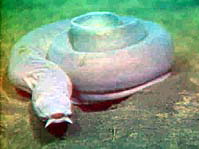 Pacific HagfishEptatretus stoutii
- Goliath HagfishEptatretus goliath
-
 Sixgill HagfishEptatretus hexatrema
-
 Black HagfishEptatretus deani
-
 Broadgilled HagfishEptatretus cirrhatus
-
 Chilean HagfishEptatretus polytrema
-
 Gulf HagfishEptatretus springeri
- Bischoff's HagfishEptatretus bischoffii
Compare
Questions and answers
What is the scientific name of the Inshore Hagfish?
The scientific name of the Inshore Hagfish is Eptatretus burgeri. Written with its author, the full name is Eptatretus burgeri (Girard, 1855).
Which family does the Inshore Hagfish belong to?
Eptatretus burgeri belongs to the family Myxinidae, in the order Myxiniformes and the class Myxini.
Where is the Inshore Hagfish found?
Checklists and occurrence records place Eptatretus burgeri in 5 countries: Japan, South Korea, Taiwan, New Zealand and China.
What is the conservation status of the Inshore Hagfish?
The IUCN Red List category recorded for Eptatretus burgeri is Near Threatened (NT).
Does anybody eat hagfish?
The Inshore Hagfish is valued as food on the Korean Peninsula and among Korean communities in Japan. It is also eaten as a local delicacy in Nagasaki and Niigata Prefectures.[10][11]
Sources
Passages the profile rests on
- The species has six pairs of gill pouches and gill apertures. Source passage: “It has six pairs of gill pouches and gill apertures” — English Wikipedia
- Its seventh gill aperture is positioned close to, but separately from, the pharyngocutaneous duct. Source passage: “a seventh gill aperture is closely adjacent to but separate from the pharyngocutaneous duct.” — English Wikipedia
- The species inhabits the sublittoral zone. Source passage: “These hagfish are found in the sublittoral zone.” — English Wikipedia
- Individuals usually live buried in bottom mud. Source passage: “They live usually buried in the bottom mud” — English Wikipedia
- Individuals migrate into deeper water to spawn. Source passage: “migrate into deeper water to spawn.” — English Wikipedia
- The species produces slime when agitated. Source passage: “the inshore hagfish produces slime when agitated.” — English Wikipedia
- The species expels all its gut contents at once in the form of large feces. Source passage: “excretes all the gut contents at once as huge feces.” — pubmed.ncbi.nlm.nih.gov
- Eptatretus burgeri is the only member of the Myxinidae family reported to have a seasonal reproductive cycle. Source passage: “The inshore hagfish is the only member of the Myxinidae family having a seasonal reproductive cycle.” — English Wikipedia
- Laboratory breeding of Eptatretus burgeri has been successfully achieved. Source passage: “laboratory breeding of Eptatretus burgeri has succeeded.” — English Wikipedia
- The species is valued as food on the Korean Peninsula and among Korean communities in Japan. Source passage: “this particular species is valued as food in the Korean Peninsula and among the Koreans in Japan.” — English Wikipedia
- The species is eaten as a local delicacy in parts of Japan, particularly Nagasaki and Niigata Prefectures. Source passage: “It is also enjoyed by Japanese as a local delicacy in some regions, particularly Nagasaki and Niigata Prefectures.” — English Wikipedia
- The species' hide is processed into eel skin in Korea and exported internationally. Source passage: “The hide of this hagfish is processed into "eel skin" in Korea and exported worldwide.” — English Wikipedia
- Slime from the species can be collected by placing a live individual in a container and striking the container with a stick. Source passage: “This is obtained by placing a live inshore hagfish into a container and knocking the container with a stick.” — English Wikipedia
- FishBase reports a moderate to high vulnerability score of 49 out of 100 for the species. Source passage: “Moderate to high vulnerability (49 of 100).” — fishbase.se
- FishBase reports a minimum population doubling time estimated at 4.5–14 years. Source passage: “Low, minimum population doubling time 4.5 - 14 years” — fishbase.se
- The species typically takes 8–10 days to digest its food. Source passage: “Eptatretus burgeri typically takes 8-10 days to digest food” — pubmed.ncbi.nlm.nih.gov
Data
- Catalogue of Life, 2026-10-16 XR cc by
- Global Biodiversity Information Facility CC BY 4.0
- Wikidata CC0
- GeoNames CC BY 4.0
- Wikimedia Commons per image; credit shown with each image
- Within the Catalogue of Life, this name comes from World Register of Marine Species cc by
This species in other databases
- Catalogue of Life 6FZ3Z
- Wikidata Q848385
- iNaturalist 100233
- WoRMS urn:lsid:marinespecies.org:taxname:279272
- ITIS 159767
Page built on 27 November 2026. See how the catalog is made and all sources and licences.
Cite this page
ScientificNames.org. (2026). Eptatretus burgeri (Inshore Hagfish). Retrieved November 27, 2026, from https://scientificnames.org/species/eptatretus-burgeri
“Eptatretus burgeri (Inshore Hagfish).” ScientificNames.org, 2026, scientificnames.org/species/eptatretus-burgeri. Accessed 27 Nov. 2026.
ScientificNames.org. “Eptatretus burgeri (Inshore Hagfish).” Accessed November 27, 2026. https://scientificnames.org/species/eptatretus-burgeri.
@misc{scientificnames_eptatretus_burgeri_inshore_hagfish,
  author = {{ScientificNames.org}},
  title = {Eptatretus burgeri (Inshore Hagfish)},
  year = {2026},
  url = {https://scientificnames.org/species/eptatretus-burgeri},
  note = {Accessed 2026-11-27}
}