Species · Fishes
Broadgilled Hagfish Eptatretus cirrhatus
The scientific name of the Broadgilled Hagfish is Eptatretus cirrhatus. It is a species of fish in the family Myxinidae (hagfishes), order Myxiniformes. The name dates from 1801.
- Scientific name
- Eptatretus cirrhatus (Forster, 1801)
- Common name
- Broadgilled Hagfish
- Genus
- Eptatretus
- Family
- Myxinidae (Hagfishes)
- Order
- Myxiniformes
- Class
- Myxini
- Red List category
- LC Least Concern
- Environment
- marine
- Recorded in
- 2 countries
- Name status
- accepted in the Catalogue of Life

Overview
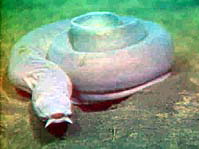
The Broadgilled Hagfish is an eel-shaped fish without a dorsal fin and with a paddle-shaped tail. It inhabits coastal shelf and slope habitats around New Zealand, as well as oceanic rises and banks.
Written 27 November 2026 from the sources listed below. Each statement was checked against the passage it cites; statements that could not be supported were removed.
Appearance
The Broadgilled Hagfish has an eel-shaped body without a dorsal fin and a paddle-shaped tail. Its body is commonly grey-brown with pink or bluish coloration, and juveniles are lighter in colour than adults.[1][2][3]
It has a skull but lacks jaws and a true vertebral column, with a cartilaginous skeleton. Its rounded mouth is surrounded by six barbels, and a single nasal passage is located above the mouth.[4][5][6]
Its dental plate bears anterior and posterior rows of keratinous grasping teeth on each side. The species has seven pairs of gill pouches and numerous pores along the lower sides of its body that secrete slime expanding upon contact with seawater.[7][8][9]
Its intestinal tract consists of mucosa, submucosa and muscularis serosa. The intestinal mucosa contains enterocytes, zymogenous cells and large goblet cells.[10][11]
Habitat
The Broadgilled Hagfish inhabits temperate coastal shelf environments at depths of 1–900 m. It is most commonly found at depths of 90–700 m.[12][13]
It occurs in coastal shelf and slope habitats around New Zealand and also inhabits oceanic rises and banks. It lives close to the seabed, resting on the substrate or occupying burrows.[14][15][16]
Diet
The Broadgilled Hagfish primarily consumes carrion but also captures living animals. Its diet includes hermit crabs, shrimps, sharks and bony fishes.[17][18]
Hagfishes, including this species, eat mostly dead fishes and worms.[19]
Behaviour
The Broadgilled Hagfish feeds from the inside out of its prey. It uses its sensory barbels and nasal passage to locate prey on the seabed.[20][21]
It can enter burrows occupied by potential prey to capture their occupants. It can form a knot with its body to gain leverage when extracting prey from burrows.[22][23]
When seized by a predator, the species releases slime that can obstruct the predator's mouth and gill chamber. It continues foraging despite predator attacks and slime secretion.[24][25]
Reproduction and life cycle
Female spawning is thought to begin when individuals reach approximately 412–534 mm in total length. Males are thought to reach sexual maturity at approximately 585 mm in length.[26][27]
Females with large eggs and postovulatory females have been observed throughout all seasons, with no indication of seasonal or cyclic breeding.[28]
Mature hagfish may take two or three years after reaching maturity to produce 20–30 eggs. The species has a low reproductive rate.[29][30]
Conservation
The species is listed as being of least concern in the cited account. Its low reproductive rate may create problems for commercial fisheries.[31][32]
Uses
The Broadgilled Hagfish is traditionally consumed as food by Māori and is regarded as a delicacy. Some iwi serve the species on special occasions.[33][34]
Classification of the Broadgilled Hagfish
| Kingdom | Animalia |
|---|---|
| Phylum | Chordata |
| Subphylum | Vertebrata |
| Infraphylum | Agnatha |
| Superclass | Cyclostomi |
| Class | Myxini |
| Order | Myxiniformes (Hagfish) |
| Family | Myxinidae (Hagfishes) |
| Subfamily | Eptatretinae |
| Genus | Eptatretus |
| Species | Eptatretus cirrhatus (Forster, 1801) |
Where the Broadgilled Hagfish is found
Checklists and occurrence records place Eptatretus cirrhatus in 2 countries. GBIF holds 857 georeferenced records of it.
Countries
Regions and cities with the most records
- Lower Hutt, New Zealand 10
- Karori, New Zealand 8
- Southland, New Zealand 8
- Wainuiomata, New Zealand 8
- Wellington, New Zealand 8
- Marlborough, New Zealand 4
- Paraparaumu, New Zealand 3
- Wellington Region, New Zealand 3
1 more country has a few records outside this range
These countries hold a few records of Eptatretus cirrhatus but lie outside the range the checklists give for it. Such records are often zoo or garden specimens, museum material or vagrants, so the species is not counted as occurring there.
A number beside a place is its count of GBIF occurrence records. A place without a number comes from a checklist alone. Records show where a species has been observed or collected, which can include escapes and vagrants.
Common names
English
- Broadgilled Hagfish
- Blind Eel
- Hagfish
- New Zealand Hagfish
- Common Hagfish
Names in 7 other languages
- Czech
- pasliznatka japonská
- Finnish
- rihmalimaaja
- German
- Breitkiemen-Schleimaal, Neuseeland-Schleimaal
- Māori
- Pia, Tuere
- Portuguese
- Peixe-bruxa-maori
- Russian
- Новозеландский пиявкорот
- Spanish
- Mixino de Nueva Zelanda
Synonyms
5 other scientific names have been used for this species and are now treated as synonyms of Eptatretus cirrhatus.
- Bdellostoma forsteri Müller, 1836
- Bdellostoma heptatrema Müller, 1836
- Eptatretus banksii (Fleming, 1822)
- Homea banksii Fleming, 1822
- Petromyzon cirrhatus Forster, 1801
Related species
-
 Pacific HagfishEptatretus stoutii
-
 Inshore HagfishEptatretus burgeri
- Goliath HagfishEptatretus goliath
-
 Sixgill HagfishEptatretus hexatrema
-
 Black HagfishEptatretus deani
-
 Chilean HagfishEptatretus polytrema
-
 Gulf HagfishEptatretus springeri
- Bischoff's HagfishEptatretus bischoffii
Compare
Questions and answers
What is the scientific name of the Broadgilled Hagfish?
The scientific name of the Broadgilled Hagfish is Eptatretus cirrhatus. Written with its author, the full name is Eptatretus cirrhatus (Forster, 1801).
Which family does the Broadgilled Hagfish belong to?
Eptatretus cirrhatus belongs to the family Myxinidae, in the order Myxiniformes and the class Myxini.
Where is the Broadgilled Hagfish found?
Checklists and occurrence records place Eptatretus cirrhatus in 2 countries: New Zealand and Australia.
What is the conservation status of the Broadgilled Hagfish?
The IUCN Red List category recorded for Eptatretus cirrhatus is Least Concern (LC).
What other names does the Broadgilled Hagfish have?
Eptatretus cirrhatus is also known in English as Blind Eel, Hagfish, New Zealand Hagfish and Common Hagfish.
What habitat do hagfish live in?
The Broadgilled Hagfish inhabits temperate coastal shelf environments at depths of 1–900 m, most commonly at 90–700 m. It occurs in coastal shelf and slope habitats around New Zealand, as well as oceanic rises and banks, and lives close to the seabed.[12][13][14][15][16]
Sources
Passages the profile rests on
- The species has an eel-shaped body without a dorsal fin and a paddle-shaped tail. Source passage: “Eptatretus cirrhatus has an eel-like body with no dorsal fin, a paddle-like tail” — English Wikipedia
- Its body is commonly grey-brown with pink or bluish coloration. Source passage: “often a grey-brown with a pink or bluish tinge of colour.” — English Wikipedia
- Juveniles are lighter in colour than adults. Source passage: “Juveniles are lighter in colour.” — English Wikipedia
- The species has a skull but lacks jaws and a true vertebral column, with a cartilaginous skeleton. Source passage: “has a skull but no jaw or true vertebral column, it instead has a skeleton made up of cartilage.” — English Wikipedia
- Its rounded mouth is surrounded by six barbels. Source passage: “The rounded mouth of the hagfish is surrounded by 6 barbels” — English Wikipedia
- The species possesses a single nasal passage above its mouth. Source passage: “above that is their singular nasal passage” — English Wikipedia
- Its dental plate bears anterior and posterior rows of keratinous grasping teeth on each side. Source passage: “a dental plate with a row of posterior and anterior keratinous grasping teeth on each side.” — English Wikipedia
- The species has seven pairs of gill pouches. Source passage: “It has seven pairs of gill pouches” — English Wikipedia
- Numerous pores along the lower sides of its body secrete slime that expands upon contact with seawater. Source passage: “pores which often many of them are ringed with a white colour and are used for secreting a snot-like slime which expands out once it has contact with the sea water.” — English Wikipedia
- Its intestinal tract consists of mucosa, submucosa and muscularis serosa. Source passage: “Hagfish presents an intestinal tract divided into three layers: mucosa, submucosa, and muscolaris serosa.” — pmc.ncbi.nlm.nih.gov
- Its intestinal mucosa contains enterocytes, zymogenous cells and large goblet cells. Source passage: “The mucosa is rich in enterocytes; zymogenous cells, which facilitate digestion; and large goblet cells, as reported in our previous study [22].” — pmc.ncbi.nlm.nih.gov
- The species inhabits temperate coastal shelf environments at depths of 1–900 m. Source passage: “The New Zealand hagfish is common throughout the temperate coastal shelves, in depths ranging between 1m and 900m.” — English Wikipedia
- It is most commonly found at depths of 90–700 m. Source passage: “The hagfish is most common between 90 and 700m.” — English Wikipedia
- The species occurs in coastal shelf and slope habitats around New Zealand. Source passage: “E. cirrhatus is found in coastal areas of New Zealand in shelf and slope areas along the coast” — English Wikipedia
- It also inhabits oceanic rises and banks. Source passage: “It is also found on rises and banks out in the open ocean.” — English Wikipedia
- The species lives close to the seabed, resting on the substrate or occupying burrows. Source passage: “All known Hagfish species live in close proximity to the bottom, either resting on the substrate or occupying burrows.” — English Wikipedia
- The species primarily consumes carrion but also captures living animals. Source passage: “Their diet mainly consists of carrion, although they prey on live animals as well.” — English Wikipedia
- Its diet includes hermit crabs, shrimps, sharks and bony fishes. Source passage: “The diet is a variety of invertebrates and includes hermit crabs, shrimps, sharks and bony fish.” — English Wikipedia
- Hagfishes, including this species, eat mostly dead fishes and worms. Source passage: “Hagfishes eat mostly dead fishes and worms.” — australian.museum
- The species feeds from the inside out of its prey. Source passage: “E. cirrhatus are bottom feeders and are known to eat their prey from the inside out.” — English Wikipedia
- It uses its sensory barbels and nasal passage to locate prey on the seabed. Source passage: “they rely on the 6 sensory barbels that surround their mouths to find their way along the ocean floor and their singular nasal passageway to smell out their prey.” — English Wikipedia
- The species can enter burrows occupied by potential prey to capture their occupants. Source passage: “It then enters the burrow and is believed to grab the prey.” — English Wikipedia
- It can form a knot with its body to gain leverage when extracting prey from burrows. Source passage: “To extract the prey from the burrow E. cirrhatus ties itself into a knot” — English Wikipedia
- When seized by a predator, the species releases slime that can obstruct the predator's mouth and gill chamber. Source passage: “When grabbed by a predator, the slime fills the mouth and gill chamber.” — English Wikipedia
- The species continues foraging despite predator attacks and slime secretion. Source passage: “The excretion of the slime appears to have no effect on E. cirrhatus, as it continues foraging despite attacks.” — English Wikipedia
- Female spawning is thought to begin when individuals reach approximately 412–534 mm in total length. Source passage: “the first female spawning is thought to occur when the total length is between 412mm – 534mm” — English Wikipedia
- Males are thought to reach sexual maturity at approximately 585 mm in length. Source passage: “Males are thought not to mature until they are about 585mm in length.” — English Wikipedia
- Females with large eggs and postovulatory females have been observed throughout all seasons, with no indication of seasonal or cyclic breeding. Source passage: “there was no indication found that Eptatretus cirrhatus breeds cyclically or seasonably as females with large eggs present and postovulatory females were found throughout all seasons of the study.” — English Wikipedia
- Mature hagfish may take two or three years after reaching maturity to produce 20–30 eggs. Source passage: “It can take up to 2 or 3 years after maturing for hagfish to produce only 20–30 eggs.” — English Wikipedia
- The species has a low reproductive rate. Source passage: “they did find a low reproductive rate occurring” — English Wikipedia
- The species is listed as being of least concern in the cited account. Source passage: “although they are currently at a 'least concern'.” — English Wikipedia
- Its low reproductive rate may create problems for commercial fisheries. Source passage: “therefore issues may arise from commercial fisheries” — English Wikipedia
- The species is traditionally consumed as food by Māori and is regarded as a delicacy. Source passage: “E. cirrhatus is a traditional food for Māori and is considered a delicacy.” — English Wikipedia
- Some iwi serve the species on special occasions. Source passage: “In modern times, some iwi serve E. cirrhatus for special occasions.” — English Wikipedia
Data
- Catalogue of Life, 2026-10-16 XR cc by
- Global Biodiversity Information Facility CC BY 4.0
- Wikidata CC0
- GeoNames CC BY 4.0
- Wikimedia Commons per image; credit shown with each image
- Within the Catalogue of Life, this name comes from World Register of Marine Species cc by
References
- Bloch and Schneider, 1801 where the name was published
This species in other databases
- Catalogue of Life 6FYRT
- Wikidata Q780463
- iNaturalist 49098
- WoRMS urn:lsid:marinespecies.org:taxname:279276
- ITIS 159765
Page built on 28 November 2026. See how the catalog is made and all sources and licences.
Cite this page
ScientificNames.org. (2026). Eptatretus cirrhatus (Broadgilled Hagfish). Retrieved November 28, 2026, from https://scientificnames.org/species/eptatretus-cirrhatus
“Eptatretus cirrhatus (Broadgilled Hagfish).” ScientificNames.org, 2026, scientificnames.org/species/eptatretus-cirrhatus. Accessed 28 Nov. 2026.
ScientificNames.org. “Eptatretus cirrhatus (Broadgilled Hagfish).” Accessed November 28, 2026. https://scientificnames.org/species/eptatretus-cirrhatus.
@misc{scientificnames_eptatretus_cirrhatus_broadgilled_hagfish,
  author = {{ScientificNames.org}},
  title = {Eptatretus cirrhatus (Broadgilled Hagfish)},
  year = {2026},
  url = {https://scientificnames.org/species/eptatretus-cirrhatus},
  note = {Accessed 2026-11-28}
}