Species · Fishes
Sixgill Hagfish Eptatretus hexatrema
The scientific name of the Sixgill Hagfish is Eptatretus hexatrema. It is a species of fish in the family Myxinidae (hagfishes), order Myxiniformes. The name dates from 1836.
- Scientific name
- Eptatretus hexatrema (Müller, 1836)
- Common name
- Sixgill Hagfish
- Genus
- Eptatretus
- Family
- Myxinidae (Hagfishes)
- Order
- Myxiniformes
- Class
- Myxini
- Red List category
- LC Least Concern
- Environment
- marine
- Recorded in
- 2 countries
- Name status
- accepted in the Catalogue of Life

Overview
Eptatretus hexatrema is a marine demersal fish native to the South Atlantic Ocean and southwestern Indian Ocean. It has six barbels surrounding its mouth and secretes large quantities of slime when provoked.
Written 26 November 2026 from the sources listed below. Each statement was checked against the passage it cites; statements that could not be supported were removed.
Similar species
Bdellostoma hexatrema Müller, 1836 and Heptatretus hexatrema (Müller, 1836) are synonyms of this species.[1][2]
Appearance
The species has six barbels on its head surrounding the mouth and two rows of slime pores along the underside of its body. It lacks paired fins and has a jawless mouth with two protrusible rows of horny teeth.[3][4][5]
Habitat
The Sixgill Hagfish is a marine demersal fish occurring at depths ranging from 10 to 400 m. It is usually found at depths between 10 and 45 m.[6][7][8]
It commonly burrows in muddy seabeds.[9]
The species is native to the South Atlantic Ocean and southwestern Indian Ocean. Its documented Southeast Atlantic distribution extends from Walvis Bay in Namibia to Durban in South Africa.[10][11]
Diet
The species feeds mainly by scavenging on dead or disabled fish.[12]
Behaviour
The Sixgill Hagfish is non-migratory. It secretes large quantities of slime when provoked.[13][14]
Reproduction and life cycle
The species' egg cases are ovoid and measure approximately 30 mm long and 12 mm wide. They have anchor filaments at both ends.[15][16]
Uses
Fishermen consider the species a pest.[17]
Classification of the Sixgill Hagfish
| Kingdom | Animalia |
|---|---|
| Phylum | Chordata |
| Subphylum | Vertebrata |
| Infraphylum | Agnatha |
| Superclass | Cyclostomi |
| Class | Myxini |
| Order | Myxiniformes (Hagfish) |
| Family | Myxinidae (Hagfishes) |
| Subfamily | Eptatretinae |
| Genus | Eptatretus |
| Species | Eptatretus hexatrema (Müller, 1836) |
Where the Sixgill Hagfish is found
Checklists and occurrence records place Eptatretus hexatrema in 2 countries. GBIF holds 62 georeferenced records of it.
Countries
Regions and cities with the most records
- Muizenberg, South Africa 16
- Rondebosch, South Africa 15
- Retreat, South Africa 14
- Cape Town, South Africa 12
- Western Cape, South Africa 7
- Eastern Cape, South Africa 4
- Gqeberha, South Africa 4
- Port Alfred, South Africa 3
A number beside a place is its count of GBIF occurrence records. A place without a number comes from a checklist alone. Records show where a species has been observed or collected, which can include escapes and vagrants.
Common names
English
- Sixgill Hagfish
- Cape Sea-snake
Names in 8 other languages
- Afrikaans
- Snotslang
- Czech
- pasliznatka jihoafrická
- Finnish
- kuusikiduslimaaja
- French
- Myxine à Six Trous
- German
- Sechskiemen-Schleimaal
- Portuguese
- Peixe-bruxa-de-seis-guelras
- Russian
- Шестижаберный пиявкорот
- Spanish
- Pez Moco de Seis Agallas
Synonyms
3 other scientific names have been used for this species and are now treated as synonyms of Eptatretus hexatrema.
- Bdellostoma heterotrema Müller, 1836
- Bdellostoma hexatrema Müller, 1836
- Heptatretus hexatrema (Müller, 1836)
Related species
-
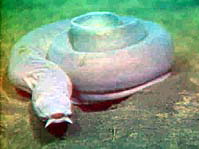 Pacific HagfishEptatretus stoutii
-
 Inshore HagfishEptatretus burgeri
- Goliath HagfishEptatretus goliath
-
 Black HagfishEptatretus deani
-
 Broadgilled HagfishEptatretus cirrhatus
-
 Chilean HagfishEptatretus polytrema
-
 Gulf HagfishEptatretus springeri
- Bischoff's HagfishEptatretus bischoffii
Compare
Questions and answers
What is the scientific name of the Sixgill Hagfish?
The scientific name of the Sixgill Hagfish is Eptatretus hexatrema. Written with its author, the full name is Eptatretus hexatrema (Müller, 1836).
Which family does the Sixgill Hagfish belong to?
Eptatretus hexatrema belongs to the family Myxinidae, in the order Myxiniformes and the class Myxini.
Where is the Sixgill Hagfish found?
Checklists and occurrence records place Eptatretus hexatrema in 2 countries: South Africa and Madagascar.
What is the conservation status of the Sixgill Hagfish?
The IUCN Red List category recorded for Eptatretus hexatrema is Least Concern (LC).
What other names does the Sixgill Hagfish have?
Eptatretus hexatrema is also known in English as Cape Sea-snake.
Sources
Passages the profile rests on
- Bdellostoma hexatrema Müller, 1836 is a synonym of this species. Source passage: “Synonyms: Bdellostoma hexatrema Müller, 1836.” — English Wikipedia
- Heptatretus hexatrema (Müller, 1836) is another synonym of this species. Source passage: “Heptatretus hexatrema (Müller, 1836)” — English Wikipedia
- The species has six barbels on its head surrounding the mouth. Source passage: “six barbels on the head around the mouth.” — English Wikipedia
- The species has two rows of slime pores along the underside of its body. Source passage: “Two rows of slime pores under the body.” — English Wikipedia
- The species lacks paired fins and has a jawless mouth with two protrusible rows of horny teeth. Source passage: “No paired fins, mouth has no jaws but has two protrusible rows of horny teeth.” — English Wikipedia
- The species is a marine demersal fish. Source passage: “Non-migratory marine demersal.” — English Wikipedia
- The species occurs at depths ranging from 10 to 400 m. Source passage: “Depth range 10 – 400 m” — English Wikipedia
- The species is usually found at depths between 10 and 45 m. Source passage: “usually found between 10 and 45 m.” — English Wikipedia
- The species commonly burrows in muddy seabeds. Source passage: “Commonly burrows in muddy bottoms.” — English Wikipedia
- The species is native to the South Atlantic Ocean and southwestern Indian Ocean. Source passage: “It is native to the South Atlantic Ocean and southwestern Indian Ocean.” — English Wikipedia
- The documented Southeast Atlantic distribution extends from Walvis Bay in Namibia to Durban in South Africa. Source passage: “Southeast Atlantic: known only from Walvis Bay, Namibia to Durban, South Africa” — English Wikipedia
- The species feeds mainly by scavenging on dead or disabled fish. Source passage: “Feeds mostly by scavenging on dead or disabled fish.” — English Wikipedia
- The species is non-migratory. Source passage: “Non-migratory marine demersal.” — English Wikipedia
- The species secretes large quantities of slime when provoked. Source passage: “Secretes large quantities of slime when provoked.” — English Wikipedia
- The species' egg cases are ovoid and measure approximately 30 mm long and 12 mm wide. Source passage: “Egg cases ovoid about 30mm long by 12mm wide” — English Wikipedia
- The egg cases have anchor filaments at both ends. Source passage: “with anchor filaments at each end.” — English Wikipedia
- Fishermen consider the species a pest. Source passage: “considered a pest by fishermen.” — English Wikipedia
Data
- Catalogue of Life, 2026-10-16 XR cc by
- Global Biodiversity Information Facility CC BY 4.0
- Wikidata CC0
- GeoNames CC BY 4.0
- Wikimedia Commons per image; credit shown with each image
- Within the Catalogue of Life, this name comes from World Register of Marine Species cc by
This species in other databases
- Catalogue of Life 6FZ43
- Wikidata Q969312
- iNaturalist 100245
- WoRMS urn:lsid:marinespecies.org:taxname:221466
- ITIS 159766
Page built on 29 November 2026. See how the catalog is made and all sources and licences.
Cite this page
ScientificNames.org. (2026). Eptatretus hexatrema (Sixgill Hagfish). Retrieved November 29, 2026, from https://scientificnames.org/species/eptatretus-hexatrema
“Eptatretus hexatrema (Sixgill Hagfish).” ScientificNames.org, 2026, scientificnames.org/species/eptatretus-hexatrema. Accessed 29 Nov. 2026.
ScientificNames.org. “Eptatretus hexatrema (Sixgill Hagfish).” Accessed November 29, 2026. https://scientificnames.org/species/eptatretus-hexatrema.
@misc{scientificnames_eptatretus_hexatrema_sixgill_hagfish,
  author = {{ScientificNames.org}},
  title = {Eptatretus hexatrema (Sixgill Hagfish)},
  year = {2026},
  url = {https://scientificnames.org/species/eptatretus-hexatrema},
  note = {Accessed 2026-11-29}
}