Species · Ferns and allies
Smooth Scouring-rush Equisetum laevigatum
The scientific name of the Smooth Scouring-rush is Equisetum laevigatum. It is a species of fern or lycophyte in the family Equisetaceae (horsetail family), order Equisetales.
- Scientific name
- Equisetum laevigatum A.Braun & Engelm.
- Common name
- Smooth Scouring-rush
- Genus
- Equisetum
- Family
- Equisetaceae (Horsetail Family)
- Order
- Equisetales
- Class
- Polypodiopsida
- Recorded in
- 3 countries
- Name status
- accepted in the Catalogue of Life

Overview
Equisetum laevigatum is native to much of North America, excluding northern Canada and southern Mexico, and usually occurs in moist areas with sandy and gravelly substrates. It has narrow green stems with small, brownish, scale-like sheaths at the nodes, occasional slender branches and rounded, cone-shaped sporangia at the tips.
Written 26 November 2026 from the sources listed below. Each statement was checked against the passage it cites; statements that could not be supported were removed.
Appearance
The smooth scouring-rush has narrow green stems. Small, brownish, scale-like sheaths form at the stem nodes, and the stems occasionally bear small, slender branches.[1][2][3]
The stems terminate in rounded, cone-shaped sporangia and can exceed 1.5 metres in height.[4][5]
Habitat
The smooth scouring-rush usually occurs in moist areas and grows in sandy and gravelly substrates.[6][7]
Behaviour
The smooth scouring-rush can grow as either an annual or a perennial plant.[8]
Classification of the Smooth Scouring-rush
| Kingdom | Plantae |
|---|---|
| Subkingdom | Pteridobiotina |
| Phylum | Tracheophyta |
| Class | Polypodiopsida (Fern) |
| Order | Equisetales |
| Family | Equisetaceae (Horsetail Family) |
| Genus | Equisetum (Horsetail) |
| Species | Equisetum laevigatum A.Braun & Engelm. |
Where the Smooth Scouring-rush is found
Checklists and occurrence records place Equisetum laevigatum in 3 countries across North America. GBIF holds 11,526 georeferenced records of it.
Countries
Regions and cities with the most records
- California, United States 1,460
- Colorado, United States 774
- Utah, United States 416
- New Mexico, United States 336
- Idaho, United States 298
- Washington, United States 294
- Arizona, United States 271
- Kansas, United States 270
- Nebraska, United States 266
- Minnesota, United States 258
- Oregon, United States 228
- Nevada, United States 216
- Michigan, United States 208
- Alberta, Canada 204
- Montana, United States 203
- Illinois, United States 184
- Wyoming, United States 169
- Texas, United States 168
- Wisconsin, United States 164
- South Dakota, United States 160
- British Columbia, Canada 112
- Ontario, Canada 82
- North Dakota, United States 81
- Baja California, Mexico 78
- Columbine, United States 76
- Ken Caryl, United States 74
- Indiana, United States 70
- Saskatchewan, Canada 69
- Boulder, United States 68
- Dakota Ridge, United States 65
- East Millcreek, United States 64
- Highlands Ranch, United States 64
- Holladay, United States 64
- Lakewood, United States 63
- Millcreek, United States 62
- South Salt Lake, United States 61
Range as the checklists state it
Russian Far East (Russian Manchuria/Primorye, Sakhalin); Canada (Alberta, British Columbia, Manitoba, Ontario, Québec, Saskatchewan); USA (Arkansas, Arizona, California, Colorado, Connecticut, Iowa, Idaho, Illinois, Indiana, Kansas, Kentucky, Michigan, Minnesota, Missouri, Montana, North Dakota, Nebraska, New Mexico, Nevada, New York, Ohio, Oklahoma, Oregon, Pennsylvania, South Dakota, Texas, Utah, Washington State, Wisconsin, Wyoming); Mexico (Baja California Norte, Chiapas, Chihuahua, Coahuila, Colima, Durango, México State, Morelos, Nuevo León, Oaxaca, Sonora, Tamaulipas)
A number beside a place is its count of GBIF occurrence records. A place without a number comes from a checklist alone. Records show where a species has been observed or collected, which can include escapes and vagrants.
Common names
English
- Smooth Scouring-rush
Names in 6 other languages
- Chinese
- 平滑木賊
- Dutch
- Gladde Paardenstaart
- Finnish
- amerikankorte
- French
- prêle lisse
- Spanish
- Caña carricillo
- nav
- Ch’ilabe’éts’óóz
Synonyms
33 other scientific names have been used for this species and are now treated as synonyms of Equisetum laevigatum.
- Equisetum fontinale Copel.
- Equisetum funstonii A.A.Eaton
- Equisetum funstonii f. caespitosum A.A.Eaton
- Equisetum funstonii f. nudum A.A.Eaton
- Equisetum funstonii f. polystachyum A.A.Eaton
- Equisetum funstonii f. ramosum A.A.Eaton
- Equisetum funstonii var. caespitosum (A.A.Eaton) Jeps.
- Equisetum funstonii var. nudum (A.A.Eaton) Jeps.
- Equisetum funstonii var. ramosum (A.A.Eaton) Jeps.
- Equisetum kansanum J.H.Schaffn.
- Equisetum kansanum f. caespiticum (Farw.) M.Broun
- Equisetum kansanum f. caespitosum (A.A.Eaton) M.Broun
- Equisetum kansanum f. polystachyum (A.A.Eaton) M.Broun
- Equisetum kansanum f. ramosum (A.A.Eaton) M.Broun
- Equisetum kansanum f. variegatoides (A.A.Eaton) M.Broun
- Equisetum laevigatum f. caespitosum A.A.Eaton
- Equisetum laevigatum f. polystachum (A.A.Eaton) A.A.Eaton
- Equisetum laevigatum f. ramosum A.A.Eaton
- Equisetum laevigatum f. scabrellum (Engelm.) M.Broun
- Equisetum laevigatum f. scabrellum (A.Braun & Engelm.) Milde
- Equisetum laevigatum f. variegatoides A.A.Eaton
- Equisetum laevigatum subsp. funstonii (A.A.Eaton) Hartm.
- Equisetum laevigatum var. scabrellum A.Braun & Engelm.
- Equisetum prealtum var. laevigatum (A.Braun) Bush
- Hippochaete laevigata (A.Braun & Engelm.) Farw.
- Hippochaete laevigata var. caespitica Farw.
- Hippochaete laevigata var. caespitosa (A.A.Eaton) Farw.
- Hippochaete laevigata var. funstonii (A.A.Eaton) Farw.
- Hippochaete laevigata var. polystachya (A.A.Eaton) Farw.
- Hippochaete laevigata var. ramosa (A.A.Eaton) Farw.
- Hippochaete laevigata var. variegatoides (A.A.Eaton) Farw.
- Hippochaete praealta var. scabrella (A.Braun & Engelm.) Farw.
- Equisetum praealtum var. laevigatum (A.Braun & Engelm.) Bush ambiguous synonym
Related species
-
 Common HorsetailEquisetum arvense
-
 Rough HorsetailEquisetum hyemale
-
 Great HorsetailEquisetum telmateia
-
 Water HorsetailEquisetum fluviatile
-
 Southern Giant HorsetailEquisetum giganteum
-
 Marsh HorsetailEquisetum palustre
-
 Mexican Giant HorsetailEquisetum myriochaetum
-
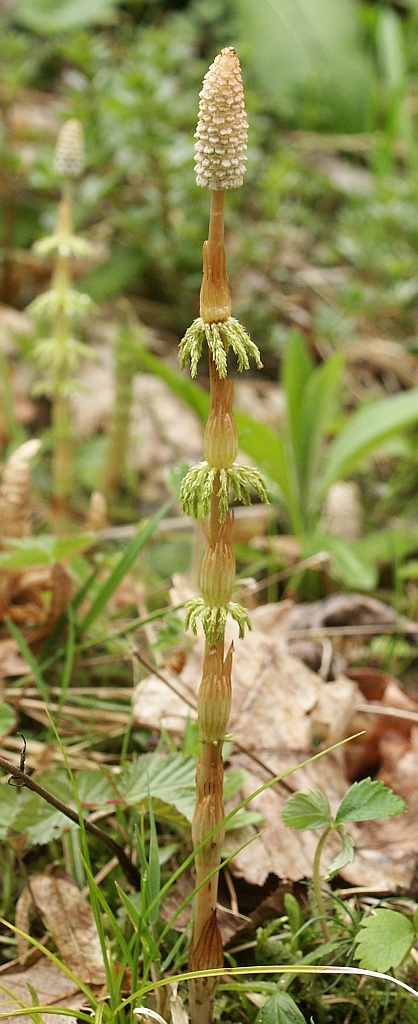 Wood HorsetailEquisetum sylvaticum
Compare
Questions and answers
What is the scientific name of the Smooth Scouring-rush?
The scientific name of the Smooth Scouring-rush is Equisetum laevigatum. Written with its author, the full name is Equisetum laevigatum A.Braun & Engelm..
Which family does the Smooth Scouring-rush belong to?
Equisetum laevigatum belongs to the family Equisetaceae, in the order Equisetales and the class Polypodiopsida.
Where is the Smooth Scouring-rush found?
Checklists and occurrence records place Equisetum laevigatum in 3 countries: United States, Canada and Mexico.
Sources
Passages the profile rests on
- The species has narrow green stems. Source passage: “It grows narrow green stems” — English Wikipedia
- The leaves at the stem nodes form small, brownish, scale-like sheaths. Source passage: “The leaves at the nodes are small, scale-like brownish sheaths” — English Wikipedia
- The stems occasionally bear small, slender branches. Source passage: “there are occasionally small, spindly branches.” — English Wikipedia
- The stems terminate in rounded, cone-shaped sporangia. Source passage: “The stems are topped with rounded cone-shaped sporangia.” — English Wikipedia
- The stems can exceed 1.5 metres in height. Source passage: “sometimes reaching heights exceeding 1.5 meters (4 ft 11 in).” — English Wikipedia
- The species usually occurs in moist areas. Source passage: “It is usually found in moist areas” — English Wikipedia
- The species usually grows in sandy and gravelly substrates. Source passage: “in sandy and gravelly substrates.” — English Wikipedia
- The species can grow as either an annual or a perennial plant. Source passage: “It may be annual or perennial.” — English Wikipedia
Data
- Catalogue of Life, 2026-10-16 XR cc by
- Global Biodiversity Information Facility CC BY 4.0
- Wikidata CC0
- GeoNames CC BY 4.0
- Wikimedia Commons per image; credit shown with each image
- Within the Catalogue of Life, this name comes from Checklist of Ferns and Lycophytes of the World cc by
References
- A.Braun & Engelm. (1844). Amer. J. Sci. Arts 46: 87 (1844). where the name was published
This species in other databases
- Catalogue of Life B9LTR
- Wikidata Q3055918
- iNaturalist 63870
- World Flora Online wfo-0001108918
- GRIN 430218
Page built on 27 November 2026. See how the catalog is made and all sources and licences.
Cite this page
ScientificNames.org. (2026). Equisetum laevigatum (Smooth Scouring-rush). Retrieved November 27, 2026, from https://scientificnames.org/species/equisetum-laevigatum
“Equisetum laevigatum (Smooth Scouring-rush).” ScientificNames.org, 2026, scientificnames.org/species/equisetum-laevigatum. Accessed 27 Nov. 2026.
ScientificNames.org. “Equisetum laevigatum (Smooth Scouring-rush).” Accessed November 27, 2026. https://scientificnames.org/species/equisetum-laevigatum.
@misc{scientificnames_equisetum_laevigatum_smooth_scouring_rush,
  author = {{ScientificNames.org}},
  title = {Equisetum laevigatum (Smooth Scouring-rush)},
  year = {2026},
  url = {https://scientificnames.org/species/equisetum-laevigatum},
  note = {Accessed 2026-11-27}
}