Species · Molluscs
Crescent Octopus Euaxoctopus panamensis
The scientific name of the Crescent Octopus is Euaxoctopus panamensis. It is a species of mollusc in the family Octopodidae (scuttles). The name dates from 1971.
- Scientific name
- Euaxoctopus panamensis G. L. Voss, 1971
- Common name
- Crescent Octopus
- Genus
- Euaxoctopus
- Family
- Octopodidae (Scuttles)
- Class
- Cephalopoda
- Red List category
- DD Data Deficient
- Environment
- marine
- Recorded in
- 2 countries
- Name status
- accepted in the Catalogue of Life
Overview
Euaxoctopus panamensis occurs offshore in the Gulf of Panama and Costa Rica, extending southward to Ecuador. Preserved specimens are gray with dark crescent-shaped mantle markings bordered by lightly colored streaks.
Written 27 November 2026 from the sources listed below. Each statement was checked against the passage it cites; statements that could not be supported were removed.
Appearance
Preserved specimens are gray and have dark crescent-shaped markings on the mantle bordered by lightly colored streaks. These streaks are believed to be iridescent in life.[1][2]
The mantle reaches a length of 3.2 cm, and the total body length reaches 20 cm.[3][4]
Males have a hectocotylus formed by the third left arm, which is approximately one-third the length of the corresponding right arm.[5]
The left salivary gland is twice the size of the right salivary gland. Both glands are fused around the crop.[6]
Habitat
The species occurs offshore in the Gulf of Panama and Costa Rica, extending southward to Ecuador. It is usually found on soft mud substrates and has been collected at depths of 30–40 metres.[7][8][9]
Reproduction and life cycle
Females produce eggs measuring approximately 1.4 by 0.5 millimetres. The eggs hatch into planktonic paralarvae.[10][11]
The planktonic paralarvae can be identified by their long second arms.[12]
Classification of the Crescent Octopus
| Kingdom | Animalia |
|---|---|
| Phylum | Mollusca |
| Class | Cephalopoda (Cephalopod) |
| Subclass | Coleoidea |
| Superorder | Octopodiformes |
| Family | Octopodidae (Scuttles) |
| Genus | Euaxoctopus |
| Species | Euaxoctopus panamensis G. L. Voss, 1971 |
Where the Crescent Octopus is found
Checklists and occurrence records place Euaxoctopus panamensis in 2 countries. GBIF holds 14 georeferenced records of it.
Countries
A number beside a place is its count of GBIF occurrence records. A place without a number comes from a checklist alone. Records show where a species has been observed or collected, which can include escapes and vagrants.
Common names
English
- Crescent Octopus
Names in 2 other languages
- French
- Poulpe croissant
- Spanish
- Pulpo medialuna
Related species
- Map OctopusEuaxoctopus pillsburyae
- Euaxoctopus scalenus
-
 Common OctopusOctopus vulgaris
-
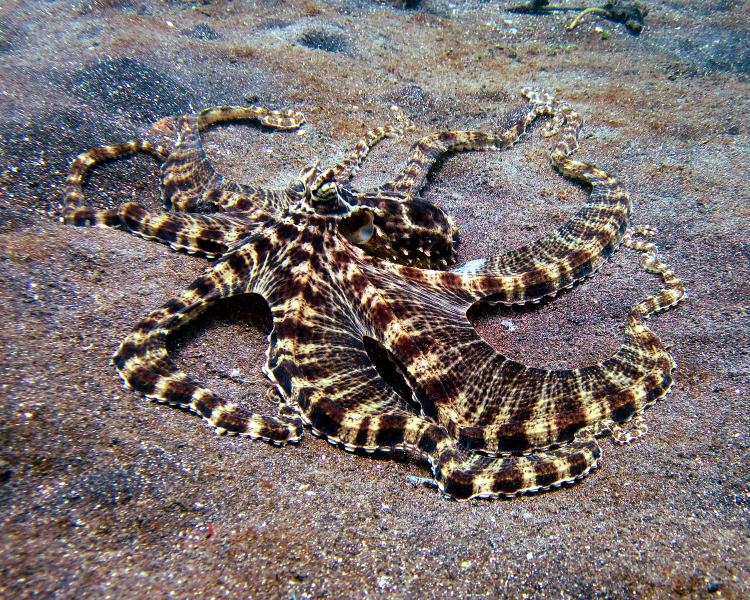 Mimic OctopusThaumoctopus mimicus
-
 Greater Blue-ringed OctopusHapalochlaena lunulata
-
 Gold-spot OctopusAmphioctopus fangsiao
-
 Southern Blue-ringed OctopusHapalochlaena maculosa
-
 Coconut OctopusAmphioctopus marginatus
Compare
Questions and answers
What is the scientific name of the Crescent Octopus?
The scientific name of the Crescent Octopus is Euaxoctopus panamensis. Written with its author, the full name is Euaxoctopus panamensis G. L. Voss, 1971.
Which family does the Crescent Octopus belong to?
Euaxoctopus panamensis belongs to the family Octopodidae and the class Cephalopoda.
Where is the Crescent Octopus found?
Checklists and occurrence records place Euaxoctopus panamensis in 2 countries: Panama and Ecuador.
What is the conservation status of the Crescent Octopus?
The IUCN Red List category recorded for Euaxoctopus panamensis is Data Deficient (DD).
Sources
Passages the profile rests on
- Preserved specimens are gray and have dark crescent-shaped markings on the mantle bordered by lightly colored streaks. Source passage: “preserved specimens are gray in color and characterized by dark, crescent-shaped markings on the octopus' mantle, bordered by lightly colored streaks” — English Wikipedia
- The lightly colored streaks bordering the mantle markings are believed to be iridescent in life. Source passage: “streaks which are believed to be iridescent in life.” — English Wikipedia
- The mantle reaches a length of 3.2 cm. Source passage: “Their mantles grow to 3.2 cm (1.3 in)” — English Wikipedia
- The total body length reaches 20 cm. Source passage: “their bodies grow to a total length of 20 cm (7.9 in).” — English Wikipedia
- Males have a hectocotylus formed by the third left arm, which is approximately one-third the length of the corresponding right arm. Source passage: “Males are characterized by a hectocotylus as their third left arm which is approximately 1/3 the size of the corresponding right arm.” — English Wikipedia
- The species has a left salivary gland twice the size of its right salivary gland, with both glands fused around the crop. Source passage: “a left salivary gland twice the size of the right gland, and both glands fused together around the crop.” — English Wikipedia
- The species occurs offshore in the Gulf of Panama and Costa Rica, extending southward to Ecuador. Source passage: “E. panamensis is found offshore in the Gulf of Panama and Costa Rica, as far south as Ecuador.” — English Wikipedia
- The species has been collected at depths of 30–40 metres. Source passage: “The species has been collected from 30 to 40 metres (98 to 131 ft) deep” — English Wikipedia
- The species is usually found on soft mud substrates. Source passage: “It is usually found in soft mud substrates.” — English Wikipedia
- Females produce eggs measuring approximately 1.4 by 0.5 millimetres. Source passage: “Females produce small eggs, approximately 1.4 by 0.5 millimetres (0.06 in × 0.02 in).” — English Wikipedia
- The eggs hatch into planktonic paralarvae. Source passage: “These eggs hatch into planktonic paralarvae” — English Wikipedia
- The planktonic paralarvae can be identified by their long second arms. Source passage: “identifiable due to their long second arms.” — English Wikipedia
Data
- Catalogue of Life, 2026-10-16 XR cc by
- Global Biodiversity Information Facility CC BY 4.0
- Wikidata CC0
- GeoNames CC BY 4.0
- Within the Catalogue of Life, this name comes from World Register of Marine Species cc by
References
- Voss, G. L. (1971). Cephalopods collected by the R/V John Elliott Pillsbury in the Gulf of Panama in 1967. Bulletin of Marine Science, 21. where the name was published
This species in other databases
Page built on 28 November 2026. See how the catalog is made and all sources and licences.
Cite this page
ScientificNames.org. (2026). Euaxoctopus panamensis (Crescent Octopus). Retrieved November 28, 2026, from https://scientificnames.org/species/euaxoctopus-panamensis
“Euaxoctopus panamensis (Crescent Octopus).” ScientificNames.org, 2026, scientificnames.org/species/euaxoctopus-panamensis. Accessed 28 Nov. 2026.
ScientificNames.org. “Euaxoctopus panamensis (Crescent Octopus).” Accessed November 28, 2026. https://scientificnames.org/species/euaxoctopus-panamensis.
@misc{scientificnames_euaxoctopus_panamensis_crescent_octopus,
  author = {{ScientificNames.org}},
  title = {Euaxoctopus panamensis (Crescent Octopus)},
  year = {2026},
  url = {https://scientificnames.org/species/euaxoctopus-panamensis},
  note = {Accessed 2026-11-28}
}