Species · Birds
Riparian Parrotlet Forpus crassirostris
The scientific name of the Riparian Parrotlet is Forpus crassirostris. It is a species of bird in the family Psittacidae (macaws), order Psittaciformes. The name dates from 1883.
- Scientific name
- Forpus crassirostris (Taczanowski, 1883)
- Common name
- Riparian Parrotlet
- Genus
- Forpus
- Family
- Psittacidae (Macaws)
- Order
- Psittaciformes
- Class
- Aves
- Recorded in
- 4 countries
- Name status
- accepted in the Catalogue of Life

Overview
Forpus crassirostris occurs from southeastern Colombia through northern Peru to western Brazil, with a small population on São Sebastião Island. It has a predominantly yellow-green body, a short pointed tail, and a pale bill, while males have blue feathers on several parts of the body and wings.
Written 26 November 2026 from the sources listed below. Each statement was checked against the passage it cites; statements that could not be supported were removed.
Appearance
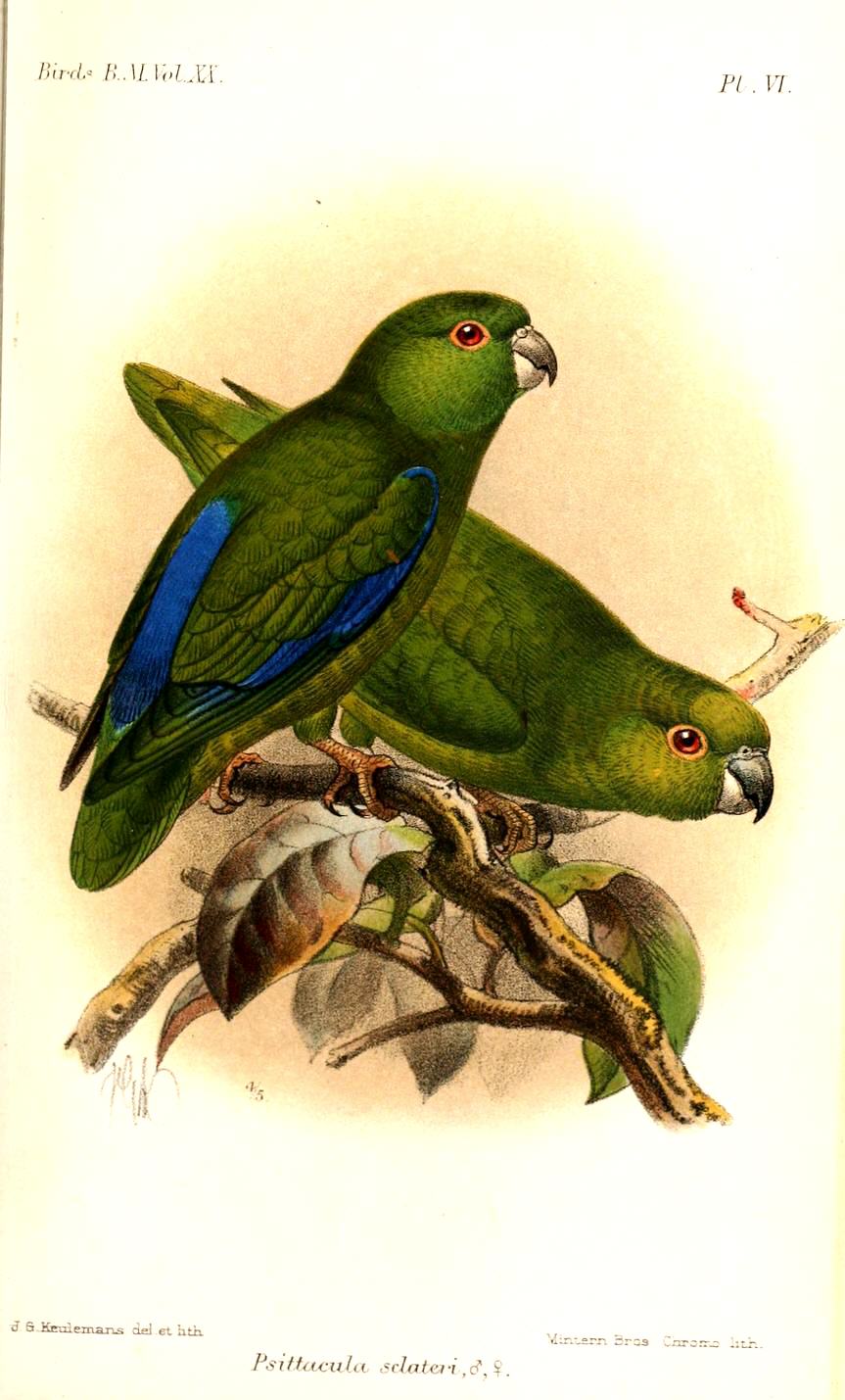
The Riparian Parrotlet has a predominantly yellow-green body, dark brown eyes, and light peach-colored beak and feet. It also has a short, pointed tail and a pale bill.[1][2]
Males have blue rumps, lower backs, leading wing edges, and secondary feathers, with blue-gray primary coverts. Females lack blue feathers and have yellow-green bellies.[3][4]
Adult Riparian Parrotlets typically measure 12–13 centimetres in length and weigh approximately 28 grams.[5][6]
Habitat
The Riparian Parrotlet occurs from southeastern Colombia through northern Peru to western Brazil. A small population also occurs on São Sebastião Island.[7][8]
It inhabits forest edges, riparian woodlands, and degraded or deforested areas.[9]
Diet
The Riparian Parrotlet feeds on seeds, fruits, flowers, buds, and other plant material. It favors palms, Cecropia species, Handroanthus serratifolius flowers and nectar, and Ceiba speciosa fruits.[10][11]
Behaviour
The Riparian Parrotlet is highly gregarious. It is often observed in flocks containing as many as 100 birds.[12][13]
The species does not fully migrate, although altitudinal migration has been suggested. Its abundance in lowland areas increases during winter and spring.[14][15]
Reproduction and life cycle
Riparian Parrotlets nest in tree cavities or comparable nesting sites. They sometimes use abandoned nests built by rufous horneros and other unrelated species.[16][17]
Females lay clutches of three to seven small white eggs. The eggs are incubated for approximately 18 days before hatching.[18][19]
Conservation
The Riparian Parrotlet is not recognized by the IUCN Red List and therefore has no official conservation status. Its populations are included in population estimates for the cobalt-rumped parrotlet, and its population is suggested to be relatively small.[20][21][22]
Similar species
The classification of the Riparian Parrotlet as a distinct species remains disputed. Many studies treat it as a subspecies of the cobalt-rumped parrotlet, while some support recognizing the large-billed parrotlet as a distinct species based on its morphological differences.[23][24]
Most taxonomic authorities, including the American Ornithological Society, do not recognize the proposed classification of the Riparian Parrotlet as a separate species.[25]
Classification of the Riparian Parrotlet
| Kingdom | Animalia |
|---|---|
| Phylum | Chordata |
| Subphylum | Vertebrata |
| Infraphylum | Gnathostomata |
| Parvphylum | Osteichthyes |
| Megaclass | Tetrapoda |
| Class | Aves (Bird) |
| Order | Psittaciformes (Parrot) |
| Family | Psittacidae (Macaws) |
| Genus | Forpus (Forpus Parrotlets) |
| Species | Forpus crassirostris (Taczanowski, 1883) |
Where the Riparian Parrotlet is found
Checklists and occurrence records place Forpus crassirostris in 4 countries across South America. GBIF holds 4,883 georeferenced records of it.
Countries
Regions and cities with the most records
- Loreto, Peru 1,106
- San Martín Department, Peru 805
- Putumayo Department, Colombia 567
- Napo, Ecuador 538
- Amazonas Department, Colombia 431
- Sucumbíos, Ecuador 405
- Moyobamba, Peru 383
- Amazonas, Brazil 343
- Orellana Province, Ecuador 334
- Puerto Asís, Colombia 310
- San Juan, Peru 282
- Iquitos, Peru 280
- Tena, Ecuador 239
- Leticia, Colombia 207
- Tabatinga, Brazil 206
- Rioja, Peru 188
- Manaus, Brazil 174
- La Banda, Peru 121
- Iranduba, Brazil 82
- Cauca Department, Colombia 68
- Puerto Francisco de Orellana, Ecuador 67
- Huánuco Department, Peru 62
- Ucayali, Peru 60
- Mocoa, Colombia 57
- Tingo María, Peru 55
- Boca Suno, Ecuador 54
- Caquetá, Colombia 46
- Careiro da Várzea, Brazil 41
- Morona-Santiago Province, Ecuador 39
- Bellavista, Peru 37
- Nueva Loja, Ecuador 34
- Requena, Peru 28
- Pucallpa, Peru 27
- San Fernando, Peru 27
- Puerto Leguízamo, Colombia 26
- Pastaza Province, Ecuador 24
Range as the checklists state it
South America
A number beside a place is its count of GBIF occurrence records. A place without a number comes from a checklist alone. Records show where a species has been observed or collected, which can include escapes and vagrants.
Common names
English
- Riparian Parrotlet
- Large-billed Parrotlet
- Thick-billed Parrotlet
Names in 18 other languages
- Chinese
- 大嘴鸚哥, 大嘴鹦哥
- Czech
- papoušíček amazonský, papoušíček modrohřbetý bledý
- Danish
- Tyknæbbet Spurvepapegøje
- Dutch
- Grootsnavelmuspapegaai
- Esperanto
- dikbeka papageto
- Finnish
- Rantaviheraranen
- French
- Forpus à gros bec, Toui à gros bec
- German
- Dickschnabel-Sperlingspapagei
- Norwegian
- galleripapitt
- Norwegian Bokmål
- Beryllspurvepapegøye
- Polish
- wróbliczka Taczanowskiego
- Portuguese
- periquito-ribeirinho, tuim-de-bico-grande
- Serbian
- Krupnokljuni vrapčasti papagaj
- Slovak
- forpus hrubozobý, papagájik hrubozobý
- Spanish
- Cotorrita azuleja
- Swedish
- flodsparvpapegoja, tjocknäbbad sparvpapegoja
- Turkish
- Mavi Kanatlı Serçe Papağanı
- Ukrainian
- папуга-горобець великодзьобий
Synonyms
3 other scientific names have been used for this species and are now treated as synonyms of Forpus crassirostris.
- Forpus crassirostris crassirostris Taczanowski, W, 1883
- Forpus xanthopterygius crassirostris (Taczanowski, 1883)
- Psittacula crassirostris Taczanowski, 1883
Related species
-
 Pacific ParrotletForpus coelestis
-
 Green-rumped ParrotletForpus passerinus
-
 Mexican ParrotletForpus cyanopygius
-
 Cobalt-rumped ParrotletForpus xanthopterygius
-
 Spectacled ParrotletForpus conspicillatus
-
 Yellow-faced ParrotletForpus xanthops
-
 Dusky-billed ParrotletForpus modestus
-
 Turquoise-winged ParrotletForpus spengeli
Compare
Questions and answers
What is the scientific name of the Riparian Parrotlet?
The scientific name of the Riparian Parrotlet is Forpus crassirostris. Written with its author, the full name is Forpus crassirostris (Taczanowski, 1883).
Which family does the Riparian Parrotlet belong to?
Forpus crassirostris belongs to the family Psittacidae, in the order Psittaciformes and the class Aves.
Where is the Riparian Parrotlet found?
Checklists and occurrence records place Forpus crassirostris in 4 countries: Peru, Ecuador, Colombia and Brazil.
What other names does the Riparian Parrotlet have?
Forpus crassirostris is also known in English as Large-billed Parrotlet and Thick-billed Parrotlet.
Where are parrotlets native to?
The Riparian Parrotlet occurs from southeastern Colombia through northern Peru to western Brazil. A small population also occurs on São Sebastião Island.[7][8]
What food can parrotlets eat?
The Riparian Parrotlet feeds on seeds, fruits, flowers, buds, and other plant material. It favors palms, Cecropia species, Handroanthus serratifolius flowers and nectar, and Ceiba speciosa fruits.[10][11]
Where do parrotlets live in the wild?
The Riparian Parrotlet inhabits forest edges, riparian woodlands, and degraded or deforested areas.[9]
What is the best food for a parrotlet?
The Riparian Parrotlet favors palms, Cecropia species, Handroanthus serratifolius flowers and nectar, and Ceiba speciosa fruits.[11]
Sources
Passages the profile rests on
- The riparian parrotlet has a predominantly yellow-green body, dark brown eyes, and light peach-colored beak and feet. Source passage: “Their bodies are mostly yellow-green. Eyes are dark brown and beaks and feet are light peach.” — English Wikipedia
- The riparian parrotlet has a short, pointed tail and a pale bill. Source passage: “Tiny parrot with green body, short pointed tail, and pale bill.” — ebird.org
- Male riparian parrotlets have blue rumps, lower backs, leading wing edges, and secondary feathers, with blue-gray primary coverts. Source passage: “males have blue rumps and lower backs, with blue feathers along the leading edges of their wings and blue secondaries; primary coverts are blue-gray.” — English Wikipedia
- Female riparian parrotlets lack blue feathers and have yellow-green bellies. Source passage: “Females have no blue feathers and a yellow-green belly.” — English Wikipedia
- Adult riparian parrotlets typically measure 12–13 centimetres in length. Source passage: “Riparian parrotlets are typically 12–13 centimetres (4.7–5.1 in) long” — English Wikipedia
- Riparian parrotlets weigh approximately 28 grams. Source passage: “weigh about 28 grams (0.99 oz).” — English Wikipedia
- The riparian parrotlet occurs from southeastern Colombia through northern Peru to western Brazil. Source passage: “Riparian parrotlets are found in southeastern Colombia to northern Peru and western Brazil.” — English Wikipedia
- A small population of riparian parrotlets occurs on São Sebastião Island. Source passage: “There is a small population on São Sebastião Island.” — English Wikipedia
- The riparian parrotlet inhabits forest edges, riparian woodlands, and degraded or deforested areas. Source passage: “Riparian parrotlets tend to inhabit forest edges, riparian woodlands, and degraded or deforested areas.” — English Wikipedia
- The riparian parrotlet feeds on seeds, fruits, flowers, buds, and other plant material. Source passage: “Riparian parrotlets feed on seeds, fruits, flowers, buds, and other plants.” — English Wikipedia
- The riparian parrotlet favors palms, Cecropia species, Handroanthus serratifolius flowers and nectar, and Ceiba speciosa fruits. Source passage: “They favor palm, Cecropia sp., Handroanthus serratifolius flowers and nectar, and Ceiba speciosa fruits.” — English Wikipedia
- The riparian parrotlet is highly gregarious. Source passage: “riparian parrotlets are highly gregarious” — English Wikipedia
- Riparian parrotlets are often observed in flocks containing as many as 100 birds. Source passage: “are often seen in flocks of up to 100 birds.” — English Wikipedia
- Riparian parrotlets do not fully migrate, although altitudinal migration has been suggested. Source passage: “Though they do not fully migrate, it has been suggested that riparian parrotlets are altitudinal migrants” — English Wikipedia
- The abundance of riparian parrotlets in lowland areas increases during winter and spring. Source passage: “abundance of the species in lowland areas increased during winter and spring;” — English Wikipedia
- Riparian parrotlets nest in tree cavities or comparable nesting sites. Source passage: “Riparian parrotlets nest in tree cavities or similar places.” — English Wikipedia
- Riparian parrotlets sometimes use abandoned nests built by rufous horneros and other unrelated species. Source passage: “They have been known to use the abandoned nests of rufous horneros and other unrelated species.” — English Wikipedia
- Female riparian parrotlets lay clutches of three to seven small white eggs. Source passage: “Females lay 3-7 small white eggs,” — English Wikipedia
- Riparian parrotlet eggs are incubated for approximately 18 days before hatching. Source passage: “which are incubated for approximately 18 days before hatching.” — English Wikipedia
- The riparian parrotlet is not recognized by the IUCN Red List and therefore has no official conservation status. Source passage: “This species is currently unrecognized by the IUCN Red List, so it does not have an official conservation status.” — English Wikipedia
- Riparian parrotlet populations are included in population estimates for the cobalt-rumped parrotlet. Source passage: “Its populations are included in estimates of cobalt-rumped parrotlets,” — English Wikipedia
- The riparian parrotlet population is suggested to be relatively small. Source passage: “It is suggested that the population of riparian parrotlets is relatively low.” — English Wikipedia
- The taxonomic classification of the riparian parrotlet as a distinct species remains disputed, with many studies treating it as a subspecies of the cobalt-rumped parrotlet. Source passage: “According to most studies, the riparian parrotlet is considered a subspecies of the cobalt-rumped parrotlet as Forpus xanthopterygius crassirostris.” — English Wikipedia
- Some studies support recognizing the large-billed parrotlet as a distinct species based on its morphological differences. Source passage: “there are some studies that argue that its morphological differences support the existence of the large-billed parrotlet as its own species, F. crassirostris.” — English Wikipedia
- Most taxonomic authorities, including the American Ornithological Society, do not recognize the proposed classification of the riparian parrotlet as a separate species. Source passage: “Most taxonomic authorities (including the American Ornithological Society) do not recognize this change in classification.” — English Wikipedia
Data
- Catalogue of Life, 2026-10-16 XR cc by
- Global Biodiversity Information Facility CC BY 4.0
- Wikidata CC0
- GeoNames CC BY 4.0
- Wikimedia Commons per image; credit shown with each image
- Within the Catalogue of Life, this name comes from The Integrated Taxonomic Information System cc0
This species in other databases
Page built on 29 November 2026. See how the catalog is made and all sources and licences.
Cite this page
ScientificNames.org. (2026). Forpus crassirostris (Riparian Parrotlet). Retrieved November 29, 2026, from https://scientificnames.org/species/forpus-crassirostris
“Forpus crassirostris (Riparian Parrotlet).” ScientificNames.org, 2026, scientificnames.org/species/forpus-crassirostris. Accessed 29 Nov. 2026.
ScientificNames.org. “Forpus crassirostris (Riparian Parrotlet).” Accessed November 29, 2026. https://scientificnames.org/species/forpus-crassirostris.
@misc{scientificnames_forpus_crassirostris_riparian_parrotlet,
  author = {{ScientificNames.org}},
  title = {Forpus crassirostris (Riparian Parrotlet)},
  year = {2026},
  url = {https://scientificnames.org/species/forpus-crassirostris},
  note = {Accessed 2026-11-29}
}