Species · Birds
Spectacled Parrotlet Forpus conspicillatus
The scientific name of the Spectacled Parrotlet is Forpus conspicillatus. It is a species of bird in the family Psittacidae (macaws), order Psittaciformes. The name dates from 1848.
- Scientific name
- Forpus conspicillatus (Lafresnaye, 1848)
- Common name
- Spectacled Parrotlet
- Genus
- Forpus
- Family
- Psittacidae (Macaws)
- Order
- Psittaciformes
- Class
- Aves
- Red List category
- LC Least Concern
- Recorded in
- 4 countries
- Name status
- accepted in the Catalogue of Life

Overview
The Spectacled Parrotlet (Forpus conspicillatus) is a tiny parrot in the family Psittacidae, order Psittaciformes, and class Aves. It is native to Middle and South America, including northern and central Colombia, Venezuela, and eastern Panama. Male Spectacled Parrotlets have blue coloring around the eyes, wings, and rump, while females have entirely green plumage.
Written 26 November 2026 from the sources listed below. Each statement was checked against the passage it cites; statements that could not be supported were removed.
Appearance
Male Spectacled Parrotlets are predominantly bright green, with blue coloring around the eyes, wings, and rump. Females have entirely green plumage without blue coloring.[1][2]
The species has a short tail and is described as a tiny parrot.[3][4]
Habitat
Spectacled Parrotlets inhabit lowland evergreen forest edges, thorn scrub, llanos, and gallery woodland. They also occupy heavily degraded former forest and low-density woodland.[5][6][7][8][9]
The species occurs at elevations no higher than 1,600 metres above sea level.[10]
Diet
Wild Spectacled Parrotlets eat seeds, nuts, leaves, and berries. Their diet also includes cactus and fruits of Tamarindus species.[11][12][13]
The species occasionally consumes small insects and has been observed eating or licking clay. The clay provides minerals, including calcium.[14][15][16]
Behaviour
Spectacled Parrotlets are highly social birds that live in small flocks. They have been observed gathering in flocks of up to 100 individuals at clay mounds.[17][18]
The species uses different calls to communicate with other birds and can adapt its calls to mimic those of the birds it communicates with. Its vocalizations include tweeting, chirping, and buzzing.[19][20][21]
Reproduction and life cycle
Spectacled Parrotlets typically breed between January and March. They nest in tree cavities or similar structures, sometimes using abandoned nesting holes or clay mountain nests made by other bird species, and can construct new nests.[22][23][24][25]
The species is monogamous, and some pairs may remain together for life. The female incubates the eggs while the male guards the nest and feeds the female and chicks after hatching.[26][27][28][29]
A female lays successive eggs at intervals of two days, and a typical clutch contains four to six eggs. Egg incubation lasts approximately 18 days.[30][31][32]
Young Spectacled Parrotlets fledge at approximately five weeks of age. Siblings remain in close contact for several weeks after fledging.[33][34]
Conservation
The Spectacled Parrotlet is classified as Least Concern by the IUCN Red List. Its population is stable and may be increasing.[35][36]
Deforestation and land development are associated with population increases because the species prefers open habitats. Numerous protected areas occur within its geographic range.[37][38]
Classification of the Spectacled Parrotlet
| Kingdom | Animalia |
|---|---|
| Phylum | Chordata |
| Subphylum | Vertebrata |
| Infraphylum | Gnathostomata |
| Parvphylum | Osteichthyes |
| Megaclass | Tetrapoda |
| Class | Aves (Bird) |
| Order | Psittaciformes (Parrot) |
| Family | Psittacidae (Macaws) |
| Genus | Forpus (Forpus Parrotlets) |
| Species | Forpus conspicillatus (Lafresnaye, 1848) |
Where the Spectacled Parrotlet is found
Checklists and occurrence records place Forpus conspicillatus in 4 countries across North America and South America. GBIF holds 91,329 georeferenced records of it.
Countries
Regions and cities with the most records
- Valle del Cauca Department, Colombia 15,232
- Antioquia, Colombia 13,912
- Cundinamarca, Colombia 10,741
- Caldas Department, Colombia 9,204
- Chinchiná, Colombia 6,213
- Tolima Department, Colombia 5,992
- Villamaría, Colombia 5,504
- Manizales, Colombia 5,372
- Santander Department, Colombia 5,316
- Cali, Colombia 4,939
- Huila Department, Colombia 4,933
- Neira, Colombia 4,839
- Quindío Department, Colombia 4,578
- Guadalajara de Buga, Colombia 4,454
- Marsella, Colombia 4,285
- Montenegro, Colombia 4,268
- Meta Department, Colombia 4,263
- Guacarí, Colombia 4,168
- Medellín, Colombia 4,156
- Envigado, Colombia 4,093
- La Tebaida, Colombia 4,003
- Santa Rosa de Cabal, Colombia 3,984
- Itagüí, Colombia 3,969
- Quimbaya, Colombia 3,919
- Armenia, Colombia 3,908
- Mosquera, Colombia 3,853
- Darien, Colombia 3,798
- La Estrella, Colombia 3,790
- Dosquebradas, Colombia 3,505
- Risaralda Department, Colombia 3,416
- Circasia, Colombia 3,349
- Madrid, Colombia 3,348
- Pereira, Colombia 3,297
- Caldas, Colombia 3,286
- Calarcá, Colombia 3,202
- Bello, Colombia 3,171
Range as the checklists state it
Middle America
South America
A number beside a place is its count of GBIF occurrence records. A place without a number comes from a checklist alone. Records show where a species has been observed or collected, which can include escapes and vagrants.
Common names
English
- Spectacled Parrotlet
Names in 26 other languages
- Catalan
- cotorreta d'ulleres
- Chinese
- 眼鏡鸚哥, 蓝眶鹦哥
- Croatian
- plavooka papigica
- Czech
- papoušíček brýlatý
- Danish
- Brillespurvepapegøje
- Dutch
- Gebrilde Muspapegaai
- Esperanto
- okulvitra papageto
- Estonian
- kolumbia värbpapagoi
- Finnish
- kolumbianaranen
- French
- Forpus à lunettes, Toui à lunettes
- German
- Augenring-Sperlingspapagei, Brillen-Sperlingspapagei, Brillenpapagei, Brillensperlingspapagei
- Hungarian
- szemgyűrűs verébpapagáj
- Italian
- Pappagallino dagli occhiali
- Japanese
- アオメルリハシインコ
- Lithuanian
- akiniuotoji žvirblinė papūgėlė
- Norwegian
- blåbrillepapitt
- Norwegian Bokmål
- blåbrillet spurvepapegøye
- Polish
- wróbliczka modrobrewa
- Portuguese
- periquito-d'óculos, tuim-colombiano, tuim-da-colômbia
- Russian
- Очковый воробьиный попугайчик
- Serbian
- Vrapčasti papagaj sa očnim prstenom
- Slovak
- forpus okuliarnatý
- Spanish
- Cotorrita de anteojos, Perico cascabelito, Perico de anteojos, Periquito de anteojos
- Swedish
- blåögd sparvpapegoja
- Turkish
- Gözlüklü Serçe Papağanı
- Ukrainian
- папуга-горобець панамський
Synonyms
One other scientific name has been used for this species and is now treated as a synonym of Forpus conspicillatus.
- Psittacula conspicillata Lafresnaye, 1848
Subspecies and varieties
- Forpus conspicillatus caucae (Cauca Spectacled Parrotlet) subspecies
- Forpus conspicillatus conspicillatus subspecies
- Forpus conspicillatus metae (Meta Spectacled Parrotlet) subspecies
Related species
-
 Pacific ParrotletForpus coelestis
-
 Green-rumped ParrotletForpus passerinus
-
 Mexican ParrotletForpus cyanopygius
-
 Cobalt-rumped ParrotletForpus xanthopterygius
-
 Yellow-faced ParrotletForpus xanthops
-
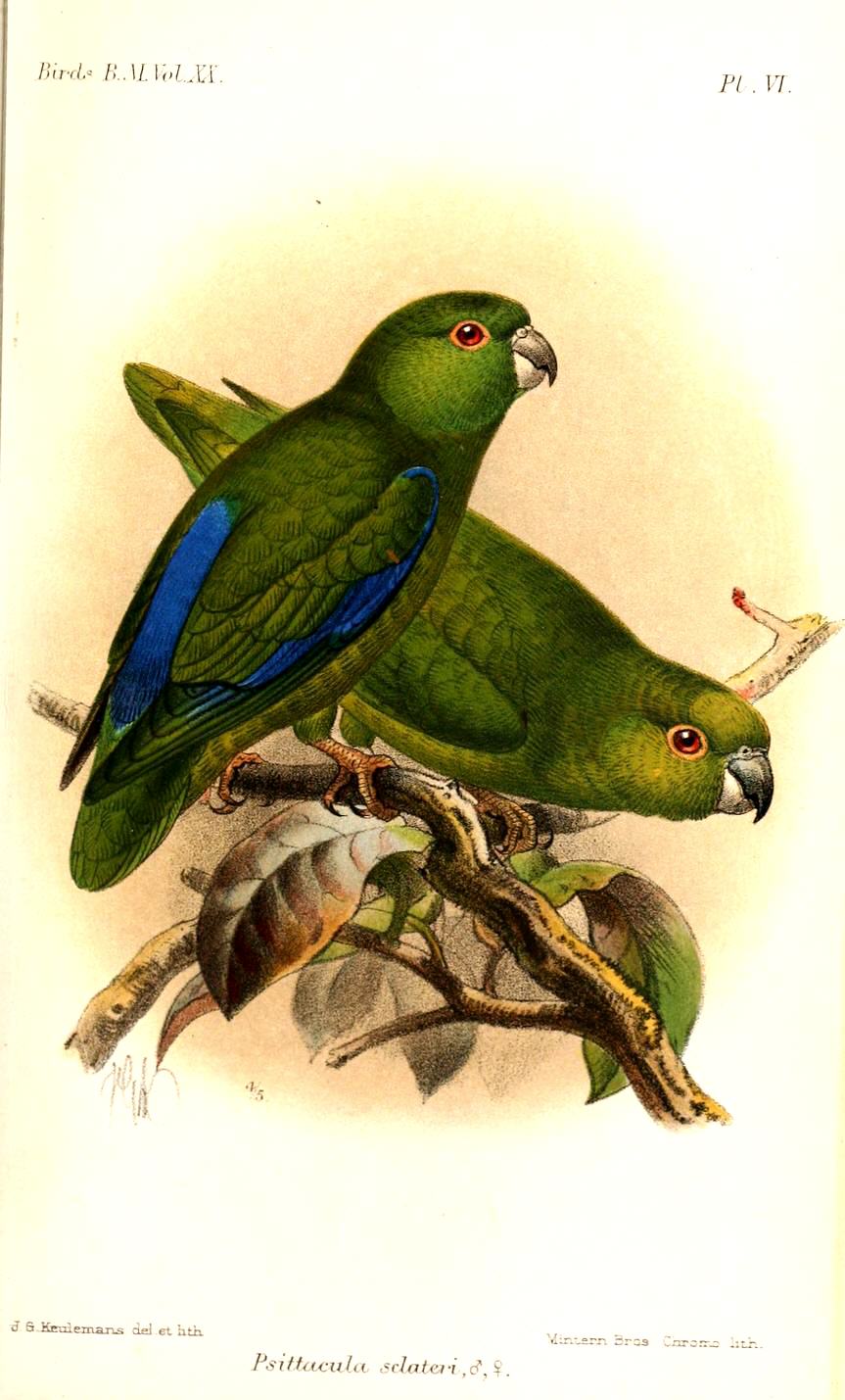 Dusky-billed ParrotletForpus modestus
-
 Turquoise-winged ParrotletForpus spengeli
-
 Riparian ParrotletForpus crassirostris
Compare
Questions and answers
What is the scientific name of the Spectacled Parrotlet?
The scientific name of the Spectacled Parrotlet is Forpus conspicillatus. Written with its author, the full name is Forpus conspicillatus (Lafresnaye, 1848).
Which family does the Spectacled Parrotlet belong to?
Forpus conspicillatus belongs to the family Psittacidae, in the order Psittaciformes and the class Aves.
Where is the Spectacled Parrotlet found?
Checklists and occurrence records place Forpus conspicillatus in 4 countries: Colombia, Panama, Venezuela and Bolivia.
What is the conservation status of the Spectacled Parrotlet?
The IUCN Red List category recorded for Forpus conspicillatus is Least Concern (LC).
What is a parrotlet diet?
Wild Spectacled Parrotlets eat seeds, nuts, leaves, berries, cactus, and fruits of Tamarindus species. They occasionally consume small insects and have also been observed eating or licking clay, which provides minerals including calcium.[11][12][13][14][15][16]
Where do parrotlets live in the wild?
Spectacled Parrotlets are native to Middle and South America, including northern and central Colombia, Venezuela, and eastern Panama. They inhabit lowland evergreen forest edges, thorn scrub, llanos, gallery woodland, heavily degraded former forest, and low-density woodland, at elevations no higher than 1,600 metres above sea level.[39][5][6][7][8][9][10]
Sources
Passages the profile rests on
- Male Spectacled Parrotlets are predominantly bright green with blue coloring around the eyes, wings, and rump. Source passage: “Male mostly bright green with blue around the eyes, wings, and rump.” — ebird.org
- Female Spectacled Parrotlets have entirely green plumage without blue coloring. Source passage: “Female all green without blue.” — ebird.org
- The species has a short tail. Source passage: “Tiny parrot with short tail.” — ebird.org
- The Spectacled Parrotlet is described as a tiny parrot. Source passage: “Tiny parrot with short tail.” — ebird.org
- The species inhabits lowland evergreen forest edges. Source passage: “Natural habitats are lowland evergreen forest edge, thorn scrub, llanos, gallery woodland” — English Wikipedia
- The species occurs in thorn scrub habitats. Source passage: “Natural habitats are lowland evergreen forest edge, thorn scrub, llanos, gallery woodland” — English Wikipedia
- The species inhabits llanos. Source passage: “Natural habitats are lowland evergreen forest edge, thorn scrub, llanos, gallery woodland” — English Wikipedia
- The species occurs in gallery woodland. Source passage: “Natural habitats are lowland evergreen forest edge, thorn scrub, llanos, gallery woodland” — English Wikipedia
- The species also occupies heavily degraded former forest and low-density woodland. Source passage: “and heavily degraded former forest or low-density woodland.” — English Wikipedia
- The species occurs at elevations no higher than 1,600 metres above sea level. Source passage: “Spectacled parrotlets are not found at altitudes higher than 1,600 metres (5,200 ft) above sea level.” — English Wikipedia
- Wild Spectacled Parrotlets eat seeds and nuts. Source passage: “In the wild, spectacled parrotlets feed on seeds, nuts, leaves, berries, cactus, Tamarindus sp., and other fruits.” — English Wikipedia
- Wild Spectacled Parrotlets consume leaves and berries. Source passage: “In the wild, spectacled parrotlets feed on seeds, nuts, leaves, berries, cactus, Tamarindus sp., and other fruits.” — English Wikipedia
- The species feeds on cactus and fruits of Tamarindus species. Source passage: “cactus, Tamarindus sp., and other fruits.” — English Wikipedia
- The species occasionally consumes small insects. Source passage: “Occasionally they may feed on small insects.” — English Wikipedia
- Spectacled Parrotlets have been observed eating or licking clay. Source passage: “They have also been observed licking or eating clay.” — English Wikipedia
- Clay consumed by the species provides minerals including calcium. Source passage: “These clay licks provide a good source of minerals, such as calcium.” — English Wikipedia
- Spectacled Parrotlets are highly social birds that live in small flocks. Source passage: “Spectacled parrotlets are highly social and live in small flocks” — English Wikipedia
- The species has been observed gathering in flocks of up to 100 individuals at clay mounds. Source passage: “but can be seen in large flocks of up to 100 individuals on clay mounds drinking runoff or eating clay.” — English Wikipedia
- Spectacled Parrotlets use different calls when communicating with other birds. Source passage: “Specific calls are used when communicating with other birds.” — English Wikipedia
- The species can adapt its calls to mimic the calls of the birds it communicates with. Source passage: “Spectacled parrotlets are able to differentiate between social companions and adapt their calls to mimic the call of the bird they are communicating with.” — English Wikipedia
- The species produces tweeting, chirping, and buzzing vocalizations. Source passage: “Calls can range between tweeting, chirping or buzzing sounds, depending on the information being relayed.” — English Wikipedia
- Spectacled Parrotlets typically breed between January and March. Source passage: “Spectacled parrotlets typically breed between January and March.” — English Wikipedia
- The species nests in tree cavities or similar structures. Source passage: “Spectacled parrotlets nest in tree cavities or similar structures.” — English Wikipedia
- Spectacled Parrotlets sometimes use abandoned nesting holes or clay mountain nests made by other bird species. Source passage: “Often they will make use of abandoned tree hole or clay mountain nests created by other unrelated bird species” — English Wikipedia
- The species is capable of constructing new nests. Source passage: “though they are also capable of creating new nests.” — English Wikipedia
- The female incubates the eggs while the male guards the nest. Source passage: “The female incubates eggs while the male assumes the role of guarding the nest” — English Wikipedia
- The male feeds the female and chicks after the chicks hatch. Source passage: “and feeding the female and chicks once they are hatched.” — English Wikipedia
- Spectacled Parrotlets are monogamous. Source passage: “Spectacled parrots are monogamous” — English Wikipedia
- Some Spectacled Parrotlet pairs may remain together for life. Source passage: “some pairs may even mate for life.” — English Wikipedia
- A female lays successive eggs at intervals of two days. Source passage: “she will lay another every two days until clutch size is reached.” — English Wikipedia
- A typical clutch contains four to six eggs. Source passage: “Typically, a couple will hatch 4–6 eggs per clutch” — English Wikipedia
- Egg incubation lasts approximately 18 days. Source passage: “after an 18-day incubation.” — English Wikipedia
- Young Spectacled Parrotlets fledge at approximately five weeks of age. Source passage: “Babies fledge at about five weeks old” — English Wikipedia
- Siblings remain in close contact for several weeks after fledging. Source passage: “siblings keep in close contact with one another for a few weeks post-fledging.” — English Wikipedia
- The Spectacled Parrotlet is classified as Least Concern by the IUCN Red List. Source passage: “According to the IUCN Red List, spectacled parrotlets are of Least Concern.” — English Wikipedia
- The species' population is stable and may be increasing. Source passage: “Their populations are stable and possibly increasing” — English Wikipedia
- Deforestation and land development are associated with population increases because the species prefers open habitats. Source passage: “possibly increasing due to deforestation and land development, as they prefer open habitat rather than dense forest.” — English Wikipedia
- Numerous protected areas occur within the species' geographic range. Source passage: “There are many protected areas across their range.” — English Wikipedia
- The species is native to Middle and South America, including northern and central Colombia, Venezuela, and eastern Panama. Source passage: “Spectacled parrotlets are endemic to Middle and South America, including northern and central Colombia, Venezuela, and eastern Panama” — English Wikipedia
Data
- Catalogue of Life, 2026-10-16 XR cc by
- Global Biodiversity Information Facility CC BY 4.0
- Wikidata CC0
- GeoNames CC BY 4.0
- Wikimedia Commons per image; credit shown with each image
- Within the Catalogue of Life, this name comes from The Integrated Taxonomic Information System cc0
References
- Dickinson, Edward C., ed. (2003). The Howard and Moore Complete Checklist of the Birds of the World, 3rd Edition.
- Gill, Frank, & and Minturn Wright. (2006). Birds of the World: Recommended English Names.
- Dickinson, E. C., and L. Christidis, eds. (2014). The Howard and Moore Complete Checklist of the Birds of the World, 4th Edition, Vol. 2 Passerines.
This species in other databases
Page built on 26 November 2026. See how the catalog is made and all sources and licences.
Cite this page
ScientificNames.org. (2026). Forpus conspicillatus (Spectacled Parrotlet). Retrieved November 26, 2026, from https://scientificnames.org/species/forpus-conspicillatus
“Forpus conspicillatus (Spectacled Parrotlet).” ScientificNames.org, 2026, scientificnames.org/species/forpus-conspicillatus. Accessed 26 Nov. 2026.
ScientificNames.org. “Forpus conspicillatus (Spectacled Parrotlet).” Accessed November 26, 2026. https://scientificnames.org/species/forpus-conspicillatus.
@misc{scientificnames_forpus_conspicillatus_spectacled_parrotlet,
  author = {{ScientificNames.org}},
  title = {Forpus conspicillatus (Spectacled Parrotlet)},
  year = {2026},
  url = {https://scientificnames.org/species/forpus-conspicillatus},
  note = {Accessed 2026-11-26}
}