Species · Mammals
Lesser Grison Galictis cuja
The scientific name of the Lesser Grison is Galictis cuja. It is a species of mammal in the family Mustelidae (mustelids), order Carnivora. The name dates from 1782.
- Scientific name
- Galictis cuja (Molina, 1782)
- Common name
- Lesser Grison
- Genus
- Galictis
- Family
- Mustelidae (Mustelids)
- Order
- Carnivora
- Class
- Mammalia
- Red List category
- LC Least Concern
- Recorded in
- 7 countries
- Name status
- accepted in the Catalogue of Life

Overview
Galictis cuja occurs across most of southern South America, from sea level to elevations of 4,200 m. It has a long, slender body, short legs, a bushy tail, and grizzled greyish dorsal fur with a pale buff-coloured stripe extending from the forehead to the shoulders.
Written 26 November 2026 from the sources listed below. Each statement was checked against the passage it cites; statements that could not be supported were removed.
Appearance
The Lesser Grison has a long, slender body, short legs, a bushy tail, and a long neck. Its head is small, with a flattened forehead and rounded ears.[1][2]
The dorsal fur consists of coarse black guard hairs with buff-coloured tips over a softer undercoat, producing a grizzled greyish appearance. The underside is predominantly black or nearly black, with a pale buff-coloured stripe extending from the forehead to the shoulders.[3][4]
The feet have webbing, five toes, and sharp, curved claws. Dorsal coloration has yellowish undertones, and individual colour patterns vary geographically.[5][6]
Head-body length ranges from 27 to 52 cm, and the tail measures 14 to 19 cm. Adults weigh between 1.2 and 2.4 kg, with females slightly smaller and more slender than males.[7][8][9][10]
Habitat
The Lesser Grison inhabits grasslands, forests, scrub, and mountain meadows, generally near water. It also occurs on agricultural land and pasture.[11][12]
Its habitats include arid Chaco environments, areas with extensive vegetation and open water, deciduous forests, evergreen forests, savannas, and mountainous regions.[13][14]
Individuals frequently use rock piles, hollow trees, and burrows made by other animals for food searching or refuge.[15]
Diet
The Lesser Grison consumes small and medium-sized rodents, rabbits, birds, frogs, lizards, and snakes. Its diet also includes eggs, invertebrates, and fruits, including avocados.[16][17][18]
It is a major predator of cavies, including wild guinea pigs, and nesting grebes. Introduced European rabbits constitute a substantial dietary component in populations where rabbit numbers are high.[19][20]
The stomach contents of one specimen collected in Peru included mice and a lizard.[21]
Behaviour
The Lesser Grison is semiplantigrade and walks partly on the soles of its feet. Its feet are adapted more for running and climbing than for swimming.[22][23]
The species hunts primarily during daylight and uses scent at least partly to locate prey. It is active during both daytime and nighttime.[24][25]
Individuals may live alone or in small family groups consisting of parents and offspring. Family groups may travel together in single file, and individuals have been observed in groups of two or more despite being solitary hunters.[26][27][28]
Individuals sleep at night in hollow trees, natural crevices, or excavated burrows. Burrows can reach 4 m in depth and have entrances concealed by leaves.[29][30]
When threatened, the Lesser Grison may use a sharp, growling bark. It also possesses anal scent glands that spray a noxious chemical.[31][32]
Reproduction and life cycle
The species has separate sexes. Females produce litters of two to five young, and gestation lasts approximately 40 days, usually resulting in two to four offspring.[33][34][35]
Births have been recorded in March, August, September, and October.[36]
Uses
Individuals have historically been used to hunt wild chinchillas by pursuing them into burrows. The species is sometimes kept on farms to control rodent populations.[37][38]
Conservation
The Lesser Grison is listed under Appendix III of CITES. It has no special conservation status under the IUCN Red List.[39][40]
Classification of the Lesser Grison
| Kingdom | Animalia |
|---|---|
| Phylum | Chordata |
| Subphylum | Vertebrata |
| Infraphylum | Gnathostomata |
| Parvphylum | Osteichthyes |
| Megaclass | Tetrapoda |
| Class | Mammalia (Mammal) |
| Subclass | Theria |
| Infraclass | Eutheria |
| Order | Carnivora (Carnivores) |
| Suborder | Caniformia (Dog-like Carnivores) |
| Family | Mustelidae (Mustelids) |
| Subfamily | Ictonychinae (Grisons) |
| Genus | Galictis (Grisons) |
| Species | Galictis cuja (Molina, 1782) |
Where the Lesser Grison is found
Checklists and occurrence records place Galictis cuja in 7 countries across South America. GBIF holds 1,785 georeferenced records of it.
Countries
Regions and cities with the most records
- Buenos Aires, Argentina 137
- São Paulo, Brazil 93
- Santa Catarina, Brazil 88
- Santiago Metropolitan, Chile 86
- Rio Grande do Sul, Brazil 84
- Los Lagos Region, Chile 80
- La Pampa, Argentina 76
- Maule Region, Chile 72
- Santa Fe, Argentina 55
- General Pico, Argentina 50
- Los Ríos Region, Chile 49
- Valparaiso, Chile 46
- Rio de Janeiro, Brazil 42
- Llaillay, Chile 40
- Paraná, Brazil 40
- Entre Rios, Argentina 36
- Rio Grande do Norte, Brazil 30
- Rio Negro, Argentina 30
- Minas Gerais, Brazil 29
- Espírito Santo, Brazil 25
- Araucania, Chile 23
- Cordoba, Argentina 22
- Biobio, Chile 20
- Goiás, Brazil 19
- Jujuy, Argentina 18
- Limache, Chile 18
- Concepción, Chile 17
- Mendoza, Argentina 17
- Açu, Brazil 16
- Penco, Chile 16
- Petrópolis, Brazil 16
- Puente Alto, Chile 16
- Quillota, Chile 16
- San Pedro de la Paz, Chile 16
- Urussanga, Brazil 16
- Corrientes, Argentina 15
Range as the checklists state it
South America
A number beside a place is its count of GBIF occurrence records. A place without a number comes from a checklist alone. Records show where a species has been observed or collected, which can include escapes and vagrants.
Common names
English
- Lesser Grison
Names in 18 other languages
- Arabic
- شره صغير
- Chinese
- 小巢鼬
- Czech
- grizon malý
- Dutch
- Kleine Grison
- Finnish
- pikkugrisoni
- French
- Petit grison
- German
- Kleiner Grison, Kleingrison
- Greek
- Μικρό Γκριζόν
- Hungarian
- Kis grizon
- Italian
- Grigione minore
- Japanese
- ヒメグリソン
- Korean
- 작은그리슨
- Norwegian Bokmål
- Dverggrison
- Polish
- Grizon mniejszy
- Portuguese
- Furão-pequeno
- Russian
- Малый гризон
- Spanish
- Grisón menor, Hurón, Hurón Menor, Quique
- Turkish
- Küçük grison
Synonyms
One other scientific name has been used for this species and is now treated as a synonym of Galictis cuja.
- Mustela cuja Molina, 1782
Subspecies and varieties
- Galictis cuja cuja subspecies
- Galictis cuja furax subspecies
- Galictis cuja huronax subspecies
- Galictis cuja luteola subspecies
Related species
-
 Greater GrisonGalictis vittata
-
 WolverineGulo gulo
-
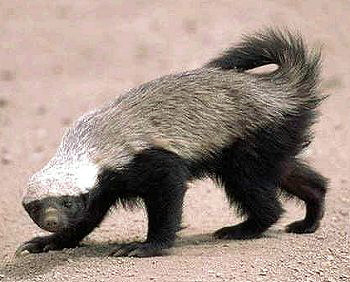 Honey BadgerMellivora capensis
-
 StoatMustela erminea
-
 Sea OtterEnhydra lutris
- SableMartes zibellina
-
 European Pine MartenMartes martes
-
 Least WeaselMustela nivalis
Compare
Questions and answers
What is the scientific name of the Lesser Grison?
The scientific name of the Lesser Grison is Galictis cuja. Written with its author, the full name is Galictis cuja (Molina, 1782).
Which family does the Lesser Grison belong to?
Galictis cuja belongs to the family Mustelidae, in the order Carnivora and the class Mammalia.
Where is the Lesser Grison found?
Checklists and occurrence records place Galictis cuja in 7 countries, including Brazil, Argentina, Chile, Uruguay, Paraguay and Bolivia.
What is the conservation status of the Lesser Grison?
The IUCN Red List category recorded for Galictis cuja is Least Concern (LC).
What does a grison look like?
The Lesser Grison has a long, slender body, short legs, a bushy tail, and a small head with rounded ears. Its dorsal fur has a grizzled greyish appearance, while its predominantly black underside contrasts with a pale buff-coloured stripe extending from the forehead to the shoulders.[1][2][3][4]
Sources
Passages the profile rests on
- The species has a long, slender body, short legs, a bushy tail, and a long neck. Source passage: “Lesser grisons have a long, slender body, short legs, and a bushy tail. They have a long neck” — English Wikipedia
- The head is small, with a flattened forehead and rounded ears. Source passage: “a small head with a flattened forehead and rounded ears.” — English Wikipedia
- The dorsal fur consists of coarse black guard hairs with buff-coloured tips over a softer undercoat, producing a grizzled greyish appearance. Source passage: “The top of the head, the back and flanks, and the tail have coarse black guard hairs with buff-coloured tips over a softer undercoat, giving them a grizzled, greyish colour.” — English Wikipedia
- The underside is predominantly black or nearly black, with a pale buff-coloured stripe extending from the forehead to the shoulders. Source passage: “The remainder of the body is black or nearly so, apart from a pale, buff-coloured stripe running from the forehead to the shoulders” — English Wikipedia
- The feet have webbing, five toes, and sharp, curved claws. Source passage: “The feet are webbed, with five toes ending in sharp, curved claws.” — English Wikipedia
- The dorsal coloration has yellowish undertones, and individual colour patterns vary geographically. Source passage: “Dorsal coloration is grizzled with yellowish undertones. Color variation and patterning may vary among individuals throughout the geographic range of the species.” — animaldiversity.org
- Head-body length ranges from 27 to 52 cm. Source passage: “head-body length of 27 to 52 cm (11 to 20 in)” — English Wikipedia
- The tail measures 14 to 19 cm in length. Source passage: “a tail 14 to 19 cm (5.5 to 7.5 in) long.” — English Wikipedia
- Adults weigh between 1.2 and 2.4 kg. Source passage: “Adults weigh from 1.2 to 2.4 kg (2.6 to 5.3 lb).” — English Wikipedia
- Females are slightly smaller and more slender than males. Source passage: “Females are slighter smaller and more slender than males.” — English Wikipedia
- The species inhabits grasslands, forests, scrub, and mountain meadows, generally near water. Source passage: “They are found in a wide range of habitats, although generally near water, including grasslands, forests, scrub, and mountain meadows.” — English Wikipedia
- The species also occurs on agricultural land and pasture. Source passage: “They are also known to inhabit agricultural land and pasture in some areas.” — English Wikipedia
- The species inhabits arid Chaco environments as well as areas with extensive vegetation and open water. Source passage: “Lesser grisons occupy a wide range of habitats, and can be found in the extremes of the arid Chaco while also inhabiting environments with extensive vegetation cover in conjuction with open water.” — animaldiversity.org
- Additional habitats include deciduous forests, evergreen forests, savannas, and mountainous regions. Source passage: “Other habitat types include deciduous and evergreen forests, savananas and mountainous regions.” — animaldiversity.org
- Individuals frequently use rock piles, hollow trees, and burrows made by other animals for food searching or refuge. Source passage: “Lesser grisons often frequent rock pilings, hollow trees, and borrows of other animals in search of food or refuge.” — animaldiversity.org
- The species consumes small and medium-sized rodents, rabbits, birds, frogs, lizards, and snakes. Source passage: “feeding on small to medium-sized rodents, as well as rabbits, birds, frogs, lizards, and snakes.” — English Wikipedia
- The species also consumes fruits, including avocados. Source passage: “They can also eat fruits, such as avocados.” — English Wikipedia
- Its diet includes small mammals, birds, eggs, cold-blooded vertebrates, invertebrates, and fruit. Source passage: “The diet of G. cuja consists of small mammals, birds, eggs, cold-blooded vertebrates, and invertebrates as well as fruit.” — animaldiversity.org
- The species is a major predator of cavies, including wild guinea pigs, and nesting grebes. Source passage: “They are among the major predators on cavies, including wild guinea pigs, and also of nesting grebes.” — English Wikipedia
- Introduced European rabbits constitute a substantial dietary component in populations where rabbit numbers are high. Source passage: “studies have shown that the consumtion of introduced European rabbits ( Oryctolagus cuniculus ) is high among populations of G. cuja where rabbit populations are high.” — animaldiversity.org
- The stomach contents of one specimen collected in Peru included mice and a lizard. Source passage: “The stomach contents of one speciemen collected in Peru contained mice and a lizard.” — animaldiversity.org
- The species is semiplantigrade and walks partly on the soles of its feet. Source passage: “They are semiplantigrade, walking partly on the soles of their feet” — English Wikipedia
- Its feet are adapted more for running and climbing than for swimming. Source passage: “their feet are adapted more for running and climbing than for swimming.” — English Wikipedia
- The species hunts primarily during daylight and uses scent at least partly to locate prey. Source passage: “Lesser grisons hunt primarily during the day, locating their prey at least partly by scent.” — English Wikipedia
- The species is active during both daytime and nighttime. Source passage: “Galictis cuja is active during both daylight and nighttime.” — animaldiversity.org
- Individuals may live alone or in small family groups consisting of parents and offspring. Source passage: “They are either solitary or live in small family groups of parents and offspring” — English Wikipedia
- Family groups may travel together in single file. Source passage: “which travel together in single file.” — English Wikipedia
- Individuals have been observed in groups of two or more despite being solitary hunters. Source passage: “Although they are solitary hunters, they have been observed in groups of 2 or more.” — animaldiversity.org
- Individuals sleep at night in hollow trees, natural crevices, or excavated burrows. Source passage: “During the night, they sleep in hollow trees, natural crevices, or excavated burrows.” — English Wikipedia
- Their burrows can reach 4 m in depth and have entrances concealed by leaves. Source passage: “Burrows may be as deep as 4 m (13 ft), and have entrances obscured by leaves.” — English Wikipedia
- A sharp, growling bark is among the vocalizations used when the species is threatened. Source passage: “a sharp, growling bark when threatened.” — animaldiversity.org
- The species possesses anal scent glands that spray a noxious chemical. Source passage: “They possess anal scent glands that spray a noxious chemical similar to, but probably weaker than, that of skunks.” — English Wikipedia
- Females produce litters of two to five young. Source passage: “their litters of two to five young.” — English Wikipedia
- Gestation lasts approximately 40 days and usually results in two to four offspring. Source passage: “Gestation in G. cuja is complete after about 40 days, when 2 to 4 offspring are produced.” — animaldiversity.org
- The species has separate sexes. Source passage: “gonochoric/gonochoristic/dioecious (sexes separate)” — animaldiversity.org
- Births have been recorded in March, August, September, and October. Source passage: “Young are born in March, August, October and September.” — animaldiversity.org
- Individuals have historically been used to hunt wild chinchillas by pursuing them into burrows. Source passage: “They were used in the past to hunt wild chinchillas, pursuing them down burrows in a similar manner to ferrets” — English Wikipedia
- The species is sometimes kept on farms to control rodent populations. Source passage: “They are still sometimes kept to control rodents on farms” — English Wikipedia
- The species is listed under Appendix III of CITES. Source passage: “Lesser grisons are listed by CITES as Appendix III.” — animaldiversity.org
- The species has no special conservation status under the IUCN Red List. Source passage: “They have no special conservation status with IUCN Redlist” — animaldiversity.org
Data
- Catalogue of Life, 2026-10-16 XR cc by
- Global Biodiversity Information Facility CC BY 4.0
- Wikidata CC0
- GeoNames CC BY 4.0
- Wikimedia Commons per image; credit shown with each image
- Within the Catalogue of Life, this name comes from The Integrated Taxonomic Information System cc0
References
- Sagg. Stor. Nat. Chile p.291 where the name was published
- Wilson, Don E., and DeeAnn M. Reeder, eds. (1993). Mammal Species of the World: A Taxonomic and Geographic Reference, 2nd Ed., 3rd Printing.
- Wilson, Don E., and F. Russell Cole. (2000). Common Names of Mammals of the World.
- Wilson, Don E., and DeeAnn M. Reeder, eds. (2005). Mammal Species of the World: A Taxonomic and Geographic Reference, 3rd Ed., Vols. 1 & 2.
- Larivière, S., and A. P. Jennings / Don E. Wilson and Russell A. Mittermeier, eds. (2009). Family Mustelidae (Weasels and relatives). Handbook of the Mammals of the World. Vol. 1: Carnivores.
- Bornholdt, Renata, Kristofer Helgen, Klaus-Peter Koepfli, Larissa Oliveira, Mauro Lucherini, & and Edu. (2013). Taxonomic revision of the genus Galictis (Carnivora: Mustelidae): species delimitation, morphological diagnosis, and refined mapping of geographical distribution. Zoological Journal of the Linnean Society, Vol. 167, No. 3.
- Burgin, Connor J., Don E. Wilson, Russell A. Mittermeier, Anthony B. Rylands, et al. (2020). Illustrated Checklist of the Mammals of the World. Vol. 1. Monotremata to Rodentia.
This species in other databases
Page built on 27 November 2026. See how the catalog is made and all sources and licences.
Cite this page
ScientificNames.org. (2026). Galictis cuja (Lesser Grison). Retrieved November 27, 2026, from https://scientificnames.org/species/galictis-cuja
“Galictis cuja (Lesser Grison).” ScientificNames.org, 2026, scientificnames.org/species/galictis-cuja. Accessed 27 Nov. 2026.
ScientificNames.org. “Galictis cuja (Lesser Grison).” Accessed November 27, 2026. https://scientificnames.org/species/galictis-cuja.
@misc{scientificnames_galictis_cuja_lesser_grison,
  author = {{ScientificNames.org}},
  title = {Galictis cuja (Lesser Grison)},
  year = {2026},
  url = {https://scientificnames.org/species/galictis-cuja},
  note = {Accessed 2026-11-27}
}